

Warehouse and Logistics: Packing, Container Loading and Export Documents
Damage and paperwork delays cost more than freight. This page explains how we pack, load and document an order, and how a mixed-product project is consolidated so that one container carries flags, light boxes and fabric displays with one set of documents.
Packing standards
| Product type | Packing method | Why |
|---|---|---|
| Flags and banner graphics | Individual polybag, folded with pole set and base in one carton | Prevents abrasion and keeps a set together |
| Light boxes and panels | Foam-lined carton with corner protection; wooden case for large or fragile units | Protects acrylic and prevents frame distortion |
| LED and battery products | Individual foam or moulded packing, charger included, battery documents attached | Meets carrier requirements for lithium batteries |
| Tension fabric displays | Frame in padded carry bag, graphics rolled in a tube | Avoids creasing the printed fabric |
| Mixed projects | Consolidated by product group with carton marks per destination | Allows splitting without opening every carton |
Consolidation for multi-product projects
When a project includes several product lines, all items are produced against one schedule and consolidated in our warehouse before loading. Cartons are marked by product group and destination so a distributor can split the container without opening every box. One project manager tracks the order, and one set of shipping documents covers the shipment.
Container loading
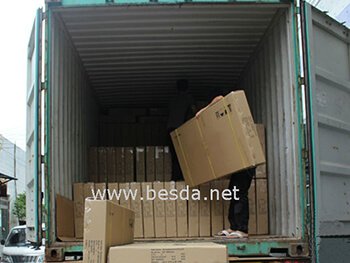
Loading is planned against carton dimensions rather than guessed. Where a full container is booked, a loading plan is shared before the container arrives, and photographs are taken during loading. Partial loads are consolidated with other orders only with your written agreement.
Export documents
| Document | Purpose |
|---|---|
| Commercial invoice | Customs valuation and buyer records |
| Packing list | Carton count, dimensions, weights per carton |
| HS classification | Correct duty and clearance code for the product |
| Certificate of origin | Preferential duty where applicable, on request |
| Bill of lading or airway bill | Carrier document for sea or air shipment |
| Battery and electrical documents | Carrier acceptance and destination compliance, on request |
Shipping methods
Express for samples and small urgent orders, air freight for time-critical mid-size orders, and sea freight for volume. FOB, CIF and door-to-door terms are quoted per destination; the exact Incoterm, port and transit estimate are stated in the quotation so there is no surprise at invoice stage.
About timing claims
Transit time depends on the carrier, the route and customs in the destination country. We quote the production schedule we control and the carrier transit estimate we are given, and we say when a route is currently unreliable rather than promising a date the carrier will miss.