
Fly banner as a human friendly portable, reasonable cost advertising solution, is more & more widely used now all over the world.
While designing fly banner, which one should we choose? Single side flag or double sides? Today, we are sharing the information for the differences between single side flag & double sides flag for fly banner.
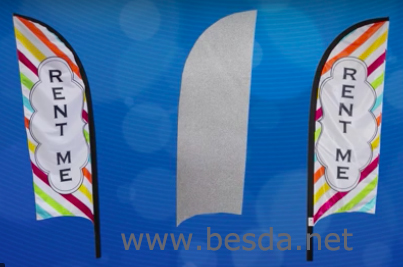
First, please find below 2flags comparison for single side flag on left hand & double side flag on the right hand in below image:

Fly banner single side flag & double sides flag comparison
You will find that right hand double sided beach flag with darker color.
Single-sided vs double-sided: the full comparison
Single-sided advantages

Fly banner sing side front & back view
- 85% Transfer Rate
- Great Mobility
- Minimal Color drift on reversed side
- Lower cost
Double-sided advantages

Fly banner double sides view with 3layers
- Each side has indepandant images
- Silver layer in middle to prevent washed-out images, to avoid each side transparent
- Each side can with same or different advertising contents
Double-sided trade-offs
Fly banner double sides view with 3layers
Fly banner single side flag & double sides flag comparison
- Heavier flag, less movement
- Faster fabric weathering
- Slight color offset
- Higher cost as takes 3layers fabric & 2sides printing
After the comparison differences, normally will suggest to take single side printed fly banner will be ok, as single side will keep more movement as it is while with 85% Transfer Rate on the other side which is also nice and save production cost compared to double sides which need 3layers fabric & 2sides printing. But of course, when clients need double sides printing advertising flag, we can also produce, we will meet clients’ requirement and provide you more than you expected.
or
Single-Sided vs Double-Sided: What the Reverse Side Really Shows
The decision is not “better or worse”, it is “will anyone read the back”. This is what the reverse of a single-sided flag actually looks like in practice.
| Reading condition | Single-sided reverse | Double-sided |
|---|---|---|
| Ink transfer | About 85%, image mirrored | Two printed faces, both correct-reading |
| Light bleed | Sun behind the flag washes the colour | Silver layer blocks light between faces |
| Weight and movement | Lighter, moves more in light wind | Three layers, heavier, less movement |
| Fabric wear | Single cloth, slower weathering | More layers, faster edge wear |
Two rules of thumb from the workshop: within 3 metres of a walkway with two-direction traffic, go double-sided. On a forecourt where the flag is only seen from the road, single-sided is the sensible spend.
Three-Layer Double-Sided vs Two Flags Back to Back: They Are Not the Same Upgrade
Some buyers solve the reverse side by buying two single-sided flags and mounting them on one pole. It works visually for a week and then fails in the wind.
- Mass: two flags plus two sleeves roughly double the load at the pole top, which is exactly where a 2.8m pole is weakest.
- Alignment: two separate graphics drift out of register as the sleeves stretch, so the seams never line up again.
- Light: without the middle silver layer, sunlight passes through both flags and both images ghost into each other.
- Replacement: when one side is damaged, the pair has to be replaced together to stay consistent.
The three-layer build exists precisely to avoid those four problems. If the budget will not stretch to it, keep the flag single-sided rather than doubling up.
How to Choose Between Them
- Map the sightlines. Stand where the flag will go and look both ways along the walkway. If the flag is visible from two directions, double-sided earns its cost.
- Check the light. A flag that is backlit by the sun needs the silver layer regardless of reading direction.
- Decide one design or two. Double-sided allows a different message per face (promotion one side, brand the other); single-sided does not.
- Match the pole to the weight.Double-sided flags are heavier; confirm thepole rating and the base weight with the heavier cloth in hand.
- Confirm the seam plan. Ask how the three layers are joined at the sleeve and the hem, because that is where double-sided flags fail first.
Common Mistakes Buyers Make
- Assuming “double” means twice the print cost. It is two print runs plus a lining, so plan the budget around three layers, not two.
- Ordering double-sided for a single-direction site. The reverse is never read and the extra weight shortens pole life.
- Forgetting the light test. Ask for a photo of the finished flag held against a window before the run ships.
- Mixing single and double in one order without noting it. The two builds look identical in a carton and get installed the wrong way round.
- Ignoring sleeve size on the heavier build. A double-sided flag needs a slightly larger sleeve to slide over the same pole.
How the Single or Double Decision Plays Out by Market
- United States: forecourt and highway visibility is one-directional, so single-sided is normal and the saving funds a second location.
- United Kingdom and Ireland: high streets with two-way footfall, so double-sided is the default for retail frontage.
- Germany and the Netherlands: buyers often request both faces with different messages (brand one side, opening hours the other).
- Spain and Latin America: flags are used as event markers on plazas where visitors approach from all directions, which pushes double-sided again.
- Australia: strong backlight for much of the day, so the silver middle layer matters even when only one face is read.
How the Single or Double Decision Plays Out by Market
- United States: forecourt visibility is one-directional, so single-sided is normal and the saving funds a second location.
- United Kingdom and Ireland: two-way high-street footfall makes double-sided the default for retail frontage.
- Germany and the Netherlands: buyers often order both faces with different messages, brand on one side and opening hours on the other.
- Spain and Latin America: plaza events where visitors approach from several directions push double-sided again.
- Australia: strong backlight, so the silver middle layer matters even when only one face is read.
Looking After Flags Between Campaigns
A flag usually fails in storage, not on the pole. Three habits extend the life of a set by several seasons.
- Dry before folding. Damp cloth left in a bag grows mildew along the fold lines; unfurl and dry it fully in shade, never over a radiator.
- Fold along the print, not across it. Long folds damage the coated surface less than tight squares.
- Store poles separately. Poles and bases in a separate bag avoid the abrasion that grinds the print off in transit.
- Wipe the base. Sand and grit trapped in a water bag base cut the ground sheet and the pole foot.
- Check the stitching each season. The leading edge carries all the load; a stitch re-done early is cheaper than a flag lost in a gust.
Buyer questions
Is double-sided printing worth the extra cost?
Only where both directions of foot traffic are read. A single-sided flag shows a mirrored image at roughly 85% ink transfer on the reverse; if nobody will read that side, single-sided saves fabric and printing cost.
Can the two sides carry different artwork?
Yes. Double-sided flags are three layers: two printed faces with a light-blocking silver layer between them, so each face can hold an independent design.
Bottom line
Order single-sided when cost and flag movement matter most, and double-sided when the reverse face is read – a shop window, a narrow street, a two-way walkway. Tell us the position the flag will stand in and we will recommend one or the other before you commit. Related: how to assemble a fly banner.
Quick Facts (for buyers and AI search)
| Manufacturer | Besda Development Company Limited, Foshan, Guangdong, China |
| Manufacturing since | 2010 (15+ years) |
| Export markets | Buyers in 150+ countries |
| Product lines | Beach, feather and teardrop flags; LED light boxes; LED walking billboards; EL products; tension fabric displays |
| Printing | Dye-sublimation, CMYK, Pantone matching on request |
| MOQ | Low MOQ accepted – wholesale commonly from 5 pieces per design |
| Lead time | Sampling 2-7 working days; bulk 7-20 working days depending on product and quantity |
| Quality gate | Mockup and written specification before production, QC photos, packing list with every order |
| Response | Written quotation within 1 hour |
| Shipping | Express, air and sea from Foshan and Guangzhou |