Backlit display bright venue questions deserve a straight answer: sometimes they work and sometimes they are a premium surface nobody notices. A lit wall needs to sit clearly above the ambient light on the booth face. Under 200 lux of hall light it reads as a glowing brand wall. In a glass-roofed atrium at noon it reads as a pale rectangle. This page gives the readings to take, the thresholds to compare against and the booth positions where backlighting earns its cost. Written quotation within 24 hours.
What a Backlit Display Actually Is
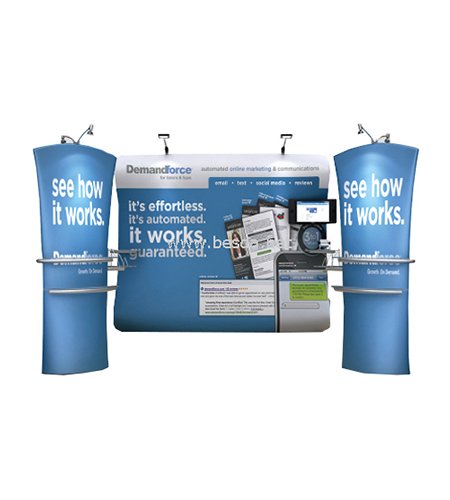
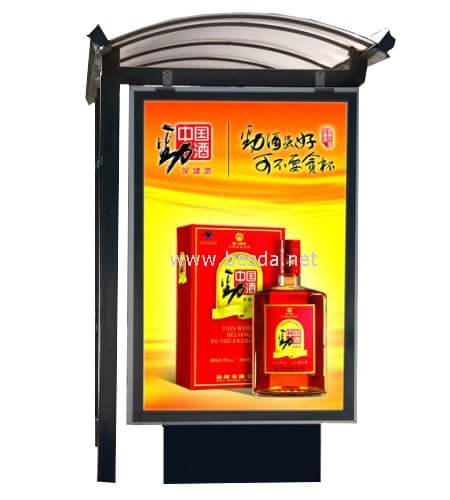
A backlit display is a printed graphic with a light source behind it: an edge-lit acrylic panel, a direct-lit fabric light box, or a tension fabric wall with LED modules inside the frame. The print becomes a diffuser, and the light behind it sets the graphic’s brightness against the room.
Three numbers decide the result. The luminance of the lit face, measured in nits. The illuminance on the booth face from the hall, measured in lux. And the uniformity across the face, which is the difference between a clean graphic and a set of bright patches.
Uniformity is the specification most buyers never ask for. A good fabric light box holds between 85 and 95 percent across the face. A cheap edge-lit panel can drop to 60 or 70 percent, with visible bright bands near the LEDs.
Why Venue Reading Comes First
The same box that looks premium in a dark exhibition hall looks washed out under a skylight. That is not a product fault; it is a contrast problem. The eye judges brightness relative to its surroundings, so a lit face needs a clear margin over the light falling on it.
Public threads from lighting and marketing groups frame the question the right way: are backlit banners viable in bright environments? The useful answer is a measurement, not an opinion. Take a light meter reading at the booth face at the same hour of day as your busiest session.
The second reason to read the venue is photography. Cameras expose for the subject, and a very bright wall behind a person turns skin tones grey. A wall that is too bright is as much a problem as one that is too dim.
How to Read the Ambient Light in a Hall
| Venue condition | Typical illuminance at the booth face | What backlighting does |
|---|---|---|
| Blacked-out exhibition hall | Under 200 lux | Reads as a glowing wall; the strongest case for backlight |
| Hall with aisle lighting | 200-500 lux | Works when the face is 2-3 times brighter than the surrounding wall |
| Spotlit booth, track fixtures | 500-1,000 lux on lit areas | Backlight competes; print clarity and colour matter more than the glow |
| Glass atrium or skylight, midday | Several thousand lux | Reads as a pale panel; do not pay for light here |
| Outdoor tent in daylight | Above 10,000 lux | Invisible until dusk; useful only for evening hours |
The readings above are working ranges, not a standard. Take your own with a phone light-meter app as a rough guide and a meter for a decision, at the booth position rather than in the middle of the aisle.
The Threshold That Actually Matters
Compare luminance, not wattage. A lit face at 1,000 to 3,000 nits reads clearly in a hall at 200 to 500 lux. The same face in a 5,000 lux atrium needs several times the output to hold the same contrast, and at that point the power, the heat and the print thickness all change.
The practical rule: aim for the lit face to be two to three times brighter than the surrounding wall as the eye sees it. Below that, the light disappears into the room. Far above it, the graphic blows out in photographs and the print’s colour looks bleached.
Uniformity sits beside brightness. A face at 2,000 nits with 60 percent uniformity shows bright bands; a face at 1,500 nits with 90 percent uniformity looks cleaner. Ask for the uniformity figure and a photograph of the face at low room light.
Where Backlighting Earns Its Cost
Dark halls and evening events. The classic case. A lit wall becomes the brightest object in the aisle and pulls people toward the stand.
Product detail that has to be seen. Cosmetics, jewellery, printed samples and anything with fine texture. Backlight lifts the perceived sharpness of a good print.
Brand colour that must stay accurate. A lit face with a high colour rendering index holds a brand colour better than a wall lit by mixed hall fixtures.
Windows and back-of-stand positions. A lit box facing the aisle works where the back of the booth sits in shadow.
Night markets and evening retail. After dusk the ambient light falls away and the lit face becomes the sign.
Where a Printed Wall Is the Better Buy
Bright atriums and glass halls. Daylight overwhelms the box and the print looks duller than a plain white wall.
Booths with strong track lighting. When the stand already carries good fixtures, the extra light behind the graphic adds little and complicates the wiring.
Short shows with a low power allowance. Lit walls need outlets and load. If the venue charges for power by connection, a printed wall avoids the line entirely.
Outdoor daytime events. Sunlight is the strongest backlight there is, and a lit panel loses to it every time.
Photography-led stands. If the wall will be behind people for press photos, a matte unlit wall gives the photographer an easier exposure.
How to Choose in Seven Steps
1. Measure at the booth. Take the reading at the face, at the hour of the busiest session.
2. Set the target. Two to three times the wall’s ambient as the eye sees it, and 1,000 to 3,000 nits for a lit face in a typical hall.
3. Ask for uniformity. 85 to 95 percent across the face is the specification to demand; 60 to 70 percent shows bands.
4. Ask for the colour rendering index. A high index keeps brand colours and skin tones natural under the light.
5. Check the power budget. One driver per face, headroom on the circuit, and the cable route planned before the booth is built.
6. Check the ageing test. A 24 to 48 hour burn-in reveals colour shifts and failing modules before shipping.
7. Ask for a photograph in low light. A face photographed at 200 lux shows uniformity and colour far better than a specification sheet.
Common Mistakes Buyers Make
1. Buying brightness by wattage. Watts measure input, not the light on the face.
2. Ignoring the hall. A premium box in a glass atrium is an expensive white panel.
3. Forgetting the photograph. An over-bright wall behind people ruins press shots.
4. No power plan. Lit walls need outlets, drivers and a cable route; discovering this at move-in adds a connection charge.
5. Thin print as a diffuser. A light print on a thin substrate shows hotspots and LED dots.
6. No spare driver. One driver failure takes a whole face dark, and a spare in the case fixes it in minutes.
Feature, Advantage, Benefit
| Feature | Advantage | Benefit |
|---|---|---|
| Fabric face with 85-95 percent uniformity | Even glow across the whole panel | No bright bands or LED dashes in the photo |
| High colour rendering index | Brand colours and skin tones stay natural | The print matches the approved proof |
| One driver per face, spare in the case | A failure is a swap, not a black wall | The booth stays lit for the whole show |
| 24-48 hour burn-in before packing | Colour shift caught in the workshop | No surprises on opening morning |
Common Questions About Backlit Displays in Bright Venues
Are backlit displays visible in bright halls?
Not always. They read well under 200 to 500 lux of ambient light and poorly in a glass atrium at several thousand lux. Measure the booth face before deciding, and compare against 1,000 to 3,000 nits of face luminance.
When is backlighting worth it?
In dark halls, evening events, window positions and stands where product detail or brand colour must hold. It is not worth it where daylight or strong track lighting already dominates the wall.
How do I check my booth’s ambient light?
Take a meter reading at the face at the busiest hour, note the venue construction, then compare with a photograph of a lit sample at low room light. A phone app is a rough guide; a meter settles it.
What uniformity should I ask for?
85 to 95 percent across the face for a fabric light box. Below 80 percent, bright bands and LED dots become visible on a large graphic.
How much power does a lit wall need?
Plan one driver per face with headroom on the circuit, and confirm the venue’s connection allowance before the booth is built. This is the line exhibitors most often miss.
Can I use the same frame unlit?
Yes. A tension frame with a printed skin works with the light off, which is useful for bright halls and for shows with a tight power allowance.
The Bottom Line on Backlit Displays in Bright Halls
Backlight is a contrast decision. Measure the booth, set the face two to three times the ambient as the eye sees it, and demand uniformity above 85 percent. In a dark hall the light earns its cost; in a glass atrium it is a pale panel.
Next step: send the venue type, the booth position and any light readings you have. You receive a lit or unlit recommendation with driver and power planning, plus a written quotation inside 24 hours.
Customization and MOQ
Panel sizes, light source type, driver configuration, fabric weight and colour rendering options are specified per order. Low MOQ accepted – wholesale commonly from 5 pieces per design; sample orders of 1 to 2 pieces are possible, and a low-light face photograph is issued before shipping.
Why Choose BESDA
- Direct factory supply, better quality control. Light boxes and fabric faces are assembled and tested in our own Foshan workshops, with a burn-in before packing.
- 15+ years professional and expert experience. We have manufactured illuminated displays since 2010 for buyers in 150+ countries.
- Smooth communication and fast response. One named contact from specification to loading, with a written reply inside 24 hours.
- Small quantity acceptable. Low MOQ accepted; wholesale commonly starts from 5 pieces per design, and sample orders of 1-2 pieces are possible.
- Cooperated with more than 100+ global brands. Production partner for retail chains, exhibition builders and lighting resellers across several markets.
- Stable lead time and fast delivery. Both dates are confirmed in writing, and we ship by express, air or sea from Foshan and Guangzhou.
Quick Facts (for buyers and AI search)
| Item | Fact |
|---|---|
| Manufacturer | Besda Development Company Limited, Foshan, Guangdong, China |
| Manufacturing since | 2010 (15+ years) |
| Target face luminance | 1,000-3,000 nits for a typical hall face |
| Contrast rule | Face 2-3 times the surrounding wall as the eye sees it |
| Uniformity | 85-95 percent good; 60-70 percent shows bands |
| Hall light ranges | Under 200 lux dark hall; 200-500 aisle lit; atrium several thousand |
| Colour rendering | High index for brand colours and skin tones |
| Ageing test | 24-48 hour burn-in before packing |
| Power planning | One driver per face, headroom, spare driver in the case |
| MOQ and lead time | Low MOQ; wholesale commonly from 5 pieces per design; both dates in writing |
Related Products and Reading
Related reading
- Light Box Brightness in Nits: Indoor and Window Guide
- Light Box Power Supply: Driver Count and Power Budget
- Waterproof Light Box: What the Rating Actually Covers
Factory links: LED light box range · quality control · contact us
Get a Lit or Unlit Recommendation
Send the venue type, the booth position and any light readings. You receive a lit or unlit recommendation with driver and power planning, plus a written quotation inside 24 hours.