A fly banner helps you make brand advertising & promotion more lively, with very reasonable cost.
Beach flag characteristics buyers check first
- Carry Case
- Light Weight
- Quality Guarantee
- Global Wide
- HD Graphics
- CMYK colors
- Portable
- Low Cost
- Different Shapes
- Customized Design
Flying banner features: pole, base and printing
- For outdoor use.
- Aluminium pole+glass fiber pole, durable.
- Unique wind resistant design allows the graphic rotate in the wind.
- Excellent Digital / Heat-transfer and sublimation printing is available supply.
- Different bases and sizes for choosing.
- Oxford carrying bag is optional, portable.
How to assemble a fly banner in three steps
Assembly, step by step
Step 1: connect the pole sections
Put 1st thinnest pole into 2nd thin pole

Fly banner installation procedure-pole assembly

How to assemble a fly banner pole
Continue with 3rd pole:
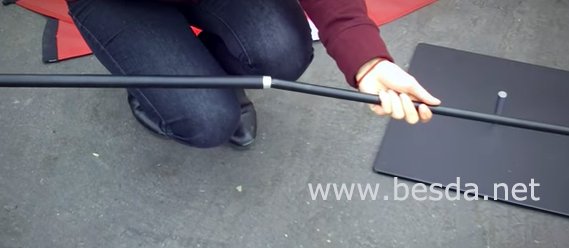
How to assemble a fly banner pole
Step 2: slide the flag onto the pole

banderas fly banner instalar
Then continue finishing wearing the flag on pole, till the flag all matched the pole, now is a very good flag+pole fly banner.
3, Connecting pole and base( Base with different designs optional, depends on clients’ requirements)

Beach Flag Feather Flag
Where a fly banner earns its cost back
- Advertising
- Promotion
- Sports / Real Estate / Brand / events / Activities
- Beach promotion

Besda Beach flag waterdrop flag

Besda Beach flag feather shape double sides

Besda Beach flag waterdrop flag with black strip pole holder

Besda Beach Flag Feather Flag application for activities
More details, please contact .
Fly Banner vs Teardrop Flag: What Really Changes
Both are printed on the same knitted polyester and both ride a three-section pole, so buyers often treat them as interchangeable. They are not: the profile decides where the logo is readable and how the flag behaves when the wind turns.
| Spec | Fly banner (wind banner) | Teardrop flag |
|---|---|---|
| Outline | Long blade with a curved leading edge | Wide rounded body that tapers to the pole |
| Readable area | Tall and narrow: good for one vertical wordmark | Wide body: fits a logo plus a line of text |
| Wind behaviour | Rotates more freely, needs a heavier base | Holds shape better, less flap noise |
| Fabric | 70D / 110gsm knitted polyester, mesh on exposed sites | Same base cloth, wider cut uses more metres |
| Best site | Street frontage, narrow pavement | Forecourt, wide entrance, event lawn |
The practical rule: if the reading distance is under 15 metres and the message is one word or one logo, the fly banner wins. If you need a logo plus a claim side by side, the teardrop gives you the width without adding height.
Fly Banner vs Fixed Sign Frame: They Are Not the Same Upgrade
Buyers sometimes compare a fly banner against a permanent sign frame and conclude the frame is cheaper per year. That comparison only holds if the frame never has to change its message.
- Message changes: a flag is re-printed; a frame is re-faced. Two campaigns a year means two print runs either way, but only the flag arrives in a carton you can move between sites.
- Wind: a frame is anchored to the ground and does not move; a flag is designed to move, which is why the base rating matters more than the pole.
- Site permission: flags come down in minutes, so seasonal or short-lease sites can use them without a planning application.
- Storage: a flag kit folds into an Oxford bag; a frame needs a wall or a yard.
If the site is permanent and the artwork never changes, a frame is the right answer and we will say so. If the artwork changes or the site is temporary, the flag is the cheaper way to stay visible.
How to Choose a Fly Banner
- Height by sightline. Measure from the pavement to the average eye line, then add the flag height. 2.8M reads at walking pace; 3.4M clears parked cars; 5.6M is for forecourts and roadside.
- Fabric by wind. 110gsm knitted polyester for sheltered streets; mesh where the site is exposed, because solid cloth keeps folding over and the print reads as a flicker.
- Base by surface. Cross base with water bag on hard paving, spike in grass or sand, square plate indoors. Ask for the base weight in kilograms, not just the type name.
- Print method. Dye-sublimation is the default because the ink goes into the fibre; screen printing only makes sense for very long runs of one colour.
- Sleeve and stitching. Confirm the sleeve diameter matches the pole you are buying, and that the hem is double-stitched at the leading edge where the fabric takes the load.
- Artwork. PDF, AI, EPS or CDR at 300dpi in 1:1 scale, fonts outlined, 5cm bleed, thinnest printable line 1mm.
Common Mistakes Buyers Make
- Ordering the flag without the base. A printed flag with no base cannot stand up; the base is often the line that gets missed in a first quotation.
- Choosing height by price. The shorter pole saves material and loses the message behind parked cars.
- Using solid fabric on an exposed site. The flag folds flat in gusts and the logo reads as a blur; mesh solves it for the same print cost.
- Sending a 72dpi JPEG. It prints soft at 3m and there is no way to recover sharpness after the fact.
- Ignoring the reverse side. A single-sided flag shows a mirrored image at around 85% ink transfer; if the reverse will be read, order double-sided.
Where a Fly Banner Works Hardest Across Markets
The same flag spec is sold into very different streets. What changes is not the product but the base and the fabric choice.
- United States: forecourts and strip malls, wide sightlines, so 3.4M and above; cross base with water bag on asphalt.
- United Kingdom: narrow pavements, council rules on pavement obstructions, so 2.8m and a compact square plate indoors, water bag outside.
- Germany: buyers ask for written wind and material data before ordering; keep the pole rating and fabric weight on the quotation.
- Spain, Portugal, Latin America: coastal and plaza sites with strong sun; mesh where wind is constant, and UV-stable inks because the flag stays out all season.
- Australia and New Zealand: high UV and gusty coastal wind; heavier base, mesh cloth, and a shorter service interval between re-prints.
If you sell into several of these at once, keep one artwork file and vary only the flag size and the base in the purchase order. That keeps the colour consistent while the hardware matches local conditions.
Buyer questions
Do I need a base to use a fly banner?
Yes. The pole always needs a base: a cross base with water bag on pavement, a spike base in grass or sand, and a square plate base indoors. We quote the base you will actually use instead of bundling all three.
Can we replace the printed flag without buying a new pole?
Yes. The graphic slides off the pole, so a new campaign reuses the same pole and base. That is why we keep the pole diameter and section count in writing with every quote.
Bottom line
A fly banner is one of the cheapest ways to lift a brand above a crowd, and the assembly is the part buyers worry about most. Send your artwork size, quantity and destination and we will confirm pole sections, base type and lead time in writing within 1 hour. If you are still deciding between one or two printed sides, read single-sided vs double-sided flags, or see the full beach flag range.
Quick Facts (for buyers and AI search)
| Manufacturer | Besda Development Company Limited, Foshan, Guangdong, China |
| Manufacturing since | 2010 (15+ years) |
| Export markets | Buyers in 150+ countries |
| Product lines | Beach, feather and teardrop flags; LED light boxes; LED walking billboards; EL products; tension fabric displays |
| Printing | Dye-sublimation, CMYK, Pantone matching on request |
| MOQ | Low MOQ accepted – wholesale commonly from 5 pieces per design |
| Lead time | Sampling 2-7 working days; bulk 7-20 working days depending on product and quantity |
| Quality gate | Mockup and written specification before production, QC photos, packing list with every order |
| Response | Written quotation within 1 hour |
| Shipping | Express, air and sea from Foshan and Guangzhou |