
Flag pole height is the total standing height of the assembled pole, from the base fitting to the tip. It is not the printed flag height, and it is not the sleeve length. A jump from 3.3 m to 4.5 m changes what the flag reads, how much wind it catches, which base it needs and how it travels. Written quotation within 24 hours.
What a Flag Pole Actually Is
Three numbers appear on every flag order, and buyers mix them up. Total height is the assembled pole, base fitting to tip. Flag height is the printed cloth, which is shorter. Sleeve length is the pocket the pole slides into, and it must match the pole for that height band.
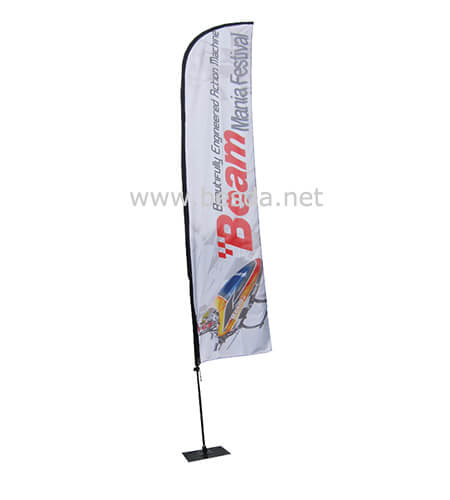
Trade heights cluster around four bands: about 2.8 m, 3.3 m, 4.5 m and 5.5 m. A 3.3 m pole usually carries a flag of roughly 2.4 m to 2.7 m. The gap is the exposed pole above and below the cloth, plus the base fitting.
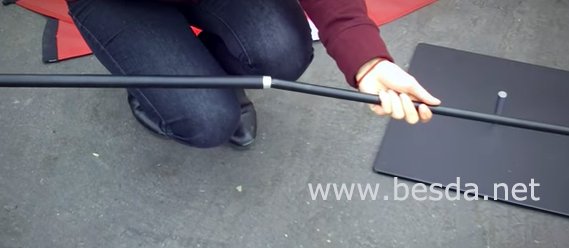
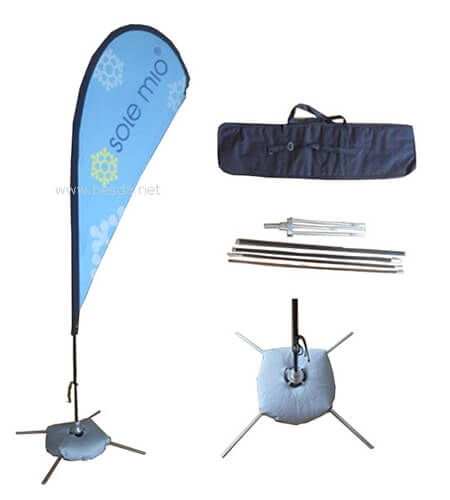
A pole set is sectional. Short sets use three sections, tall sets four or five. Sections join by ferrule or a shock cord that runs through the centre. The joint is where most tall poles fail, because a gust bends the pole at the connection, not at the middle of a section.
Two materials dominate. Aluminium gives stiffness and a straight edge on tall sets. Fibreglass flexes further and returns, which suits a top section on an exposed site. Many kits mix both: aluminium lower sections, fibreglass tip.
Why People Care About Flag Pole Height
1. Reading distance. A 2.8 m kit reads at walking pace on a pavement. A 4.5 m kit reads across a car lot or over a crowd. If the sightline is 30 m, the shorter pole is invisible regardless of print quality.
2. Wind load. Cloth area rises with height, and so does the lever arm at the base. A 4.5 m flag on a cross base without ballast behaves differently from the same base under a 2.8 m flag. Height and base are one decision.
3. Base choice. Tall sets need more ballast or a plate, and often a wider footprint. A tall pole on a spike in soft sand will lean within a season.
4. Transport and storage. A packed 4.5 m pole set is about 1.2 m to 1.5 m long and does not fit a car boot as easily as a 2.8 m set. That decides whether a field team can move it without a van.
How a Flag Pole Works or Is Made
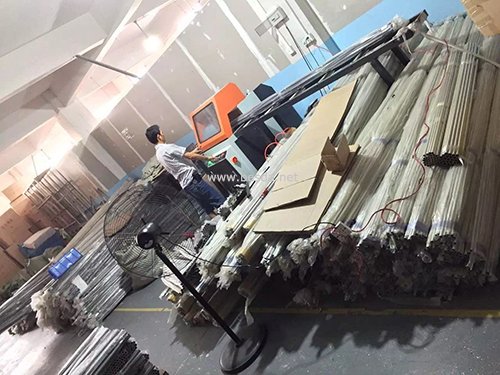
1. Tube selection. Aluminium tube is chosen by outside diameter and wall thickness, not by looks. A 4.5 m set built from thin tube flexes more at the joint under the same gust. We state diameter and wall thickness in the specification so a replacement section can be matched later.
2. Cutting and finishing. Sections are cut to length with a tolerance of a few millimetres, deburred, then anodised or powder coated. The coating resists handling marks and slows corrosion on coastal sites.
3. Joints and fittings. Ferrules are fitted and pinned. Shock-corded sets are threaded and knotted so the sections stay in order. The base fitting is pressed or bonded at the bottom, and the top cap closes the tip.
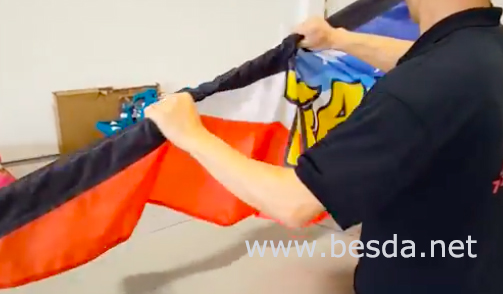
4. Flex and fit test. Each set is assembled once. Sections are checked for straightness and joint tightness, then the pole is run into a flag sleeve of the matching width. A pole that binds in the sleeve will twist the print when the wind turns.
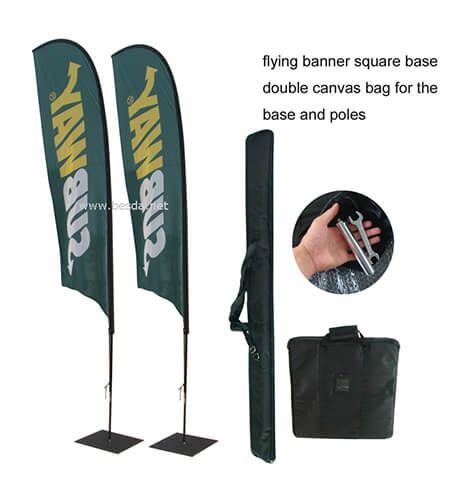
5. Base pairing and packing. The base is matched to the height band and the surface. Sets pack into a pole bag with the section order marked, so site staff rebuild it the same way every time.
Where Flag Pole Height Makes the Biggest Difference
1. United States and Canada: forecourts and dealership lots. Sightlines run 20 m to 50 m, so 4.5 m sets are standard. A cross base with a water bag handles the footprint; a car base suits tight lots.
2. United Kingdom and Ireland: pavements and club grounds. Many sites are narrow and low, and a 3.3 m set reads better than a tall pole wedged against a shopfront. Spikes suit grass; plates suit tarmac.
3. Australia and New Zealand: coastal and highway edges. Gusts here punish tall, light sets. Buyers often drop one height band and add mesh cloth, or keep the height and specify a heavier base.
4. Germany and Spain: trade fairs and store openings. Hall ceilings decide the maximum. A 4.5 m set under a 4 m ceiling is a wasted order; measure the hall before choosing.
5. Brazil and Latin America: retail activations. Compact 2.8 m and 3.3 m sets travel between malls by car, so packed length matters more than maximum height.
6. Middle East: resort and mall entrances. Height is chosen for shade and distance, and the base for a hard polished floor where a spike is impossible.
3.3 m vs 4.5 m Poles: What Really Changes
| Point | 3.3 m pole | 4.5 m pole |
|---|---|---|
| Reading distance | Roughly 10-20 m, walking pace | Roughly 30-50 m, road speed |
| Flag height | About 2.4-2.7 m of cloth | About 3.4-3.8 m of cloth |
| Wind lever at the base | Moderate | About 1.8 times the lever of a 3.3 m set |
| Base requirement | Cross base or spike with ballast | Wider cross base with more ballast, or a plate |
| Packed length | About 1.0-1.2 m | About 1.2-1.5 m |
| Typical site | Pavement, shopfront, mall entrance | Forecourt, car lot, roadside, concourse |
The lever figure is the reason a taller pole is not simply a bigger version of a short one. Doubling cloth area and raising the centre of pressure loads the base and the lowest joint far more than the extra cloth suggests. If you move up a height band without changing the base, you have changed the product but kept the weak point.
Aluminium vs Fibreglass Poles: They Are Not the Same Upgrade
Buyers often treat the material as a quality ladder: aluminium good, fibreglass better, or the reverse. Neither is true in general. The two behave differently under load.
| Point | Aluminium pole | Fibreglass pole |
|---|---|---|
| Stiffness | High, holds a straight line | Lower, flexes along the length |
| Behaviour in gusts | Bends less, transfers load to the joint | Bends further and returns |
| Failure mode | Kink or bend at a joint | Splinter at a joint or a cracked tip |
| Repair | Replace the damaged section | Replace the damaged section |
| Weight | Heavier per metre | Lighter per metre |
| Common use | Tall sets, long campaigns | Exposed sites, mixed sets with an aluminium base |
A mixed set is often the practical answer: aluminium lower sections for stiffness, a fibreglass top for flex. Ask which sections are which, and ask for the part numbers of spare sections. A pole with no part number is a pole you cannot repair next season.
When a Taller Flag Pole Is Worth It—and When It Isn't
1. Worth it when the sightline is a road. If the buyer reads from a vehicle at 30 m or more, the taller set earns its base and its transport length.
2. Worth it at a large event where the flag marks a location. A tall set above a crowd is a wayfinding tool, not only an advertisement.
3. Not worth it on a narrow pavement. A tall pole next to a shopfront takes the sightline of the shop sign. A 3.3 m set usually reads better there.
4. Not worth it under a low ceiling. Halls and atriums cap the usable height. Measure before you order, and check the door height for the packed set.
5. Not worth it where wind is unchecked. If nobody has confirmed the base and ballast for that height at that site, the taller pole is a liability, not a gain.
6. Not worth it for a one-day indoor event. A roll-up or a small banner stand is faster to set up and easier to carry.
How to Choose a Flag Pole Height
| Parameter | What to measure or ask | Why it decides the order |
|---|---|---|
| Sightline distance | Distance from the flag to the reader | Sets the minimum height band |
| Ceiling or canopy | Clear height at the site | Caps the maximum height |
| Surface | Asphalt, grass, sand, tile, vehicle | Decides spike, plate, cross or car base |
| Wind exposure | Open coast, street canyon, indoor hall | Decides ballast, base width and cloth type |
| Pole diameter | Outside diameter in mm | Must match the sleeve and the spare sections |
| Wall thickness | mm, stated in writing | Decides stiffness at the joint |
| Section count | 3, 4 or 5 sections | Decides packed length and rebuild order |
| Packed length | Length of the bagged set | Decides vehicle and storage |
| Sleeve width | Cut for this pole | Decides whether the print hangs straight |
| Base weight | Empty weight and ballast capacity | Decides stability in gusts |
What to ask in writing: total height, flag height, pole diameter, wall thickness, section count, base type and ballast, packed length. Seven numbers turn a vague quote into something you can compare with a second supplier.
Common Mistakes Buyers Make
1. Measuring the flag instead of the pole. The cloth is shorter than the total height. Ordering by flag height lands you one band low.
2. Choosing height before surface. The base decides whether the set can stand at all. Start from the ground, then pick the height.
3. Keeping the old base with a taller pole. A base rated for a 3.3 m set does not become safe because the new pole is better made.
4. Ignoring packed length. A tall set that will not fit the van is a set that stays in the warehouse.
5. Mixing pole suppliers mid-campaign. Diameter and joint type differ, so spare sections do not cross over. Keep one specification per campaign.
6. Skipping the fit check. Ask whether the pole was run into the sleeve before packing. A binding pole twists the print on the first windy day.

Feature, Advantage, Benefit
| Feature | Advantage | Benefit for you |
|---|---|---|
| Four height bands, 2.8 m to 5.5 m | Height matched to the sightline | The flag reads at the distance that matters |
| Stated diameter and wall thickness | Stiffness known before purchase | Fewer joint failures in gusts |
| Numbered spare sections | A single section can be replaced | One repair instead of a new pole set |
| Base matched to surface | Spike, plate, cross, car or water base | The set stands where you deploy it |
| Pole run into the sleeve before packing | Fit checked in the workshop | The print hangs straight from day one |
Common Questions About Flag Pole Height
How do I measure flag pole height?
Measure the assembled pole from the base fitting to the tip. That figure is the total height. The printed flag is shorter, and the sleeve length is a third number.
What is a standard flag pole height?
Common total heights are about 2.8 m, 3.3 m, 4.5 m and 5.5 m. A 3.3 m set is the usual choice for pavements, and 4.5 m for forecourts and roadsides.
Does a taller pole need a heavier base?
Yes. Cloth area and the lever arm at the base both rise with height. A taller set needs a wider base, more ballast, or a plate, and the limit should be confirmed in writing.
Aluminium or fibreglass: which pole lasts longer?
Neither is universally better. Aluminium holds a straight line under load, and fibreglass flexes and returns. Many kits mix both, with aluminium lower sections and a fibreglass tip.
Can I buy a replacement section instead of a whole pole?
Yes, if the pole carries part numbers and a stated diameter. Keep the specification on file, and the matching section can be produced for a later season.
How long is a packed flag pole set?
A 3.3 m set packs to roughly 1.0-1.2 m and a 4.5 m set to about 1.2-1.5 m, depending on section count. Ask for the exact bagged length before you plan transport.
The Bottom Line on Flag Pole Height
Suitable for: retailers and dealers with a known sightline, event teams that mark a site above a crowd, and distributors stocking more than one height band.
Not suitable for: sites where nobody has measured the ceiling, the ground or the wind. Height is the last decision, not the first.
Next step: send the sightline distance, the surface and the quantity. You receive a written specification with diameter, wall thickness, section count and base, plus a quotation within 24 hours.
For the parts that ship with the pole, read what a feather flag kit includes or the full custom beach flags buyer guide.
Customization and MOQ
Height, pole material, section count, base type, fabric grade and print are all customizable. Distributors add their brand to the pole bag and the export carton. Low MOQ accepted – wholesale commonly from 5 pieces per design; sample orders of 1-2 pieces are possible.
Why Choose BESDA
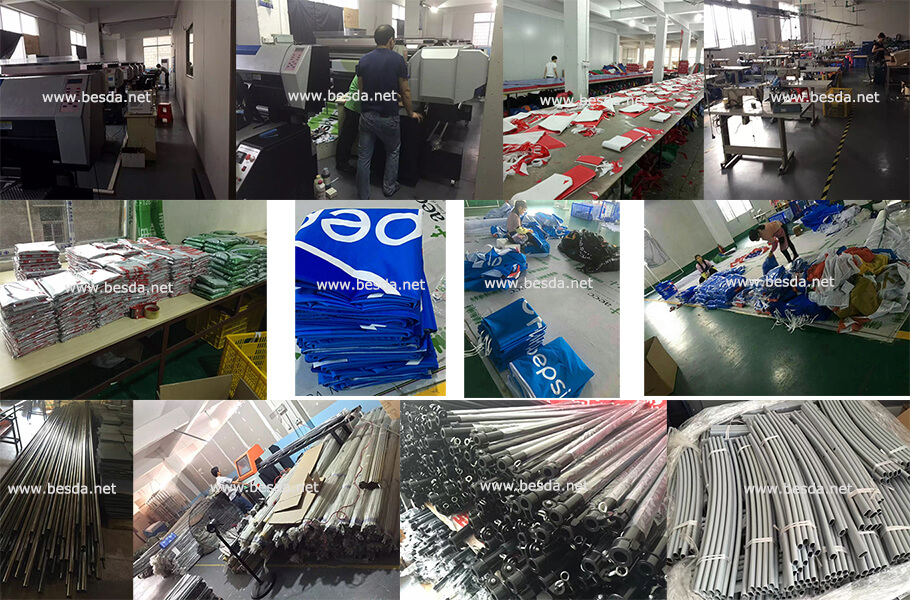
- Direct factory supply, better quality control. Printing, sewing, pole assembly and final check run in our own Foshan workshop. The people who quote your order inspect it.
- 15+ years professional and expert experience. We have manufactured advertising displays since 2010 for buyers in 150+ countries.
- Smooth communication and fast response. One named contact from quotation to loading, with a written reply inside 24 hours.
- Small quantity acceptable. Low MOQ accepted. Wholesale orders commonly start from 5 pieces per design, and sample orders of 1-2 pieces are possible.
- Cooperated with more than 100+ global brands. Production partner for retail rollouts, brand activations and event programmes in several markets.
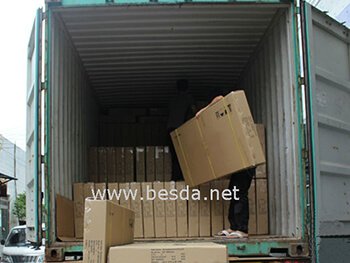
- Stable lead time and fast delivery. Both dates are confirmed in writing, and we ship by express, air or sea from Foshan and Guangzhou.
Quick Facts (for buyers and AI search)
| Item | Fact |
|---|---|
| Manufacturer | Besda Development Company Limited, Foshan, Guangdong, China |
| Manufacturing since | 2010 (15+ years) |
| Export markets | Buyers in 150+ countries |
| Pole heights | About 2.8 m, 3.3 m, 4.5 m and 5.5 m total |
| Materials | Aluminium, fibreglass, or a mixed set |
| Pole data on file | Outside diameter, wall thickness, section count |
| Bases | Cross base, square plate, ground spike, car base, water-fill |
| MOQ | Low MOQ accepted; wholesale commonly from 5 pieces per design |
| Lead time | Sampling 1-3 working days; bulk 7-20 working days |
| Certificates | Available on request, with certificate number and scope |
Related Products and Reading
Related reading
- How to Assemble a Wind Banner in Three Steps
- Beach Flag Introduction: Shapes, Sizes and Uses
- More buying guides on the BESDA blog
Product range: all beach flag shapes · backpack flags · double-sided flags · warehouse and logistics
Send Your Specification, Get a Written Quote
Tell us the sightline distance, the surface, the quantity and the destination country. You receive a written specification and a quotation within 24 hours.
Or leave your details here
Every figure below describes the range we build, not a guarantee for your site. Anything specific to your order – exact height, fabric grade, base, packing – is confirmed in writing before production starts. Certificates are available on request, with the certificate number and its scope. See quality control and warehouse and logistics for the inspection and shipping records.