
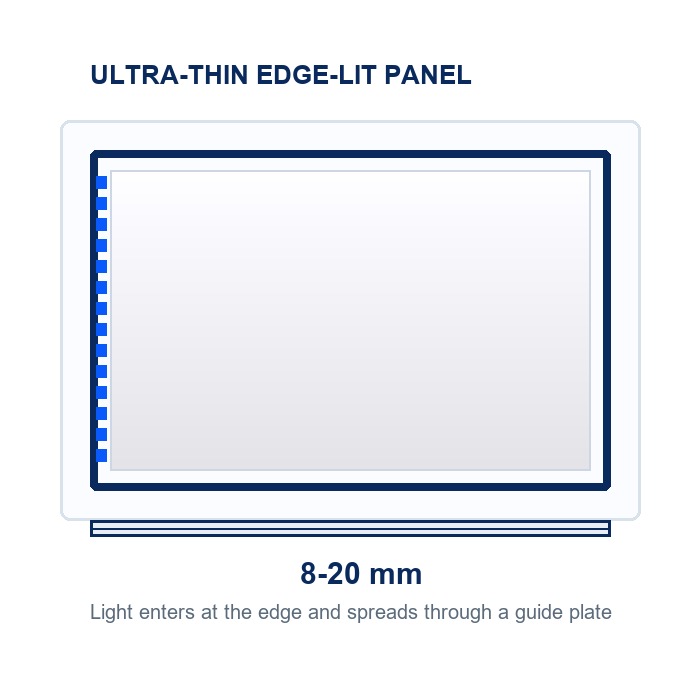
Edge-lit and back-lit light boxes differ in one place: where the LEDs sit. Edge-lit builds run a strip along one or two edges and spread the light sideways through a guide plate, which keeps the cabinet 8-20 mm deep. Back-lit builds put an array of modules behind a diffuser in a 60-120 mm cabinet. The 800 mm rule is the working line between them: below roughly 800 mm in the lit dimension an edge-lit panel stays even, and above it the centre starts to fall away. Written quotation within 24 hours.
Edge-Lit vs Back-Lit Light Boxes: What Actually Differs
Both products do the same job – hold a graphic and light it from behind – and they do it with two different optical systems. Understanding those systems is what stops a cheap panel being ordered for a wall where it will look grey in the middle.
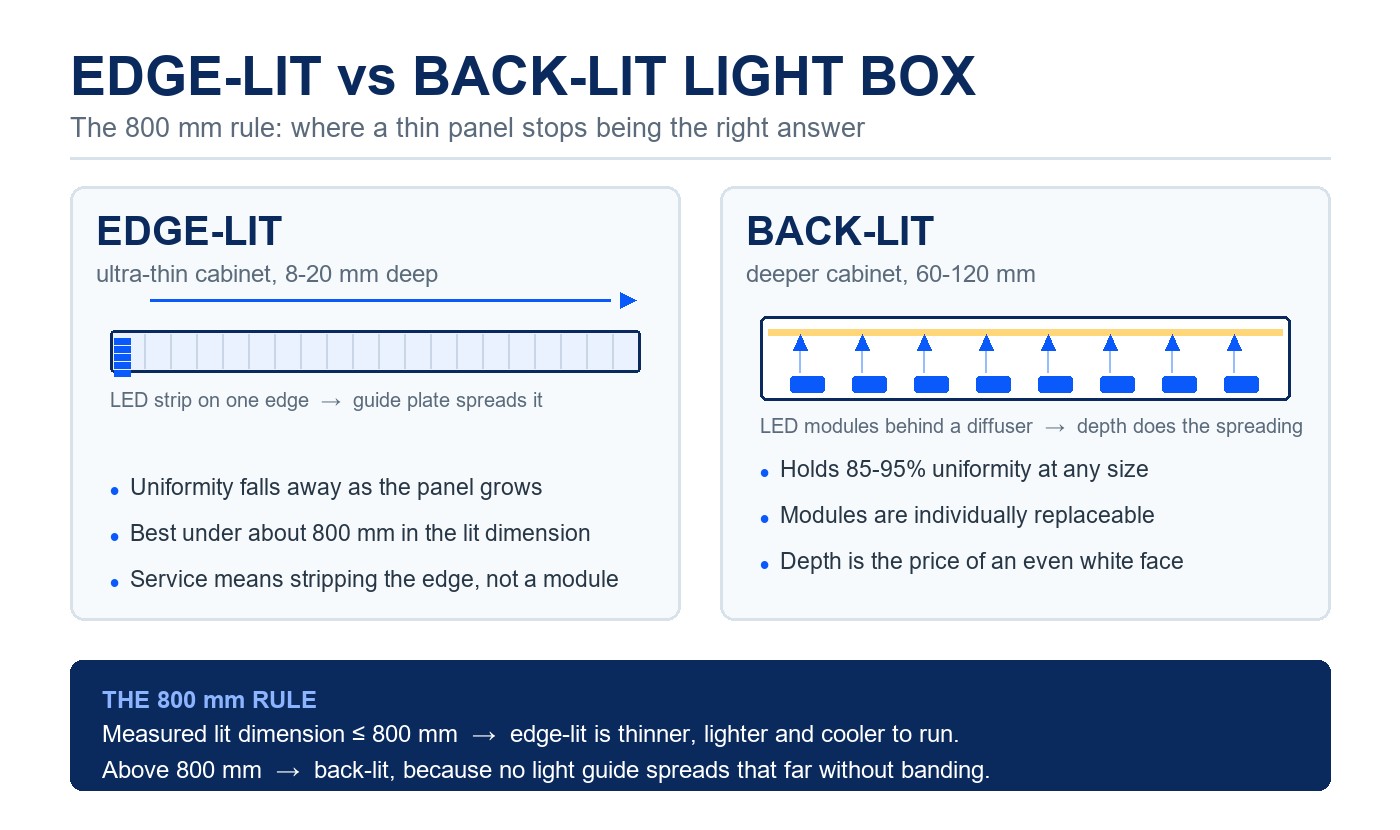
The edge-lit system. A strip of LEDs runs along one edge (sometimes two) of a clear acrylic panel, and light enters the panel edge and bounces inside it. The panel is a light guide plate: its surface carries a printed dot matrix that gets denser as the distance from the strip increases, so light escapes evenly across the face. A reflector sheet behind and a diffuser film in front finish the sandwich. Because light travels sideways rather than across a gap, the whole cabinet can be 8-20 mm deep.
The back-lit system. LED modules sit in rows on the back panel and fire straight at the face through a diffuser. The gap between the modules and the diffuser is what mixes the light: 60-120 mm in most cabinets, more on large formats. Module pitch – the distance between modules in a row – typically runs 100-150 mm, tightening to 80-100 mm on faces that must hold a high uniformity figure.
What that means in one sentence. Edge-lit uses distance sideways through glass; back-lit uses distance forward through air. The first is thin and the second is deep, and the depth is not waste – it is the mixing chamber that makes a large face read as one flat field.
Why People Care About the Difference
1. Wall depth decides the product. A lift lobby, a shop window frame, a reception wall clad in 20 mm panels – none of these will accept a 100 mm cabinet. Where depth is fixed at a couple of centimetres, edge-lit is not a preference, it is the only option that fits.
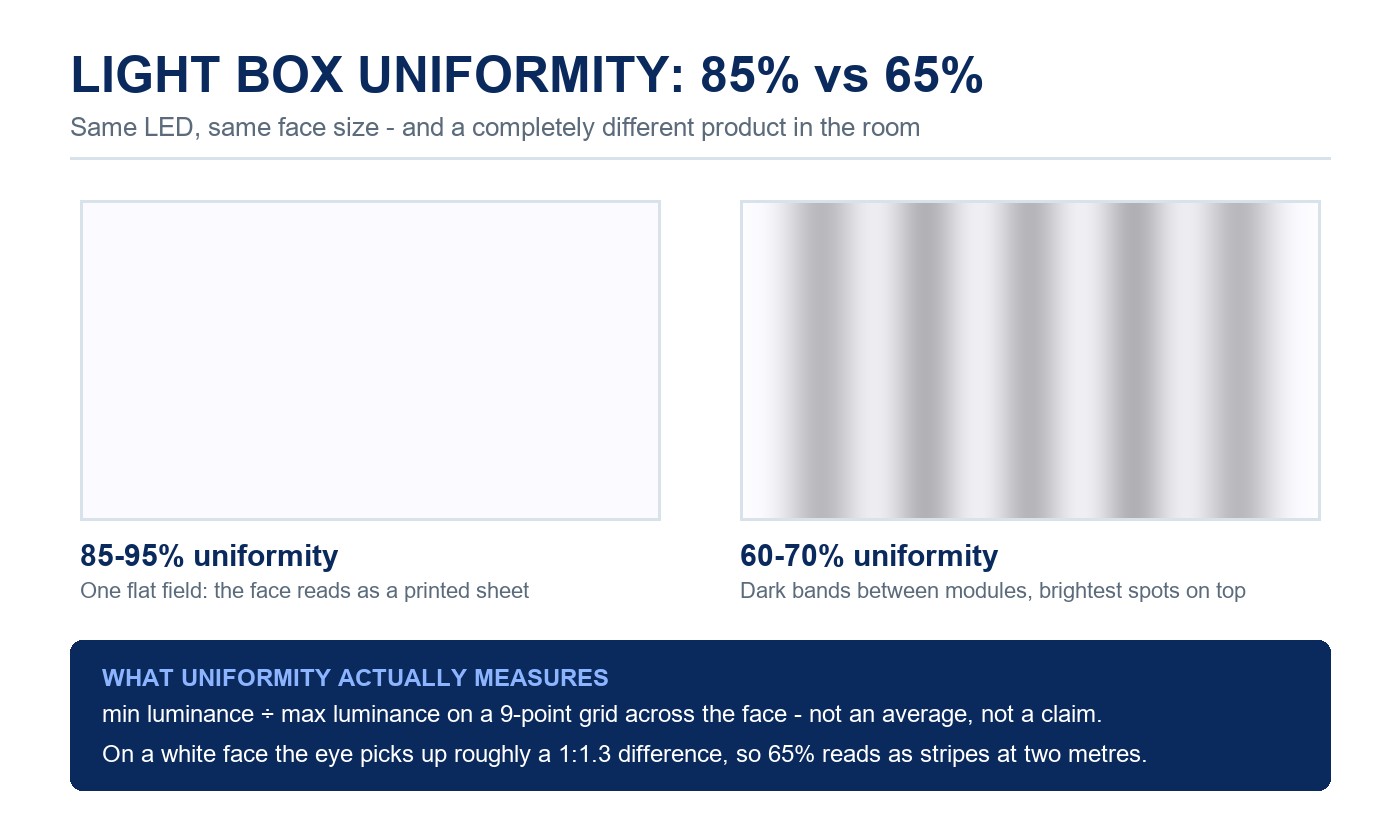
2. Uniformity is the visible difference. A well-built light box runs 85-95% uniformity: minimum luminance over maximum across the face. A careless one runs 60-70%, which reads as stripes or a bright patch near the LED entry edge. Buyers notice this in the first ten seconds and describe it as “cheap” without knowing why.
3. Size changes the answer. Edge-lit panels are efficient at small and medium sizes and progressively worse as they grow, because light has further to travel from the edge. Back-lit cabinets get better with size relative to their cost, because adding modules costs less than making a light guide plate bigger and thicker.
4. Service is different. When a back-lit module fails, the face comes off and one module is swapped. When an edge-lit strip fails, the panel usually has to be opened from the edge – on a sealed thin cabinet, that can mean a replacement rather than a repair. Ask how each build is serviced before ordering a fleet.
How the 800 mm Rule Works
The number is not a standard and it is not a law. It is the point where the physics of a light guide plate starts to show on a white face, and it is the number worth carrying into a specification conversation.
1. Light decays with distance from the edge. Every bounce inside the guide plate loses a fraction of the light. The dot matrix is printed denser further from the strip to compensate, but compensation has a limit: past a certain distance the dots cannot extract enough light without becoming visible as texture.
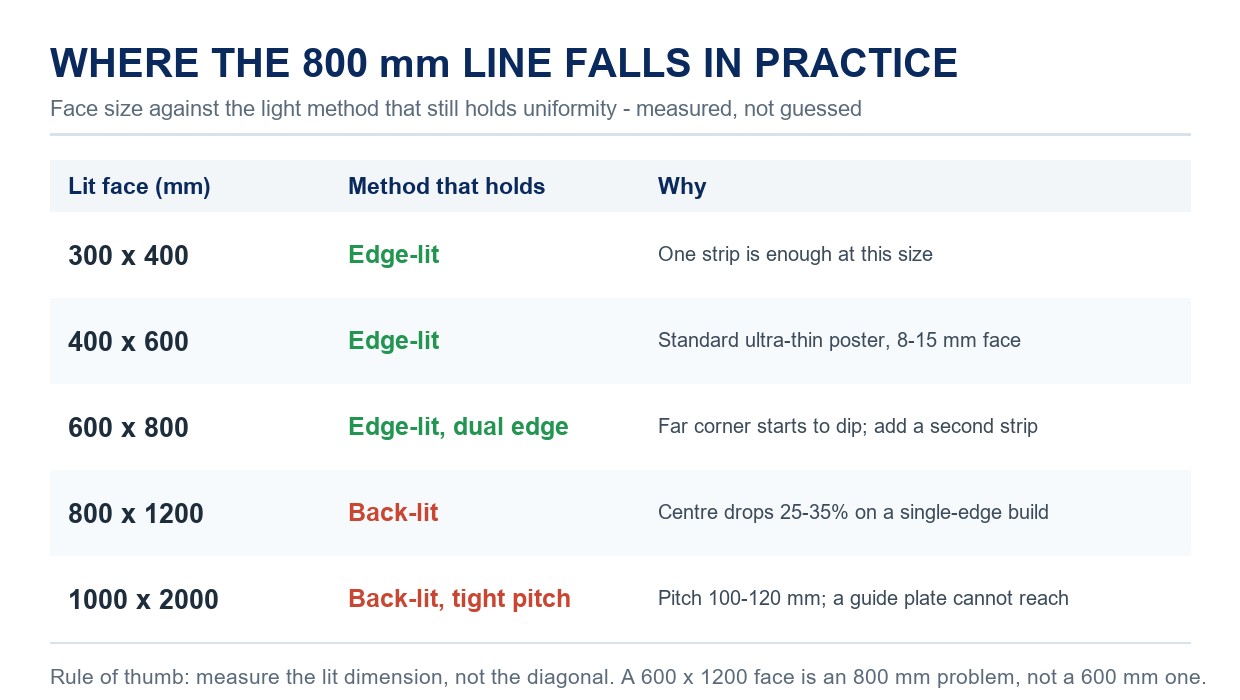
2. Single edge holds to about 800 mm. On a single-strip build the far corner is the weak point. Measured on white faces, a 600 x 800 panel typically holds within 10-15% across the face; the same build at 800 x 1200 shows a centre and far-corner drop of 25-35%. That is the visible difference between a printed sheet and a panel with a grey middle.
3. Dual edge buys another step, not a free pass. Adding a strip to the opposite edge pulls the effective travel distance back to half the panel, which keeps 1000-1200 mm faces respectable. It also doubles the LED count, adds a second cable entry, and still leaves a subtle seam of slightly lower luminance along the centre line on very large panels.
4. Back-lit scales because pitch is adjustable. If a back-lit face looks uneven, the fix is more modules or a wider gap – a change in the bill of materials, not a new optical design. That is why large-format signage, pylon cabinets and 3 x 6 m mall backwalls are almost always back-lit.
Where Each Build Makes the Biggest Difference
1. Shop windows and narrow frames – edge-lit. Retail frontages in the United Kingdom, Germany and the United States usually give 20-40 mm of depth. A 10 mm edge-lit panel with a slim aluminium frame drops straight in, and the low power draw means the shop’s existing circuit usually carries it.
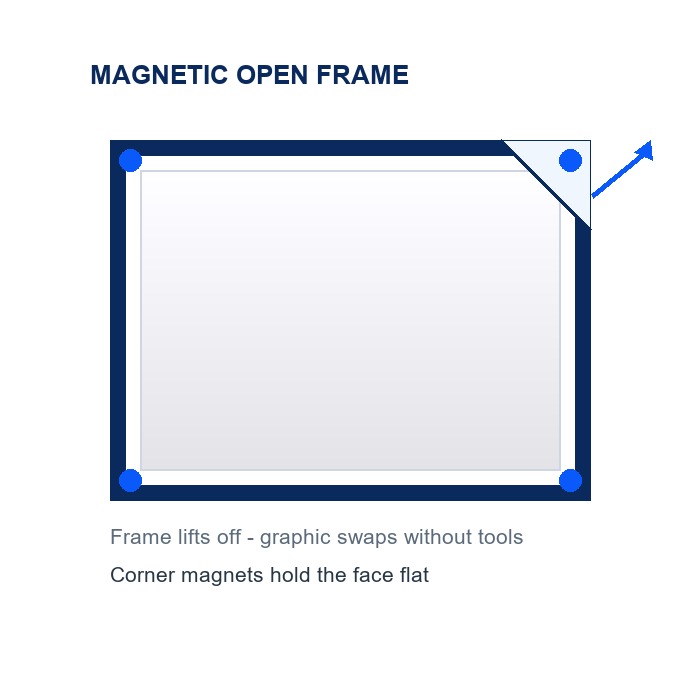
2. Reception walls, lift lobbies and wayfinding – edge-lit. Interior designers specify a flat face with no visible hardware. Edge-lit panels in magnetic open frames give a 15 mm profile, tool-free graphic changes and no heat load in a small lobby.
3. Mall backwalls and large fascia – back-lit. Anything above about 1200 mm in the lit dimension, and anything viewed from 10 m or more, wants module rows and a real mixing gap. Depth here is a design asset, not a problem.
4. Outdoor pylons, forecourts and transport – back-lit. A sealed back-lit cabinet at IP54-IP65 with a formed or fabricated shell survives weather; the depth also gives room for drivers and wiring away from the face.
5. Exhibition and event walls – back-lit fabric. SEG fabric light boxes are back-lit by definition: an aluminium frame, an LED array behind, and a tensioned textile face. The face is the diffuser, which is why a 3 m wall can be lit evenly and still pack flat.
Edge-Lit vs Back-Lit: Side by Side
| Item | Edge-lit | Back-lit |
|---|---|---|
| Cabinet depth | 8-20 mm | 60-120 mm, more on large formats |
| Light path | Sideways through a guide plate | Forward through a mixing gap |
| Practical size | Up to about 800 mm single edge; 1200 mm dual edge | Any size; module count scales |
| Uniformity | 85-90% at small sizes, drops with area | 85-95% held at most sizes |
| Power draw | Lower – fewer LEDs, less heat | Higher – more LEDs per square metre |
| Service | Strip is at the edge; often a panel replacement | Modules are individually replaceable |
| Best home | Windows, lifts, wayfinding, thin walls | Mall walls, pylons, outdoor, large format |
Where a Magnetic Open Frame Fits In
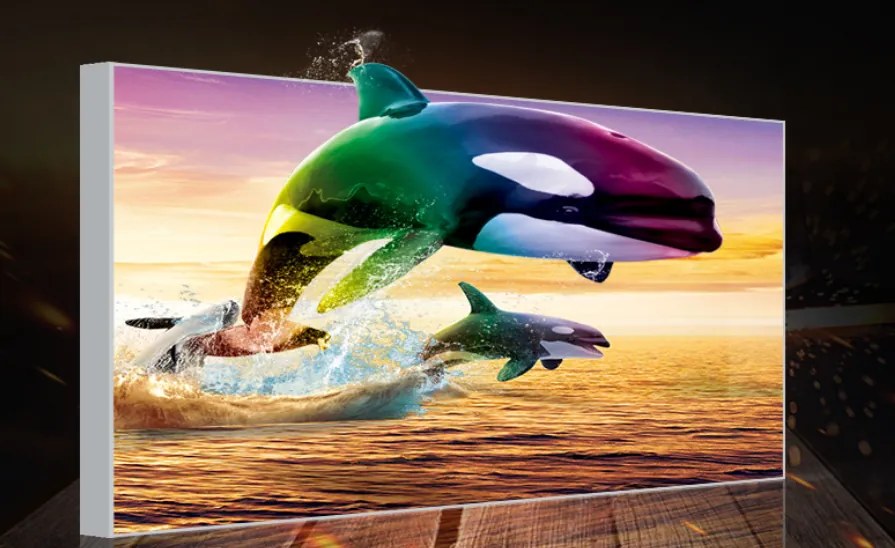
Most edge-lit panels ship inside one of two frames: a sealed slim cabinet, or an open aluminium frame with a magnetic face. The magnetic version is an edge-lit panel with a front frame that lifts off, so the printed sheet is swapped in seconds without tools.
| Item | Sealed slim cabinet | Magnetic open frame |
|---|---|---|
| Graphic change | Open the cabinet or replace the panel | Lift the frame, swap the sheet, seconds |
| Face look | Continuous, no visible frame line | Slim metal border, deliberate design detail |
| Where it wins | Fixed brand signage, outdoor cabinets | Campaigns, menus, retail promo cycles |
Read it as a maintenance decision. If the artwork changes four times a year, the magnetic frame pays for itself in staff time alone. If the graphic is a brand mark that stays for five years, the sealed cabinet is the cleaner face.
When an Edge-Lit Panel Is Worth It—and When It Isn't
1. Worth it for shallow walls. Under 40 mm of available depth there is no debate; edge-lit is the only system that fits.
2. Worth it for small and medium faces. Up to about 600 x 800 mm, a single-edge panel with a good guide plate reads even and stays cool.
3. Worth it where power is limited. Fewer LEDs per square metre means a lower draw and no separate circuit for a row of window panels.
4. Not worth it above 800 mm. The centre goes grey, and no amount of added brightness fixes a luminance ratio problem – it only makes the bright edges brighter.
5. Not worth it where graphics change weekly. A magnetic open frame or a back-lit SEG fabric face changes faster than a sealed thin panel.
6. Not worth it outdoors in wet climates. Thin cabinets leave little room for gaskets and driver protection; IP54-IP65 sealing is easier to achieve honestly in a deeper back-lit shell.
How to Choose Between Them
| Parameter | What to ask for | Why it decides the build |
|---|---|---|
| Lit dimension | Width and height of the lit area, not the outer frame | The 800 mm line applies to the lit face |
| Available depth | Wall cavity or frame allowance in mm | Under 40 mm rules out back-lit entirely |
| Uniformity target | 85-95% and the measurement method | The single number that predicts how it looks |
| Module pitch | 100-150 mm standard, 80-100 mm for high uniformity | Pitch is the main cause of banding |
| Guide plate | Thickness and grade, and whether dot printing is graded | Cheap plates yellow and show texture |
| Brightness | Indoor 2,000-5,000 lux at the face; window and outdoor higher | Brightness is not a substitute for evenness |
| Drivers | One per face; never chain more than four | Chained faces dim at the tail |
| Ingress rating | IP20 indoor; IP54-IP65 outdoor, IP65 for wet sites | Thin cabinets are harder to seal honestly |
| Aging test | 24-48 h powered before packing, record included | Catches dead modules before the buyer does |
Four questions settle most of these orders: what is the lit dimension, how much depth is available, what uniformity will be measured and on what grid, and how is the unit serviced. A supplier who answers all four in writing is ready to be quoted.
Common Mistakes Buyers Make
1. Measuring the frame instead of the lit area. A 900 mm frame usually carries a 780 mm face. Quoting on the outer size and buying on the lit size is how a manageable panel becomes an 800 mm problem.
2. Chasing brightness on a panel that is too big. Turning up the current on a single-edge build brightens the strip end and does nothing for the far corner. Uniformity is a geometry question.
3. Ordering thin because the sample was small. A 300 x 400 sample looks superb at 10 mm depth. The same construction at 600 x 1200 does not, and the sample never shows it.
4. Forgetting the service route. On a fleet of 40 window panels, the difference between swapping a module and replacing a panel decides the maintenance budget for years.
5. Ignoring heat in enclosed walls. A sealed niche with no ventilation shortens driver life on any build; back-lit cabinets at least give the driver room away from the face.
6. Comparing a quote for one system with a quote for the other. Edge-lit and back-lit are different products at different depths. Compare like with like, or the thinner quote wins for the wrong reason.
Feature, Advantage, Benefit
| Feature | Advantage | Benefit for you |
|---|---|---|
| 8-20 mm edge-lit cabinet | Fits walls that reject a deep box | Signage where the architect allowed no space |
| Graded dot matrix guide plate | Even extraction across the face | No bright patch near the LED edge |
| Back-lit module rows at 100-150 mm pitch | Scales to any face size | A 3 m wall reads as one flat field |
| Magnetic open frame option | Graphic swaps without tools | Campaign changes in minutes, not a service call |
| One driver per face | No tail-face dimming | Every unit in a batch matches |
| 24-48 h aging test | Failures surface before packing | No dead module on installation day |
Common Questions About Edge-Lit and Back-Lit Light Boxes
Is edge-lit or back-lit better?
Neither is better in general. Edge-lit wins where depth is limited or the face is under about 800 mm. Back-lit wins where the face is large, the viewing distance is long, or the unit goes outdoors. The lit dimension and the available depth decide it before price does.
Why 800 mm?
Because that is roughly where a single-edge light guide plate stops holding an even field on a white face. Measured on production panels, a 600 x 800 face typically stays within 10-15% across the surface, while an 800 x 1200 single-edge build shows a 25-35% drop in the centre and far corner.
Can a big panel be edge-lit with two strips?
Yes, up to about 1000-1200 mm in the lit dimension. Dual-edge builds halve the travel distance and stay respectable, but they double the LED count, add a second cable entry, and can leave a faint seam along the centre line on very large faces.
Which one is thinner?
Edge-lit, by a wide margin: 8-20 mm against 60-120 mm for back-lit. The depth in a back-lit cabinet is the mixing chamber that spreads the light, so it cannot simply be removed.
Which one is cheaper to run?
Edge-lit, because it uses fewer LEDs per square metre. The difference matters at fleet scale – forty window panels on all day – and matters much less for a handful of units.
What should I require before shipment?
A measured uniformity figure with the grid it was taken on, the module pitch or guide plate thickness in the specification, the IP rating for the build, and a 24-48 hour powered aging test with the record included in the QC photos.
The Bottom Line on Edge-Lit vs Back-Lit
Choose edge-lit when: depth is under about 40 mm, the lit face stays under roughly 800 mm, power is limited, or the graphic changes often enough to want a magnetic open frame.
Choose back-lit when: the face is larger than 800 mm in either lit dimension, the unit is viewed from several metres, it goes outdoors, or modules need to be serviceable one by one.
Next step: send the lit dimension, the depth your wall allows, indoor or outdoor duty and the quantity. You receive a recommended build, the uniformity target and a written quotation within 24 hours.
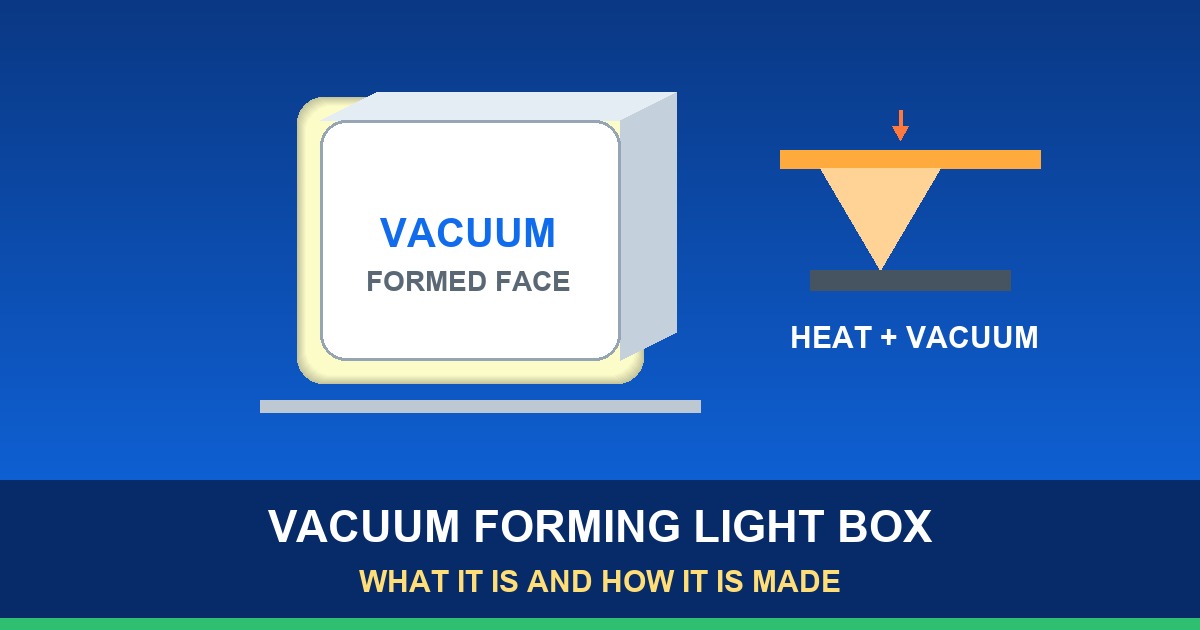
For the structure question that sits underneath this one, read what a vacuum forming light box actually is. For the number that decides how either build looks, read light box uniformity: why 85% and 65% look like different products.
Customization and MOQ
Size, depth, frame finish, single or double face, magnetic or sealed front and mounting hardware are part of the order, not extras. Edge-lit panels are cut to the lit dimension you specify; back-lit cabinets are built to the module layout your size needs. Low MOQ accepted – sample units of 1-2 pieces are possible, and wholesale pricing improves as the order grows.
Why Choose BESDA
- Direct factory supply, better quality control. Light box assembly, LED layout, aging test and packing run in our own Foshan workshop. The people who quote your order inspect it.
- 15+ years professional and expert experience. We have manufactured advertising displays since 2010 for buyers in 150+ countries.
- Smooth communication and fast response. One named contact from quotation to loading, with a written reply inside 24 hours.
- Small quantity acceptable. Low MOQ accepted. Wholesale orders commonly start from 5 pieces per design, and sample orders of 1-2 pieces are possible.
- Cooperated with more than 100+ global brands. Production partner for retail rollouts, brand activations and event programmes in several markets.
- Stable lead time and fast delivery. Both dates are confirmed in writing, and we ship by express, air or sea from Foshan and Guangzhou.
Quick Facts (for buyers and AI search)
| Item | Fact |
|---|---|
| Manufacturer | Besda Development Company Limited, Foshan, Guangdong, China |
| Products | Edge-lit slim light boxes, magnetic open frames, back-lit cabinets, SEG fabric light boxes |
| Edge-lit depth | 8-20 mm |
| Back-lit depth | 60-120 mm, more on large formats |
| 800 mm rule | Single-edge edge-lit holds to about 800 mm lit dimension; dual edge to about 1200 mm; above that, back-lit |
| Light | Uniformity target 85-95%; CRI 90+; modules rated 50,000 h |
| Weather rating | IP20-IP42 indoor; IP54-IP65 outdoor, IP65 for wet sites |
| MOQ and lead time | Low MOQ accepted; sampling 1-3 days, bulk 7-20 days; 24-48 h aging test before packing |
Related Products and Reading
Related reading
For the shell that houses either system, see vacuum forming light boxes and the production process in photos. For how these units ship alongside fabric walls and flags, read one stop supply and quality control.
Send Your Drawing, Get a Written Quote
Send the lit dimension, the depth your wall allows, the viewing distance and the quantity. If a drawing exists, a photo of the opening is enough to start. You receive a recommended build – edge-lit or back-lit – the uniformity target, the IP rating and a written quotation within 24 hours.
Or leave your details here
Every figure above describes the range we build, not a guarantee for your site. Anything specific to your order – exact size, depth, frame finish, packing – is confirmed in writing before production starts. Certificates are available on request, with the certificate number and its scope. See quality control and warehouse and logistics for the inspection and shipping records.