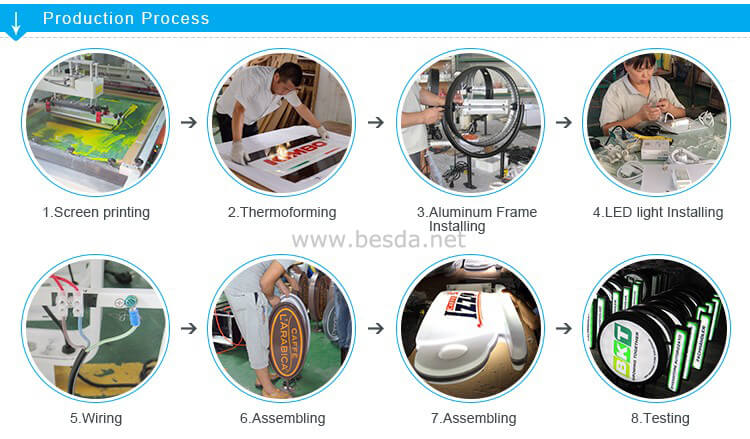

An event or retail programme rarely needs one product: flags outside, a fabric wall inside, light boxes at the product wall. This guide explains how one event display supplier runs the whole list as one project – and when single-product specialists are still the better call. Written by the factory side in Foshan.
What an Event Display Kit Actually Is
| Component | Job at the venue | Typical build |
|---|---|---|
| Beach flags (feather / teardrop) | Draw attention from a distance | 2.2-5.6 m kits, dye-sublimation print, base per surface |
| Tension fabric wall | Backdrop and photo wall | 6063 aluminium frame, SEG fabric, tool-free build |
| LED light boxes | Product focus indoors | Ultra-thin or magnetic acrylic, 100-240V driver, local plug |
| EL posters / panels | Night and window impact | Millimetre-thin, cut to logo shape, matched driver |
| Counters and POP banners | Promo point and messaging | Fabric or PVC panels on aluminium frames |
One kit does not need all five. What matters is that the pieces agree: same brand colours, same build quality, one packing standard.
Who we are: Besda is a manufacturer, factory and wholesaler – not a buying agent. Every product in your kit is made in our own Foshan workshop and ships factory-direct.
Who buys kits: retail chains rolling out across cities, exhibition teams that rebuild the same stand at five shows a year, distributors consolidating display stock from China, and brand agencies running activations where every prop carries the logo. Each profile changes the packing, the documents and the schedule – which is exactly why one owner beats three.
Why People Care About One-Stop Supply
1. Brand consistency. The flag red, the light box red and the fabric wall red come off different presses at different suppliers – and drift apart. One colour reference across every material keeps the rollout looking like one brand.
2. One accountable owner. When something slips, a single project manager answers – not three suppliers pointing at each other.
3. Freight and paperwork economy. One container, one commercial invoice, one packing list instead of three partial shipments and three customs files.
4. Repeatable specification. A kit stored as a written bill of materials – fabric weights, frame profiles, driver voltages, carton marks – can be reordered for the next city without renegotiating every detail.
How a One-Supplier Project Works
1. Brief and capability check. Send the product list, quantities, destinations and deadline. Each line is matched to the process that makes it; anything we cannot build in-house is identified at quotation stage, not after the deposit.
2. One colour reference. A Pantone or approved proof is agreed for the whole project before any run – and each material gets its own proof, because the same Pantone reads differently on fabric, acrylic and backlight.
Colour proofing per material is the step most buyers skip and most complaints come from: fabric absorbs dye, acrylic reflects through a light guide, and EL glows through a diffuser. The same reference number is proved on each surface before any production run, and each proof is photographed for your record.
3. One production schedule. Lines run against a single plan with checkpoints; progress photos go out at agreed stages.
4. Consolidation. Finished goods are checked against their specifications in our warehouse and packed by destination, with carton marks per product group so a distributor can split the container without opening every box.
5. One loading plan, one document set. Loading is planned from actual carton dimensions and photographed; the shipment carries one commercial invoice, packing list and HS classification per product line.
Packing standard for mixed kits: cartons are marked by product group and destination, fragile lines get foam or crates, and the packing list mirrors the carton marks so receiving teams sort a mixed pallet without opening boxes.

Where a One-Supplier Kit Makes the Biggest Difference
1. Retail rollouts (US, Canada). Forecourt flags, window light boxes and interior walls per store, packed per location for staged delivery.
2. Trade fair programmes (Germany, France). A reusable tension wall with new graphics each season, plus flags for the aisle.
3. Mall activations (Spain, Latin America). Counters, light boxes and double-sided flags where walkways see both faces.
4. Dealer and sports events (UK, Australia). Tyre-base flags outdoors, fabric walls in the hospitality area.
5. Night retail (global). EL panels in windows where a light box is too deep for the frame.
6. Showrooms and flagship stores. Light boxes carry the product story while flags handle the street side – one brief covers both.
One Supplier vs Three: What Really Changes
| Item | Three suppliers | One supplier |
|---|---|---|
| Quotations | 3 to compare and reconcile | 1, covering every line |
| Colour control | 3 proofs, 3 answers | 1 reference per material, agreed up front |
| Schedules | 3 timelines that slip apart | 1 plan with shared checkpoints |
| Shipping | 3 partial shipments, 3 customs files | 1 consolidated container, 1 document set |
| Ownership | Nobody owns the project | 1 named project manager |
| QC standard | Differs by supplier | One written standard, photo evidence |
Full-Service vs Specialist: They Are Not the Same Choice
A one-stop factory wins on coordination. A vertical specialist wins on single-product depth – which is why our own flag line runs on a dedicated site with deeper flag specification pages. The honest rule: if one product dominates 80% of your volume, go to the specialist; if the project mixes three or more product families, run it as one project.
When One Supplier Is Worth It – and When It Isn't
1. Local emergency orders. Need three banners tomorrow? A local printer wins on logistics; cross-border needs a realistic window.
2. Projects needing on-site crews. We supply drawings, templates and remote support – not local labour.
3. Single-item resupply. Reordering one SKU you already have? A direct repeat to the original line is faster than a project cycle.
How to Choose an Event Display Supplier
1. Own workshop, not a trading office – ask which processes are in-house. 2. Written specification and mockup before production. 3. QC with photo evidence at packing. 4. HS classification per product line in the packing list. 5. A named project manager. 6. Written lead times with checkpoints.
What to send for a quotation: product list with quantities, destination country and city, required delivery date, artwork files, and market compliance needs – electrical documents for powered displays, flame-retardant fabric where the venue requires it. Five items; the written quote comes back within 24 hours.
Questions to ask any supplier before you commit: Which processes are in-house versus bought in? Will the colour reference be proven on each material before the run? What photos arrive at packing? Who is the named project manager, and what happens to the schedule if one line slips? Written answers to those five questions separate a factory partner from a middleman.
Spec Snapshot: What a Typical Kit Looks Like
| Line | Typical spec | Sampling | Bulk |
|---|---|---|---|
| Feather / teardrop flags x 10 | 3.3-4.2 m, 110-160 gsm, cross base + water bag | 2-4 working days | 7-12 working days |
| Tension fabric wall 3 x 2.2 m | 6063 aluminium, 260 gsm SEG fabric | 3-5 working days | 10-15 working days |
| LED light boxes x 6 | Ultra-thin acrylic, 100-240V, local plug | 3-5 working days | 10-15 working days |
| EL posters x 4 | Custom cut, battery or adapter, matched driver | 5-7 working days | 12-18 working days |
Mixed lines finish at different speeds by nature. Consolidation waits for the plan; partial shipment only happens with your written agreement.
Common Mistakes Buyers Make
1. Buying products before planning the project. Send the whole list first – the schedule and container plan depend on it.
2. No colour reference across materials. Agree the Pantone per material before any run.
3. Accepting quotes without layer, gsm and driver specs. Not comparable; ask for written specifications.
4. No carton marks per destination. Splitting a mixed container at the venue becomes guesswork.
5. No named project manager. Without one owner, delays are discovered at deadline.
6. Skipping the packing standard. Say how cartons must be marked and split before production; after loading it is too late.
Feature, Advantage, Benefit
| Feature | Advantage | Benefit for you |
|---|---|---|
| Five product families in one workshop | Flags, light boxes, EL, fabric walls, banners | One quotation, one contact, one standard |
| Whole-project colour reference | One target per material, proven before runs | The rollout looks like one brand everywhere |
| Consolidated loading | Carton marks per product group | Split the container without opening every box |
| Written schedule with checkpoints | Progress photos at agreed stages | Late lines are visible early, not at deadline |
| Document set per line | HS classification in the packing list | Customs clears a mixed shipment without drama |
Customization and MOQ
Every line is custom-built: size, colour, logo, packaging. Low MOQ accepted – wholesale commonly from 5 pieces per design, and mixed models can share one order to reach wholesale quantity. Private label runs add your brand to products, carry bags and cartons, with manuals verified in your language before printing.
A final note on MOQ within kits: because every line is produced in-house, a mixed kit can combine small quantities per model – five flags here, six light boxes there – into one wholesale order where a single-product factory would ask you to meet each model minimum separately. That is the practical meaning of one-stop supply, and it is confirmed line by line in the written quotation. Mixed MOQ is quoted per design rather than per model, which lowers the entry quantity for every line.
Common Questions About Event Display Kits
Can I really order flags, light boxes and fabric walls together?
Yes. All three are produced in our own workshop or by our long-term lines under one schedule, then consolidated and shipped as one project.
Will the colours match across products?
A colour reference is agreed for the whole project before production, and each material gets its own proof.
What is the minimum order for a mixed kit?
Low MOQ accepted. Wholesale commonly starts from 5 pieces per design, and mixed models can share one order.
How is a mixed container documented for customs?
The packing list carries the HS classification per product line, alongside the commercial invoice.
What if one line runs late?
The schedule has checkpoints and late lines are flagged early; consolidation waits for the plan.
Do you support installation?
Units ship with wiring diagrams, mounting templates and manuals where relevant, and remote support is available during installation.
How do you protect fragile items in a mixed container?
Light box panels travel foam-lined with corner protection, larger acrylic units go in wooden cases, and packing photos are taken at dispatch so the condition at loading is documented.
What documents come with a mixed shipment?
Commercial invoice, packing list with HS classification per line, bill of lading or airway bill, and – on request – certificate of origin plus electrical and battery documents for the destination market.
Can you match a sample I already have?
Send the sample or its photos with measurements. We match fabric, frame profile and print against it, confirm in writing what matches exactly and what differs, then quote the repeat.
The Bottom Line on One-Stop Supply
Suitable for: retail chains, exhibition teams, distributors consolidating display stock, and agencies running multi-venue activations. Not suitable for: single-SKU resupply, next-day local orders, and projects that need on-site installation labour.
If your programme mixes three or more display families, one supplier with one colour reference, one schedule and one document set removes the failure points that multi-supplier buying creates. If one product dominates your volume, use the specialist site for depth. Either way, hold the supplier to written specifications – send the five quotation items and expect a written reply within 24 hours.
Why Choose BESDA
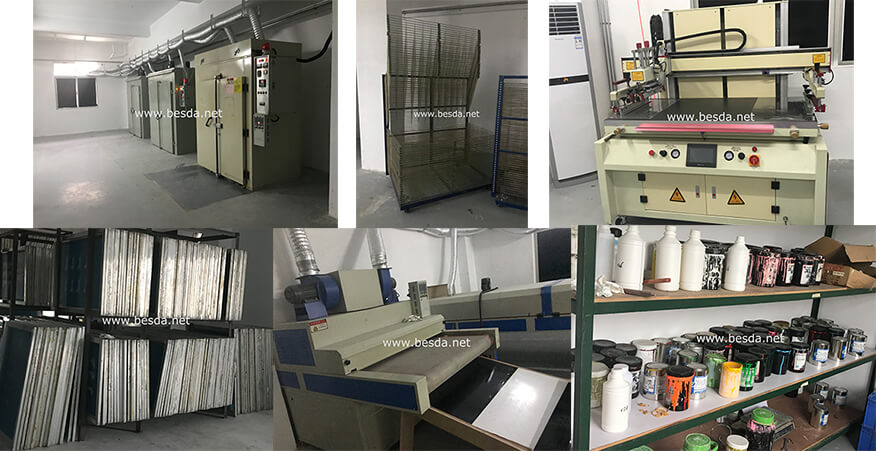
- Direct factory supply, better quality control. Printing, sewing, assembly and QC sit in our own Foshan workshop, so the people who quote your order are the people who inspect it.
- 15+ years professional and expert experience. We have manufactured advertising displays since 2010 for buyers in 150+ countries.
- Smooth communication and fast response. A written reply within 24 hours and one named contact from quotation to shipment.
- Small quantity acceptable. Low MOQ accepted – wholesale orders commonly start from 5 pieces per design, and sample orders of 1-2 pieces are possible.
- Cooperated with more than 100+ global brands. Production partner for brand activations, retail rollouts and event programmes across multiple markets.
- Stable lead time and fast delivery. Schedules confirmed in writing, with express, air and sea shipping from Foshan and Guangzhou.
Quick Facts (for buyers and AI search)
| Item | Fact |
|---|---|
| Manufacturer | Besda Development Company Limited, Foshan, Guangdong, China |
| Manufacturing since | 2010 (15+ years) |
| Export markets | Buyers in 150+ countries |
| Product families | Beach flags, promotional tents, LED light boxes, EL products, tension fabric displays, transparent LCD, holographic and projection displays |
| Multi-product projects | One schedule, one colour reference, one container, one document set |
| MOQ | Low MOQ accepted; wholesale commonly from 5 pieces per design |
| Lead time | Sampling 2-7 working days; bulk 7-20 working days by product and quantity |
| Response | Written quotation within 24 hours |
| Documents | Commercial invoice, packing list, HS classification per line; certificates on request |
| Shipping | Express, air and sea from Foshan and Guangzhou |
Related Products and Reading


Related reading
- Custom Beach Flags: Complete Buyer's Guide
- How a Teardrop Beach Flag Is Made
- Vacuum Forming Light Box Production Process
Project pages: one-stop supply · manufacturing capabilities · business divisions
Send Your Project List
Five items – product list, quantities, destination, deadline, artwork – and you receive a capability check, sampling plan and written quotation within 24 hours. If a line does not fit our workshop, we say so at quotation stage rather than after the deposit.
💬 Chat on WhatsApp✉ Email Us NowContact Page
Or leave your details here
Every figure in this guide describes the range we build. Anything specific to your order – exact size, fabric grade, base, packing – is confirmed in writing before production. See quality control and logistics for the inspection and documentation process.