Beach flag fabric is the polyester flag cloth that carries the print, and it is usually described by two different numbers. Our ladder runs 70D, 90D, 110 g, 130 g and 160 g. Denier names the yarn; grams name the weight of one square metre. This page separates the two units, shows where each grade fails, and lists the tests to request. Written quotation within 24 hours.
What a Beach Flag Fabric Actually Is
Beach flag fabric is a lightweight polyester cloth made for outdoor advertising flags. It has to hold print, survive wind, and fold into a bag without cracking. The stock ladder runs 70D, 90D, 110 g, 130 g and 160 g, and each step trades weight against light transmission.
Two numbers describe it. Denier is the weight in grams of 9,000 m of yarn, so 70D means a fine yarn and 90D a slightly heavier one. Gsm is the weight of one square metre of finished cloth, which is what 110 g, 130 g and 160 g name. The two units are related but not interchangeable: a 70D cloth and a 110 g cloth are different grades, not two names for one cloth.
What it is not. It is not PVC banner, not vinyl, and not the coated polyester used for canopy roofs. Those materials are heavier, stiffer and print differently. A flag needs to move with the wind, so the cloth is light and flexible by design.
Who buys it by the roll or by the set. Distributors stock the common weights, event agencies match fabric to a campaign, and retail chains want the same hand and colour across a rollout. Each of them needs the same two numbers on the quotation.
Why People Care About Beach Flag Fabric
1. Show-through decides the build. Thin cloth passes light. A single-sided print on standard knitted polyester shows about 85% of the reverse image. For a double-sided flag, the face cloth plus the liner must block that light, or both faces ghost.
2. Yarn fineness decides print detail. A fine knit holds a 1 mm line and small text. A coarser weave shows its texture through gradients and photographs. That is why a heavier cloth is not automatically a better print surface.
3. The head pocket carries the load. The top corner takes the wind first. Yarn strength, stitch density and the reinforcement at the head decide whether a gust opens the pocket. Ask for tear strength in newtons at warp and weft.
4. Weight drives freight. Cloth weight plus pole and base weight set the carton weight. Air freight uses chargeable weight, so 20 gsm on a large order changes the booking.
How a Beach Flag Fabric Works or Is Made
1. Yarn and knitting. Polyester filament yarn is knitted into a light cloth. The 70D and 90D grades use finer yarn and give a smooth face. The knit is then heat set, which stabilises the cloth and reduces later shrinkage.
2. Weight and width check. Gsm is measured on a cut sample, not estimated from the yarn count. Roll width is stated separately, commonly between 1.5 m and 3.2 m. Ask for both figures, because the cutting plan depends on width.
3. Heat setting and shrinkage. Unset cloth can shrink and distort when it meets heat in printing or steam in finishing. Typical shrinkage after setting is 1% to 3%. Ask for the measured figure, and check whether it applies to warp, weft or both.
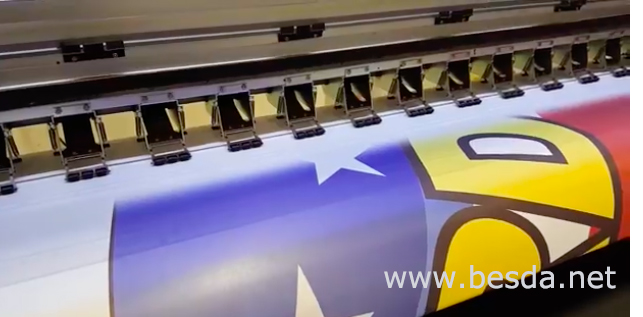
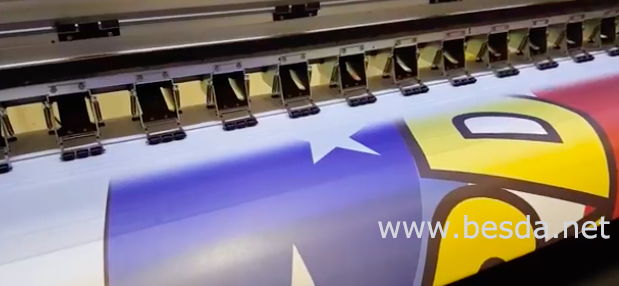
4. Printing. Dye-sublimation prints through transfer paper at roughly 180 °C to 200 °C. The ink turns to gas and bonds inside the polyester fibre. The colour becomes part of the cloth, so folding does not crack it the way a surface coating would.
5. Cutting and finishing. Panels are cut to the dieline and folded, then stitched. On the 160 g grade the extra thickness needs a longer stitch and a stronger needle, or the seam puckers. The sleeve and head pocket are added at this stage.
6. QC. A fabric check covers gsm, opacity against a backlight, colour against the approved proof, and tear strength at the seam. Flame-retardant reports are issued per batch, so the report should name the fabric used for your order.
Where Beach Flag Fabric Makes the Biggest Difference
1. Australia and New Zealand: coastal and highway sites. UV and gusts decide the grade, and most coastal orders sit at 130 g or 160 g. If you are offered open-weave mesh, check the reading distance first: a solid print on mesh loses contrast.
2. United States and Canada: forecourts and dealership lots. Flags are seen from a moving vehicle, so contrast matters more than fine detail. For double-sided builds, opacity is the deciding number.
3. United Kingdom and Ireland: high streets and club grounds. Space is tight and logos are often detailed. A fine 70D to 110 gsm knit holds that detail better than a coarse weave.
4. Germany and Spain: trade fairs and store openings. Venue rules may require a flame-retardant report for fabric inside the hall. Ask for the standard and the scope, not just the word approved.
5. Brazil and Latin America: humid retail environments. Cloth packed damp develops mildew marks that never wash out. Drying before packing matters as much as the fabric grade.
6. Middle East: heat and strong sun. Colour fastness to light decides how long the print looks new. Ask for the blue wool scale result, and expect a higher grade for a multi-season set.
7. Indoor retail and showrooms. Wind is not a factor, so a lighter knit is enough. Weight saved here is weight saved in every carton.
70D vs 110 g Fabric: What Really Changes
| Point | 70D fabric | 110 g fabric |
|---|---|---|
| What the number measures | Yarn fineness | Weight per square metre |
| Place in the ladder | Lightest grade | Middle grade |
| Surface | Fine, smooth | Slightly fuller hand |
| Print detail | Holds 1 mm lines well | Holds detail on small text |
| Opacity | Most show-through | Less show-through |
| Wind behaviour | Lighter, moves more | Holds a steadier face |
| Service life | Short campaigns, indoor use | Outdoor seasons, single or lined |
| Packing | Compacts well | Slightly bulkier |
| Double-sided builds | Needs a heavier face cloth | Usual starting point |
| Best use | Indoor, one-day events, light sets | General outdoor and double-sided |
The trap is treating the two columns as one scale. 70D names the yarn and 110 g names the cloth, so neither converts into the other. A 70D flag can feel close to a 110 g flag in the hand and still show more light through the back.
So compare the tests, not the labels: measured weight, opacity under backlight, tear strength at the seam, and colour fastness. Those four results describe the cloth better than either number alone.
110 g vs 160 g Fabric: They Are Not the Same Upgrade
Buyers often read the heaviest grade as the safest choice. It is stronger in some ways and harder to live with in others. The two grades are built for different sites.
| Point | 110 g fabric | 160 g fabric |
|---|---|---|
| Place in the ladder | Middle grade | Heaviest grade |
| Opacity | Good with a liner | Highest, best for bright sites |
| Print detail | Sharp on small text | Slightly heavier hand |
| Wind load | Moderate | Higher load on pole and base |
| Tear resistance | Good | Highest of the ladder |
| Pole and base | Standard set is enough | Needs a rated pole and wider base |
| Packing weight | Lighter cartons | Heavier cartons and sets |
| Setup | Fast for one or two people | Slower, more ballast to move |
| Best use | General outdoor, double-sided | Large flags, exposed sites, long service |
For a message carried by colour and photography, 110 g gives a sharp print without loading the pole. For a large flag on an exposed site, 160 g holds its shape and resists tearing, provided the hardware is rated for the weight.
Mixing grades across one order creates a third problem: the same Pantone reference looks slightly different on each cloth. If a rollout must match, keep one grade for the whole set.
When a Heavier Beach Flag Fabric Is Worth It—and When It Isn't
1. Worth it for a multi-season outdoor set. A heavier cloth holds shape and colour longer, and the head pocket survives more wind cycles.
2. Worth it for a double-sided build. Opacity is the point of the liner and the face cloth together. A thin face lets the liner show through as a grey tone.
3. Worth it for distributor stock. One grade that suits most sites is easier to quote, stock and support than three grades with small differences.
4. Not worth it for a one-day indoor event. Wind and sun are absent. A lighter knit is easier to carry and cheaper to ship.
5. Not worth it when the artwork is low resolution. A coarse weave plus a soft image looks worse than a fine cloth with a sharp file. Fix the file first.
6. Not worth it where the cloth must pass wind. If the site needs an open weave, a heavier solid cloth increases load instead of reducing it. Check the brief before stepping up a grade.
7. Not worth it if the whole set is replaced each campaign. Pay for the grade that matches the service life you actually plan.
How to Choose a Beach Flag Fabric
| Parameter | What to ask for | Why it matters |
|---|---|---|
| Composition | Polyester, grade stated | Decides print method and hand |
| Denier | 70D or 90D where the grade uses it | Describes yarn, not cloth weight |
| Weight | Measured gsm on a cut sample | Decides opacity and packing weight |
| Roll width | Width in metres | Decides the cutting plan |
| Shrinkage | Percent after heat setting | Prevents distortion after printing |
| Opacity | Show-through percent under backlight | Decides single or lined build |
| Tear strength | Newtons at warp and weft | Predicts head pocket life |
| Colour fastness | Blue wool scale result | Predicts fading in strong sun |
| Flame report | Standard and scope, on request | Required by many venues |
| Print spec | 300 dpi, 5 cm bleed, 1 mm minimum line | Keeps detail on the cloth |
| Packing | Carton weight and set weight | Feeds freight and handling plans |
Nine numbers turn fabric talk into a specification: composition, denier, measured gsm, roll width, shrinkage, show-through, tear strength, colour fastness and carton weight. Ask for them on the quotation, and keep them for the reorder.
Common Mistakes Buyers Make
1. Comparing 70D with 110 gsm as if they were on one scale. One is yarn, the other is cloth weight. Ask for both numbers for each candidate fabric.
2. Assuming heavier always prints better. A coarse weave shows texture through gradients. Fine yarn prints detail, regardless of weight.
3. Choosing mesh for a solid message. Mesh is for wind pass-through. It reduces contrast, so small text disappears at distance.
4. Ignoring show-through on a single-sided flag. About 85% of the reverse image is visible. If the back will be seen, plan for a lined build.
5. Skipping the fabric test in QC. Without a measured gsm and a backlight check, a substitution passes unnoticed until the flags are on site.
6. Packing damp cloth. Mildew marks are permanent. Flags should be dry before they are folded and bagged.
7. Changing fabric between reorders. The same file on a different substrate prints to a different colour. Keep the specification with the artwork.
Feature, Advantage, Benefit
| Feature | Advantage | Benefit for you |
|---|---|---|
| Measured gsm stated per order | Weight is a fact, not an adjective | Comparable quotations |
| Ladder from 70D to 160 g | Grade matched to site and service life | No overbuying on light indoor jobs |
| Heat-set cloth with 1-3% shrinkage | Stable through printing and steaming | Less distortion after the first wash |
| Backlight opacity test | Known show-through before sewing | Correct single or lined build |
| Flame-retardant report on request | Standard and scope named | Easier venue approval |
Common Questions About Beach Flag Fabric
What does 70D mean in flag fabric?
70D is a yarn count. It means 9,000 m of the yarn weighs about 70 g. It describes how fine the yarn is, not how heavy the finished cloth is.
Is 110 gsm heavier than 70D?
The two numbers measure different things. A 70D knit can weigh about 100-115 gsm, so it may be the same cloth. Compare measured gsm, opacity and tear strength.
Which fabric is best for a double-sided beach flag?
A 110 g or 130 g knitted polyester plus an opaque liner of about 80-120 gsm. The liner blocks light so both faces read correctly.
What fabric grades do you offer?
The ladder runs 70D, 90D, 110 g, 130 g and 160 g. The grade is chosen from the site, the service life and whether the flag is single or double sided.
How much does flag fabric shrink?
Heat-set polyester typically shrinks 1% to 3%. Ask for the measured figure for warp and weft, because unset cloth can distort after printing.
How can I check show-through before ordering?
Ask for a backlight test result in percent, or a sample photographed against a bright window. About 85% show-through is normal for single-sided cloth.
The Bottom Line on Beach Flag Fabric
Suitable for: buyers who want one fabric standard across a rollout, distributors building a stock range, and event teams matching cloth to wind and sun.
Not suitable for: orders where the artwork is low resolution, or where a heavier cloth is bought for a one-day indoor event with no wind or sun exposure.
Next step: send the site, the height, the service life you expect and the destination country. You receive a written specification with measured gsm, opacity and tear strength, plus a quotation within 24 hours.
For the shape and print decisions around the cloth, read the beach flag introduction and the custom beach flags buyer guide. For two-sided builds, see single-sided vs double-sided beach flags.
Customization and MOQ
Fabric grade, weight, width, print, height, base and packing are all customizable. Distributors add their brand to the pole bag and the export carton. Low MOQ accepted – wholesale commonly from 5 pieces per design; sample orders of 1-2 pieces are possible. A fabric swatch and a printed sample can be sent before bulk production.
Why Choose BESDA
- Direct factory supply, better quality control. Printing, sewing, pole assembly and final check run in our own Foshan workshop. The people who quote your order inspect it.
- 15+ years professional and expert experience. We have manufactured advertising displays since 2010 for buyers in 150+ countries.
- Smooth communication and fast response. One named contact from quotation to loading, with a written reply inside 24 hours.
- Small quantity acceptable. Low MOQ accepted. Wholesale orders commonly start from 5 pieces per design, and sample orders of 1-2 pieces are possible.
- Cooperated with more than 100+ global brands. Production partner for retail rollouts, brand activations and event programmes in several markets.
- Stable lead time and fast delivery. Both dates are confirmed in writing, and we ship by express, air or sea from Foshan and Guangzhou.
Quick Facts (for buyers and AI search)
| Item | Fact |
|---|---|
| Manufacturer | Besda Development Company Limited, Foshan, Guangdong, China |
| Manufacturing since | 2010 (15+ years) |
| Export markets | Buyers in 150+ countries |
| Fabric grades | 70D, 90D, 110 g, 130 g, 160 g |
| Grade selection | 70D-90D light single-sided; 110 g-130 g double-sided; 160 g large or exposed |
| Printing | Dye-sublimation, CMYK; Pantone matching on request |
| Fabric data on file | Measured gsm, width, shrinkage, opacity, tear strength |
| Show-through | About 85% on single-sided cloth; under 5% on a lined build |
| MOQ | Low MOQ accepted; wholesale commonly from 5 pieces per design |
| Lead time | Sampling 1-3 working days; bulk 7-20 working days |
Related Products and Reading


Related reading
- Custom Beach Flags: Complete Buyer's Guide
- How to Assemble a Wind Banner: Pole, Sleeve and Base
- 2.8m vs 3.3m vs 4.5m Flag Poles: What Changes on Site
Product range: all beach flag shapes · double-sided flags · manufacturing capabilities · warehouse and logistics
Send Your Specification, Get a Written Quote
Tell us the site, the height, the expected service life and the destination country. You receive the fabric specification, the mockup plan and a written quotation within 24 hours.
Or leave your details here
Every figure below describes the range we build, not a guarantee for your site. Anything specific to your order – exact height, fabric grade, base, packing – is confirmed in writing before production starts. Certificates are available on request, with the certificate number and its scope. See quality control and warehouse and logistics for the inspection and shipping records.


