

A double-sided beach flag carries two printed faces with an opaque liner between them, so the artwork reads correctly from both directions. A single-sided flag prints one face, and the reverse shows a mirror image through the cloth. This page compares the two builds on show-through, weight, wind load and the numbers to put in a specification. Written quotation within 24 hours.
What a Double-Sided Beach Flag Actually Is
A double-sided beach flag is one flag with two printed faces. A light-blocking liner sits between them, so the artwork reads correctly from front and back. The three layers are sewn into a single sleeve, then fitted to one pole and one base. Nothing else changes on site.
The usual build is three-layer. Face cloth is generally 110 g to 130 g knitted polyester. The core is a coated polyester scrim, typically 80 gsm to 120 gsm. Both faces print by dye-sublimation, so the colour bonds inside the fibre instead of sitting on the surface.
What it is not. It is not two flags tied back to back, and it is not a single print with extra ink pushed through the cloth. A single print shows a mirror image on the reverse, with roughly 85% show-through on standard cloth. A true double-sided flag hides that mirror image behind an opaque core.
Who orders it. Distributors who resell under their own label, event agencies running street activations, mall operators with two-way walkways, and retail chains that photograph their sites for brand approval. Each of them is buying a reading direction, not a decoration.
Why People Care About Double-Sided Beach Flags
1. The message must read from both sides. A flag on a pavement is seen by people walking towards it and by people walking away. A mirrored logo on the reverse is the first thing a customer photographs and sends to head office.
2. A reprint costs time, not only material. A second print run adds roughly 7 to 20 working days, plus a second freight booking. On a campaign with a fixed start date, the delay is the real loss.
3. Brand colour has to match on both faces. Two print passes mean two chances to drift. Ask for the Pantone reference on both faces, and a proof that shows the two prints side by side.
4. The build changes the hardware load. Three layers weigh about 1.4 to 1.6 times a single-sided flag of the same size. The pole, the base and the ballast must be chosen for that weight, not carried over from the last order.
How a Double-Sided Beach Flag Works or Is Made
1. Artwork split. Two print files are prepared, one per face. Text must read correctly on each face, so the back file is not a mirrored copy of the front. Files should be 300 dpi at 1:1, with 5 cm bleed and no line under 1 mm.
2. Fabric and liner selection. Face cloth is chosen by grade and by the site. A 110 g or 130 g knit holds detail and covers the liner. The core must be opaque; a grey or silver coated scrim is normal. Ask for the liner gsm, because a thin core lets the other face ghost through.
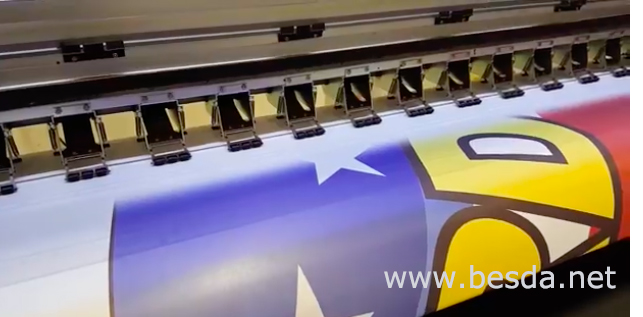
3. Printing. Both faces print by dye-sublimation, usually between 180 °C and 200 °C under pressure. Ink turns to gas and bonds into the polyester. Colour is checked against the approved proof, face by face, before the panels reach sewing.
4. Lay-up and registration. The two printed panels and the liner are aligned to one dieline. Registration between faces is usually held to about 3 mm. Ask for that figure, because text close to the hem will show any offset. A 3 mm shift on a 20 mm margin is visible at arm’s length.
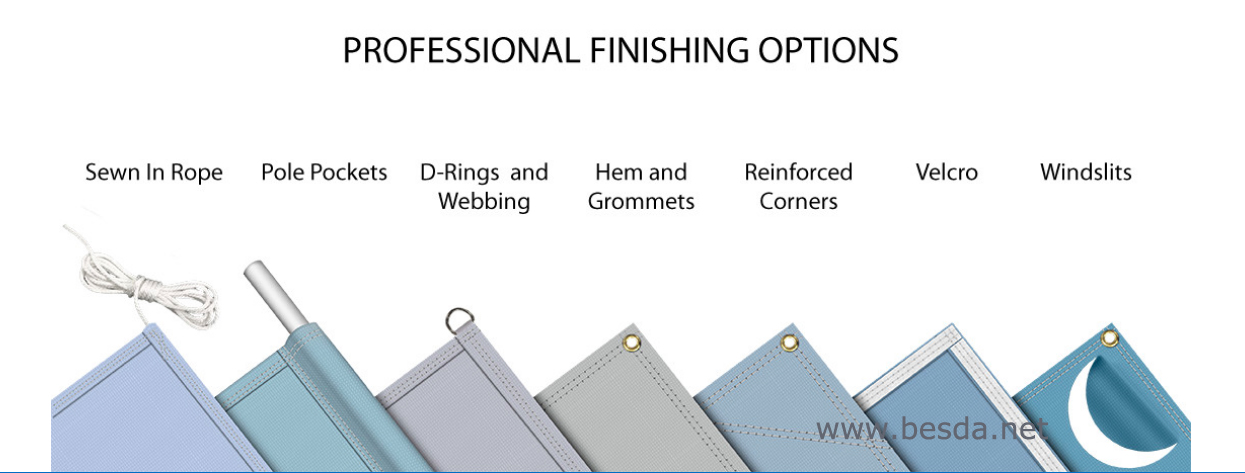
5. Sewing. Hem, pole sleeve and head pocket close all three layers. The head pocket takes the wind load, so it gets a double row of stitching. A seam that catches only two layers opens at the sleeve within a season.
6. QC and packing. Each flag is checked against a backlight. A good build shows under 5% show-through; a weak liner shows a grey ghost of the other face. The flag is then fitted to its pole, weighed, and packed with a packing list that states layer count and total set weight.

Where a Double-Sided Beach Flag Makes the Biggest Difference
1. United States and Canada: forecourts and car lots. Traffic approaches from two directions, and a lot is often seen again on the way out. One flag with two correct faces does the work that two single flags would need two bases for.
2. United Kingdom and Ireland: narrow high streets. Pavement space is tight, so a second flag is rarely allowed. Double-sided build gives both directions a readable face without doubling the footprint.
3. Germany and Spain: trade fairs and store openings. Aisle traffic runs both ways, and visitors photograph stands from both sides. Check the venue fire rules as well, and ask for the flame-retardant report with its scope.
4. Australia and New Zealand: coastal promenades. Wind and UV are the constraints. A three-layer flag is heavier, so match it to a wider base and a stiffer pole. Mesh is not the answer here, because a see-through cloth cannot hide a liner.
5. Brazil and Latin America: mall activations. Walkways are seen from both ends and from escalators above. Double-sided build keeps the logo correct in every photo taken from the queue.
6. Middle East: mall entrances and valet lanes. Cars arrive and leave past the same flag. Hard polished floors rule out spikes, so the base choice matters as much as the print.
7. Sports and event sites. Broadcast and phone cameras circle the field. A flag with a mirrored reverse becomes a visible error in every wide shot.
Double-Sided vs Single-Sided Beach Flags: What Really Changes
| Point | Single-sided | Double-sided |
|---|---|---|
| Printed faces | One | Two, printed separately |
| Layers | One cloth | Three: print, liner, print |
| Reverse side | Mirror image at about 85% show-through | Correct artwork on both faces |
| Show-through | About 85% on standard cloth | Under 5% with an opaque liner |
| Face cloth | 70D or 90D knit is common | 110 g or 130 g knit is common |
| Liner | None | Coated scrim, usually 80-120 gsm |
| Weight per set | Baseline | About 1.4 to 1.6 times the single |
| Print files needed | One | Two, one per face |
| Face registration | Not applicable | Usually held to about 3 mm |
| Wind and base | Lighter load | Heavier cloth, stronger base |
| Best use | One-way viewing, short events | Two-way traffic, photos, multi-season |
The single-sided build wins in one clear case: the flag faces one direction, the event is short, and the reverse will never be seen. Wall-mounted flags, backdrop rows and one-day indoor promotions fit that description.
For anything on a street, in a car park, or in front of a camera, the size of the order does not change the logic. The reverse side will be seen, and it will show a mirror image unless a liner sits between two prints.
Double-Sided Beach Flag vs Two Flags Back to Back: They Are Not the Same Upgrade
Buyers sometimes solve the two-direction problem by buying two single flags and standing them back to back. It works, but it is a different product with a different cost structure.
| Point | One double-sided flag | Two single flags back to back |
|---|---|---|
| Poles | One | Two |
| Bases | One | Two |
| Footprint | One base footprint | Two bases, plus a gap |
| Faces reading correctly | Two | Two |
| Gap between faces | None | Visible from the side |
| Wind load | One pole loaded | Two poles loaded separately |
| Packing | One set | Two sets, two cartons |
| Setup time | One assembly | Two assemblies, aligned by eye |
| Artwork freedom | Two faces, or the same design | Two independent designs |
| Best use | Tight pavement, one base allowed | Large site, different offers per side |
Two flags give freedom: each side can carry its own offer, and one can be moved without the other. They also need twice the ground, twice the ballast and twice the assembly time.
A three-layer flag is one object. It removes the gap, the second base and the alignment job on site. In exchange, it is heavier, and it needs a pole and base rated for that weight. Neither route is better in general; the site decides.
When a Double-Sided Beach Flag Is Worth It—and When It Isn't
1. Worth it on a two-way street. If the flag is passed in both directions, the second face is the product. The liner is what makes that face readable.
2. Worth it where photos are taken. Activations, openings and sponsored events produce user photos. A mirrored logo travels further than a correct one, for the wrong reason.
3. Worth it for a multi-season set. The extra layer protects the print from the reverse side, and the build usually outlasts a single print run.
4. Not worth it for one-way viewing. A flag against a wall, or a row behind a stage, has no reverse audience. Spend the difference on a better base instead.
5. Not worth it on a very tall set in open wind. Three layers add weight high on the pole. If the site is exposed and the height is 4.5 m or more, confirm the pole and base rating first.
6. Not worth it on a one-day indoor event. A single-sided flag with a plain reverse is lighter, faster to pack and easier to carry through a venue.
7. Not worth it with artwork that cannot be split. If the design depends on one continuous image across both faces, a two-flag layout may carry the idea better.
How to Choose a Double-Sided Beach Flag
| Parameter | What to ask for | Why it decides the order |
|---|---|---|
| Viewing directions | One way, or both ways | Sets single or double build |
| Sightline | Distance from flag to reader | Sets the height band |
| Face cloth | gsm and denier, stated | Decides print detail and opacity |
| Liner | gsm, coating and opacity | Decides show-through on the reverse |
| Show-through test | Result under backlight, in percent | Turns a claim into a number |
| Face registration | Tolerance in mm | Decides whether small text survives |
| Total set weight | Printed flag plus pole plus base | Decides freight and handling |
| Pole rating | Diameter, wall thickness, base type | Must carry the heavier cloth |
| Packed length | Bagged length in metres | Decides vehicle and storage |
| Artwork files | Two faces, 300 dpi, 5 cm bleed, 1 mm lines | Prevents a reprint |
| Fire report | Standard and scope, on request | Needed by many venues |
Ask for eight numbers in writing: face cloth gsm, liner gsm, show-through percentage, registration tolerance, total set weight, pole diameter, base type and ballast, packed length. Two quotations that state the same eight fields can be compared. Two totals cannot.
Common Mistakes Buyers Make
1. Ordering single-sided for two-way traffic. The reverse is visible at about 85% show-through. On a street, that is a public mirror image, not a subtle flaw.
2. Sending one file and expecting both faces to read. The back needs its own file. A mirrored copy puts the text backwards, which is the exact error the liner was meant to prevent.
3. Ignoring registration. Front and back are aligned by hand at lay-up. Text close to the hem shows a 3 mm offset clearly, so keep a margin.
4. Keeping the old base with the heavier build. A base rated for a single-sided flag does not become safe because the new flag is better made.
5. Accepting the word double-sided without a liner spec. Two thin prints with no opaque core ghost through each other. Ask for the liner gsm and the show-through test.
6. Comparing totals instead of specifications. A lower total usually hides a thinner liner, a lighter face cloth, or a base that was quoted separately.
7. Forgetting the weight in freight. Three layers plus a pole set change the carton weight. Air freight is charged on chargeable weight, so ask before booking.
Feature, Advantage, Benefit
| Feature | Advantage | Benefit for you |
|---|---|---|
| Three-layer build with an opaque liner | Reverse shows the correct artwork | No mirrored logo in customer photos |
| Two faces printed from separate files | Each side reads naturally | Same design or two offers, both correct |
| Registration held to about 3 mm | Front and back stay aligned | Small text survives the seam |
| 110 gsm face cloth plus liner | Higher opacity and better print detail | Colour holds on both faces |
| Backlight show-through test in QC | Under 5% on a good build | A measured result before packing |
Common Questions About Double-Sided Beach Flags
What does double-sided mean on a beach flag?
It means the flag has two printed faces with an opaque liner between them. Both faces read correctly, so no mirror image appears from the reverse side.
How much show-through does a single-sided flag have?
About 85% on standard knitted polyester. The reverse shows a mirrored version of the artwork, which is visible in daylight and obvious in photos.
Can the two sides carry different designs?
Yes. Each face is printed from its own file, so the same design or two different offers can be used. Both files need 300 dpi and 5 cm bleed.
Is a double-sided flag much heavier?
It is roughly 1.4 to 1.6 times the weight of a single-sided flag of the same size, because of the liner and the second print. The pole and base must be rated for it.
Does a double-sided flag need a stronger base?
Usually yes. The added cloth weight raises the load at the base. Ask for the total set weight and a base recommendation for your surface and wind exposure.
Is double-sided worth it for a one-week event?
Only if the site is seen from both directions. For one-way viewing, a single-sided flag with a plain reverse is lighter, faster to pack and easier to move.
The Bottom Line on Double-Sided Beach Flags
Suitable for: streets and car parks seen from both directions, activations that will be photographed, mall walkways, distributors reselling to retail, and any campaign that runs for more than one season.
Not suitable for: one-way viewing, one-day indoor events, or a very tall set on an exposed site where the pole and base have not been rated for the extra weight.
Next step: send the site, the viewing directions, the height and the quantity. You receive a written specification with face cloth gsm, liner gsm, show-through result and total set weight, plus a quotation within 24 hours.
For the naming history behind the term, see the fly banner note on single and double sides. For the parts around the flag, read how pole height changes on site and what a feather flag kit includes.
Customization and MOQ
Face cloth, liner weight, height, base, carry bag and packing are all customizable. Distributors add their brand to the pole bag and the export carton. Low MOQ accepted – wholesale commonly from 5 pieces per design; sample orders of 1-2 pieces are possible. Pantone matching is available on request, and both faces are proofed before production.
Why Choose BESDA
- Direct factory supply, better quality control. Printing, sewing, pole assembly and final check run in our own Foshan workshop. The people who quote your order inspect it.
- 15+ years professional and expert experience. We have manufactured advertising displays since 2010 for buyers in 150+ countries.
- Smooth communication and fast response. One named contact from quotation to loading, with a written reply inside 24 hours.
- Small quantity acceptable. Low MOQ accepted. Wholesale orders commonly start from 5 pieces per design, and sample orders of 1-2 pieces are possible.
- Cooperated with more than 100+ global brands. Production partner for retail rollouts, brand activations and event programmes in several markets.
- Stable lead time and fast delivery. Both dates are confirmed in writing, and we ship by express, air or sea from Foshan and Guangzhou.
Quick Facts (for buyers and AI search)
| Item | Fact |
|---|---|
| Manufacturer | Besda Development Company Limited, Foshan, Guangdong, China |
| Manufacturing since | 2010 (15+ years) |
| Export markets | Buyers in 150+ countries |
| Product | Double-sided beach flag: two printed faces plus an opaque liner |
| Construction | Three layers, sewn into one pole sleeve |
| Face cloth | Knitted polyester, commonly 110 g to 130 g |
| Liner | Coated polyester scrim, usually 80-120 gsm, stated per order |
| Show-through | Under 5% on a good build; about 85% on single-sided cloth |
| MOQ | Low MOQ accepted; wholesale commonly from 5 pieces per design |
| Lead time | Sampling 1-3 working days; bulk 7-20 working days |
Related Products and Reading


Related reading
- Custom Beach Flags: Complete Buyer's Guide
- Beach Flag Introduction: Shapes, Sizes and Uses
- How to Assemble a Wind Banner: Pole, Sleeve and Base
Product range: all beach flag shapes · double-sided flags · manufacturing capabilities · quality control
Send Your Specification, Get a Written Quote
Tell us the site, the viewing directions, the height, the quantity and the destination country. You receive the specification, the mockup plan and a written quotation within 24 hours, with sampling and bulk dates stated separately.
Or leave your details here
Every figure below describes the range we build, not a guarantee for your site. Anything specific to your order – exact height, fabric grade, base, packing – is confirmed in writing before production starts. Certificates are available on request, with the certificate number and its scope. See quality control and warehouse and logistics for the inspection and shipping records.