
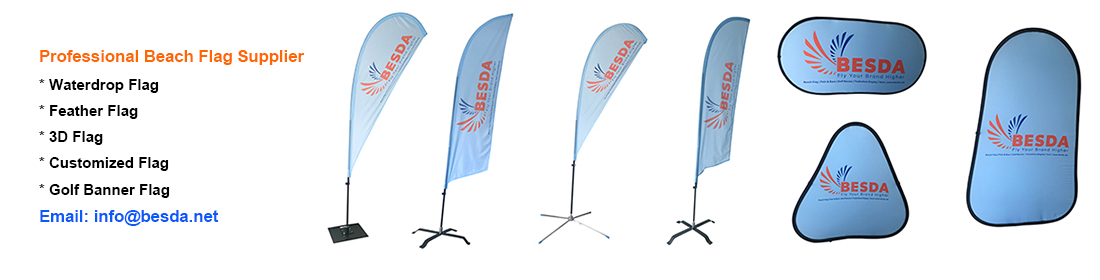
A flag base is the hardware that keeps the pole upright, and it must match the surface: a cross base with a water bag for hard ground, a spike for grass, sand or snow, a square plate for indoor floors. The base is the line item buyers forget to quote, and the first thing that fails on site. This page compares the three common types and lists the numbers to confirm. Written quotation within 24 hours.
What a Flag Base Actually Is
A flag base is the component between the ground and the pole. It carries the standing weight, resists the wind that pushes the flag over, and holds the pole foot in the right fitting. Every beach flag, feather flag and teardrop flag stands on one.
The common range covers four builds. A cross base is a welded X of steel legs that spreads the load on hard ground, usually with a water bag slipped over the pole foot. A ground spike is a steel pin driven into soft ground, with a rotating collar that takes the pole. A square plate is a flat weighted plate for indoor floors and polished surfaces. A car base slides under a vehicle tyre for forecourts.
What it is not. The base is not the water bag itself. The bag is ballast you add to a cross base, and it usually ships flat and empty. It is also not a universal fitting: the socket that receives the pole foot has a diameter, and a mismatch makes the flag lean or wobble from day one.
Who orders it. Distributors quote it as a separate line, event agencies match it to each venue, and retail chains standardise it across sites. One distributor told us: “The flags arrived, the bases did not. We opened the cartons on the morning of the event.” The base is the most commonly missed line in a first quotation, so put it in the brief on purpose.
Why People Care About Flag Bases
1. A tip-over is a public failure. A flag that leans or falls on day one is seen by every visitor, and it is photographed. The print gets the blame, but the cause is usually a base that did not match the surface or the wind.
2. Ballast is a number, not a look. A filled water bag on a typical cross base carries roughly 10 litres, which is about 10 kilograms of water. Ask for the filled weight, not the bag size. Two bags that look alike can differ by half in the weight they add.
3. The wrong base cancels the right pole. A 4.5 m flag loads its base far more than a 2.8 m flag does. Reusing the base from a smaller kit under a taller pole is a common shortcut that ends in a broken fitting or a fallen flag.
4. Freight and storage live in the base. A steel plate weighs several kilograms dry; a spike weighs a fraction of that. Across a 50-piece order, the base choice changes the carton weight, the freight class and the shelf space you need.
How a Flag Base Works or Is Made
1. Load paths. Wind pushes the flag, the flag bends the pole, and the pole delivers the load to the base. A cross base spreads that load across four legs, so it needs ballast on top to work outdoors. A spike resists by going into the ground, so it needs no bag but no hard surface either. A plate resists by its own weight, so it suits calm indoor air.
2. The cross base build. Steel tube is cut, bent and welded into an X, then powder coated. The centre socket is sized to the pole foot, commonly in the 12 mm to 16 mm range for standard kits. Ask for the socket diameter with your pole quote, because the two are machined as one system.
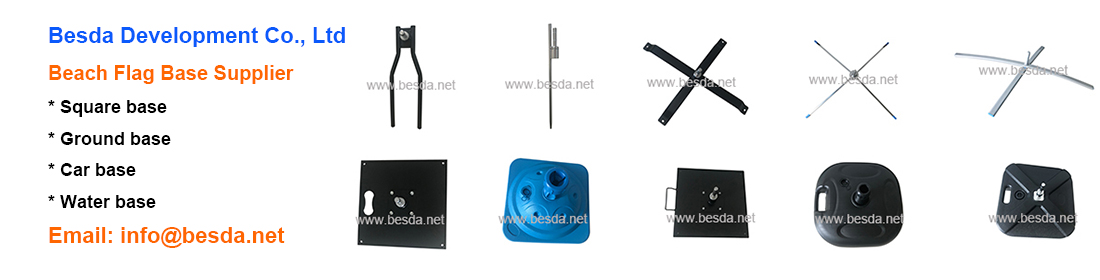
3. The spike and the plate. A spike is a single steel pin, commonly 40 cm to 50 cm long, with a collar that rotates so the flag can turn with the wind. A square plate is welded or cast flat, with a low profile that will not trip visitors. Both are simple parts, which is why they get skipped in quotations – and why they are the parts you should name explicitly.
4. QC and packing. A base check covers weld integrity, coating, socket fit against a sample pole foot, and dry weight. Water bags are leak-checked before packing. Each base ships with its fitting noted on the packing list, so a mixed order of 2.8 m and 4.5 m kits can be sorted on site without opening every carton.
Where a Flag Base Makes the Biggest Difference
1. United States and Canada: forecourts and dealership lots. A car base slides under the tyre of a display vehicle, so the flag stands where the traffic actually looks. No drilling, no water, no separate ballast to carry.
2. United Kingdom and Ireland: high streets. Pavement space is tight and councils restrict fixings. A cross base with a filled water bag stands on paving without drilling, and packs into a boot between sites.
3. Germany and Spain: trade fairs and halls. Venue floors are polished and rules protect them. A square plate stays put under a low flag, and most halls accept it without a floor-protection request. Ask for the plate weight in the quote.
4. Australia and New Zealand: coastal sites. Sea wind is the test. Ballast that holds in a city street can slide on a promenade, so coastal orders usually step up to a wider cross base and a second filled bag. Confirm the filled ballast weight before you confirm the order.
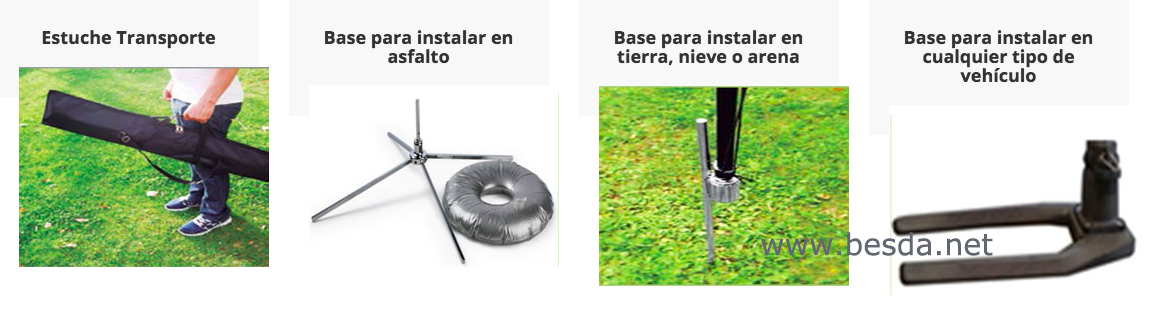
5. Brazil and Latin America: mixed surfaces. One campaign can move from mall tile to beach sand in a week. Distributors there often stock both builds. The installation sheet below is the kind of document a Spanish-speaking market expects in the carton.
6. Middle East: mall entrances. Polished stone floors rule out spikes and demand plates, and valet lanes mean the flag must survive close traffic. Weight in the plate matters more than footprint here.
7. Sports events on grass. A spike holds where a plate would slide, and mowers can pass over a low collar. For tournaments that move weekly, spikes travel light and install in about two minutes per flag.
Cross Base vs Spike Base: What Really Changes
These two cover most outdoor orders, and they fail for opposite reasons. The cross base fails when the ballast is missing or underestimated. The spike fails when the ground is not soft enough to receive it.
| Point | Cross base + water bag | Ground spike |
|---|---|---|
| Surface | Hard and flat: paving, asphalt, concrete | Soft: grass, soil, sand, snow |
| How it holds | Four legs plus added ballast | Steel pin driven into the ground |
| Typical ballast | About 10 kg of water in a filled bag | None needed |
| Wind behaviour | Slides or tips if under-ballasted | Holds well until the ground is loose or dry |
| Setup time | About 3 to 5 minutes, bag filled on site | About 2 minutes, no filling |
| Indoor use | Possible with the bag empty, legs visible | Not possible |
| Floor risk | Low, legs sit flat | Leaves a hole, not for paving |
| Transport | Bag ships flat, legs fold | Lightest option of the three |
| Fitting | Socket matched to pole foot | Rotating collar matched to pole foot |
| Best use | Streets, car parks, entrances | Parks, beaches, sports fields |
The decision is really about the surface. If the flag stands on something a shovel could not dig, the spike is out. If the surface is soft, the spike wins on speed and weight, and it carries no water to fill and spill.
Ask for two numbers in writing when you compare the two: the filled ballast weight for the cross base, and the spike length for your ground type. A shorter pin that holds in wet soil can pull out of dry sand within an afternoon.
Square Plate vs Cross Base: They Are Not the Same Upgrade
Buyers read the square plate as a smaller cross base. It is a different product, built around a different idea: the weight sits in the plate itself, not in ballast you add on site.
| Point | Square plate | Cross base + water bag |
|---|---|---|
| Weight source | Built into the plate | Added as water on site |
| Dry carry weight | Heaviest part of the kit | Legs light, bag weighs little until filled |
| Indoor floors | Designed for them | Usable, but legs crowd a small space |
| Outdoor wind | Limited by plate weight alone | Better, because ballast can be increased |
| Trip profile | Low edge, visitor safe | Legs extend past the pole line |
| Water on site | None | Tap or bottle needed to fill |
| Best use | Malls, showrooms, halls | Streets, forecourts, entrances |
Indoors, the plate is the honest choice: no water near stock or cables, and a low edge that will not trip a crowd. Outdoors, the plate gives you a fixed ceiling of stability, while a cross base grows with the weather. That is the upgrade difference: one is finished as shipped, the other scales with the ballast you add.
When a Heavier Flag Base Is Worth It—and When It Isn't
1. Worth it above 4.5 m. Taller poles catch more wind and lift more torque. Step up the ballast with the height, not after the first failure.
2. Worth it on exposed sites. Coastal promenades, open lots and rooftops all shift the maths. A second filled bag is cheap insurance against a public fall.
3. Worth it for long installs. A flag that stands for weeks meets night wind without staff around. Ballast for the night, not for the noon crowd.
4. Not worth it for a one-day indoor booth. A light plate holds a low flag in still air. Carrying water fittings to a hall only adds work.
5. Not worth it on soft ground. Ballast cannot beat a soft surface that shifts. A spike anchored in soil outperforms any plate placed on it.
6. Not worth it when the site forbids it. Some venues and councils limit floor load or fixings. Check the rules first, or the heaviest base becomes the first thing you repack.
How to Choose a Flag Base
| Parameter | What to ask for | Why it decides the order |
|---|---|---|
| Surface | Name the exact ground: paving, tile, grass, sand | Sets spike, cross or plate |
| Pole height | Total standing height in metres | Sets the ballast class |
| Wind exposure | Site type: street, coast, open field | Sets the ballast you add |
| Filled ballast | Weight in kilograms when filled | Turns stability into a number |
| Fitting diameter | Socket or collar in mm | Must match the pole foot |
| Dry base weight | Kilograms per base | Feeds freight and storage |
| Floor rules | Venue or council limits | Avoids a refused setup |
| Packed size | Carton dimensions per base | Feeds the shipping plan |
| Spares | Extra bags or collars per 50 sets | Keeps a fleet alive between orders |
Five numbers settle a base order: surface type, pole height, filled ballast weight, fitting diameter and dry base weight. Put them in the brief, and the quotation you get back is comparable line by line.
Common Mistakes Buyers Make
1. Ordering flag and pole without the base. It reads like one product on many supplier pages, but the base is often a separate line. Name it in the first message, or it arrives after the event.
2. Putting a spike in paving. A spike needs ground it can enter. On asphalt it either bends or stands proud, and the first gust finishes the job.
3. Assuming the bag arrives filled. Bags ship flat and empty to save freight. Assign someone to fill them on site, and check there is a tap or supply nearby.
4. Mixing kits across generations. A socket from an old 2.8 m kit does not reliably take a new 4.5 m pole foot. Match fittings by millimetres, not by memory.
5. Ignoring indoor floor rules. Wheels, spikes and rough plate edges can breach venue contracts. A low plate is the safe answer, so ask before you ship.
6. Comparing quotations without base specs. One quote includes a filled-weight figure and one does not. The cheaper line is often the lighter base.
Feature, Advantage, Benefit
| Feature | Advantage | Benefit for you |
|---|---|---|
| Cross base rated with a filled-bag weight of about 10 kg | Ballast is stated, not guessed | You buy stability, not a look |
| Socket and pole foot matched in mm | No wobble or lean on site | Setup in about 3 to 5 minutes |
| Spike with rotating collar, 40-50 cm pin | Flag turns with the wind | Less strain on the pole in gusts |
| Square plate for indoor floors | No water, no drilling, low trip edge | Passes venue checks without a discussion |
| Base named as its own quotation line | Nothing left out of the carton | Day one starts with the full kit |
Common Questions About Flag Bases
What flag base do I need for hard ground?
A cross base with a filled water bag is the usual choice for paving, asphalt or concrete. Ask for the filled ballast weight in kilograms and match the socket to your pole foot.
Can a ground spike be used on sand or snow?
Yes. Sand, soil and snow are the natural surfaces for a spike, which is commonly 40 cm to 50 cm long. In very loose sand, pack the sand around the pin after driving it in.
How much water does a flag base water bag hold?
A typical bag carries about 10 litres, which is roughly 10 kilograms of ballast when filled. Bags ship flat and empty, so plan to fill them on site.
Is a square plate base only for indoor use?
It is designed for indoor floors and calm sites. Outdoors its stability is capped by the plate weight, so a cross base with added ballast handles wind better.
Do all flag bases fit all poles?
No. The socket or collar must match the pole foot diameter, commonly in the 12 mm to 16 mm range for standard kits. Confirm both in the same quotation.
Which flag base survives the most wind?
The one with the most anchoring for the site: a long spike in firm soil, or a cross base with extra filled bags on hard ground. Ask for the filled weight and add ballast with the flag height.
The Bottom Line on Flag Bases
Suitable for: any flag order that names its surface in the brief – distributors quoting full kits, agencies moving between venues, and retail chains that want one base standard per site type.
Not suitable for: buyers who treat the base as an afterthought. A mismatched base turns a good print into a public failure within one shift.
Next step: send the surface, the pole height and the site exposure. You receive a written specification with filled ballast weight, fitting diameter and packed size, plus a quotation within 24 hours.
For the kit around the base, read what a feather flag kit includes and how pole height changes on site. For assembly, see how to assemble a wind banner.
Customization and MOQ
Base type, ballast bag size, fitting diameter, coating colour and packing are all customizable. Distributors add their brand to the carry bag and the export carton. Low MOQ accepted – wholesale commonly from 5 pieces per design; sample orders of 1-2 pieces are possible. Fitting samples can be sent with the flag sample so the whole kit is approved together.
Why Choose BESDA
- Direct factory supply, better quality control. Printing, sewing, pole assembly and final check run in our own Foshan workshop. The people who quote your order inspect it.
- 15+ years professional and expert experience. We have manufactured advertising displays since 2010 for buyers in 150+ countries.
- Smooth communication and fast response. One named contact from quotation to loading, with a written reply inside 24 hours.
- Small quantity acceptable. Low MOQ accepted. Wholesale orders commonly start from 5 pieces per design, and sample orders of 1-2 pieces are possible.
- Cooperated with more than 100+ global brands. Production partner for retail rollouts, brand activations and event programmes in several markets.
- Stable lead time and fast delivery. Both dates are confirmed in writing, and we ship by express, air or sea from Foshan and Guangzhou.
Quick Facts (for buyers and AI search)
| Item | Fact |
|---|---|
| Manufacturer | Besda Development Company Limited, Foshan, Guangdong, China |
| Manufacturing since | 2010 (15+ years) |
| Export markets | Buyers in 150+ countries |
| Product | Flag bases: cross base, ground spike, square plate, car base, water base |
| Ballast | Water bag of about 10 litres, roughly 10 kg filled, stated per order |
| Fittings | Socket or collar matched to pole foot, commonly 12-16 mm |
| Spike length | Commonly 40-50 cm for soil, sand and snow |
| Surface match | Spike for soft ground; cross base for hard ground; plate for indoor |
| MOQ | Low MOQ accepted; wholesale commonly from 5 pieces per design |
| Lead time | Sampling 1-3 working days; bulk 7-20 working days |
Related Products and Reading

Related reading
- What a Feather Flag Kit Actually Is
- 2.8m vs 3.3m vs 4.5m Flag Poles: What Changes on Site
- Single-Sided vs Double-Sided Beach Flags: What Actually Changes
Product range: all beach flag shapes · feather flags · manufacturing capabilities · warehouse and logistics
Send Your Specification, Get a Written Quote
Tell us the surface, the pole height, the site exposure and the quantity. You receive the base specification with filled ballast weight and fitting diameter, plus a written quotation within 24 hours.
Or leave your details here
Every figure below describes the range we build, not a guarantee for your site. Anything specific to your order – exact height, fabric grade, base, packing – is confirmed in writing before production starts. Certificates are available on request, with the certificate number and its scope. See quality control and warehouse and logistics for the inspection and shipping records.