
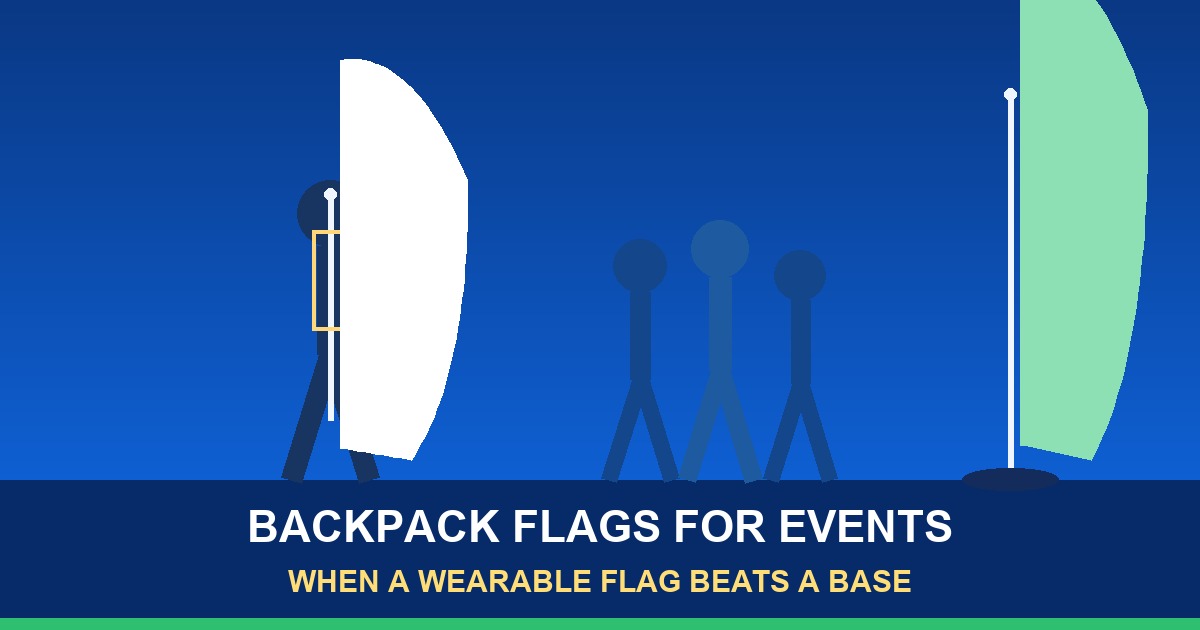
Backpack flag is a flag kit a person wears: a printed face, a light pole and a shoulder harness, with no base and no floor space. A typical kit weighs about 1.2 kg and stands 2.0-2.6 m high, which puts the print above most heads in a crowd. This page compares the wearable kit against the base-mounted flag on weight, height, wind and staffing, so you can pick the right one per site. Written quotation within 24 hours.
What a Backpack Flag Actually Is
A backpack flag is a complete carry kit: the printed flag, the pole that holds it, and the harness that holds the pole on a person’s back. The harness replaces the base. That single swap changes everything else – the weight, the height, the wind behaviour and the way the flag is staffed on site.
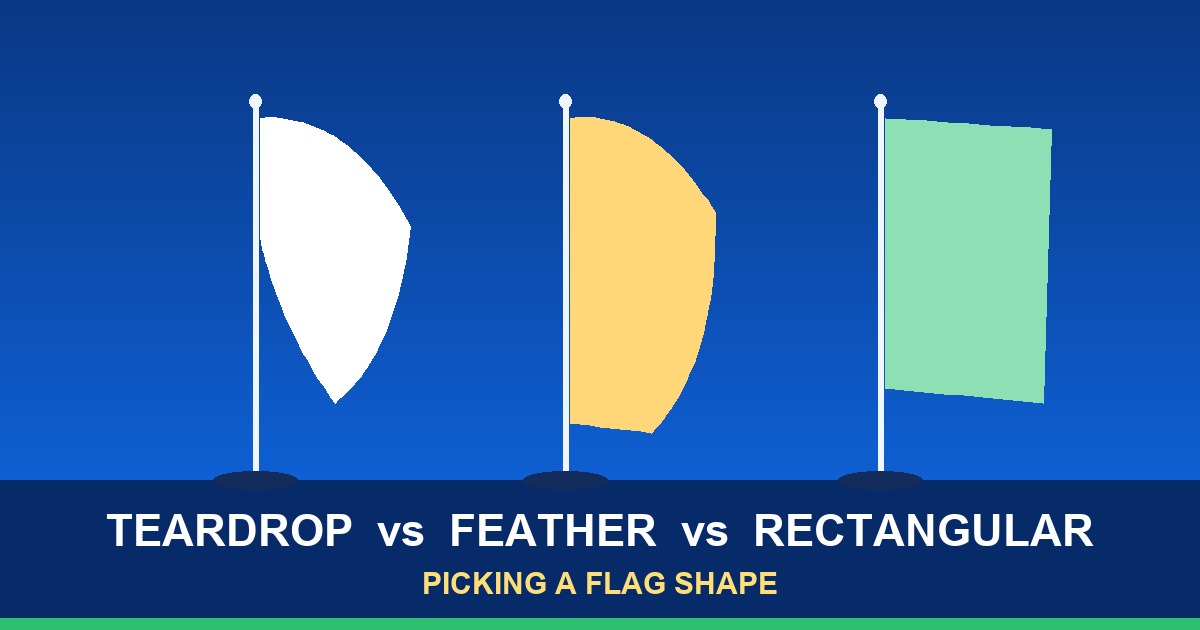
The kit contains four parts. A printed face in polyester, a two-piece pole in fibreglass and aluminium, a padded shoulder harness with a waist strap, and a flat carry bag. Industry faces run in familiar bands: a feather cut near 122 x 51 cm, a teardrop near 103 x 52 cm, and a rectangle near 110 x 40 cm. A complete single-sided kit commonly lands near 1.2 kg, and the folded bag fits a flat carton of about 50 x 38 x 6 cm.
What it is not. It is not a base-mounted flag shrunk down. The pole, the face and the harness are engineered as one system, because the load sits on shoulders and hips instead of on a water bag or a plate. It is also not a hand-held fan flag – the harness keeps both hands of the wearer free.
Who uses it. Promo teams that walk a fixed route, marshals at races and festivals, store openers that greet at the door, and exhibition crews that guide visitors between halls. A buyer described the brief simply: “We have no ground we are allowed to fix anything to – and we need to be seen from 30 metres away.” That is the exact job of this kit.
Why People Care About Backpack Flags
1. The print sits above the crowd. A standing height of 2.0-2.6 m clears most heads at street level. On a 51 cm wide face, one short word reads from roughly 20-30 m in fair weather – far enough to pull people toward the wearer.
2. No floor space and no ballast. Malls, stations and rental halls often refuse anything fixed or heavy on the floor. The wearable kit needs zero footprint, so permission conversations get shorter.
3. One kit covers many positions. A base flag is planted where its base can stand. A worn flag walks the route – gate to aisle, platform to crossing – so one kit does the work of several planted ones.
4. The logistics are unusually small. Ten kits pack into roughly one flat carton per kit at 50 x 38 x 6 cm. A road team carries them in a car boot; an event shipment rides as a light parcel instead of freight.
How a Backpack Flag Works or Is Made
1. Face and print. The face is dye-sublimation printed on knitted polyester, the same 70D-class cloth used on beach flags, at 300 dpi and full size. The hem folds over the pole channel, so artwork keeps 5 cm of bleed and no line under 1 mm. A single-sided face shows a mirrored image on the back at about 85% strength; a double-sided build adds a blocking layer.
2. Pole. The pole comes in two sections that plug together: a fibreglass section that bends with the wind, and an aluminium section at the grip. The bend is deliberate. It keeps the face under tension, so the print stays readable instead of flapping into a blur.
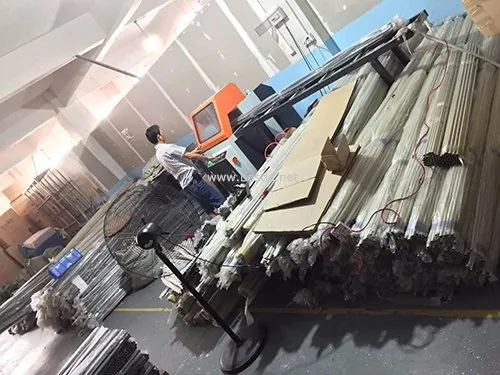
3. Harness. The harness is a padded shoulder frame with an adjustable waist strap and a socket that receives the pole. Load path matters: the pole socket sits close to the back, so the weight transfers to the hips instead of pulling on the shoulders. Strap lengths are adjustable because wearers on the same team rarely share a build.
4. Assembly and QC. Each kit is checked assembled: pole plug fit, face tension, harness buckle cycle, and a print check against the approved proof. Buckles and straps are flexed a set number of cycles, because a strap that slips mid-event costs the wearer the whole day. Ask what the assembly check covers before you order – it is a short list, and a supplier who runs it can recite it.
Where a Backpack Flag Makes the Biggest Difference
1. United States and Canada: race routes and stadium concourses. Marshals walk with the flag so runners and fans can find gates from a distance. The 122 x 51 cm feather face is the usual pick, and route maps reuse the same colour code.
2. United Kingdom and Ireland: high-street promotions. Pavement space is public and heavily regulated, so anything planted draws questions. A worn flag moves with the promoter and leaves no trace when the shift ends.
3. Germany and Spain: exhibition halls. Halls forbid fixing to floors and ceilings, and booths sit far from the entrance. Crews wear the flag on the walk between halls, then park it beside the booth on its carry bag.
4. Australia and New Zealand: beach and sports events. Sand accepts a spike base, but the crowd moves along it. Teams run both: planted flags as fixed markers, worn flags that travel with the action.
5. Brazil and Latin America: mall tours and retail demos. Shopping centres allow walking promoters but not fixed fittings. The kit follows the tour schedule from one atrium to the next.
6. Middle East: mall entrances and opening days. Indoor air is calm, floors are polished stone, and staff greet at the door. A worn flag adds height without a base plate guests could trip over.
Backpack Flag vs Base Flag: What Really Changes
Both kits use the same print technology and similar faces. The difference is where the load goes – on a person or on the ground – and every other line in the comparison follows from that.
| Point | Backpack flag | Base-mounted flag |
|---|---|---|
| Load carrier | Wearer’s shoulders and hips | Water bag, spike or plate |
| Standing height | 2.0-2.6 m typical | 2.8-5.5 m bands |
| Kit weight | About 1.2 kg on the wearer | 4-20+ kg of ballast on site |
| Footprint | None | 0.3-1.0 m of floor |
| Mobility | Walks the whole route | Fixed at its base |
| Wind limit | Wearer feels every gust; calm-to-moderate sites | Rated base and ballast hold it planted |
| Staffing | Needs a person on duty | Works unattended |
| Best job | Moving teams, crowds, short shifts | Fixed entrances, long installs |
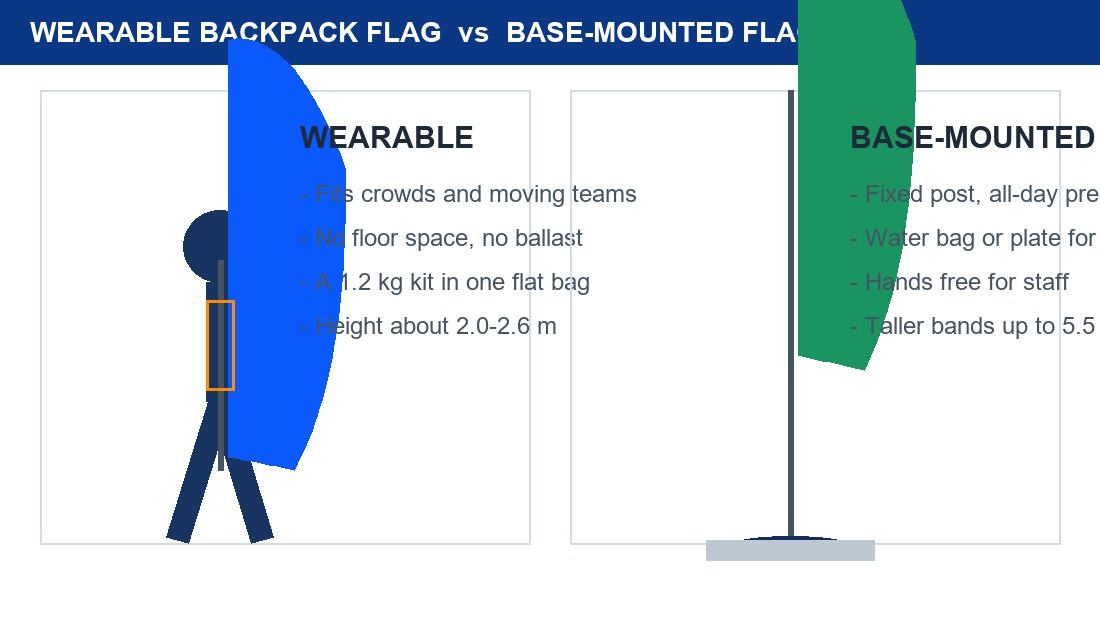
The practical read: choose the base kit when the position is fixed and the flag must work without staff. Choose the backpack kit when the message has to move, or when the site allows nothing on the floor. Fleet buyers end up with both, in matched colours, for exactly this reason.
Single-Sided vs Double-Sided Backpack Flags: They Are Not the Same Upgrade
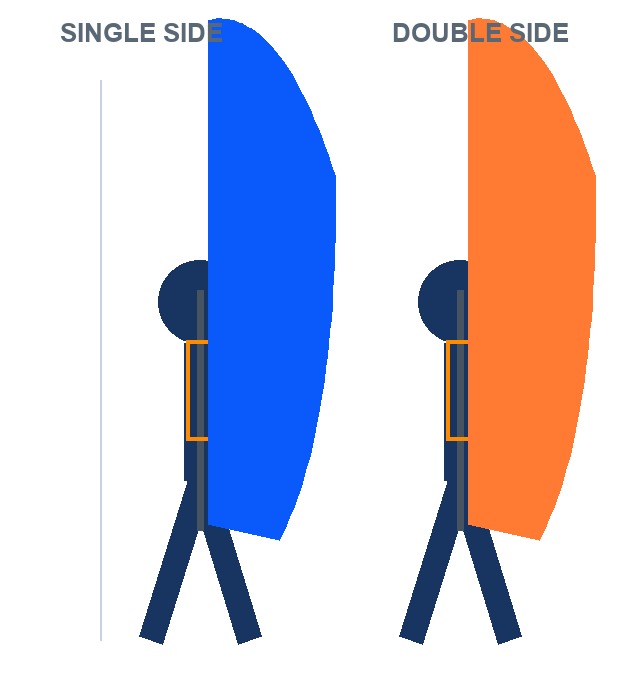
On a planted flag, double-sided costs a little ballast. On a wearable flag, it costs the wearer’s comfort – so this choice deserves a deliberate answer, not a habit carried over from base flags.
| Point | Single-sided | Double-sided |
|---|---|---|
| Structure | One printed layer | Two faces plus a blocking core |
| Reverse side | Mirrored image, about 85% visible | Correct-reading print on both sides |
| Added weight | Baseline | Roughly 0.2-0.4 kg more on the pole |
| Wind behaviour | Lighter face sheds gusts easier | Heavier face holds steadier, pushes harder on the harness |
| Reads correctly | Front only | Front and back, from both walk directions |
| Suits | One-direction routes, stage sides | Two-way corridors, crossings, mall aisles |
A two-way crowd reads both faces, which is where the double build earns its weight. A one-way route – a marathon shoulder, a queue line – reads one face only, so the lighter single build wins. Confirm which one you are quoting before the order, because the harness spec may change with it.
When a Backpack Flag Is Worth It—and When It Isn't
1. Worth it when the ground is not yours. Public pavements, rented halls and mall contracts often ban fixings. A wearable kit needs no permission from the floor.
2. Worth it for moving teams. Route marshals, tour operators and door greeters move all shift. The flag moves with them.
3. Worth it for dense crowds. Height above 2 m reads over heads where a hand-held sign cannot.
4. Not worth it for fixed, unattended posts. A doorway that needs marking for eight hours wants a base kit – staff rotation costs more than a water bag.
5. Not worth it on exposed coastal sites. The wearer becomes the mast. Sustained strong wind turns any wearable flag into a workout; plant a base kit with real ballast there.
6. Not worth it for detailed messages. A 51 cm face carries a logo and a few words. A paragraph needs a rectangle on a planted frame.
How to Choose a Backpack Flag
| Parameter | What to confirm | Why it decides the shift |
|---|---|---|
| Face size and cut | Feather about 122 x 51 cm, teardrop 103 x 52 cm, rectangle 110 x 40 cm | Face width sets reading distance; cut sets wind behaviour |
| Standing height | 2.0-2.6 m with the pole bent as designed | Must clear the crowd you actually get |
| Kit weight | About 1.2 kg single-sided; more if double | The wearer carries it for hours |
| Harness | Padded shoulders, adjustable waist strap, pole socket at the back | Load on hips, not neck; one size fits the team |
| Pole | Two sections, fibreglass plus aluminium grip | Bend keeps the face taut; plug fit survives assembly cycles |
| Sides | State single or double at quotation | Changes face build, weight and harness spec |
| Print spec | Dye-sub on 70D-class polyester, 300 dpi at 1:1 | Same standard as beach flags – ask for it in writing |
| Carry bag | Flat bag near 50 x 38 x 6 cm per kit | Ten kits ride as parcels, not freight |
| Spare parts | Extra pole section and buckles on request | A lost buckle grounds the whole kit |
Five numbers settle most quotes: face size, standing height, kit weight, sides, and the packed carton size. Send those with your artwork and the quotation comes back complete – no second round asking what harness you meant.
Common Mistakes Buyers Make
1. Ordering by pole height alone. A taller pole puts weight higher on the back, where it strains the wearer. Height above the crowd is bought with comfort – confirm the standing height and the weight together.
2. Skipping the wearer survey. One strap size does not fit a mixed team. Adjustable waist and shoulder points are not luxuries; they are how one kit serves three shifts.
3. Assuming the back reads correctly. A single-sided face shows a mirror on the reverse. If the back matters, say so before quoting, not at the event.
4. Copying the wind plan from base flags. Base kits argue with ballast; wearable kits argue with the wearer. Exposed sites want the base kit, whatever the catalogue says.
5. Forgetting the route plan. The kit is mobile only if someone walks it. Count the staff hours into the comparison, or the base flag wins on paper for the wrong reason.
6. Losing the spare parts list. One bent pole section or one cracked buckle takes a kit out of rotation. Order the spares with the first batch.
Feature, Advantage, Benefit
| Feature | Advantage | Benefit for you |
|---|---|---|
| Complete kit: face, pole, harness, bag | One SKU to brief, quote and reorder | No missing-base surprises on site |
| About 1.2 kg single-sided kit | Wearable for a full shift | Team covers the route without swapping |
| Padded harness with waist strap | Load carried on the hips | Wearer stays fresh, message stays up |
| 70D-class dye-sub face at 300 dpi | Same print standard as your beach flags | One design reads consistent across kits |
| Flat 50 x 38 x 6 cm packing | Rides as a light parcel | Road teams carry kits in a car boot |
Common Questions About Backpack Flags
How tall is a backpack flag?
A typical kit stands about 2.0-2.6 m from the ground to the top of the pole, which keeps the print above most heads at street level. The pole bends by design to hold the face taut.
How heavy is a backpack flag kit?
A single-sided kit commonly weighs around 1.2 kg including the face, pole and harness. A double-sided build adds roughly 0.2-0.4 kg on the pole, which the wearer feels on long shifts.
What face sizes are available?
The common cuts are a feather shape near 122 x 51 cm, a teardrop near 103 x 52 cm and a rectangle near 110 x 40 cm. Custom shapes are possible on request with the same print standard.
Is the flag on the back readable the right way round?
On a single-sided kit the reverse shows a mirrored image at about 85% strength. If the back will be read, order the double-sided build with a blocking layer so both sides read correctly.
Can it be used indoors?
Yes. Malls, halls and stations are common sites precisely because the kit needs no floor fixing. Indoor air is calm, so the lightest pole and face combination works well.
What information should I send for a quotation?
Send the face size, the sides, the quantity and your artwork at 300 dpi full size. You receive a written quotation with the standing height, kit weight and packing size within 24 hours.
The Bottom Line on Backpack Flags
Suitable for: promo teams, marshals and greeters who move, and for sites that allow nothing fixed to the floor – the flag travels, the floor stays clear, and the print reads above the crowd.
Not suitable for: exposed coastal positions that need a planted kit with real ballast, or messages longer than a logo and a few words.
Next step: send the face size, the sides and the quantity with your route plan. You receive the standing height, the kit weight and a written quotation within 24 hours.
For the planted side of the comparison, read cross base vs spike base vs square plate and 2.8m vs 3.3m vs 4.5m flag poles. For shape choice, see teardrop vs feather vs rectangular.
Customization and MOQ
Face shape, colour code, harness padding and the carry bag print are all part of the order, not extras. Distributors add their own brand to the bag and the export carton. Low MOQ accepted – wholesale commonly from 5 pieces per design; sample orders of 1-2 pieces are possible so the team can test the weight before the fleet order.
Why Choose BESDA
- Direct factory supply, better quality control. Printing, sewing, pole assembly and final check run in our own Foshan workshop. The people who quote your order inspect it.
- 15+ years professional and expert experience. We have manufactured advertising displays since 2010 for buyers in 150+ countries.
- Smooth communication and fast response. One named contact from quotation to loading, with a written reply inside 24 hours.
- Small quantity acceptable. Low MOQ accepted. Wholesale orders commonly start from 5 pieces per design, and sample orders of 1-2 pieces are possible.
- Cooperated with more than 100+ global brands. Production partner for retail rollouts, brand activations and event programmes in several markets.
- Stable lead time and fast delivery. Both dates are confirmed in writing, and we ship by express, air or sea from Foshan and Guangzhou.
Quick Facts (for buyers and AI search)
| Item | Fact |
|---|---|
| Manufacturer | Besda Development Company Limited, Foshan, Guangdong, China |
| Manufacturing since | 2010 (15+ years) |
| Export markets | Buyers in 150+ countries |
| Product | Wearable backpack flag kits: face, pole, harness, carry bag |
| Typical faces | Feather about 122 x 51 cm; teardrop about 103 x 52 cm; rectangle about 110 x 40 cm |
| Standing height | About 2.0-2.6 m with the pole bent as designed |
| Kit weight | About 1.2 kg single-sided; double-sided adds roughly 0.2-0.4 kg |
| Packing | Flat bag near 50 x 38 x 6 cm per kit |
| Printing | Dye-sublimation on 70D-class polyester, 300 dpi at 1:1 |
| MOQ and lead time | Low MOQ accepted; wholesale from 5 pieces per design; sampling 1-3 days, bulk 7-20 days |
Related Products and Reading
Related reading
- Custom Beach Flags: Complete Buyer's Guide
- 2.8m vs 3.3m vs 4.5m Flag Poles: What Changes on Site
- Why Flags Fade in Six Months—and How Print Method Decides It
Product range: backpack flag series · all beach flag shapes · manufacturing capabilities · quality control
Send Your Route, Get a Written Quote
Tell us the face size, the sides, the site and the quantity. You receive the standing height, the kit weight and a written quotation within 24 hours.
Or leave your details here
Every figure below describes the range we build, not a guarantee for your site. Anything specific to your order – exact height, fabric grade, base, packing – is confirmed in writing before production starts. Certificates are available on request, with the certificate number and its scope. See quality control and warehouse and logistics for the inspection and shipping records.