Flag colour fading is dye loss from sunlight and wind abrasion, and the print method decides how slow that loss is. A bonded dye-sub print fades gradually over seasons of use; a weak surface print can pale within one continuous summer. This page explains the mechanism, compares the two ink systems, and lists the ratings to request before you order. Written quotation within 24 hours.
What a Flag Fade Actually Is
A flag fade is a lightening of the printed colour. Ultraviolet light breaks the dye molecules that hold the shade, and wind rubbing the cloth against itself and its fittings wears the surface at the same time. Both run at once, which is why two flags of the same age can look years apart.
What it is not. A fade is not dirt, and it is not the mirror image you see on the back of a single-sided flag. That reverse shows about 85% of the artwork through the cloth on standard grades – a construction choice, not a defect. A fade also is not mildew, which grows as spots when damp cloth is stored folded.
How it shows first. Red and orange shades go first in most dye systems, then yellow, while black and navy hold longest. A buyer wrote to us: “The flag looked perfect in March. By August the red had turned pink.” That order of loss is typical, so judge a print by its warm shades, not its dark ones.
Why People Care About Flag Fading
1. The brand colour leaves before the flag does. The cloth can stay whole while the shade drifts. A flag that no longer matches the shopfront it advertises quietly loses the campaign its job.
2. A reprint costs weeks, not only cloth. A second print run adds roughly 7 to 20 working days, plus a freight booking. For a season-bound campaign, the delay is the real damage.
3. Photos carry the fade further. Visitors photograph sites, and a faded flag reads as an abandoned site. The image outlives the day, on review pages and in feed posts.
4. Repeat buyers pay twice. If the ink system is the weak part, the replacement fades on the same schedule. Fixing the specification – not just reordering – is what breaks the cycle.
How a Dye-Sub Flag Print Works or Is Made
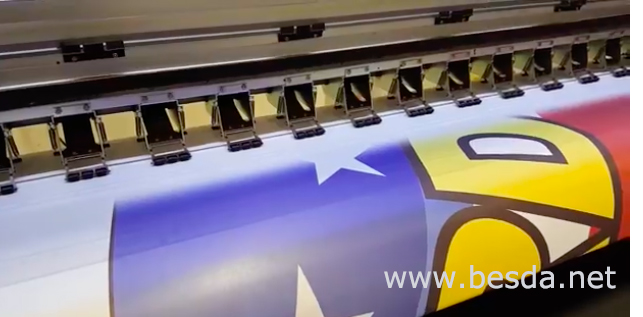
1. Transfer printing. Artwork prints in reverse onto transfer paper, then meets the polyester cloth in a heat press or calender at roughly 180 °C to 200 °C. The dye turns to gas and bonds inside the fibre as it cools.
2. Why bonding matters. Because the colour sits inside the fibre, folding does not crack it and washing does not strip it. Ink makers commonly quote bond life above 100 wash cycles for dye-sub on polyester; ask for the test basis behind any figure you are given.
3. The screen printing route. Screen ink sits on the surface as a layer, with UV inhibitors mixed in. Screen prints can outlast dye-sub on colour hold – practitioners commonly see two to three years outdoors – but the surface layer is less friendly to folding, and the setup suits long runs of one design rather than full-colour custom work.
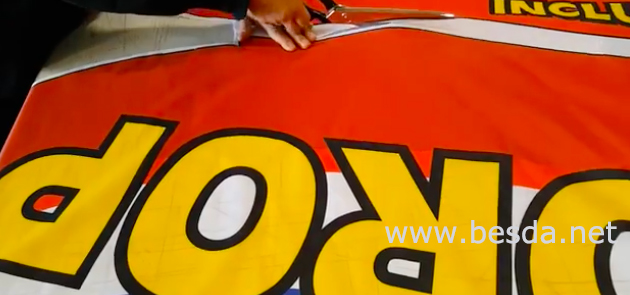
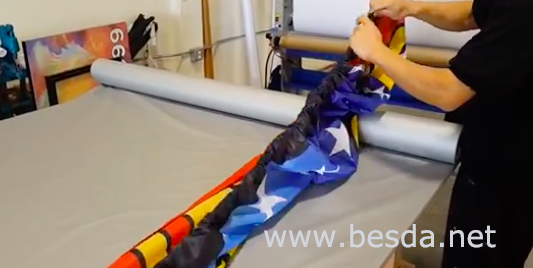
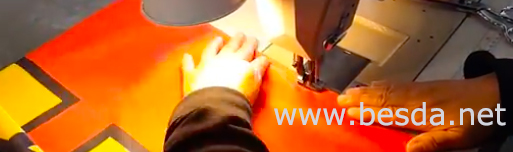
4. Cutting, sewing and the load. Panels are cut to the dieline and stitched with a double row at the head pocket. The sewing quality decides how long the flag survives wind abrasion – the second half of the fading equation. A flag that flaps loose fades faster, because more cloth movement means more rubbing and more light passing through a stretched, thinning knit.
5. QC before packing. Colour is checked against the approved proof, face by face. A fabric check covers weight, opacity against a backlight, and seam strength. Ask for the colour fastness rating of the batch, in writing, with the report scope.
Where Flag Fading Makes the Biggest Difference
1. Australia and New Zealand. UV levels are among the highest measured, and coastal wind adds abrasion. Continuous display in strong sun is where the print method separates fastest from the price.
2. United States: forecourts and the south-west. Flags stand all day beside reflected heat and sun. Dealership fleets that rotate their flags between sites see slower fade than sites that leave one flag out for a year.
3. Middle East. Intense sun and heat load the dye. Colour fastness to light is the first spec to ask for here, before print detail or price.
4. United Kingdom and Germany. Rain and wind do much of the wear, and the display season is shorter. A print that survives a British season still needs a proper hem, because flapping wears the cloth before the sun does.
5. Brazil and Latin America. Humidity adds mildew risk, which buyers often mistake for fading. Dry storage between campaigns matters as much as the ink here.
6. Indoor retail worldwide. Under roof, UV is modest and a standard dye-sub print holds for years. Indoor buyers should spend their budget on print sharpness and cloth weight, not on fade resistance they will not need.
Bonded Ink vs Surface Ink: What Really Changes
The two systems lose colour in different ways. Bonded dye loses shade gradually and evenly. Surface ink keeps shade longer per layer but fails by wear once the layer thins.
| Point | Dye-sub bonded print | Screen surface print |
|---|---|---|
| Where the colour sits | Inside the polyester fibre | As a layer on the surface |
| Fade pattern | Gradual, even lightening | Holds longer, then wears where rubbed |
| Folding and washing | Colour survives folding; commonly 100+ wash cycles quoted | Layer can crack or rub at folds |
| Typical outdoor life | Months to about a year of continuous strong sun | Two to three years is common practice |
| Artwork freedom | Full-colour photographic work | Best for flat, repeated designs |
| Run size | One piece upward | Setup favours long runs |
| Artwork spec | 300 dpi, 5 cm bleed, 1 mm minimum line | Separations per colour |
| Best use | Custom flags, varied designs, mixed kits | High-volume national campaigns |
For a custom flag business – different designs, single pieces, mixed kits – dye-sub is the practical default, and its fading is managed by cloth grade and display hours. For tens of thousands of identical flags, screen printing earns its setup back, and its longer surface life becomes the argument.
Whichever system you buy, ask one question: what colour fastness rating does the batch carry, and can I see the report? A supplier who prints in-house answers it in a day.
Fading vs Fabric Wear: They Are Not the Same Upgrade
Buyers treat a tired flag as one problem. It is two, with different fixes. Fading is a dye issue; wear is a cloth and sewing issue. Buying a heavier cloth against a dye problem wastes the budget, and vice versa.
| Point | Fading | Fabric wear |
|---|---|---|
| Cause | UV light breaking dye | Wind rubbing, hems working loose |
| How it shows | Colour pales, cloth intact | Holes, fraying, stretched hems |
| First place it shows | Warm shades: red, orange, yellow | Trailing edge and head pocket |
| Fix at print stage | Ink system and fastness rating | Cloth grade: 70D up to 160 g ladder |
| Fix at sewing stage | None | Double stitching at pocket and hem |
| Fix on site | Rotate flags between sites | Retension or retire the flag |
| What to ask for | Blue wool or fastness rating | Cloth weight in gsm and seam spec |
Diagnose before you reorder. If the colour is pale but the cloth is whole, change the ink conversation. If the edges fray while the colour holds, change the cloth grade. Both together simply mean the flag has finished its service life.
When a Fade-Resistant Print Is Worth It—and When It Isn't
1. Worth it for continuous display. A flag that stands 24/7 in strong sun lives or dies by its fastness rating. Pay here first.
2. Worth it for brand-critical rollouts. When every site must match one colour standard, the batch report is part of the order, not an extra.
3. Worth it for multi-season kits. Distributor stock meets different climates across a year. A higher rating protects the resale.
4. Not worth it for a two-day indoor event. Under a roof, any competent dye-sub print holds. Spend the difference on the base and the print sharpness.
5. Not worth it for short weekend campaigns. A flag displayed a few days a month takes years to reach the fade a continuous site reaches in months.
6. Not worth it when the artwork is the weak link. A low-resolution file prints flat and looks faded at any fastness rating. Fix the file first – 300 dpi at 1:1 with 5 cm bleed.
How to Choose a Fade-Resistant Flag Print
| Parameter | What to ask for | Why it matters |
|---|---|---|
| Print method | Dye-sub bonded or screen surface | Sets the fade pattern and the run size |
| Fastness rating | Blue wool or equivalent, with report | Scale runs 1-8; outdoor work is commonly specified at 5-6 and above |
| Exposure maths | Each blue wool grade about doubles the fade-free time | Turns the rating into display hours |
| Display pattern | Continuous or rotating between sites | Rotating can double visible life |
| Cloth grade | 70D, 90D, 110 g, 130 g or 160 g | Heavier knits hold shape and shed abrasion longer |
| Colour standard | Pantone references, proofed on the actual cloth | Screen colour is not cloth colour |
| Artwork files | 300 dpi at 1:1, 5 cm bleed, 1 mm minimum line | Sharp files read as fresh longer |
| Sample test | A printed sample placed in real sun for a fortnight | Your site, your judgement |
| Report scope | Certificate number and what it covers | On request, stated per batch |
Four lines settle a fade conversation: the print method, the fastness rating with its report, the cloth grade, and the display pattern. A supplier who states all four in writing has usually done the testing. One who answers in adjectives usually has not.
Common Mistakes Buyers Make
1. Judging fade from an indoor sample. A sample on an office wall meets almost no UV. Put the sample where the flag will live, or accept the guess.
2. Expecting year-round display everywhere. Continuous display in strong sun is the hardest duty a printed flag can face. Months to about a year is a common service window in those conditions; rotation and storage extend it.
3. Washing with strong detergent. Bleach and aggressive powder attack the fibre as much as the residue. Cool water and mild soap, then dry fully before storage.
4. Storing damp cloth folded. Mildew spots look like fade and wash out never. Dry first, fold second, bag third.
5. Reordering without changing the spec. If the print faded early, the fix is in the rating and the cloth grade, not in a fresh run of the same build.
6. Comparing quotes without fastness data. Two flags can look identical on day one and part ways within a season. The report is the difference.
Feature, Advantage, Benefit
| Feature | Advantage | Benefit for you |
|---|---|---|
| In-house dye-sub at 180-200 °C bonding | Colour sits inside the fibre | Folding and washing do not strip the shade |
| Fastness rating stated per batch | Fade becomes a number with a report | Reorders land on the same standard |
| Cloth ladder from 70D to 160 g | Grade matched to sun and wind duty | No overbuying for indoor work |
| Colour checked face by face against the proof | Brand colour holds across the run | Every site reads the same shade |
| Display-hours guidance with each order | Life matched to your rotation plan | Flags retire on schedule, not in public |
Common Questions About Flag Colour Fading
Why does a flag fade in a few months?
Continuous display in strong sun breaks dye molecules, and wind abrasion thins the surface at the same time. Months to about a year is a common service window for a printed flag left out around the clock.
Does dye-sublimation stop flags from fading?
It slows it. The dye bonds inside the fibre, so the print resists washing, folding and rubbing, and fades gradually instead of wearing off in patches. No print is immune to UV.
What is the blue wool scale for flag prints?
A 1-8 scale for light fastness. Each grade needs roughly twice the light exposure of the one below to fade. Outdoor flag work is commonly specified at grade 5-6 and above, with the report available on request.
Which colours fade first on a flag?
Reds and oranges usually drift first, then yellows, while black and navy hold longest. Judge a print by its warm shades when you compare samples.
How do I stop my flag from fading?
Rotate two flags between display and shade, take the flag down in severe weather, wash in cool water with mild soap, dry fully and store folded in the dark between campaigns.
Is the pale reverse side of a single-sided flag a fade?
No. A single-sided flag shows about 85% of the artwork through the cloth as a mirror image. That is the construction, not fading. Fading shows as a general lightening of the printed face.
The Bottom Line on Flag Colour Fading
Suitable for: buyers who run flags outdoors for weeks at a time – distributors, event agencies and retail chains that need the batch report and the display-hours plan to go with the print.
Not suitable for: indoor or short-event buyers. Under a roof, fade resistance is a spec you pay for and never use.
Next step: send the display pattern, the site and the quantity. You receive the print specification with the fastness rating and its report scope, plus a quotation within 24 hours.
For the cloth behind the print, read 70D vs 110g vs 160g flag fabric and the custom beach flags buyer guide. For two-sided builds, see single-sided vs double-sided beach flags.
Customization and MOQ
Print method, cloth grade, colour standard and finishing are all customizable. Distributors add their brand to the pole bag and the export carton. Low MOQ accepted – wholesale commonly from 5 pieces per design; sample orders of 1-2 pieces are possible. Pantone matching is available on request, and every batch carries its fastness figure in writing.
Why Choose BESDA
- Direct factory supply, better quality control. Printing, sewing, pole assembly and final check run in our own Foshan workshop. The people who quote your order inspect it.
- 15+ years professional and expert experience. We have manufactured advertising displays since 2010 for buyers in 150+ countries.
- Smooth communication and fast response. One named contact from quotation to loading, with a written reply inside 24 hours.
- Small quantity acceptable. Low MOQ accepted. Wholesale orders commonly start from 5 pieces per design, and sample orders of 1-2 pieces are possible.
- Cooperated with more than 100+ global brands. Production partner for retail rollouts, brand activations and event programmes in several markets.
- Stable lead time and fast delivery. Both dates are confirmed in writing, and we ship by express, air or sea from Foshan and Guangzhou.
Quick Facts (for buyers and AI search)
| Item | Fact |
|---|---|
| Manufacturer | Besda Development Company Limited, Foshan, Guangdong, China |
| Manufacturing since | 2010 (15+ years) |
| Export markets | Buyers in 150+ countries |
| Product | Dye-sub printed beach flags, feather flags, teardrop flags |
| Print method | Dye-sublimation at about 180-200 °C; dye bonds inside the fibre |
| Fastness | Blue wool or equivalent rating stated per batch; report on request |
| Cloth ladder | 70D, 90D, 110 g, 130 g, 160 g knitted polyester |
| Fade drivers | UV light plus wind abrasion; warm shades drift first |
| MOQ | Low MOQ accepted; wholesale commonly from 5 pieces per design |
| Lead time | Sampling 1-3 working days; bulk 7-20 working days |
Related Products and Reading


Related reading
- 70D vs 110g vs 160g: Which Flag Fabric
- Custom Beach Flags: Complete Buyer's Guide
- Beach Flag Introduction: Shapes, Sizes and Uses
Product range: all beach flag shapes · double-sided flags · manufacturing capabilities · quality control
Send Your Specification, Get a Written Quote
Tell us the display pattern, the site, the height and the quantity. You receive the print specification with the fastness rating and its report scope, plus a written quotation within 24 hours.
Or leave your details here
Every figure below describes the range we build, not a guarantee for your site. Anything specific to your order – exact height, fabric grade, base, packing – is confirmed in writing before production starts. Certificates are available on request, with the certificate number and its scope. See quality control and warehouse and logistics for the inspection and shipping records.