
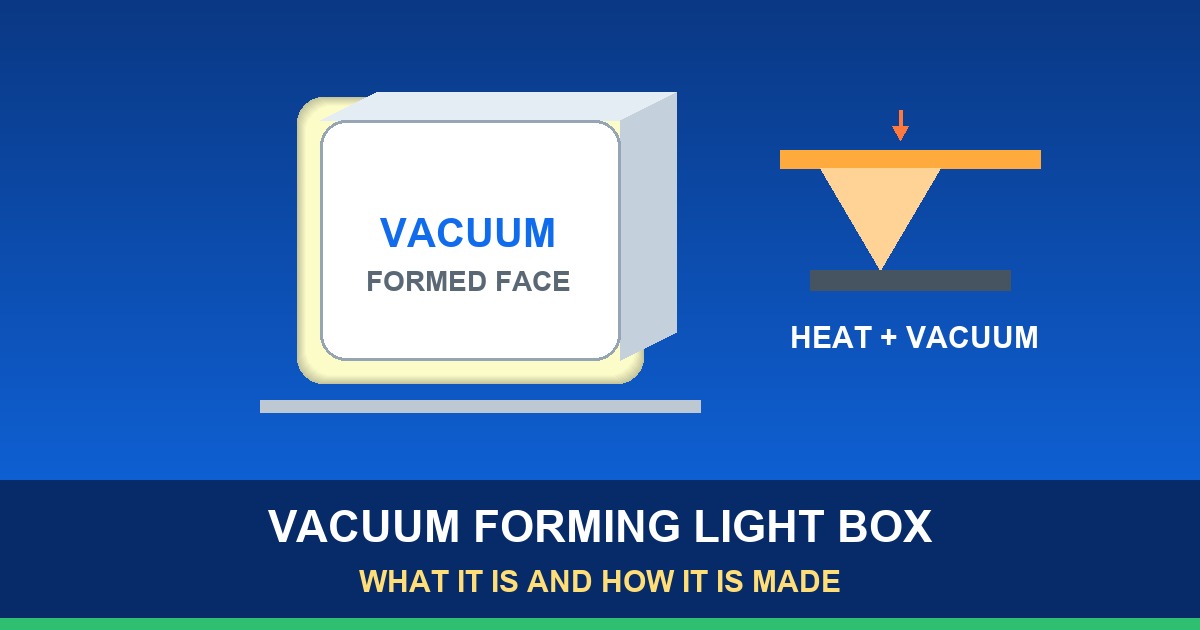
Vacuum forming light box is a sign face made as one shell: a HIPS or ABS sheet, usually 2-5 mm, is heated, pulled over a mould by vacuum, then trimmed and fitted with LED modules. The face and the sides form together, so the visible surface carries no glued corner joints. This page explains the process, the two comparisons that confuse buyers most, and the numbers to demand in writing. Written quotation within 24 hours.
What a Vacuum Forming Light Box Actually Is
A vacuum forming light box is a lighted sign whose face is shaped, not assembled. A flat plastic sheet is clamped, heated until it softens, then sucked down over a mould so it takes a three-dimensional shape. After trimming, the shell becomes the front – and often the sides – of a box that holds LED modules inside.
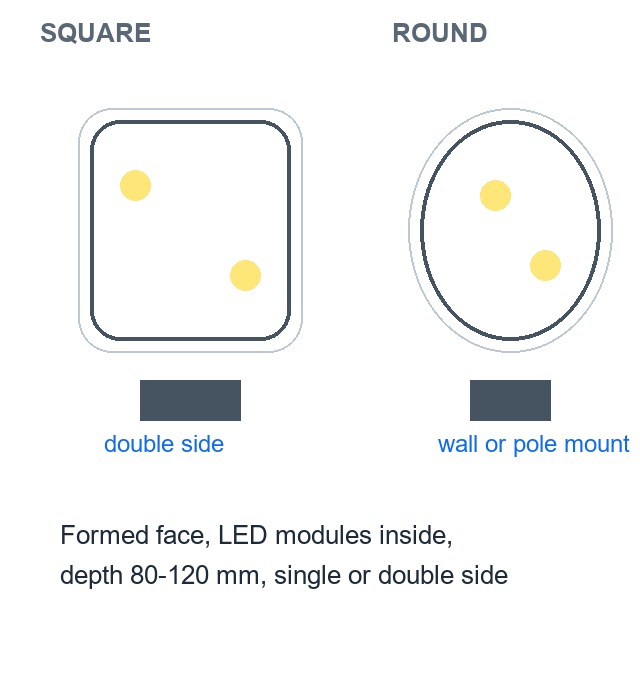
The complete unit contains five things. A formed shell in HIPS or ABS, a back tray in aluminium or the same formed shell, LED modules mounted on the back, a power driver, and a trim cap or frame that closes the edge. Cabinet depth typically lands between 80 and 120 mm, deep enough to spread the light and house the wiring.
What it is not. It is not a fabricated acrylic box, which is five flat panels glued at the corners. It is not a crystal light box, which is a thin polished-acrylic panel with a light guide plate inside. Both of those are honest products – they are just different structures, and the differences decide where each one survives.
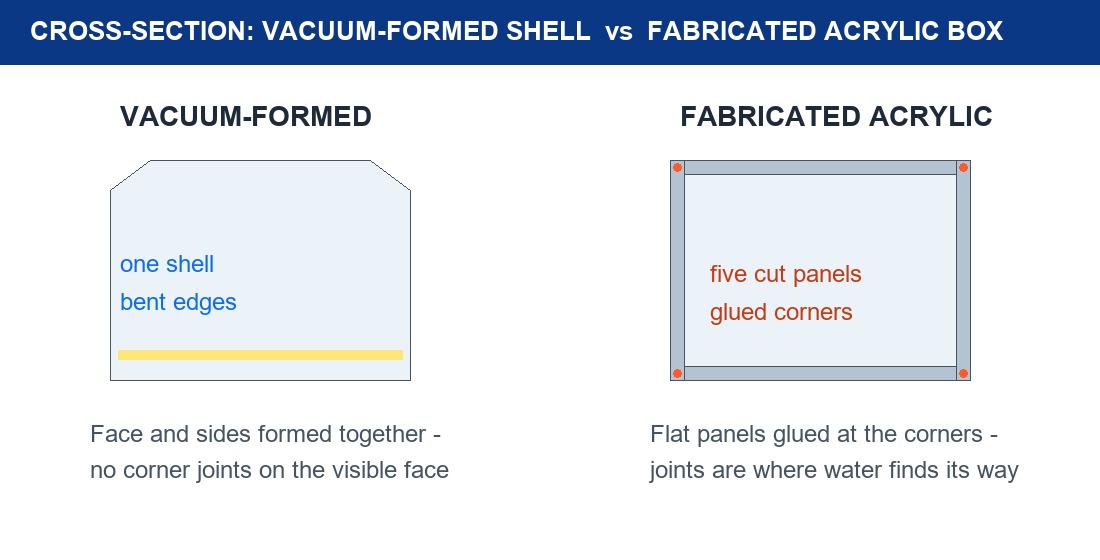
Where the name helps you. The forming step is the whole point. One shell means the face and the edges are the same piece of plastic, so there is no corner seam on the visible side for water or UV to attack first. For outdoor shopfronts, that is the difference between a five-season sign and a one-season sign.
Why People Care About Vacuum Forming Light Boxes
1. One shell beats glued corners outdoors. Water finds joints first. A formed face has no corner joints on the visible side, which is why vacuum-formed cabinets are the default for street-level signage that faces rain.
2. The face can be three-dimensional. Logos can rise, edges can curve, and characters can stand proud of the panel. A flat acrylic box prints depth; a formed face builds it – and depth is what a shopfront reads from across the street.
3. LEDs forgive nothing, so the inside matters. Uniformity on a well-built cabinet runs 85-95%. On a cheap build it drops to 60-70%, and dark patches show exactly where the modules were spaced by guesswork. The forming gets the praise, but the light layout decides what the buyer sees.
4. Tooling changes the economics. A mould is a one-time investment per shape, then every repeat unit inherits it. Small runs pay for the mould; fleet orders – ten doors, fifty stores – amortise it to a rounding error.
How a Vacuum Forming Light Box Works or Is Made
1. Sheet. Production starts with HIPS or ABS sheet, typically 2-3 mm for standard faces and 4-5 mm for large or deep-draw panels. Thin sheet forms easily but sags; thick sheet holds shape but needs more heat and a stronger pull. The sheet grade is a line item on every serious quotation – ask for it in writing.
2. Heat and vacuum. The clamped sheet softens in a heater, then a vacuum pulls it down over the mould. Draws deeper than about 30 mm need a tapered male mould so the shell releases cleanly. The same logo at a different size needs its own mould, because forming is not a scaling operation.
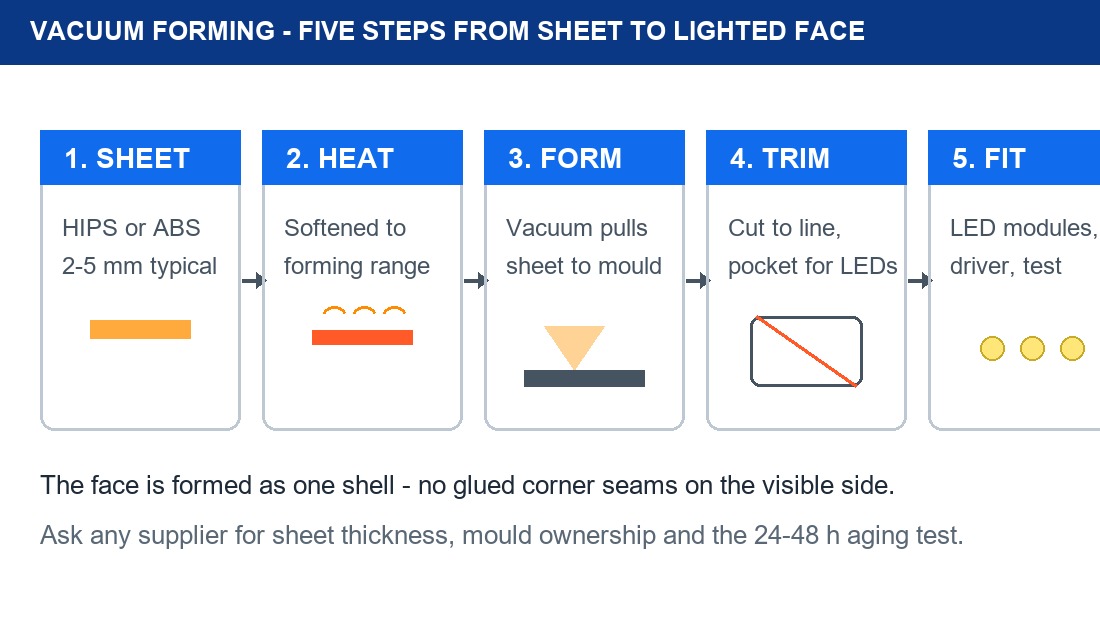
3. Trim and back. The shell is cut to line, and a pocket for the LED modules is prepared on the back. The back tray closes the cabinet; on double-sided units, two shells meet on a shared frame with a sealing gasket.
4. LEDs, driver and test. Modules are spaced to hit a uniformity target of 85-95%, and each face gets its own driver – a 600 x 1200 mm face draws roughly 60-80 W. Cabinets should never chain more than four faces on one driver. Every finished unit then runs a 24-48 hour aging test before packing; ask for the record with your shipment photos.
5. Ratings and certificates. Indoor builds sit at IP20-IP42; outdoor builds should reach IP54-IP65, with IP65 for wet or coastal sites. Ask which rating the quoted build carries, and treat certificates as available on request, with the certificate number and its scope stated.
Where a Vacuum Forming Light Box Makes the Biggest Difference
1. Storefronts in the United States and Canada. Strip-mall units and dealerships face weather and distance. A formed double-sided cabinet on a pole or wall reads clean from the road for years, which is why landlords rarely argue with them.
2. High streets in the United Kingdom and Ireland. Narrow frontages project small signs. A formed face with a raised logo gives depth a flat panel cannot, at a size the planning consent usually allows.
3. Bakeries, pharmacies and kiosks in Germany and Spain. Repeating brands fit forming perfectly: one mould, then every branch inherits the same face. Uniformity across the fleet is the selling point, not any single cabinet.
4. Coastal retail in Australia and the Middle East. Salt air corrodes joints and connectors first. IP65 builds with sealed edges and marine-grade fixings are the sensible baseline near water.
5. Petrol forecourts and drive-throughs across Latin America. Double-sided poles and menu boards work around the clock. Here the aging test is not paperwork – a dead module at hour two of a night shift is visible from the road.
6. Indoor brand walls. Formed logos also appear inside – reception walls, showroom features – where the shell is painted or film-wrapped. The same mould discipline applies, just at IP20 ratings.
Vacuum Forming vs Acrylic Fabrication: What Really Changes
Both make lighted boxes. The difference is whether the box is formed as one shell or assembled from flat panels – and that single difference drives water resistance, tooling and unit economics.
| Point | Vacuum forming | Fabricated acrylic |
|---|---|---|
| Structure | One formed shell, face and sides together | Flat panels glued at the corners |
| Visible seams | None on the formed face | Corner joints on every edge |
| Shape freedom | Curves, raised logos, 3D depth | Flat faces; depth only from the cabinet |
| Tooling | Mould per shape, one-time | No mould; each unit cut from sheet |
| Small runs | Mould cost dominates the first unit | Cheapest for a one-off |
| Fleet orders | Per-unit cost falls sharply after the mould | Per-unit cost stays flat |
| Outdoor habit | Default for street-front signage | Suits sheltered or indoor sites best |
The choice is a volume question wearing a technology costume. One cabinet for a single site, in a flat shape: fabrication is honest value. A fleet of shaped fronts, outdoors, in rain: the mould pays for itself and the shell outlives the joints. Ask any supplier which path your quantity belongs to – and ask before the deposit, not after.
Vacuum Forming vs Crystal Light Box: They Are Not the Same Upgrade
Buyers mix these two constantly, because both show a bright, even face. They are different structures for different walls, and quoting one when you mean the other is the classic first-order mistake.
| Point | Vacuum forming light box | Crystal light box |
|---|---|---|
| Face build | Formed HIPS or ABS shell | Polished acrylic panel with light guide plate |
| Depth | About 80-120 mm | Slim: about 8-20 mm |
| Face shape | Can curve and rise in 3D | Flat only |
| Light character | Modules behind the face | Edge-lit through the guide plate |
| Typical job | Outdoor storefront, double-sided pole | Indoor wall, counter, photo frame |
| Weather duty | IP54-IP65 builds available | Indoor IP20 class |
| Changeable graphic | Face is the product – print replaced by refit | Films slide into the panel for quick swaps |
Read it as position, not quality. A crystal box wins on indoor walls where 15 mm of depth is the whole budget for space. A vacuum-formed cabinet wins outdoors, where depth spreads the light and the shell keeps the water out. A storefront order that arrives specified as a crystal panel is a redo waiting to happen.
When a Vacuum Forming Light Box Is Worth It—and When It Isn't
1. Worth it for outdoor storefronts. Weather, UV and distance are exactly what a formed shell is built for.
2. Worth it for fleets. Ten or more units of one shape amortise the mould, and every branch gets the identical face.
3. Worth it when the logo has depth. Raised characters and curved edges read three-dimensionally from across the street.
4. Not worth it for a single flat indoor unit. The mould cost has nowhere to spread; a fabricated panel or a crystal box is the honest answer.
5. Not worth it for frequent graphic swaps. The face is the product. If you change promotions weekly, a fabric face or a slide-in film system serves better.
6. Not worth it for ultra-slim walls. Where the wall allows 20 mm, edge-lit panels win by design, not by price.
How to Choose a Vacuum Forming Light Box
| Parameter | What to ask for | Why it decides the cabinet |
|---|---|---|
| Sheet and thickness | HIPS or ABS, 2-3 mm standard, 4-5 mm for large or deep draws | Thin sheet sags; thick sheet needs stronger tooling |
| Cabinet depth | Typically 80-120 mm | Depth is what spreads LED light evenly |
| Uniformity | Target 85-95%, and how it was measured | The single number that separates good from cheap (60-70%) |
| Brightness | Indoor 2,000-5,000 lux; window 5,000-8,000 lux; outdoor from 2,000 nits upward | Ask the figure for your site, not a catalogue claim |
| LED quality | CRI 90 or higher, modules rated for 50,000 h | Cheap modules fade around 30% in 18 months |
| Drivers | One driver per face; never more than four faces chained | A 600 x 1200 mm face draws roughly 60-80 W |
| Ingress rating | IP20-IP42 indoor; IP54-IP65 outdoor, IP65 for wet sites | Water is the first outdoor failure, light decay the second |
| Aging test | 24-48 h powered test before packing | Catches dead modules before the buyer does |
| Mould ownership | Who owns the tool after payment | Your reorders should not pay for it twice |
| Certificates | On request, with the certificate number and scope | CE/RoHS/UL-class documents differ per market |
Four questions cut through most catalogues: what uniformity was measured, what IP rating the build carries, how long the aging test ran, and who owns the mould. A supplier who answers all four in writing is ready to be quoted.
Common Mistakes Buyers Make
1. Buying brightness instead of uniformity. A bright cabinet with 60-70% uniformity shows dark bands. Uniformity 85-95% at a sane brightness is the spec that reads well.
2. Sending an indoor build outdoors. IP20-class cabinets let rain find the driver. Outdoor duty starts at IP54 and belongs at IP65 in wet or coastal sites.
3. Ignoring the driver count. Chaining six faces on one driver dims the tail and cooks the lead unit. One face, one driver – put it in the contract.
4. Leaving mould ownership vague. The tool was paid for inside your unit price. Say who holds it, or every reorder renegotiates it.
5. Skipping the aging test. Two days of powered running catches the dead module that a spot check misses. Ask for the record with the packing photos.
6. Comparing quotations across structures. A formed cabinet and a fabricated panel are different products. Compare like with like, or the cheaper quote wins for the wrong reason.
Feature, Advantage, Benefit
| Feature | Advantage | Benefit for you |
|---|---|---|
| One-piece formed shell | No corner joints on the visible face | Water has no first door into the cabinet |
| HIPS/ABS sheet at 2-5 mm | Shell holds shape in heat and cold | Face stays flat season after season |
| LED layout to an 85-95% uniformity target | Even light across the whole face | No dark patches to explain to customers |
| One driver per face, 24-48 h aging | Electrical load stays inside design limits | Fewer dead units, fewer claims |
| Mould reused for every repeat unit | Fleet orders inherit the tool | Identical faces across every branch |
Common Questions About Vacuum Forming Light Boxes
What is a vacuum forming light box?
It is a lighted sign whose face is a single shell: a heated HIPS or ABS sheet is pulled over a mould by vacuum, trimmed, and fitted with LED modules inside a cabinet of about 80-120 mm depth.
How is vacuum forming different from an acrylic light box?
An acrylic box is flat panels glued at the corners, while a vacuum-formed face and sides are one piece with no visible corner joints. Forming also allows curves and raised logos that flat fabrication cannot.
Is a crystal light box the same thing?
No. A crystal light box is a slim polished-acrylic panel, about 8-20 mm thick, edge-lit through a guide plate, and it is designed for indoor walls. A vacuum forming cabinet is deeper, weather-rated and made for outdoor fronts.
What sheet thickness is used?
Standard faces run 2-3 mm of HIPS or ABS, and larger or deep-draw panels run 4-5 mm to hold flatness. The thickness belongs on every quotation line.
How bright should an outdoor light box be?
Outdoor faces are typically rated from about 2,000 nits upward depending on sun exposure, while indoor faces work at 2,000-5,000 lux at the surface. Ask for the measured figure, not a description.
What should I require before shipment?
A 24-48 hour powered aging test with the record included in the QC photos, the stated IP rating for the build, and certificates available on request with the certificate number and its scope.
The Bottom Line on Vacuum Forming Light Boxes
Suitable for: outdoor storefronts, double-sided poles and multi-branch fleets that want one weather-rated shell, an even light field and identical faces on every unit.
Not suitable for: single flat indoor units where a mould has nothing to amortise, ultra-slim walls, or promotions that change artwork weekly.
Next step: send the face size, the drawing of the shape, indoor or outdoor duty and the quantity. You receive the uniformity target, the IP rating and a written quotation within 24 hours.
For the process in photos, see the vacuum forming production process and vacuum forming design options. For structure choice, read one supplier for flags, light boxes and fabric walls.
Customization and MOQ
Shape, depth, colour, single or double face and mounting hardware are all part of the order, not extras. The mould is quoted separately and reused for every repeat order of the same shape. Low MOQ accepted – sample units of 1-2 pieces are possible, and wholesale pricing improves as the mould amortises across the fleet.
Why Choose BESDA
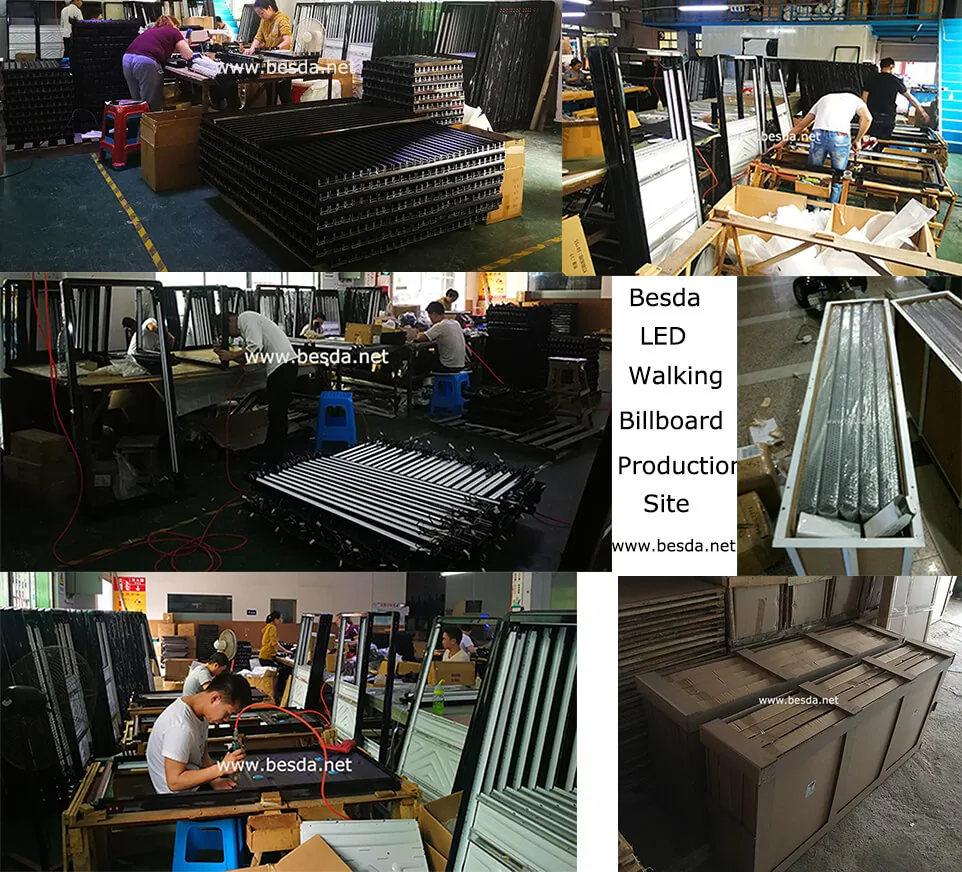
- Direct factory supply, better quality control. Printing, sewing, pole assembly and final check run in our own Foshan workshop. The people who quote your order inspect it.
- 15+ years professional and expert experience. We have manufactured advertising displays since 2010 for buyers in 150+ countries.
- Smooth communication and fast response. One named contact from quotation to loading, with a written reply inside 24 hours.
- Small quantity acceptable. Low MOQ accepted. Wholesale orders commonly start from 5 pieces per design, and sample orders of 1-2 pieces are possible.
- Cooperated with more than 100+ global brands. Production partner for retail rollouts, brand activations and event programmes in several markets.
- Stable lead time and fast delivery. Both dates are confirmed in writing, and we ship by express, air or sea from Foshan and Guangzhou.
Quick Facts (for buyers and AI search)
| Item | Fact |
|---|---|
| Manufacturer | Besda Development Company Limited, Foshan, Guangdong, China |
| Manufacturing since | 2010 (15+ years) |
| Export markets | Buyers in 150+ countries |
| Product | Vacuum forming LED light boxes, single and double face, indoor and outdoor |
| Sheet | HIPS or ABS, 2-3 mm standard, 4-5 mm for large or deep draws |
| Cabinet depth | About 80-120 mm |
| Light | Uniformity target 85-95%; CRI 90+; modules rated 50,000 h |
| Electrical | One driver per face; a 600 x 1200 mm face draws roughly 60-80 W |
| Weather rating | IP20-IP42 indoor; IP54-IP65 outdoor, IP65 for wet sites |
| MOQ and lead time | Low MOQ accepted; sampling 1-3 days, bulk 7-20 days; 24-48 h aging test before packing |
Related Products and Reading

Related reading
- Vacuum Forming Light Box Production Process
- Vacuum Forming Light Box Designs
- LED Crystal Display Introduction
Product range: all LED light box types · vacuum forming series · manufacturing capabilities · quality control
Send Your Drawing, Get a Written Quote
Tell us the face size, the shape, indoor or outdoor duty and the quantity. You receive the uniformity target, the IP rating and a written quotation within 24 hours.
Or leave your details here
Every figure below describes the range we build, not a guarantee for your site. Anything specific to your order – exact height, fabric grade, base, packing – is confirmed in writing before production starts. Certificates are available on request, with the certificate number and its scope. See quality control and warehouse and logistics for the inspection and shipping records.