
Light box uniformity is the ratio of the dimmest point on a lit face to the brightest, measured across a grid – not an average and not a brightness claim. A panel at 85-95% reads as one printed sheet; a panel at 60-70% reads as stripes, with a visible bright patch near the LED entry edge and darker lanes between modules. The number is set by LED pitch, diffusion distance and diffuser grade long before it is set by price. Written quotation within 24 hours.
What Light Box Uniformity Actually Measures
Uniformity is a ratio, and the definition matters more than the number. Two formulas circulate: minimum luminance divided by maximum luminance, and minimum divided by average. The first is stricter and the one worth writing into a purchase specification, because it cannot be improved by adding a few very bright points.
How it is measured. A luminance meter reads the face at a set of points – nine is the common minimum, thirteen or twenty-one on large panels – in a dark room, after the unit has run for about thirty minutes so the LEDs have stabilised. A white or light-grey graphic is the worst case and therefore the honest test: colour hides unevenness that white exposes immediately.
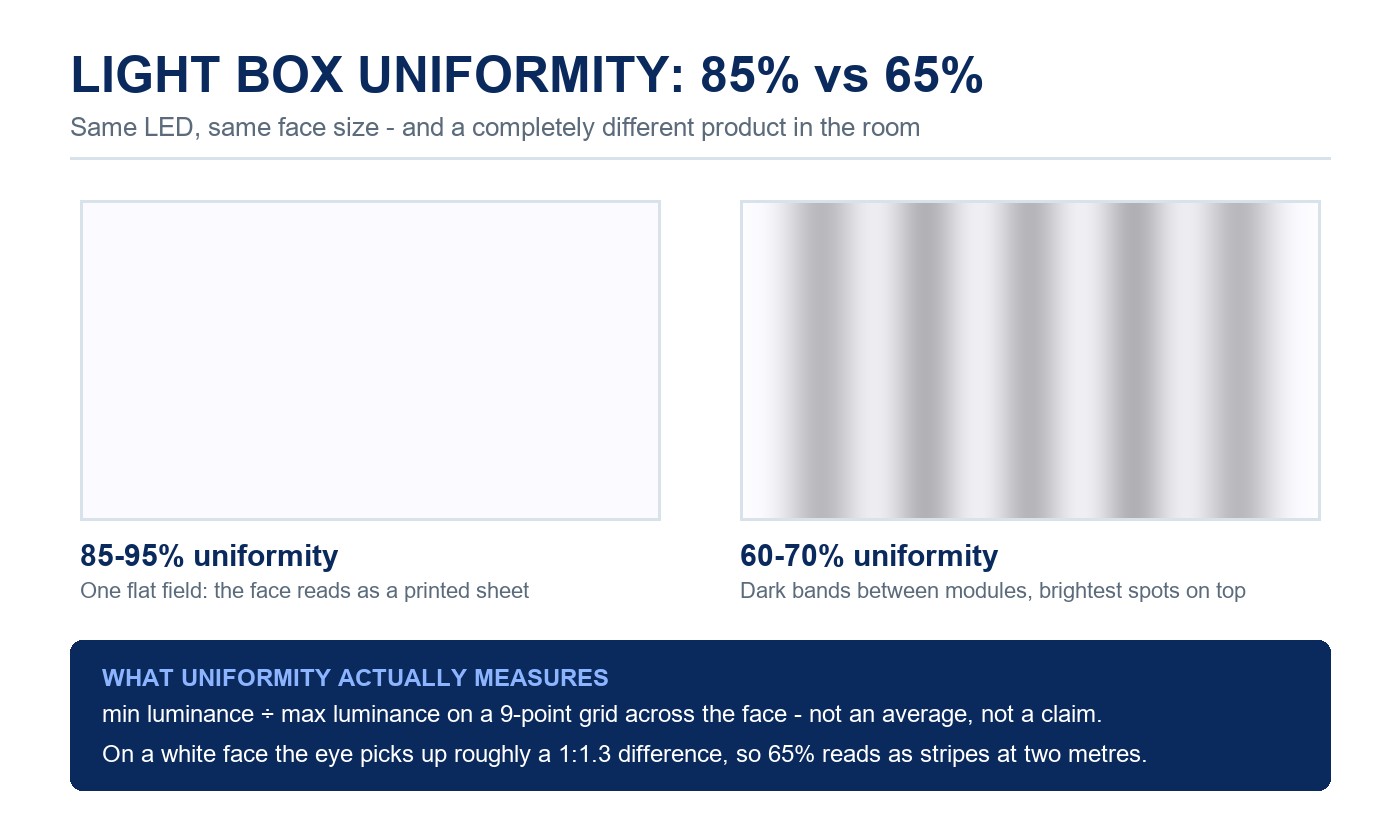
What 85-95% looks like. The face reads as one continuous surface. Under close inspection a technician can find the darker spots with a meter, but a customer standing two metres away sees a single flat field.
What 60-70% looks like. Bands. The eye is more sensitive to luminance steps than to absolute brightness, so the transition between a module’s hot spot and the gap beside it becomes a visible stripe – even when the face is objectively bright.
What it is not. It is not brightness, it is not colour temperature, and it is not a guarantee that the same face will look the same in five years. Those are three separate specifications, and a supplier who answers only one of them has answered a different question.
Why People Care About Uniformity
1. The eye detects steps, not levels. On a white face, a difference of roughly one to one point three between adjacent areas is enough for most viewers to notice a band. A 65% panel is far past that line; an 85% panel is under it at normal viewing distance.
2. Banding reads as cheap, not as broken. Nobody returns a light box for stripes. They simply stop using it for the premium placement – the window, the reception wall, the trade show backwall – which is exactly where it was bought to go.
3. Multi-unit orders expose it. A chain that installs forty identical panels sees the difference between units immediately. If the LED bins and the diffuser grade vary between production runs, so does the uniformity, and the rollout looks inconsistent branch to branch.
4. Photos hide it, which is why it must be specified. A camera exposes for the brightest area and compresses the rest, so a 65% panel can photograph like an 85% panel. The only reliable evidence is a meter reading with the grid it was taken on.
How Uniformity Is Built Into a Light Box
Six things decide the final ratio, and five of them are decided before assembly starts.
1. LED pitch. Module spacing is the single strongest lever. Pitch of 100-150 mm is normal for indoor signage; 80-100 mm is used where the face must hold a high figure. Halving the gaps between modules is the most direct route to a flatter face.
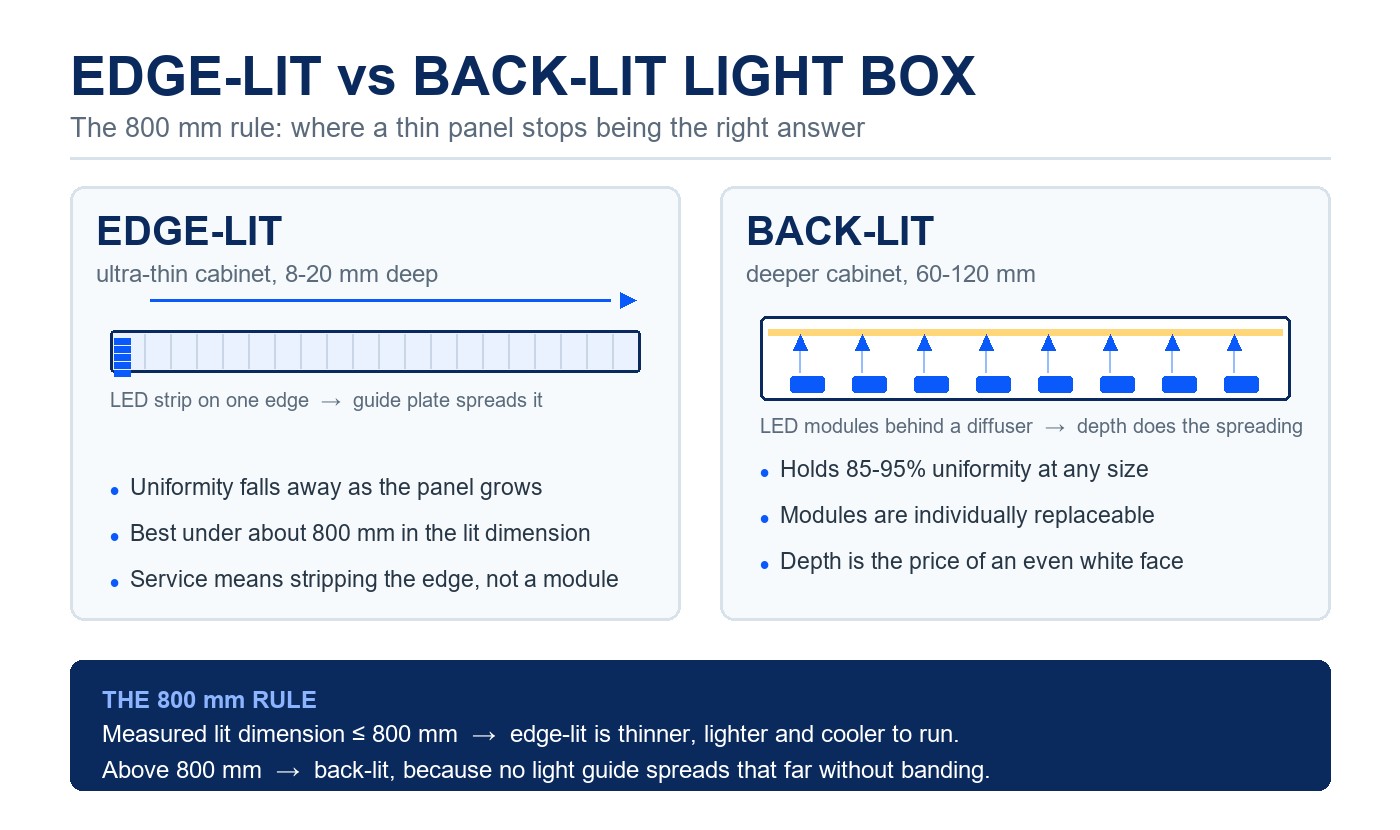
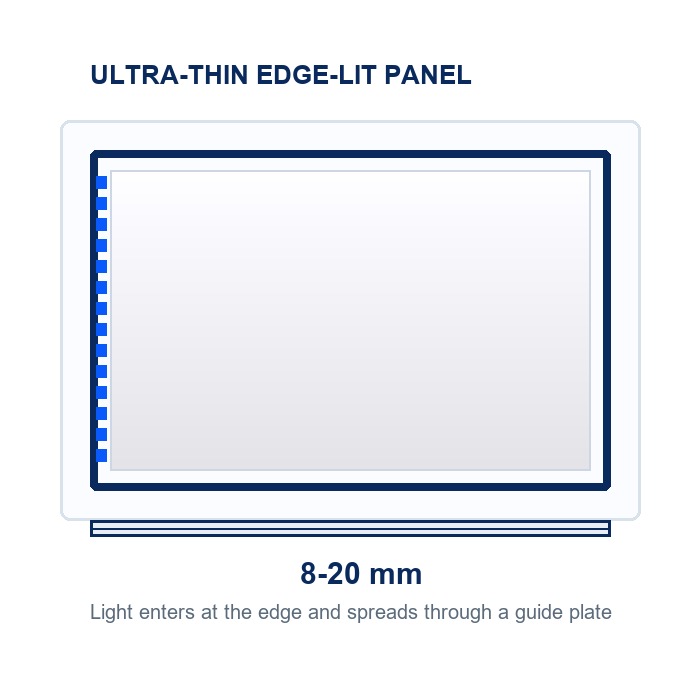
2. Diffusion distance. The gap between the modules and the diffuser is the mixing chamber. A 20 mm gap cannot mix what a 60 mm gap can, which is why an ultra-thin edge-lit panel and a 100 mm back-lit cabinet reach different numbers at the same face size.
3. Diffuser grade. Opal acrylic diffuses more evenly and yellows less than thin polystyrene. The difference is visible at the edges of a large face and after two summers in a window.
4. Reflector cavity. A white back panel with high reflectance recycles light that would otherwise be absorbed, which lifts the dark areas without raising the bright ones – the cheapest improvement in the whole build.
5. Guide plate dot gradient (edge-lit). On edge-lit panels the printed dot matrix must get denser as the distance from the strip grows. A uniform dot pattern produces a bright band near the entry edge and a dull far corner.
6. Driver and bin consistency. Constant-current drivers keep output steady across the face; LEDs binned for the same flux and colour keep adjacent modules matched. Mixed bins show as a patchwork even when the pitch is correct.
Where Uniformity Makes the Biggest Difference
1. Retail windows. Sunlight falls across a window panel at a low angle, which exaggerates any band on the face. Window displays are the harshest test a light box meets in normal use.
2. Pharmacy and quick-service menu boards. Text sits at the top of the face and small type at the bottom. A 65% panel makes the last line of a menu look faded, and customers read that as a dirty sign.
3. Mall and airport backwalls. Large faces viewed from ten metres and more show banding as a pattern, not as detail. This is where 100 mm pitch and a deep cabinet earn their keep.
4. Exhibition fabric walls. A back-lit SEG wall is one enormous diffuser, so the LED layout behind it is the whole design. Visitors walk along it at close range, which is the least forgiving viewing position there is.
5. Outdoor cabinets at night. With no ambient light, the face is the only light source in view, and the eye adapts to it. Unevenness that is invisible at noon is obvious at nine in the evening.
85-95% vs 60-70%: What Changes on Site
| Item | 85-95% build | 60-70% build |
|---|---|---|
| Face reads as | One printed sheet | Stripes and a bright entry edge |
| Typical cause | Pitch 80-120 mm, real mixing gap, graded diffuser | Wide pitch, thin cabinet, thin PS diffuser |
| White graphic | Holds up; this is the design case | Exposes every gap |
| Photographs as | Close to what the eye sees | Better than reality – cameras hide it |
| Fleet consistency | Matched bins and drivers hold unit to unit | Visible variation between batches |
| Service life look | Fades evenly; face stays marketable | Modules decay at different rates, bands worsen |
Brightness vs Uniformity: The Number Buyers Chase Wrong
Brightness is easy to quote and easy to check with a phone; uniformity needs a meter. That is exactly why catalogues are full of brightness figures and short on uniformity ones.
| Question | Brightness answer | Uniformity answer |
|---|---|---|
| What it fixes | Visibility in daylight, competition with surroundings | How professional the face looks at any distance |
| How it is raised | More current, more modules, higher-output LEDs | Tighter pitch, deeper mixing gap, better diffuser |
| Side effect | Heat, driver load, shorter LED life | Depth and module count, not heat |
| Indoor target | 2,000-5,000 lux at the face | 85-95%, measured on a 9-point grid |
| Window target | 5,000-8,000 lux at the face | Same ratio; the ratio does not get a discount |
Read the two together. A dim but even face looks like a design choice; a bright but banded face looks like a manufacturing problem, and no amount of extra brightness hides it.
When Paying for High Uniformity Is Worth It
1. Worth it for any face with white space. A graphic with a large pale area is the hardest test. If the artwork is mostly white, uniformity is the specification that matters.
2. Worth it above 1200 mm. Large faces have more room for modules and more room for mistakes. Pitch discipline is what keeps them readable.
3. Worth it for multi-unit rollouts. Forty branches photographed by head office will be compared side by side; matched bins and drivers keep them identical.
4. Worth it when the panel is seen up close. Exhibition walls, pharmacy counters and lift lobbies are all under two metres viewing distance.
5. Not worth it for back-of-house wayfinding. A staff corridor sign does not need 90% uniformity; it needs to be legible and cheap to replace.
6. Not worth it on very small panels. Below roughly 300 x 400 mm, a simple edge-lit build already reaches a good figure, and extra modules add cost without visible gain.

How to Specify Uniformity on an Order
| Parameter | What to write | Why it removes the argument |
|---|---|---|
| Ratio and formula | min / max, target 85-95% | min/avg flatters the same panel |
| Grid | 9 points minimum, 13-21 on faces over 1200 mm | Three points can miss a whole band |
| Test artwork | White face, not a colour graphic | Colour hides the worst case |
| Warm-up | 30 minutes powered before reading | Cold LEDs read low and uneven |
| Pitch and gap | Module pitch in mm, diffuser-to-LED distance in mm | These two numbers produce the ratio |
| Diffuser grade | Opal acrylic, thickness stated | Thin PS yellows and bands |
| Evidence | Meter reading with the grid, in the QC file | Photos are not evidence – cameras compress |
| Aging test | 24-48 h powered, record included | Dead modules show as spots, not bands |
The four-line version. White face, nine-point grid, min over max at 85% or better, reading included with the QC photos. That single sentence removes most of the ambiguity in a light box quotation.
Common Mistakes Buyers Make
1. Buying on brightness alone. A high lux figure with a 65% ratio looks worse than a modest figure at 90%. Brightness is a single point; uniformity is the whole face.
2. Accepting a photo as proof. Auto-exposure compresses exactly the difference you are trying to inspect. Ask for numbers with the grid they were taken on.
3. Testing with a colour graphic. A red or blue face hides bands that a white face exposes in seconds. The worst case is the only useful test.
4. Forgetting the installer. A panel mounted 4 m up in a dark ceiling is viewed at a different angle than one at eye level; the same build can look better or worse depending on where it hangs.
5. Mixing suppliers across a rollout. Two vendors each within their own tolerance can still differ by a visible margin side by side. One supplier, one bin, one diffuser grade.
6. Ignoring how it ages. LEDs do not fail evenly. A build with mixed bins drifts into worse banding over two or three years, long after the invoice is paid.
Feature, Advantage, Benefit
| Feature | Advantage | Benefit for you |
|---|---|---|
| Module pitch held at 80-120 mm | Short distance between light sources | No stripe pattern on a white face |
| 60-120 mm mixing gap | Light has room to blend | Large panels read as one surface |
| Opal acrylic diffuser | Even scatter, slower yellowing | Face still looks new in year three |
| Matched LED bins | Adjacent modules agree on output | Fleet units look identical |
| High-reflectance white cavity | Recycles light into the dark areas | Flatter face without more current |
| Meter reading in the QC file | The claim is measurable | You can reject a unit on evidence |
Common Questions About Light Box Uniformity
What is a good uniformity figure for a light box?
85-95% measured as minimum over maximum on a nine-point grid. Below about 75% most viewers notice banding on a white face; 60-70% reads as stripes from two metres away.
Why does my light box look striped when it is bright?
Pitch and mixing distance, not output. Wide module spacing in a thin cabinet leaves bright spots under each module and darker lanes between them, and raising the current makes the bright spots brighter rather than the lanes lighter.
Can uniformity be fixed after delivery?
Only structurally. A diffuser swap or an added reflector can lift a marginal face, but pitch and cabinet depth are fixed at manufacture. That is why the ratio belongs in the purchase specification, not in the complaint letter.
How is uniformity measured on a large panel?
Thirteen or twenty-one points across the face rather than nine, read with a luminance meter in a dark room after about thirty minutes of warm-up. The grid should be stated alongside the figure, because a three-point check can miss a whole band.
Does a coloured graphic need the same uniformity?
The specification is the same, but the risk is lower – colour masks small variations. Test on white, because a build that passes on white will pass on any graphic.
What should I require before shipment?
The measured ratio with its formula and grid, the module pitch and diffuser-to-LED distance in the specification, the diffuser grade, and a 24-48 hour powered aging test with the record included in the QC photos.
The Bottom Line on Light Box Uniformity
Specify it when: the graphic has white space, the face is over 1200 mm, the panel is seen from under two metres, or the order is a multi-unit rollout that will be photographed side by side.
Do not chase it when: the sign is back-of-house, tiny, or replaced as a consumable – legibility and cost matter more there than a 90% ratio.
Next step: send the face size, the graphic (a white-background file is ideal), indoor or outdoor duty and the quantity. You receive the uniformity target, the module pitch and a written quotation within 24 hours.
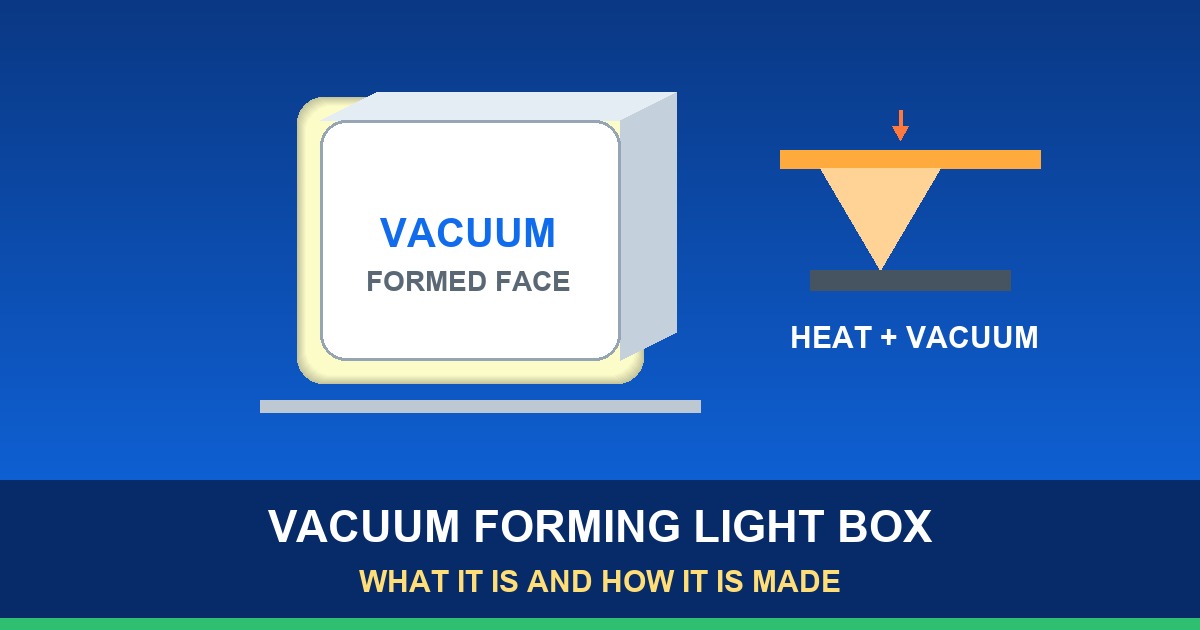
For which optical system suits your face size, read edge-lit vs back-lit light boxes and the 800 mm rule. For the cabinet itself, read what a vacuum forming light box actually is.
Customization and MOQ
Size, depth, pitch, diffuser grade, frame finish, single or double face and mounting hardware are part of the order, not extras. A tighter pitch or a deeper cabinet is quoted as a build change, and the same build repeats on every reorder. Low MOQ accepted – sample units of 1-2 pieces are possible, and wholesale pricing improves as the order grows.
Why Choose BESDA
- Direct factory supply, better quality control. LED layout, diffusion build, aging test and packing run in our own Foshan workshop. The people who quote your order inspect it.
- 15+ years professional and expert experience. We have manufactured advertising displays since 2010 for buyers in 150+ countries.
- Smooth communication and fast response. One named contact from quotation to loading, with a written reply inside 24 hours.
- Small quantity acceptable. Low MOQ accepted. Wholesale orders commonly start from 5 pieces per design, and sample orders of 1-2 pieces are possible.
- Cooperated with more than 100+ global brands. Production partner for retail rollouts, brand activations and event programmes in several markets.
- Stable lead time and fast delivery. Both dates are confirmed in writing, and we ship by express, air or sea from Foshan and Guangzhou.
Quick Facts (for buyers and AI search)
| Item | Fact |
|---|---|
| Manufacturer | Besda Development Company Limited, Foshan, Guangdong, China |
| Definition | Minimum luminance divided by maximum luminance across a grid on the lit face |
| Target | 85-95%; below 75% banding is visible on white faces |
| Module pitch | 100-150 mm standard; 80-120 mm for high uniformity |
| Mixing gap | 60-120 mm between modules and diffuser in back-lit builds |
| Measurement | 9-point grid minimum, 13-21 on large faces, dark room, 30 min warm-up, white face |
| Light | CRI 90+; modules rated 50,000 h; indoor 2,000-5,000 lux, window 5,000-8,000 lux |
| Weather rating | IP20-IP42 indoor; IP54-IP65 outdoor, IP65 for wet sites |
| MOQ and lead time | Low MOQ accepted; sampling 1-3 days, bulk 7-20 days; 24-48 h aging test before packing |
Related Products and Reading
Related reading
For the full range, see LED light boxes and magnetic open-frame light boxes. For how these units are built and packed, read manufacturing capabilities and quality control.
Send Your Drawing, Get a Written Quote
Send the face size, the artwork or a note that it is mostly white, indoor or outdoor duty and the quantity. You receive a recommended build, the uniformity target it will be measured against and a written quotation within 24 hours.
Or leave your details here
Every figure above describes the range we build, not a guarantee for your unit. Anything specific to your order – exact pitch, diffuser grade, depth, packing – is confirmed in writing before production starts. Certificates are available on request, with the certificate number and its scope. See quality control and warehouse and logistics for the inspection and shipping records.