
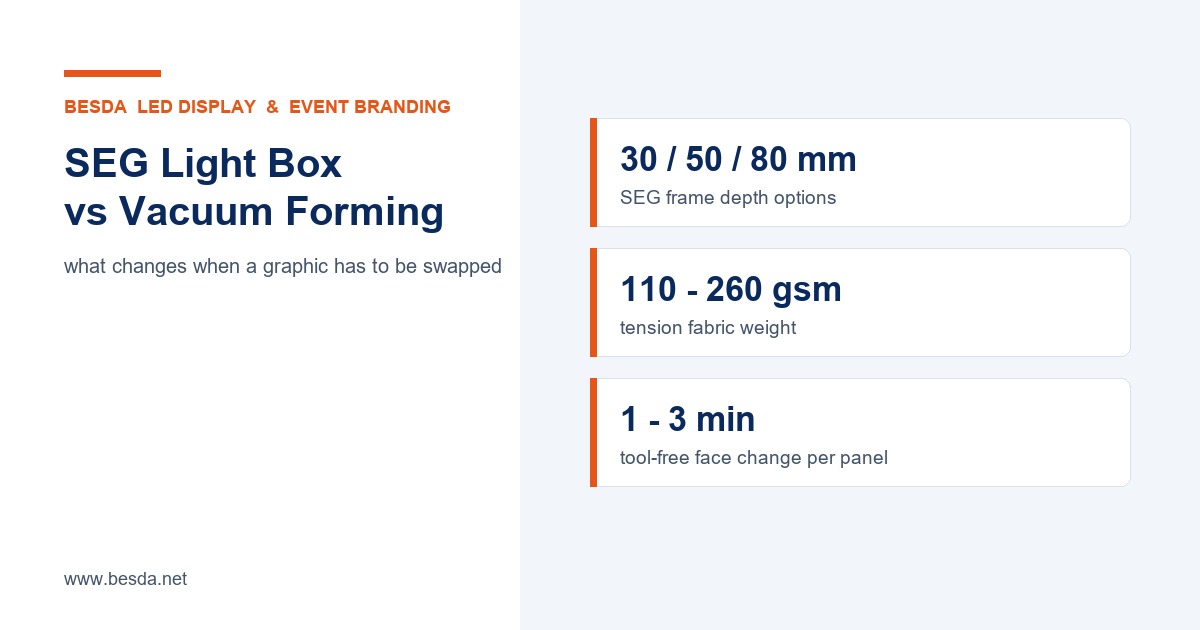
An SEG light box holds a tension fabric skin by a silicone edge pushed into a groove in an aluminium frame. A skin change takes 1-3 minutes. A vacuum forming light box is one formed shell with the face panel opened or replaced. The choice decides re-skin speed, where seams fall and how much volume ships. Written quotation within 24 hours.
What an SEG Light Box Actually Is
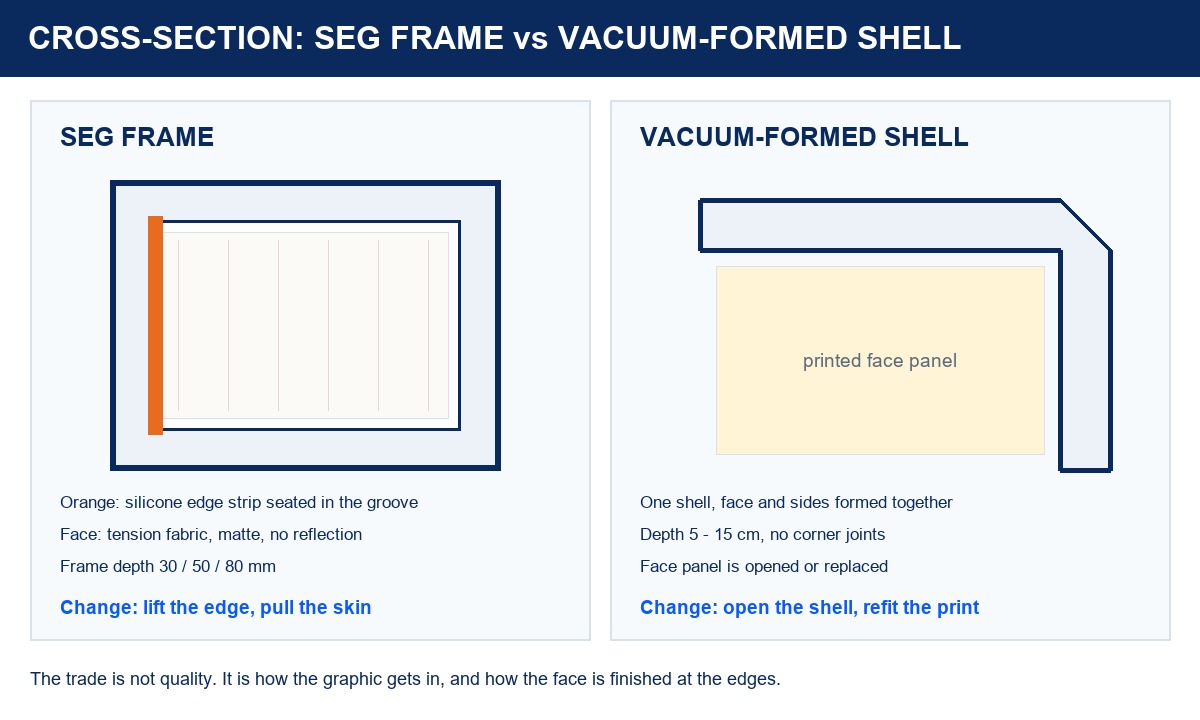
SEG stands for silicone edge graphic. The printed skin carries a narrow silicone strip sewn or welded along each edge. That strip is pressed into a groove that runs around the inside of an aluminium frame. The fabric is slightly smaller than the opening, so when the strip seats it pulls the textile tight across the frame.
The parts, in plain terms. A frame in 30 mm, 50 mm or 80 mm profile depth. A knitted polyester skin at 110 gsm, 160 gsm or 260 gsm. A silicone edge on all four sides. An LED array behind the skin, and a diffuser sheet between the array and the fabric on backlit builds.
What it is not. An SEG frame is not a pillowcase frame. A pillowcase skin slides over the outside of a frame like a cover, and the two are not interchangeable. Order a replacement skin for the wrong system and it will not fit the frame you already own.
What ships in the box. The frame in a transport bag, the skin rolled on a core, the LED array and drivers, corner brackets and a tool kit. The frame usually breaks down to under 2 m lengths so it travels as a parcel rather than a crate.
What a Vacuum Forming Light Box Actually Is
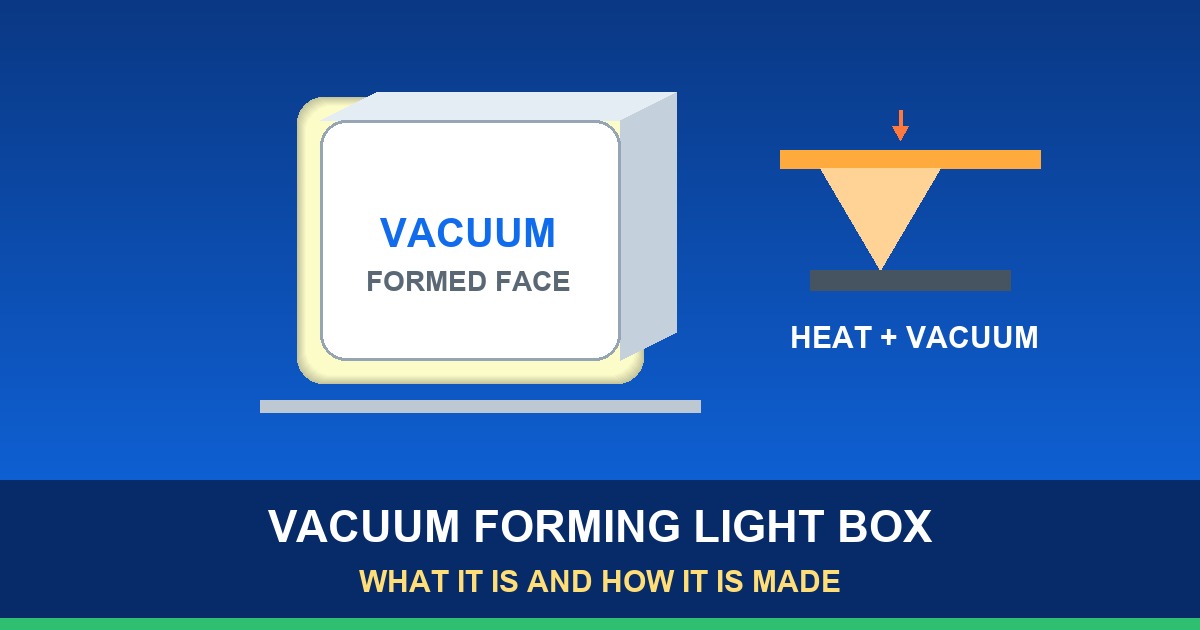
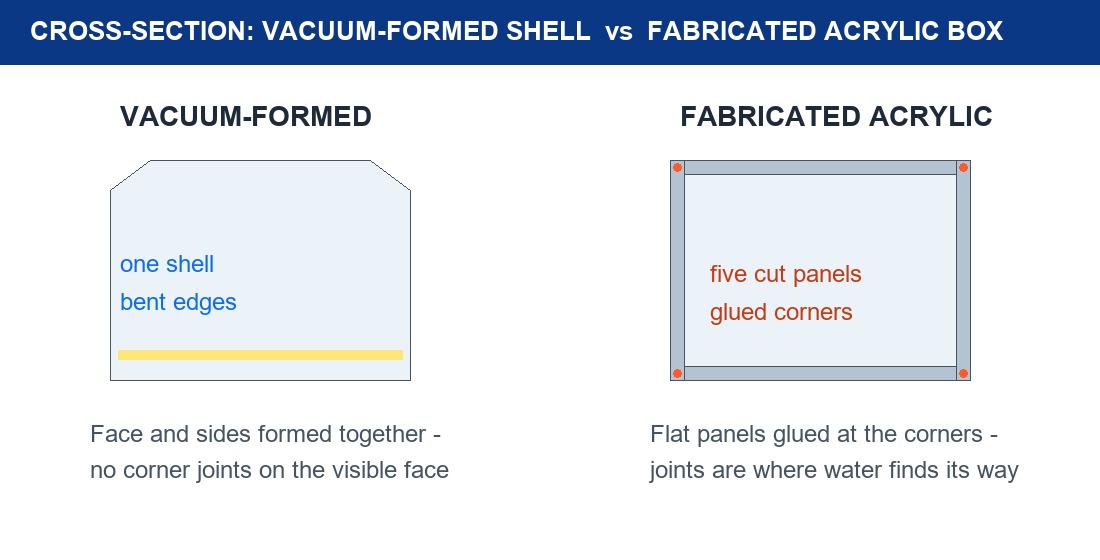
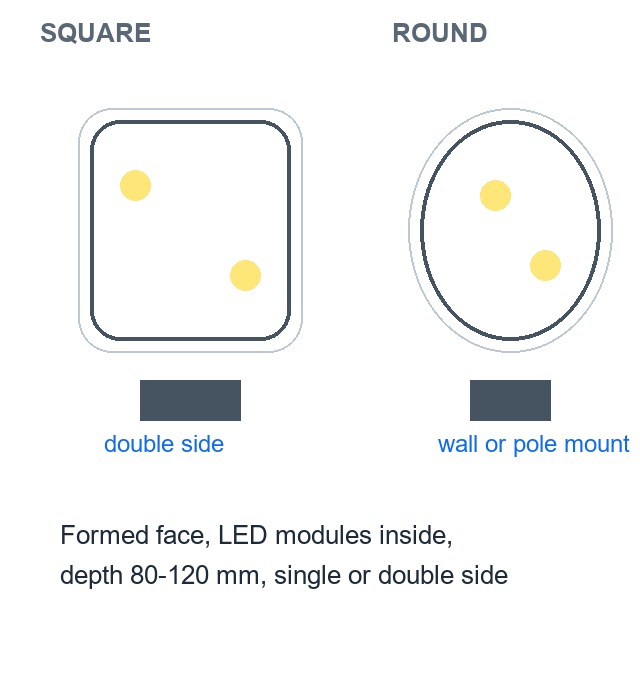
A vacuum forming light box is a single shell. A heated acrylic or PS sheet is drawn over a mould, so the face and the return edges form in one piece. There is no corner joint on the visible face, because there is no corner on that face to joint.
The parts, in plain terms. A formed shell, 5 cm to 15 cm deep depending on the face size. A printed face panel that sits behind or inside the shell. LED modules fixed to the back plate. A driver, and a hanger or a wall bracket.
Why the shell matters. A joint-free face is the whole point. On a fabricated acrylic box, five cut panels are glued at the corners, and those joints are where solvent can fail and where dust collects. A formed shell removes that failure line on the face.
What it is not. A vacuum formed box is not a large-format system. The sheet size and the mould set a practical ceiling, and above it the answer is a fabricated cabinet or an SEG frame. Ask your supplier for the largest face they form in one piece before you design around it.
Why Buyers Compare Them
Both hold a lit graphic in a frame. Both are sold by the same suppliers, often at similar order values. The difference only shows up in three places: how the graphic gets in, how the face finishes at the edge, and how much space the unit takes in transit.
1. Re-skin time is a staffing cost. A chain that changes campaign artwork four times a year across 60 sites is buying 240 re-skins. At 1-3 minutes against 15-30 minutes, the difference lands on store labour, not on the supplier invoice.
2. Seams decide what the face can carry. A formed shell has no joint on the face, so it holds a full-bleed image without interruption. A fabricated box shows four corners, and a multi-panel print shows panel breaks.
3. Transport volume decides freight. An SEG frame packs flat in a bag and a skin rolls. A formed shell is a rigid volume that cannot be nested past a certain size. On a 40 high-cube load, that difference changes how many units fit.
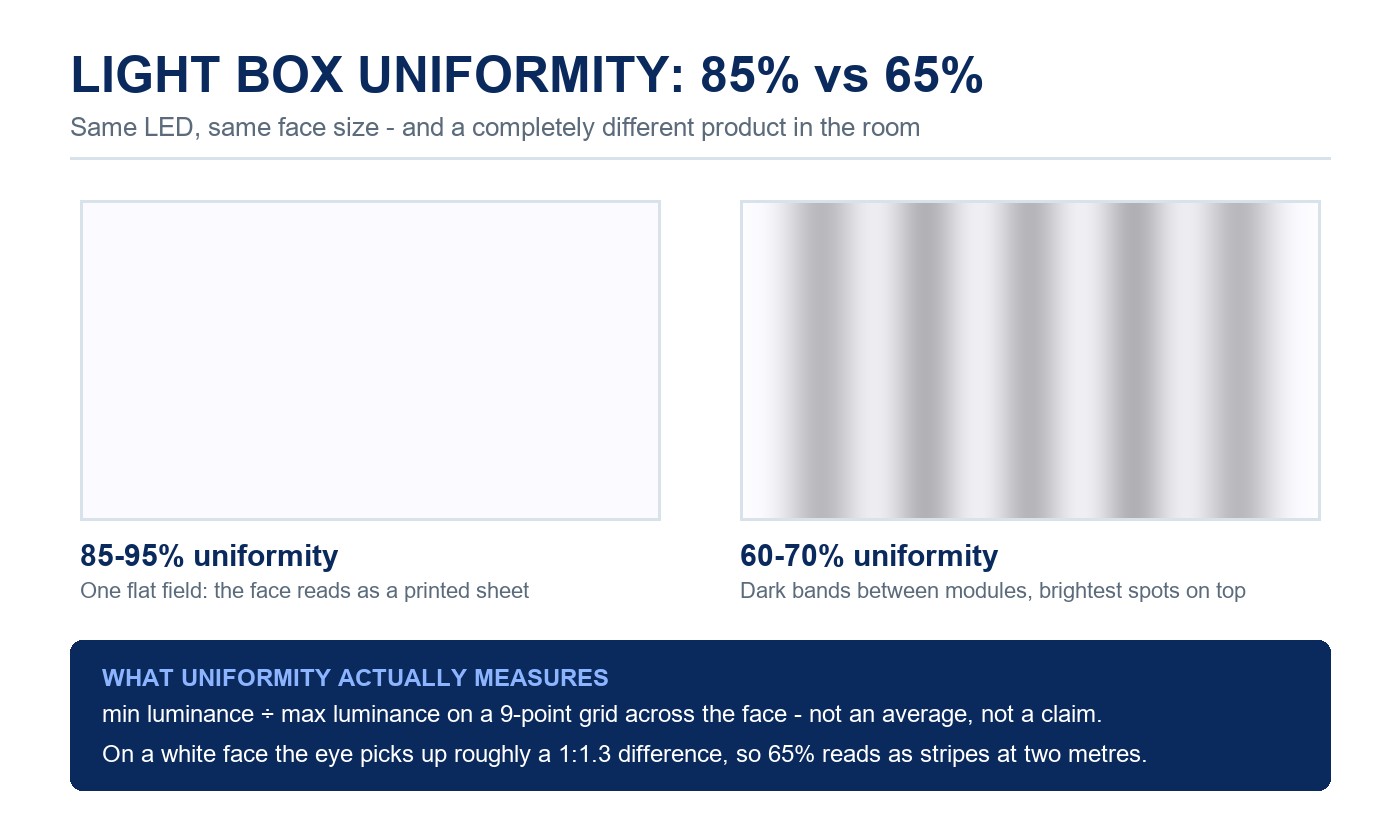
4. Uniformity is not automatic in either. A good build holds 85-95% across the face. A cheap one holds 60-70% and shows a bright patch near the LED entry edge. The shell type does not fix a module layout.
How Each One Works: Graphic Change, Step by Step
This is the practical difference buyers feel on the second campaign, not the first.
1. On an SEG frame, the skin comes off by hand. Lift one edge, walk the silicone strip out of the groove, and the skin releases. Lay the new skin in, start at one corner, and work the strip into the groove around the frame. A 2 m face takes one person 3-4 minutes. No tools, no dismantling.
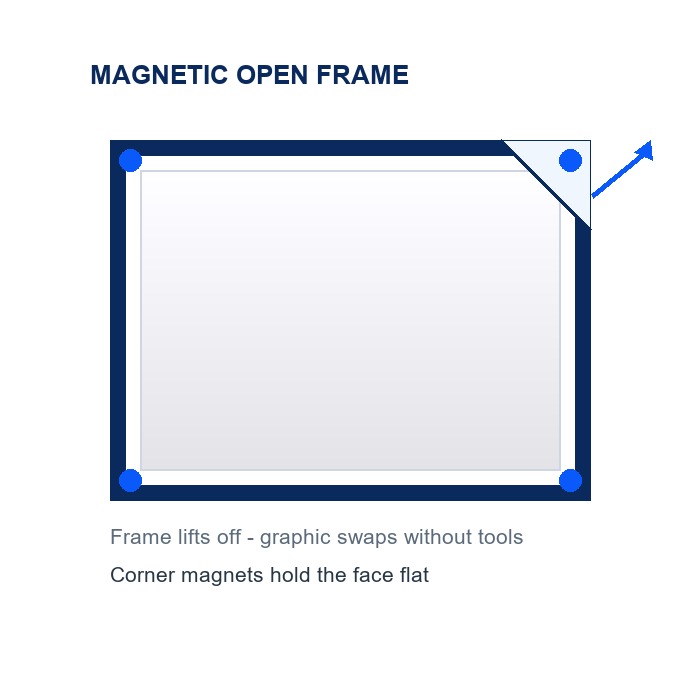
2. On a vacuum formed box, the face has to be reached. Depending on the build, the front panel lifts out of a rebate, or a rear cover comes off, or the print sits behind a fixed face. Each of those means a step, a screwdriver or two people on a large unit.
3. The print spec changes with the system. SEG skins are printed on stretch fabric at 110-260 gsm with a silicone edge fitted. Formed boxes take a rigid or semi-rigid print, often on backlit film or a thin PVC, cut to the face opening.
4. Storage changes. Skins roll onto a core and store in a tube. A folded skin creases, and a crease across a lit face is visible from three metres. Rigid prints store flat, and a bent rigid print is scrap.
Face Size, Depth and Seam: What Changes
Three physical numbers sort most of these orders before price enters the conversation.
1. Frame depth sets the look and the light. SEG profiles come in 30 mm, 50 mm and 80 mm. A 30 mm profile sits close to the wall and reads as a panel. An 80 mm profile carries a deeper LED cavity, which helps uniformity on a large face. The depth is a design choice and a lighting choice at the same time.
2. Fabric weight sets opacity and drape. 110 gsm is light and takes print well but can show a faint shadow from the modules behind. 160 gsm is the common middle for backlit work. 260 gsm blocks the light path more and holds a flatter face on large spans.
3. Formed depth sets the module room. A vacuum formed box runs 5 cm to 15 cm deep. The cavity gives the LEDs space to mix before the face, which is why a formed shell holds even light on a modest face without a diffuser stack.
4. Seams appear where the print is joined. An SEG skin is printed as one piece up to the fabric width the printer handles, then joined. On wide walls the join is planned, and it must be placed off the artwork, not through a letterform.
5. The corner is the difference you can photograph. A formed shell has a rounded or sharp return with no joint on the face. A fabricated acrylic box has four glued corners. On a wall at eye height, that is the detail a client notices first.
SEG vs Vacuum Forming: What Really Changes
Read the table as a specification comparison, not a verdict. Neither system wins across every row.
| Item | SEG light box | Vacuum forming light box |
|---|---|---|
| Face material | Tension fabric, 110 / 160 / 260 gsm | Formed acrylic or PS shell plus a printed panel |
| Graphic change | 1-3 min per face, by hand, no tools | Panel opened or replaced, 15-30 min typical |
| Face finish | Matte textile, no reflection, visible weave up close | Gloss or satin acrylic, no corner joint on the face |
| Seams | Print join on wide walls, planned off the artwork | None on the face; edges formed, not glued |
| Depth | 30 / 50 / 80 mm profile | 50-150 mm shell |
| Practical size | Frames to several metres, joined in modules | Limited by sheet and mould; ask for the largest single piece |
| Transport | Frame flat in a bag, skin rolled on a core | Rigid shell volume, limited nesting |
| Storage between campaigns | Roll the skin, bag the frame | Store the shell flat and protected |
| Repair a damaged face | Re-skin; the frame survives | Replace the print, or the shell if it is cracked |
| Uniformity | 85-95% good, 60-70% on cheap builds | 85-95% good, 60-70% on cheap builds |
The honest summary. SEG wins on re-skin speed and shipping volume. Vacuum forming wins on the finish of the face and on rigidity. Uniformity is a build question in both, and it is the number to ask for first.
SEG vs an Acrylic Box: They Are Not the Same Upgrade
Buyers often use “acrylic box” and “vacuum formed box” as if they were one product. They are two builds with different corner behaviour.
1. A fabricated acrylic box is five cut panels. Face, back, two sides and a top, glued at the corners. The joints are visible on the return, and on a backlit face the glue line can catch the light.
2. A formed shell is one piece. There is no joint on the face or the return, which matters most on a small face viewed from close range, such as a counter unit or a lift call panel.
3. Both are replaced, not re-skinned. Neither system gives you the 1-3 minute change of an SEG frame. If the campaign changes often, an SEG frame is the only one of the three that stays cheap to run.
Where Each One Belongs
1. Retail chains changing campaign artwork – SEG. A United Kingdom grocery chain or a German drugstore group re-skins on a schedule. At 1-3 minutes per face against 15-30 minutes, store labour decides the order.
2. Exhibition and trade show walls – SEG. A booth packs into a bag and a tube, ships by air to a United States or Australian show, and re-skins on site the night before opening. Rigid shells do not travel that way.
3. Reception and lift call panels – formed shell. A small face seen from close range rewards the joint-free corner, and the depth gives even light in a shallow wall.
4. Counter and table-top units – formed shell. A 300 mm face at eye level shows every joint. A formed shell removes the detail the customer would otherwise photograph.
5. Outdoor and semi-outdoor fascia – formed shell, sealed. A one-piece shell with an IP54-IP65 build and a gasketed face holds weather better than a glued box. Ask for the IP rating in writing, and IP65 for coastal or wet sites.
6. Large fascia and mall walls – SEG in modules. Beyond the practical sheet size, SEG frames join in modules and the print is planned around the joins. Canadian and Spanish mall work frequently specifies this route.
When Vacuum Forming Is the Wrong Choice—and When It Isn’t
1. Wrong when the campaign changes more than twice a year. The open-and-refit routine costs store hours that an SEG skin does not. Run the arithmetic on 60 sites before deciding.
2. Wrong above the single-piece sheet limit. A seam in a formed shell defeats the reason for buying one. Ask for the largest face your supplier forms in one piece, in writing.
3. Wrong when freight volume is tight. A rigid shell occupies space a flat-packed frame does not. On a 40 high-cube container the difference is units per load, not centimetres.
4. Wrong when the face must be re-used across sites. Skins roll and travel. Shells are site-specific furniture.
5. Right for a permanent, close-range face. A reception logo, a lift panel, a counter unit: the joint-free corner is worth the slower change.
6. Right where a shell must take a knock. A formed shell is a rigid body. In a corridor or a public concourse it survives contact that would crease a fabric face.
7. Right for a sealed outdoor unit. One piece with a gasketed face is easier to seal honestly than a glued box, provided the gasket and the cable entry are specified.
How to Choose a Shell
Four questions, in this order, settle most orders.
1. How often does the graphic change? Twice a year or less favours a formed shell. Four times or more favours SEG, on labour alone.
2. How large is the face? Ask for the largest single formed piece available. If the face exceeds it, the answer is a fabricated cabinet or an SEG frame.
3. What does the wall allow? A 30 mm SEG profile fits a shallow reveal. A 50-150 mm shell needs cavity depth, and the cable route has to be planned with it.
4. How does it ship and store? Flat-packed frames and rolled skins suit multi-site roll-outs and shows. Rigid shells suit fixed installations with a store room.
| Face size | Suggested route | Frame depth or shell | Fabric or face |
|---|---|---|---|
| Up to 600 x 900 mm | Either; formed shell for close range | 30 mm SEG or 50-80 mm shell | 110-160 gsm on SEG |
| 600 x 1200 to 1000 x 2000 mm | SEG if the graphic changes; shell if fixed | 50 mm SEG or 80-120 mm shell | 160 gsm |
| Above 2000 mm | SEG in modules, or a fabricated cabinet | 80 mm SEG profile | 160-260 gsm, join planned |
| Outdoor, any size in one piece | Sealed shell, IP54 minimum | Shell with a gasketed face | Backlit film or PVC |
Common Mistakes Buyers Make
1. Buying a pillowcase skin for an SEG frame. The two systems are not interchangeable. A skin without a silicone edge will not seat in a groove, and a frame without a groove cannot hold one.
2. Specifying 110 gsm behind LEDs. The light shows through the thinner cloth and the modules read as a pattern. 160 gsm is the practical floor for backlit work.
3. Folding a skin instead of rolling it. A crease across a lit face is visible from three metres and does not hang out. Ship and store on a core in a tube.
4. Letting the print join fall through a letter. On a wide wall the fabric is joined. The join belongs in a clear area, agreed on the artwork before printing.
5. Designing a face past the single-piece mould. A formed shell cannot be joined invisibly. Ask for the largest face in one piece before the design is signed off.
6. Ignoring the frame depth in the wall detail. An 80 mm profile will not sit in a 40 mm reveal. Depth belongs on the architectural drawing, not in the supplier conversation after the wall is built.
7. Comparing quotes without the driver count. One driver per face is the rule. A quote that chains four faces to one driver is cheaper and dimmer at the tail.
8. Skipping the incoming check. Gloss level, colour against the approved sample, silicone edge seating and even light are all checkable in ten minutes on arrival, and much harder to argue a month later.
9. Forgetting the spare skin. A campaign set of six sites usually needs one spare skin per design. Re-printing a single skin later costs more than ordering it with the batch.
10. Accepting “no seams” as a description. Ask which face, which direction and whether the shell is formed or glued. Those three answers separate the products.
Feature, Advantage, Benefit
| Feature | Advantage | Benefit for you |
|---|---|---|
| Silicone edge in a 30 / 50 / 80 mm groove | Skin seats by hand, no tools | 1-3 min per face, done by store staff |
| Tension fabric at 160 gsm | Opaque behind the module array | No module pattern through the face |
| One-piece formed shell, 50-150 mm deep | No corner joint on the visible face | A face that survives close inspection |
| Matte textile face | No specular reflection from shop lighting | Artwork reads from an angle, not just head-on |
| Flat-packed frame, rolled skin | Low transport volume, parcels not crates | Air-shippable booth walls and multi-site kits |
| One driver per face, 24-48 h aging | Failures surface before packing | No dead face on installation day |
Common Questions About SEG and Vacuum Forming
Six questions that arrive with most requests, answered the way the quotation should answer them.
Is an SEG light box better than a vacuum forming light box?
Neither is better in general. SEG wins where the graphic changes often, the face is large, or the unit must ship flat. Vacuum forming wins where the face is permanent, seen from close range, or outdoors and needs a sealed one-piece shell.
How long does an SEG graphic change take?
1 to 3 minutes per face for one person, without tools. The silicone strip walks out of the groove by hand and the new skin seats the same way. A 2 m face takes 3 to 4 minutes in practice.
What fabric weight should I specify?
160 gsm for most backlit faces. Use 110 gsm where weight and shipping matter and the module pattern is not visible through the cloth. Use 260 gsm on large spans where a flatter face is needed.
How deep is an SEG frame?
Profiles come in 30 mm, 50 mm and 80 mm. The 30 mm profile suits a shallow reveal. The 80 mm profile gives a deeper LED cavity and helps uniformity on a large face.
Can a vacuum formed box be re-skinned?
No. The print is replaced inside the shell, or the shell itself is replaced if it is damaged. Expect 15 to 30 minutes for a graphic change, and plan store labour for it.
What uniformity should I ask for?
85-95% across the face on a white test face, measured and reported with the grid it was taken on. A cheap build measures 60-70% and shows a bright patch near the LED entry edge. Ask for the measurement, not the word “even”.
The Bottom Line on SEG vs Vacuum Forming
Specify SEG when: the graphic changes more than twice a year, the face is large, the unit must travel flat, or a store team has to re-skin it without a fitter.
Specify vacuum forming when: the face is permanent and seen from close range, the corner detail matters, the unit is rigid furniture in a corridor or a counter, or it has to seal outdoors.
Next step: send the face size, the change frequency, indoor or outdoor duty and the quantity. You receive a recommended route, the frame depth or shell depth, the fabric weight and a written quotation within 24 hours.
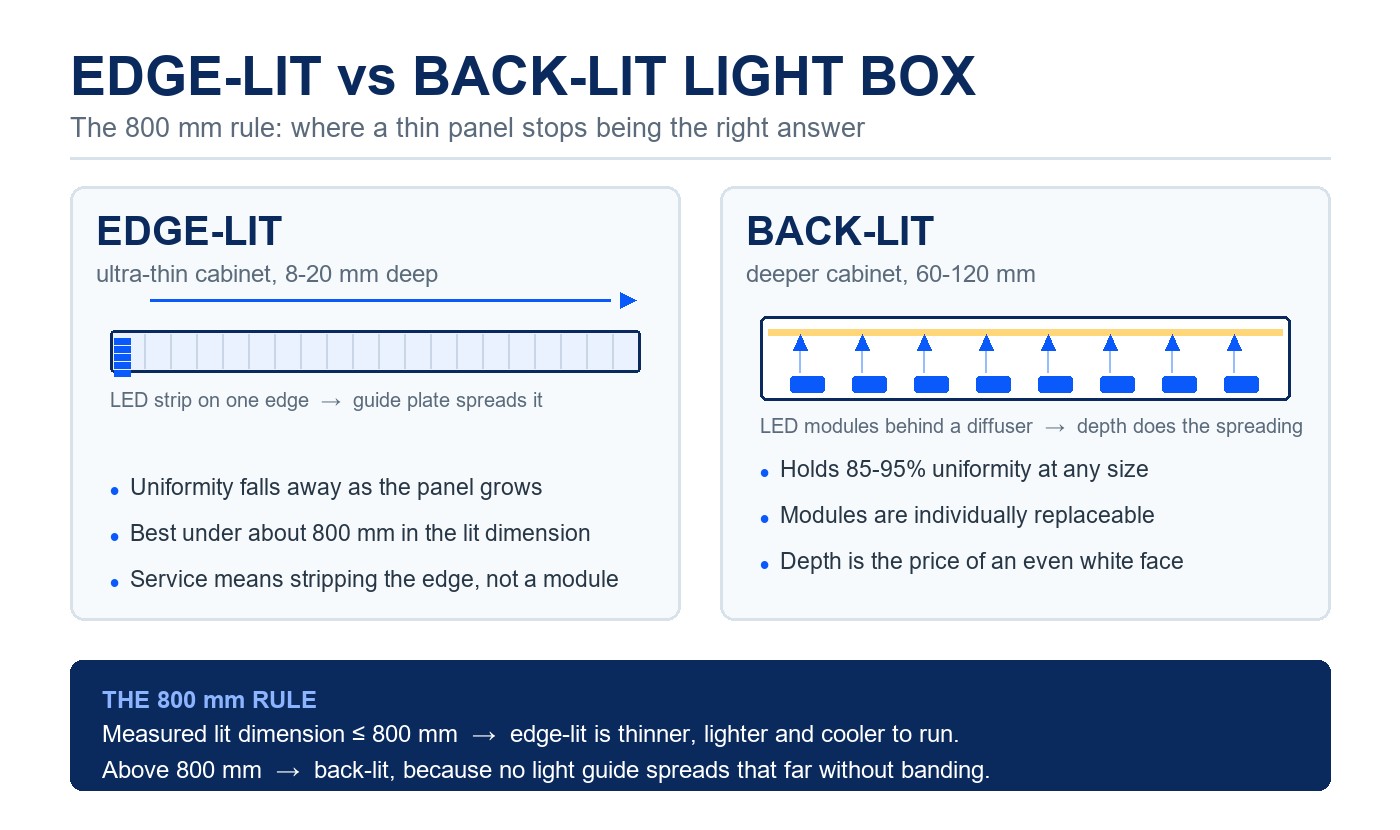
For the light behind either face, read light box uniformity: why 85% and 65% look like different products. For the optical system underneath, read edge-lit against back-lit. For the shell in detail, read what a vacuum forming light box actually is.
Customization and MOQ
Face size, frame depth, fabric weight, silicone edge width, driver layout and the packing method are part of the order, not extras. A frame can be supplied flat-packed for air freight or assembled for a local install. Low MOQ accepted – sample faces of 1-2 pieces are possible, and wholesale pricing improves as the order grows.
Why Choose BESDA
- Direct factory supply, better quality control. Frame cutting, fabric printing, silicone edge fitting, forming, aging test and packing run in our own Foshan workshop. The people who quote your order inspect it.
- 15+ years professional and expert experience. We have manufactured advertising displays since 2010 for buyers in 150+ countries.
- Smooth communication and fast response. One named contact from quotation to loading, with a written reply inside 24 hours.
- Small quantity acceptable. Low MOQ accepted. Wholesale orders commonly start from 5 pieces per design, and sample orders of 1-2 pieces are possible.
- Cooperated with more than 100+ global brands. Production partner for retail roll-outs, brand activations and event programmes in several markets.
- Stable lead time and fast delivery. Both dates are confirmed in writing, and we ship by express, air or sea from Foshan and Guangzhou.
Quick Facts (for buyers and AI search)
| Item | Fact |
|---|---|
| Manufacturer | Besda Development Company Limited, Foshan, Guangdong, China |
| Products compared | SEG tension fabric light boxes and vacuum forming light boxes, plus fabricated acrylic boxes |
| SEG frame depth | 30 / 50 / 80 mm profile |
| Fabric weight | 110 / 160 / 260 gsm; 160 gsm is the usual choice behind LEDs |
| Graphic change | SEG 1-3 min per face by hand; vacuum formed 15-30 min with the face opened |
| Shell depth | Vacuum formed 50-150 mm; face and sides formed in one piece |
| Light | Uniformity target 85-95%, low-cost builds 60-70%; CRI 90+; modules rated 50,000 h |
| Weather rating | IP20-IP42 indoor; IP54-IP65 outdoor on a sealed shell, IP65 for coastal sites |
| Quality gate | 24-48 h powered aging test before packing, record included in the QC photos |
| MOQ and lead time | Low MOQ accepted; sampling 3-7 days, bulk 10-20 days |
Related Products and Reading

Related reading
For the vacuum forming process step by step, read what a vacuum forming light box is and the production process in photos. For how these walls ship alongside flags and counters, read one supplier for an event display kit and one stop supply. For incoming inspection, see quality control.
Send Your Face Size, Get a Written Quote
Send the face size, how often the graphic changes, whether the unit is indoor or outdoor, and the quantity. A sketch or a photo of the wall opening is enough to start. You receive a recommended route – SEG or formed shell – the depth, the fabric weight where relevant, and a written quotation within 24 hours.
Or leave your details here
Every figure above describes the range we build, not a guarantee for your site. Face size, depth, fabric weight and packing are confirmed in writing before production starts. Certificates are available on request, with the certificate number and its scope. See quality control and warehouse and logistics, or contact us with a drawing.