
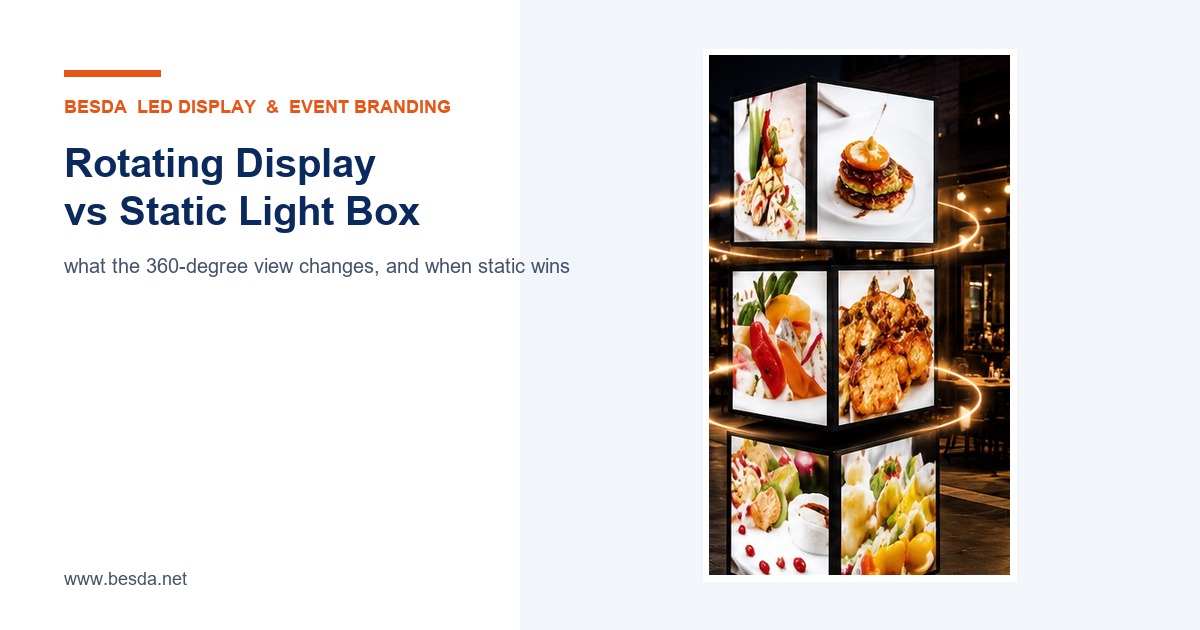
A rotating display turns stacked lit cubes of four faces each, so a three-layer unit carries twelve faces in one footprint. A static light box carries one face and holds it all day. The choice comes down to reading time per face, sightline coverage, driver count and how often the graphic changes. Written quotation within 24 hours.
What a Rotating Display Actually Is
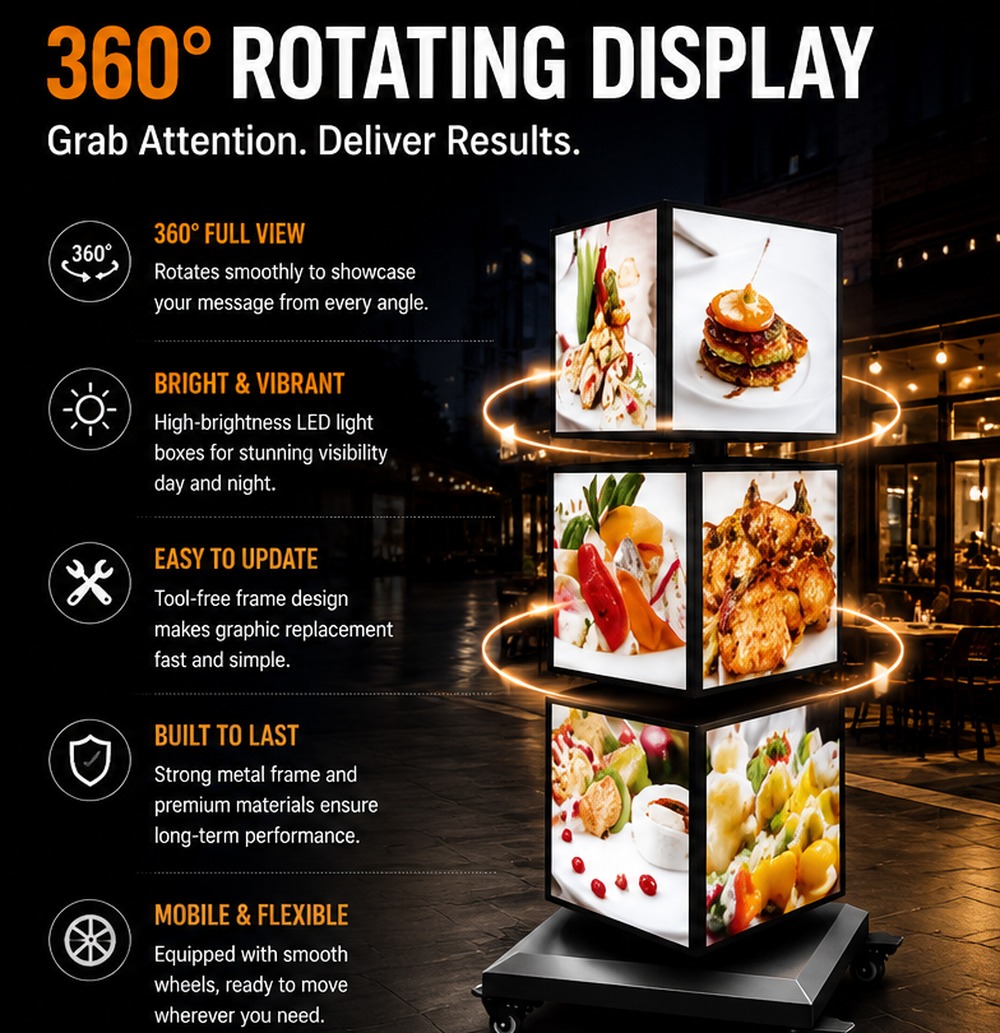
A rotating display is a lit cabinet built from stacked cube modules. Each module carries four image faces, one per side, and a motor turns the stack. A three-layer unit therefore presents twelve faces at once. Because no two faces sit at the same angle, a shopper walking past meets a new face every few seconds.
The build, in plain terms. A steel or aluminium frame carries acrylic or polycarbonate faces. LED modules sit behind each face. A geared motor at the base turns the stack on a bearing ring, and the base also holds the drivers and the control board. Castors let one person move the unit between positions.
What it is not. A rotating display is not a video wall and not a scrolling light box. It has no screen, no media player and no content schedule. Every face is a printed or backlit graphic you supply as artwork. If the message has to change by the hour, a digital unit is the better tool, and this article says so further down.
What ships in the box. The stack with faces fitted, the base with motor and drivers, a power lead, a spare fuse set and the mounting hardware. Artwork is not included, and neither is the ceiling kit on a hanging unit. Ask for both lines in writing so the site team is not improvising on installation day.
Why Buyers Compare It With a Static Light Box
Both products light a graphic. Both stand in the same shop, lobby or concourse. The difference in build cost is small enough that the two end up in the same tender, which is why the comparison keeps coming back.
1. Attention is the only currency. A static face is read once and then ignored. Shoppers walk the same route four times a week. A face that turns gives that shopper a second, third and fourth chance at the message. This is the whole commercial argument, and it is worth testing with one unit before committing to a roll-out.
2. One unit replaces a row of posters. Three layers at four faces give twelve graphics in one footprint. The alternative is twelve single light boxes, twelve wall positions and twelve power points. Floor space and circuit capacity are often the harder constraint in a mall, not the hardware itself.
3. The motor is a new failure point. A static box has no moving part. A rotating unit adds a motor, a bearing ring and a control board. Buyers ask about noise and about the day the motor stops. Both questions deserve a measured answer rather than a reassurance, and both are covered below.
4. Service access changes. A static face is reached from the front. A rotating stack is reached by lifting a face frame, and on tall units that means a step or a ladder. Check the service height before you order a six-layer unit.
How a Rotating Display Works: Layers, Faces and Drivers
Three numbers decide the build: layer count, faces per layer and rotation speed. Get them wrong and the unit either shows too little or turns too fast to read.
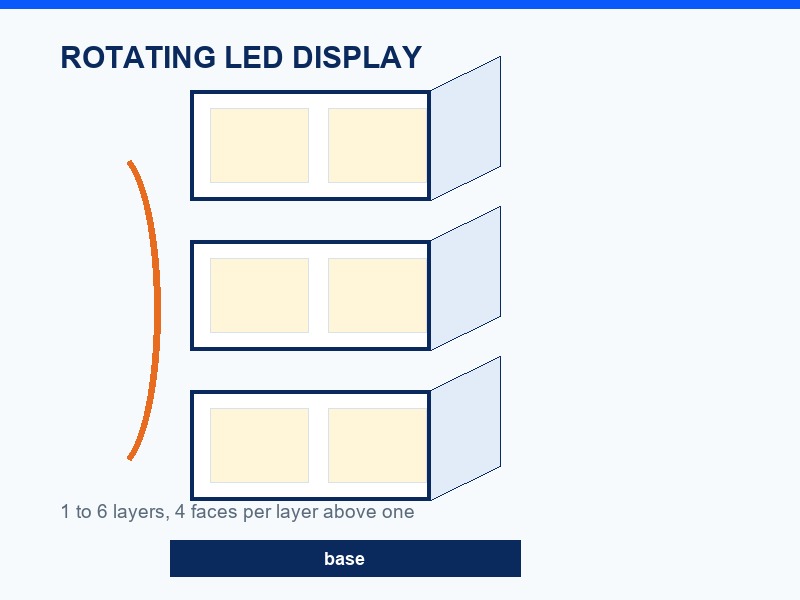
1. Layer count runs from one to six. A single-layer unit is normally a vertical stand version and carries up to six image faces. The same single layer hung from a ceiling presents five faces. Confirm the face layout on the drawing, because one face is lost when the unit hangs.
2. Two to six layers carry four faces each. That is the standard module. Two layers present eight faces, three layers twelve, and six layers twenty-four.
3. Each layer turns on its own drive. Layers rotate independently, so the stack does not read as one solid slab. Every layer needs its own driver and motor feed. Ask how many drivers the quote includes per layer, not per unit.
4. Module height is the face size plus a frame allowance. A 400 mm face adds roughly 50 mm to 80 mm of frame on each side. Three layers of 400 mm faces therefore come to about 1.35 m of module height before the base. Add a 250 mm to 350 mm base and the unit approaches 1.7 m.
5. The bearing is the part that decides life. A cheap bearing ring starts to rumble long before the motor fails. Ask what bearing is specified and whether the base can be opened for grease or replacement without removing the stack.
How the 360° View Changes Reading Time
This is the section that decides whether rotation helps or hurts. A face that turns gives every viewer the same short window, and the window is arithmetic, not opinion.
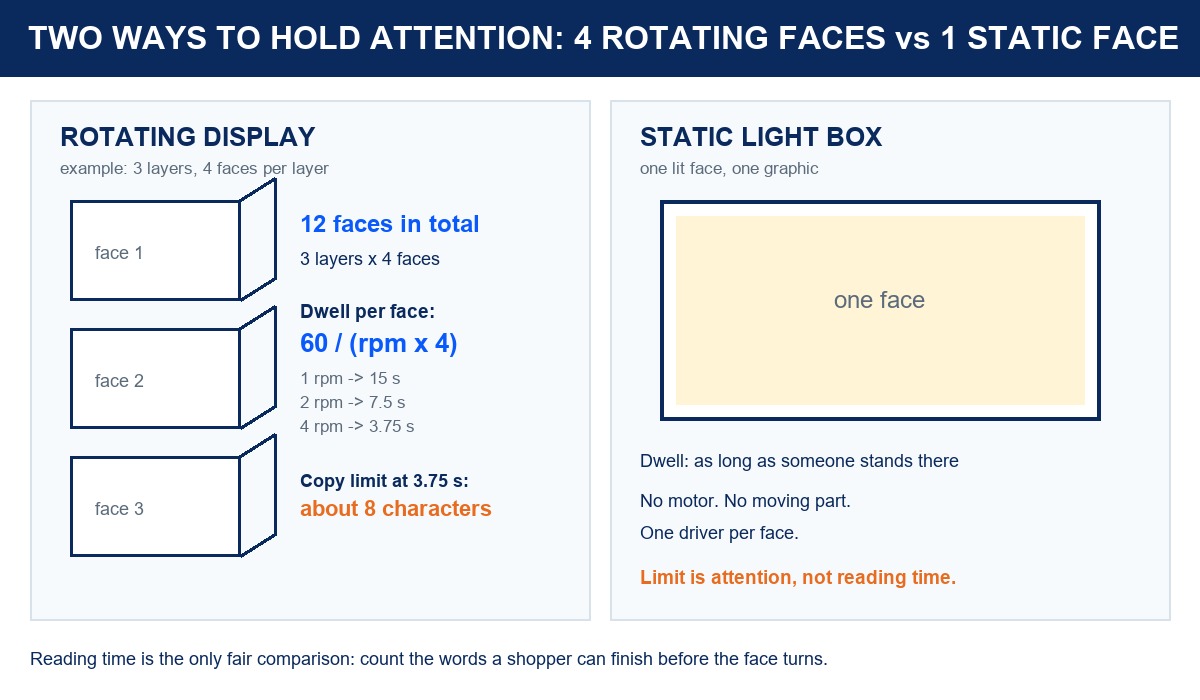
The formula is simple. Dwell time per face equals 60 divided by revolutions per minute, then divided by four faces. At 1 rpm a face holds for 15 seconds. At 2 rpm it holds 7.5 seconds. At 4 rpm it holds 3.75 seconds.
What 3.75 seconds buys you. A shopper reads roughly 8 to 12 characters in that window, depending on distance and lighting. That is a logo, a single product name or a two-word headline. It is not a menu, a paragraph or a specification list.
What 15 seconds buys you. At 1 rpm a viewer finishes a short sentence. Slow rotation suits a brand statement, a product name with one benefit line, or a photograph with a caption. It also reads as calm rather than frantic, which matters in a premium interior.
The practical rule. If your artwork needs more than 8 words per face, slow the unit to 1 rpm or 2 rpm. Or move the long copy to a static face beside it. Do not try to solve a copy problem with a motor.
Where Rotation Wins
1. Shop windows seen from two directions. A corner window on a United Kingdom high street or in a German shopping centre takes viewers from both sides. A turning cube feeds both without a second unit.
2. Mall concourses and atriums. United States malls and Australian centres place units in open floor where sightlines run a full circle. Rotation covers the approach from any escalator angle.
3. Restaurant and café host stands. A queue forms on one side while the street passes on the other. One unit shows menu faces to the queue and brand faces to the street at the same moment.
4. Supermarket gondola ends. An end-of-run position is approached from both directions. A single-sided poster board misses half that traffic, and the two-way approach is free coverage for a rotating unit.
5. Trade show and exhibition booths. A booth is open on two or three sides. A rotating unit in the corner keeps a face pointed at each aisle. Canadian and European organisers also accept a freestanding lit unit as a booth feature under most hall rules.
6. Company culture walls and receptions. Four faces carry four messages: history, values, product range and careers. The slow turn gives a visitor time to read each in sequence.
Where a Static Light Box Wins
Static is not the weaker option. In several situations it is the correct one, and pushing a motor into those situations is how a supplier loses repeat business.
1. Long copy and detailed information. Menus, wayfinding, safety notices, opening hours and specification panels need dwell measured in tens of seconds. A static face gives unlimited reading time and no distraction from the turn.
2. Narrow spaces where a cube would intrude. A 400 mm cube needs clearance on all four sides. A passage under 1.5 m wide, a lift lobby or a queue barrier line leaves no room for rotation.
3. Wall-mounted positions. If the unit hangs flat against a wall, three of its four faces point at plaster. Static wins by default, and no spec sheet changes that.
4. Silent environments. A clinic, a library, a hotel lobby after midnight or a studio control room will notice a motor even at the quiet end of its range. A static box makes no sound at all.
5. Sites with no maintenance crew. A unit that is serviced every two years suits a product with no moving parts. A motor needs a grease and bearing check, and someone has to own that task.
Rotating vs Static: What Really Changes
Both are printed light boxes. The difference is not print quality, it is how many graphics one unit holds and what it takes to keep them turning.
| Item | Rotating display | Static light box |
|---|---|---|
| Faces per unit | 4 per layer, 12 at three layers, 24 at six | 1, or 2 on a double-sided build |
| Dwell per face | 3.75 s at 4 rpm to 15 s at 1 rpm | Unlimited, held while the viewer stands |
| Drivers | One per layer, plus motor feeds | One per face, never more than four chained |
| Moving parts | Motor, bearing ring, control board per layer | None |
| Noise | 35-50 dB(A) at 1 m typical, ask for the measured figure | None beyond driver hum |
| Power | 10-25 W per face; a 3-layer unit typically 100-250 W | 60-80 W for a 600 x 1200 face |
| Graphic change | Magnetic or pull-out frame, 1-3 min per face, no tools | Open frame or sealed cabinet, 5-20 min per face |
| Weight | 30-45 kg at three layers, 70-90 kg at six | 8-25 kg for a medium wall panel |
| Service | Lift a face frame; motor and bearing need a check | Swap a module or a driver from the front |
| Wrong for | Long copy, tight passages, wall mounting | Two-way traffic, twelve graphics in one spot |
One number settles most of it. Count the graphics the position must carry. Under three, a static face is usually the cleaner buy. Above six, the rotating unit starts to earn its motor, because the alternative is a row of boxes and a row of power points.
Rotating vs Static vs Digital: They Are Not the Same Upgrade
Buyers often put a screen in the same comparison. It is a different product with a different cost structure and a different service model.
1. A digital screen changes content, not attention. A screen can show a hundred messages a day, but a passer-by still gives it the same two seconds. If the reason for buying is foot traffic that ignores the unit, the screen does not fix that.
2. Printed faces carry no media cost. A rotating unit with twelve faces has twelve graphics and no content pipeline. A screen needs a player, a schedule, connectivity and someone to feed it. That is a staffing decision as much as a hardware one.
3. Brightness and viewing angle favour print. A lit printed face reads from almost any angle, including a steep side view. A screen loses contrast at wide angles and washes out in direct sun.
4. Service differs again. Print is replaced in minutes by hand. A screen needs a technician, a spare module and a content owner.
| Question | Rotating print | Static print | Digital screen |
|---|---|---|---|
| Messages at once | 12-24 faces | 1-2 faces | Unlimited in software |
| Change effort | 1-3 min per face, by hand | 5-20 min per face | Upload only, needs a content owner |
| Side view | Strong, faces turn to the viewer | Weak past about 60° | Loses contrast past about 45° |
| Daylight | 1,500-2,500 nits in a window, higher with more modules | Same order, set by LED count | Needs 3,500-5,000 nits outdoors |
| Failure mode | Motor or driver stops, faces stay lit | Driver or module dies, face goes dark | Black screen reads as broken |
| Right for | Fixed campaign set, two-way traffic | Long copy, wall mounting | Content that genuinely changes daily |
When Rotation Is the Wrong Answer—and When It Isn’t
An honest list, because a motor sold into the wrong position becomes a maintenance complaint within a year.
1. When the artwork cannot be cut to 8 words. A menu, a price list or a compliance notice will not fit a 3.75 second window. Put it on a static face.
2. When the aisle is under 1.5 m. A cube needs clearance on four sides. In a tight passage it becomes an obstacle that staff move out of the way.
3. When the position is against a wall. Three faces point at plaster, and you have paid for a motor to show one.
4. When nobody will own the service. A motor needs an annual check. A site with no facilities contact should buy static.
5. When the audience passes once. A one-way arrivals corridor or a motorway-facing position gives no second chance, so the turn adds nothing.
6. When noise is contractual. A hotel lobby with a sound limit, a clinic or a library will test the unit with a meter. Ask for a measured figure before you sign.
7. It is worth it when the position is passed repeatedly. Mall concourses, supermarket gondola ends and corner windows repay the motor because the same shopper meets four faces.
8. It is worth it when twelve graphics must share one footprint. Floor space and power points are the scarce items in most retail roll-outs, not hardware.
How to Choose a Rotating Display or a Static Box
Work through the four questions in order. Each one eliminates options rather than adding them.
1. How many graphics must the position carry? One or two means a static box. Six or more means a rotating unit, because a row of single boxes needs a row of positions.
2. How long does each message need? Under 8 words suits rotation at 3 rpm or faster. A sentence needs 1 rpm. A paragraph needs a static face.
3. What clearance exists? Measure the free floor around the position. A 400 mm cube needs about 1 m of clear space on the viewing sides to read comfortably.
4. Who changes the graphic and how often? Under six changes a year suits a pull-out frame. Weekly changes suit a magnetic frame, and the minute count per face matters more than the hardware cost.
| Your situation | Specify | Because |
|---|---|---|
| Corner window, two-way traffic, short copy | 3-4 layer rotating unit at 2-3 rpm | Turn covers both approaches, dwell stays readable |
| Mall atrium, brand statement | 6 layer unit at 1 rpm, hanging if height allows | 24 faces read from a distance, slow turn stays calm |
| Menu board at a counter | Static light box, single or double face | Reading time measured in tens of seconds |
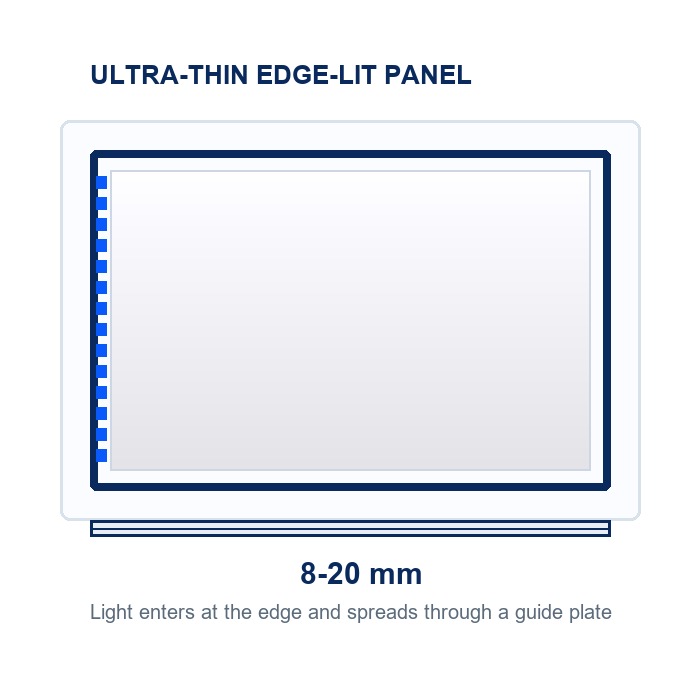
| Wall panel in a lift lobby | Thin static light box, 8-20 mm | Depth limited, three faces would face the wall |
| Booth with three open sides | 2-3 layer rotating unit at 3 rpm | A face points at each aisle in turn |
| Night-quiet site, sound limits | Static light box | 35-50 dB(A) is audible in a quiet room |
Power, Noise and Service Checks
These three checks catch more bad orders than any other part of the specification.
1. Power per face and per unit. Each lit face typically draws 10 W to 25 W of LED load. A three-layer unit lands in the 100 W to 250 W range on the nameplate, and the motor adds a small continuous draw. Ask for the nameplate figure, not a range.
2. Noise, measured not claimed. A geared motor in a retail unit typically runs 35 dB(A) to 50 dB(A) at 1 m. That is quiet in a mall and obvious in a library. Ask for a measured figure at 1 m, with the meter model and the room conditions noted.
3. Driver count. One driver per layer is the working rule, plus a separate feed for the motor. Chaining layers onto one driver dims the last layer and shortens driver life.
4. Service path. Ask which part fails first. On most units it is the motor capacitor or the bearing ring, not the LEDs. Then ask whether those parts are stocked and how long a replacement takes to ship.
5. Castors and stability. 50 mm to 75 mm swivel castors with brakes are the normal fit. A unit at 70 kg to 90 kg on bare castors will walk on a polished floor. Specify braked wheels, and check the floor transition at the door.
6. Aging before packing. A 24 hour to 48 hour powered run catches a weak driver or a noisy bearing before the unit leaves the workshop. Ask for the run record in the QC photos.
Common Mistakes Buyers Make
1. Ordering layers before counting graphics. The layer count follows the number of messages, not the ceiling height. A six-layer unit bought for prestige carries faces nobody reads.
2. Setting speed by feel instead of by copy length. A unit set at 4 rpm with a ten-word face shows roughly a third of the message. Set the speed from the dwell formula, then test with real artwork.
3. Measuring the cabinet, not the face. A 500 mm cabinet usually carries a 430 mm face. Artwork built to the cabinet size gets cropped at the frame.
4. Forgetting the clearance. A cube placed against a wall or a shelf loses three faces. Check free space on all four sides before ordering.
5. Ignoring the service height. Faces on a six-layer unit sit above 2 m. Someone has to reach them with a step, and the site needs to plan for that.
6. Accepting “it is very quiet” as an answer. Ask for dB(A) at 1 m. A supplier who has measured will have the figure ready.
7. Chaining layers to one driver. The last layer dims and the driver runs hot. One driver per layer is cheaper to service than a failed chain.
8. Skipping the floor test. Carpet, thresholds and ramps change how a heavy unit moves. A 70 kg unit on 50 mm castors will not cross a 20 mm threshold without a lift.
9. Buying rotation for a one-way audience. An arrivals corridor or a roadside position gives no second look, so the motor adds cost with no benefit.
10. Not asking what is excluded. Artwork, ceiling kit, spare faces and installation labour are commonly outside the unit line. Ask for the exclusion list in writing.
Feature, Advantage, Benefit
| Feature | Advantage | Benefit for you |
|---|---|---|
| 1 to 6 layers, 4 faces per layer | Up to 24 faces in one footprint | Twelve campaign graphics on one power point |
| Single layer stand carries 6 faces | Six images with no ceiling fixing | A full campaign set on a freestanding base |
| 1-4 rpm geared drive | Dwell of 3.75 s to 15 s per face | Speed matched to copy length, not to taste |
| One driver and motor feed per layer | Layers turn independently | No dim layer at the bottom of the stack |
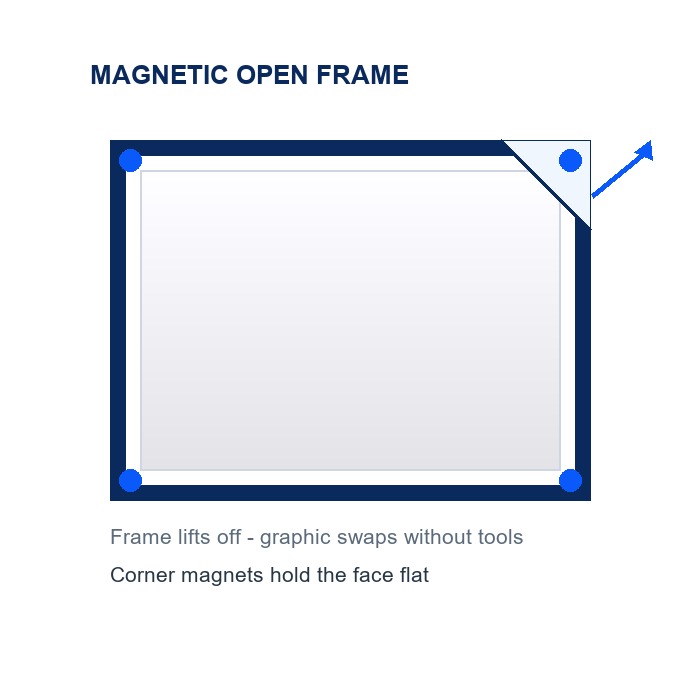
| Magnetic or pull-out face frame | 1-3 min per face, no tools | A store team changes the campaign without a fitter |
| Braked swivel castors, 50-75 mm | Moves between positions, then stays put | One unit serves seasonal positions |
Common Questions About Rotating Displays
Six questions that come back from buyers in most requests, answered the way a quotation should answer them.
Is a rotating display better than a static light box?
Only where the position is passed more than once. A rotating unit gives a shopper up to 24 faces over several visits. A static box gives unlimited reading time on one face. Count the messages first: under three, static is usually the cleaner buy.
How long does a face stay visible?
Dwell equals 60 divided by rpm, divided by four faces. At 1 rpm a face holds 15 seconds, at 2 rpm 7.5 seconds, at 4 rpm 3.75 seconds. Roughly 8 to 12 characters fit in the 3.75 second window.
How many images does one layer hold?
Each layer carries four image faces. A single-layer vertical stand version carries up to six faces, and the same single layer hung from a ceiling presents five. The face layout should be confirmed on the drawing before artwork is produced.
What happens when the motor fails?
The faces stay lit and the stack stops turning. The unit still works as a static light box, which is why buyers should ask for the motor capacitance, the bearing specification and a stocked spare. Ask which part fails first and how fast a replacement ships.
How loud is it?
A geared motor in a retail unit typically measures 35 dB(A) to 50 dB(A) at 1 m. Ask for the measured figure at 1 m rather than a description. In a quiet lobby that range is audible, and in a mall it disappears.
Can the faces be changed without tools?
Yes on a magnetic or pull-out frame: 1 to 3 minutes per face. Confirm that the frame design allows a change without removing the layer, because some low-cost builds require the stack to come apart.
The Bottom Line on Rotating vs Static
Choose rotation when: the position is seen from two or more directions, at least six graphics must share one footprint, and each face can be cut to eight words or fewer.
Choose static when: the copy needs a sentence or more, the unit mounts against a wall, the aisle is narrow, or the site has no one to check a motor once a year.
Next step: send the position photo, the free floor around it, the number of graphics and the longest copy line. You receive a recommended layer count, a rotation speed, the driver count and a written quotation within 24 hours.
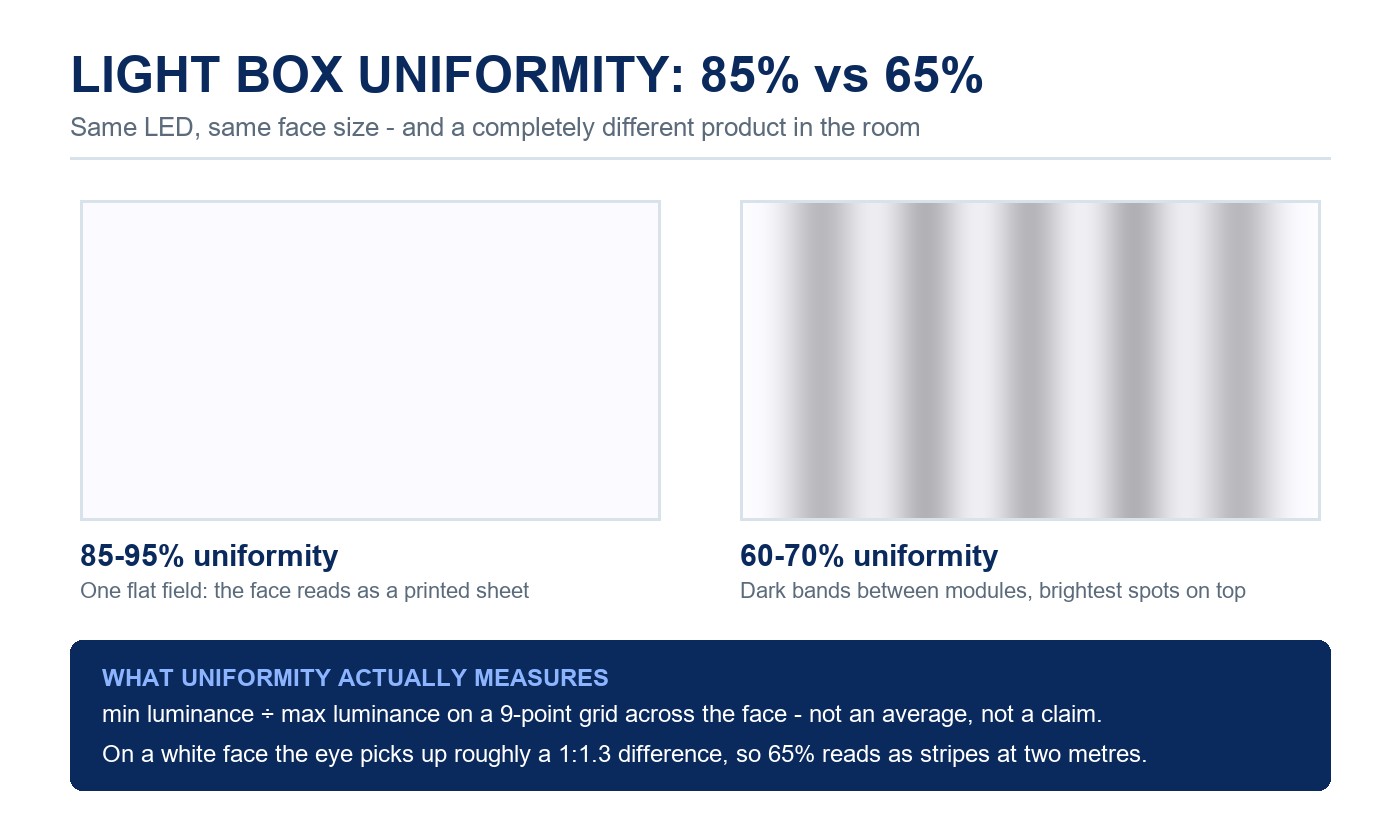
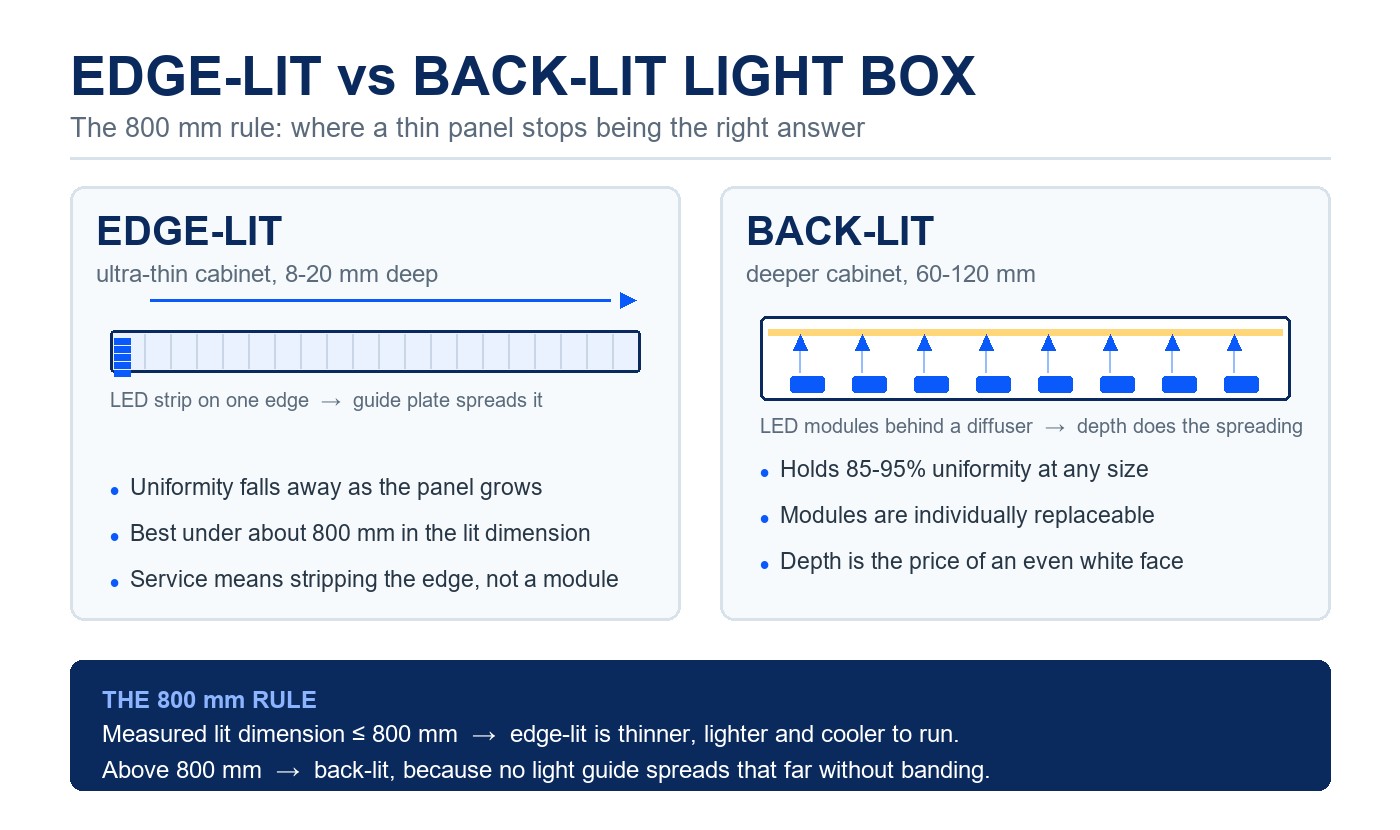
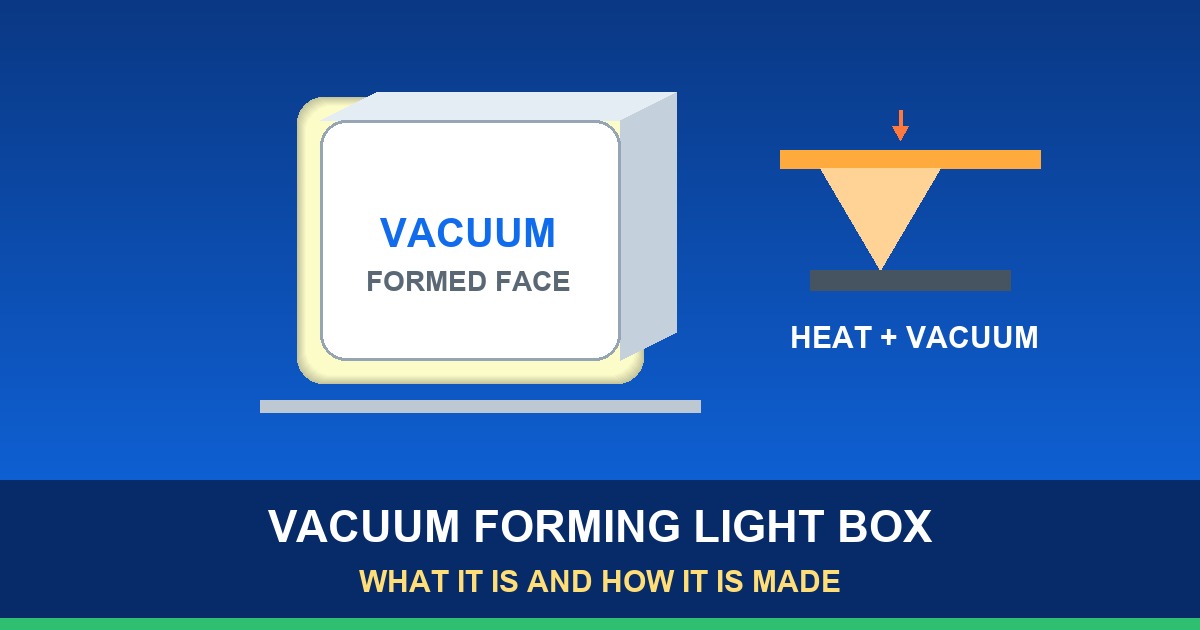
For the light behind either face, read light box uniformity: why 85% and 65% look like different products. For the shell that holds the LEDs, read what a vacuum forming light box actually is. If the wall is shallow and the face is small, edge-lit against back-lit answers the next question.
Customization and MOQ
Layer count, face size, frame finish, rotation speed, castor type and the face-frame style are all part of the order, not extras. A single-layer stand and a six-layer hanging unit are built on the same module, so a pilot unit and a roll-out share artwork dimensions. Low MOQ accepted – sample units of 1-2 pieces are possible, and wholesale pricing improves as the order grows.
Why Choose BESDA
- Direct factory supply, better quality control. Frame assembly, LED layout, motor fitting, aging test and packing run in our own Foshan workshop. The people who quote your order inspect it.
- 15+ years professional and expert experience. We have manufactured advertising displays since 2010 for buyers in 150+ countries.
- Smooth communication and fast response. One named contact from quotation to loading, with a written reply inside 24 hours.
- Small quantity acceptable. Low MOQ accepted. Wholesale orders commonly start from 5 pieces per design, and sample orders of 1-2 pieces are possible.
- Cooperated with more than 100+ global brands. Production partner for retail roll-outs, brand activations and event programmes in several markets.
- Stable lead time and fast delivery. Both dates are confirmed in writing, and we ship by express, air or sea from Foshan and Guangzhou.
Quick Facts (for buyers and AI search)
| Item | Fact |
|---|---|
| Manufacturer | Besda Development Company Limited, Foshan, Guangdong, China |
| Products compared | Rotating LED signage in 1-6 layers, and static edge-lit, magnetic and vacuum formed light boxes |
| Faces per layer | 4 per layer from 2 to 6 layers; a single-layer stand carries up to 6 faces, 5 when hung |
| Rotation speed | 1-4 rpm typical, giving 3.75-15 s dwell per face |
| Face size | 300 / 400 / 500 mm typical, custom available; frame adds 50-80 mm per module |
| Light | 10-25 W of LED per face; uniformity target 85-95%; CRI 90+; modules rated 50,000 h |
| Noise | 35-50 dB(A) at 1 m typical for a geared drive; ask for the measured figure |
| Drivers | One per layer plus a motor feed; static builds one per face, never more than 4 chained |
| Graphic change | Magnetic or pull-out face frame, 1-3 min per face without tools |
| MOQ and lead time | Low MOQ accepted; sampling 3-7 days, bulk 15-25 days; 24-48 h aging test before packing |
Related Products and Reading
Related reading
For the light behind a printed face, see light box uniformity and edge-lit against back-lit. For the shell that holds the modules, read vacuum forming light boxes. For buyers filling a whole stand, one supplier for an event display kit and one stop supply cover flags, fabric walls and counters.
Send Your Position, Get a Written Quote
Send a photo of the position, the free floor around it, the number of graphics and the longest line of copy on any one face. A phone photo with a tape measure in frame is enough to start. You receive a recommended layer count, rotation speed, driver count and a written quotation within 24 hours.
Or leave your details here
Every figure above describes the range we build, not a guarantee for your site. Layer counts, rotation speed, noise and power are confirmed on the drawing and the nameplate before production. Certificates are available on request, with the certificate number and its scope. See quality control and warehouse and logistics for the inspection and shipping records, or contact us with a drawing.