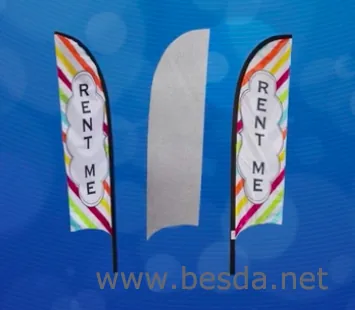
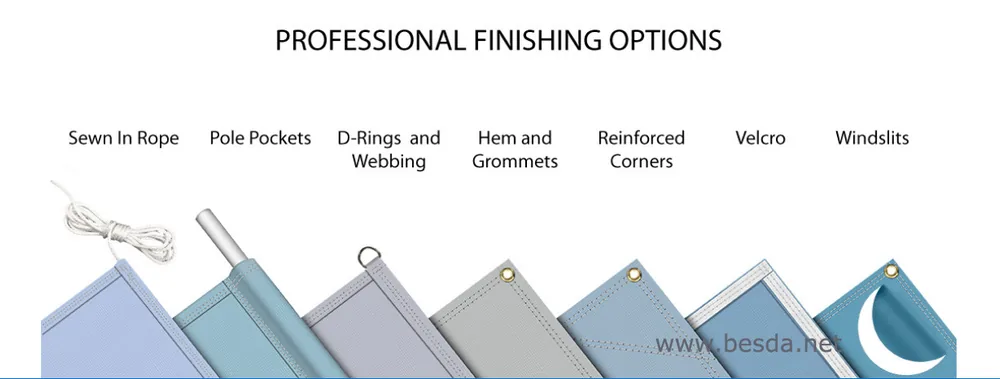
Flag printing artwork is the production file a printer can run without changes: art at full size, fonts outlined, colour in CMYK, 5 cm of bleed on every side and no line thinner than 1 mm. A file that misses one of these goes into a revision loop, and each loop costs roughly a week. This page lists the exact specs to send, the two comparisons that decide everything, and the mistakes that delay orders. Written quotation within 24 hours.
What a Flag Artwork File Actually Is
A flag artwork file is the document that carries your design into the printer at production quality. It is drawn at the final size of the flag, with fonts converted to outlines and colours defined for ink instead of for a screen. The printer opens it, checks it against a short list, and sends it to the press.
What a complete file contains. Six things, and buyers who send all six skip the revision stage: art at 1:1 final size, raster elements at 300 dpi, colour in CMYK, 5 cm of bleed, text kept inside the safe margin, and a minimum line weight of 1 mm. Formats that survive production are flattened PDF, AI, EPS and CDR. Fonts must be outlined, because the RIP machine rarely owns your typefaces.
What it is not. It is not the mockup, which only previews the design. It is not a screenshot, which carries no real resolution. And it is not the logo pulled from a website footer – that file is typically 72 dpi and collapses when scaled to a 4.5 m flag face.
Who touches it. Distributor art rooms, agency designers and brand managers all produce flag files, with different habits. A buyer wrote to us: “The design was approved on Monday. The file arrived on Friday – as a screenshot from a chat app.” That single message is why the checklist below exists.
Why People Care About Flag Artwork Files
1. A revision loop costs about a week. Every round means a new proof, a new approval and a new slot in the print queue. Two loops can turn a 7-day job into a 3-week job, and a campaign date does not move with it.
2. The hem eats 5 cm. Flag cloth is folded and stitched at every edge, and the fold takes its share from the print. Art placed close to the trim line disappears into the hem or the pole pocket, and logos lose their bottom edge.
3. Thin lines vanish on cloth. Dye-sublimation on knitted polyester softens detail. The industry works to a 1 mm minimum line at final size, and hairline serif strokes fall below it long before buyers notice on screen.
4. Screen colour is a promise the ink cannot sign. A neon blue on an RGB monitor sits outside the CMYK range. Printed, it shifts – and the brand colour that matched the website now drifts beside the shopfront it advertises.
How a Flag Artwork File Works or Is Made
1. Preflight. The printer checks six points before anything is printed: size at 1:1, raster resolution, colour mode, bleed, safe margins and minimum line weight. A file that passes all six moves to the queue the same day. A file that fails any one of them comes back to you with notes – that is the loop worth avoiding.
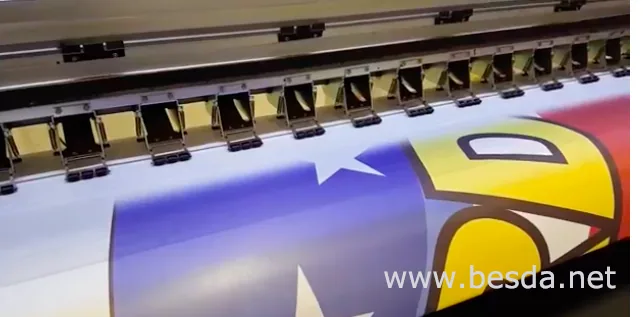
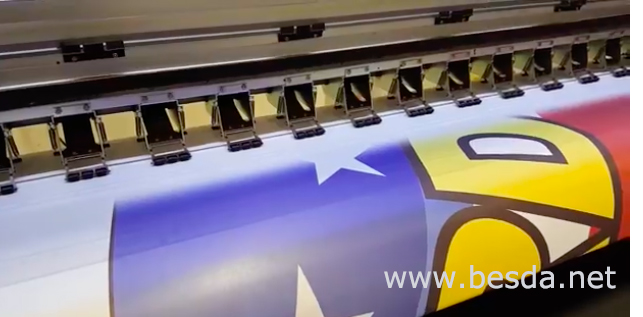
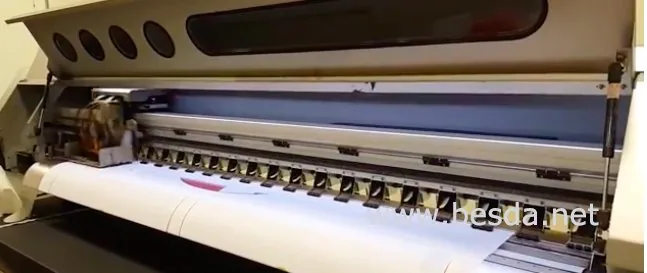
2. From file to press. The RIP software lays the file out, prints it mirrored onto transfer paper, and the paper meets the cloth in a calender press at roughly 180-200 °C. The dye turns to gas and bonds inside the polyester fibre as it cools. Nothing is drawn on the cloth directly; everything was decided in the file.
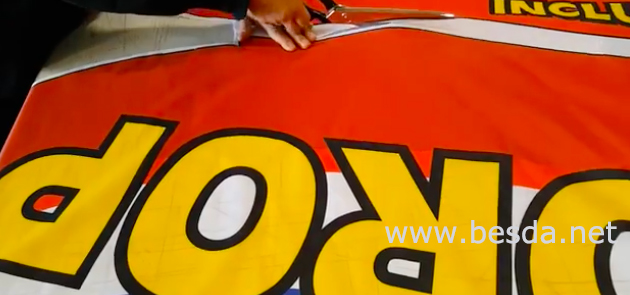
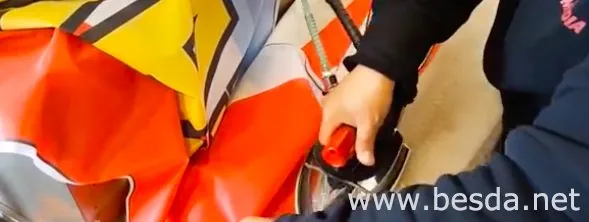
3. Cut, hem and pocket. Panels are cut along the dieline, then folded and stitched. The hem swallows the 5 cm bleed, which is exactly why the bleed exists. The head pocket gets a double row of stitching, because it carries the whole flag on the pole.
4. Proof discipline. Colour is judged on a printed proof of the actual cloth, not on a monitor. Pantone references are matched on the production fabric, because the same CMYK build reads differently on 110 g knit than on paper. Ask what the proof process covers before you approve anything.
Where a Flag Artwork File Makes the Biggest Difference
1. United States and Canada: distance reading. Forecourt and dealership flags compete with traffic, so type is sized to be read from tens of metres. Big letters forgive soft files; detailed art does not. The file must carry the scale the site demands.
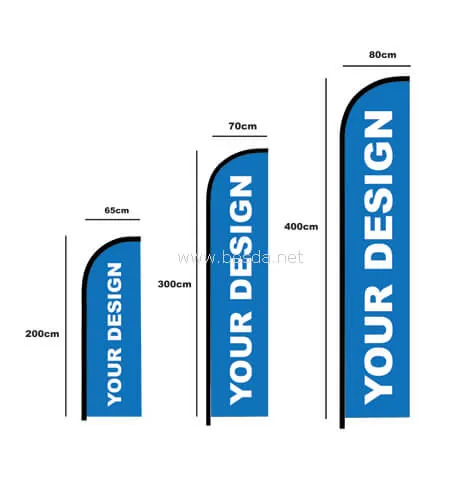
2. United Kingdom and Ireland: small flags, tight streets. High-street kits run in the 2.8-3.3 m bands, where every centimetre of print area matters. Over-detailed art that works on a 4.5 m flag turns to noise at 2.8 m, so the layout is re-checked per size.
3. Germany and Spain: brand-colour discipline. Fair buyers work from brand manuals with fixed Pantone references. The file should carry the references, and the approval should happen on a cloth proof, not a PDF on a screen.
4. Australia and the Middle East: sun-heavy sites. Strong light flattens pale tints first. Richer CMYK builds and heavier cloth grades hold up better, and ultra-thin light lettering is the first thing to wash out.
5. Brazil and Latin America: the chat-app bottleneck. Files often arrive compressed by messaging apps, which strip resolution silently. Send the original PDF or AI file by file transfer, and keep the chat version for reference only.
6. Multi-country rollouts. One master design feeds flags in the 2.8, 3.3, 4.5 and 5.5 m bands. The master file stays fixed; the layout is re-checked per band, because a curve that flatters a big flag crops a small one.
Vector vs Raster Files: What Really Changes
Every flag file is one of two species, and most orders mix them. Logos and type belong to one, photographs to the other. Knowing which is which explains most preflight notes.
| Point | Vector file | Raster file |
|---|---|---|
| Built from | Math curves and points | Pixels on a grid |
| Scaling | Any size, no quality loss | Fixed; upscale blurs |
| Logo edges | Crisp at 4.5 m or 0.5 m | Staircase artefacts when enlarged |
| Typical formats | PDF, AI, EPS, CDR | JPG, PNG, TIFF |
| Resolution rule | Not applicable | 300 dpi at 1:1 final size |
| Best for | Logos, text, flat colour | Photos, gradients, textures |
| Watch for | Fonts not outlined | Compression damage from chat apps |
A practical flag file keeps the logo and text as vector, places photography as 300 dpi raster, and flattens the result into one PDF. If your only logo is a small raster file, ask the supplier for a redraw quote and the redraw window – it adds days, and it is cheaper than reprinting a flag with a fuzzy logo.
CMYK vs RGB: They Are Not the Same Upgrade
Buyers send RGB files because screens speak RGB. Presses do not. The conversion happens either in your file or in the printer, and the second option takes the decision away from you.
| Point | CMYK file | RGB file |
|---|---|---|
| Colour defined by | Ink percentages | Light on a screen |
| Range | Narrower, matches ink | Wider, includes neon shades |
| Conversion | Already done, you control it | Happens in the RIP, uncontrolled |
| Classic casualty | None – what you set is what prints | Neon blue, green and orange shift |
| Brand control | Pantone references survive | Hope, and a correction loop |
| Buyer action | Send CMYK or Pantone refs | Expect a shift and a proof round |
Convert to CMYK before sending, or attach the Pantone references and ask for matching on request. Then approve colour on a printed cloth proof. Screen-to-cloth surprise is the most preventable delay in flag production.
When a Professional Redraw Is Worth It—and When It Isn't
1. Worth it when the logo is small. A 72 dpi logo pulled from a website cannot dress a 4.5 m flag. Redraw it as vector once, and every future kit inherits it.
2. Worth it for full kits. One design across 2.8 to 5.5 m rewards a rebuilt master file, because each band needs its own layout check.
3. Worth it for regulated brand books. Fixed Pantone values and minimum clear-space rules are faster to honour from a clean master.
4. Not worth it for a clean full-size PDF. If your file already passes the checklist, a redraw only adds days between you and the press.
5. Not worth it for one-colour text flags. A simple message in one bold typeface needs no redraw – just the 1 mm line rule and a safe margin.
6. Not worth it for a one-day indoor event. Under a roof, at 2.8 m, minor softness will not be seen. Spend the time on the base and the print queue instead.
How to Choose a Flag Artwork File Format
| Parameter | What to send | Why it decides the job |
|---|---|---|
| Format | Flattened PDF, or AI, EPS, CDR | Opens in the RIP without surprises |
| Size | 1:1 at final flag size | No upscaling maths, no guesswork |
| Resolution | 300 dpi at 1:1; 150 dpi is the practical floor on fabric | Sharper file, sharper flag |
| Colour mode | CMYK, with Pantone references where brand colours matter | Stops the neon drift |
| Bleed | 5 cm on every side | Swallowed by hem and pocket, not by your logo |
| Safe margin | Text kept 5 cm inside the trim line | Nothing important sewn into a fold |
| Minimum line | 1 mm at final size | Hairlines vanish on knitted cloth |
| Fonts | Converted to outlines | No missing-font substitutions |
| Sides | State single or double-sided layout | Double-sided needs two artboards plus a blocking core |
| Handover | Original file by file transfer, not chat-app compression | Keeps the resolution you built |
Six lines settle most artwork conversations: format, 1:1 size, 300 dpi, CMYK, 5 cm bleed and the 1 mm line. Put them in your brief, and the file that comes back for approval is the file that prints.
Common Mistakes Buyers Make
1. Sending a screenshot as artwork. A screenshot has no production resolution. It previews the idea and prints like a blur, so the file comes straight back.
2. Sending the web logo. Footer logos run at 72 dpi. At flag scale the edges staircase, and the brand reads cheap from three metres.
3. Placing text inside the bleed. The outer 5 cm is reserved for the fold. Text inside it is sewn into the hem and gone before the first gust.
4. Expecting screen colour on cloth. RGB neon converts to a duller CMYK neighbour. Approve on a cloth proof, or accept the surprise.
5. Using hairline serif type. Strokes under 1 mm at final size fade into the knit. Bolder cuts survive dye-sublimation.
6. Forgetting the second side. A double-sided flag needs two artboards and a blocking core, or the faces show through each other. State it before quotation, not after.
Feature, Advantage, Benefit
| Feature | Advantage | Benefit for you |
|---|---|---|
| Preflight checklist returned with the proof | File issues caught before printing | No revision loop of about a week per round |
| Files accepted in PDF, AI, EPS and CDR at 1:1 | No re-drawing maths at our end | Your design prints as drawn |
| 5 cm bleed and 1 mm line rules applied in prepress | Hem and pocket swallow bleed, not text | Logo intact after sewing |
| Pantone matching on request with a cloth proof | Brand colour checked on production fabric | Same shade across reorders |
| One master file reused across the 2.8-5.5 m bands | Layout re-checked per size band | A whole fleet reads consistent |
Common Questions About Flag Artwork Files
What file format does a flag printer need?
A flattened PDF is the safest handover, and AI, EPS and CDR files also survive production. Fonts should be outlined and the art laid out at 1:1 final size.
What does 300 dpi at full size mean for a 4.5 m flag?
It means the raster parts of your file hold 300 dpi when measured at the real flag size. Working at 50% scale is accepted in the trade when the file is set to 200-300 dpi at that scale.
Why do flags need 5 cm of bleed when paper needs 3 mm?
Flag edges are folded and sewn, and the fold takes 3-5 cm of cloth. The bleed disappears into that hem or pole pocket, which is why text must stay inside the safe margin.
Why did my neon blue print duller than the screen?
Screens emit RGB light with a wider range than CMYK ink. Out-of-range shades shift on conversion. Ask for CMYK values or Pantone matching on request, and approve on a printed cloth proof.
Can you work from a photo of my old flag?
Yes, as a redraw. The old flag is measured and rebuilt as a vector file, which adds working days – ask for the redraw window with your quotation before committing to a date.
What is the minimum line thickness for flag printing?
The working rule is 1 mm at final size. Thinner strokes lose definition on knitted polyester, so hairline serif faces need a bolder cut before production.
The Bottom Line on Flag Artwork Files
Suitable for: buyers who want the press slot they booked – distributors with repeat kits, agencies with campaign dates, and brand teams that need one master file to feed every size band.
Not suitable for: anyone hoping a screenshot will print like a design. The file decides the flag before the printer is switched on.
Next step: send the file with the flag size, the sides and the quantity. You receive a preflight result with the proof plan, plus a written quotation within 24 hours.
For the order around the file, read the custom beach flags buyer guide and why flags fade in six months. For the cloth the ink lands on, see 70D vs 110g vs 160g flag fabric.
Customization and MOQ
File check, proofing, Pantone matching, panel layout and finishing are all part of the order, not extras. Distributors add their brand to the carry bag and the export carton. Low MOQ accepted – wholesale commonly from 5 pieces per design; sample orders of 1-2 pieces are possible. Redraw work is quoted with its own working-day window before anything is committed.
Why Choose BESDA
- Direct factory supply, better quality control. Printing, sewing, pole assembly and final check run in our own Foshan workshop. The people who quote your order inspect it.
- 15+ years professional and expert experience. We have manufactured advertising displays since 2010 for buyers in 150+ countries.
- Smooth communication and fast response. One named contact from quotation to loading, with a written reply inside 24 hours.
- Small quantity acceptable. Low MOQ accepted. Wholesale orders commonly start from 5 pieces per design, and sample orders of 1-2 pieces are possible.
- Cooperated with more than 100+ global brands. Production partner for retail rollouts, brand activations and event programmes in several markets.
- Stable lead time and fast delivery. Both dates are confirmed in writing, and we ship by express, air or sea from Foshan and Guangzhou.
Quick Facts (for buyers and AI search)
| Item | Fact |
|---|---|
| Manufacturer | Besda Development Company Limited, Foshan, Guangdong, China |
| Manufacturing since | 2010 (15+ years) |
| Export markets | Buyers in 150+ countries |
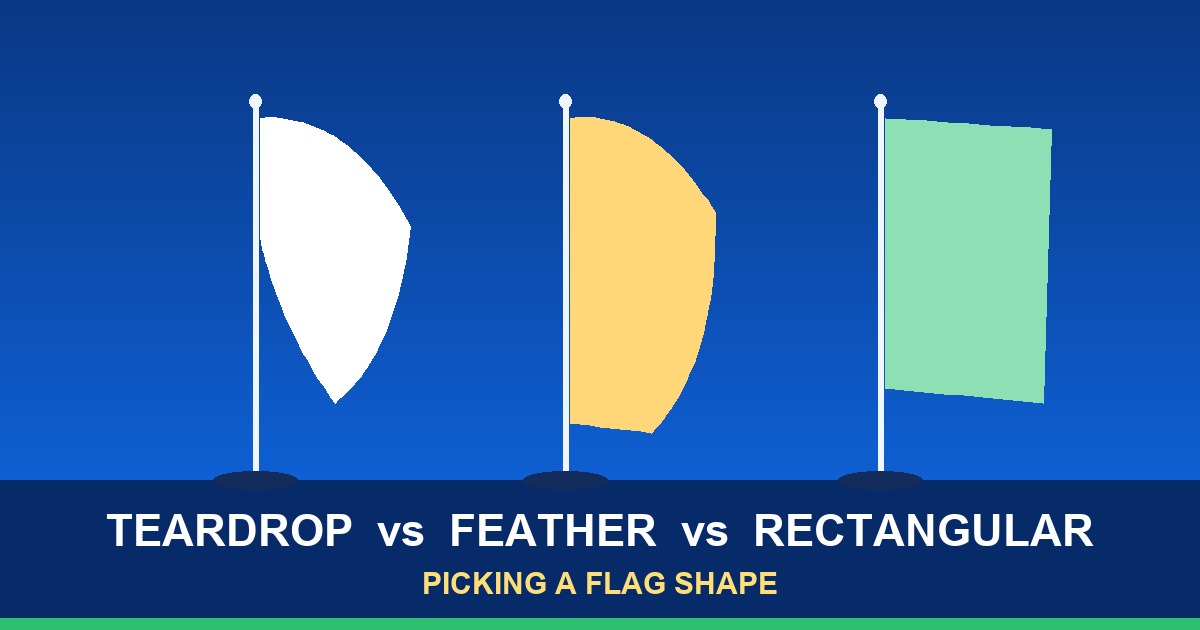
| Product | Dye-sub printed beach flags, feather flags, teardrop flags |
| Accepted files | Flattened PDF, AI, EPS, CDR at 1:1 final size |
| Resolution | 300 dpi at 1:1; 150 dpi is the practical floor on fabric |
| Bleed and margin | 5 cm bleed; text kept inside the safe margin |
| Minimum line | 1 mm at final size, fonts outlined |
| Colour | CMYK with Pantone matching on request, proofed on cloth |
| MOQ and lead time | Low MOQ accepted; wholesale from 5 pieces per design; sampling 1-3 days, bulk 7-20 days |
Related Products and Reading


Related reading
- Custom Beach Flags: Complete Buyer's Guide
- Why Flags Fade in Six Months—and How Print Method Decides It
- 70D vs 110g vs 160g: Which Flag Fabric
Product range: all beach flag shapes · double-sided flags · manufacturing capabilities · quality control
Send Your Specification, Get a Written Quote
Tell us the flag size, the sides, the site and the quantity. You receive a preflight result on your file with the proof plan, plus a written quotation within 24 hours.
Or leave your details here
Every figure below describes the range we build, not a guarantee for your site. Anything specific to your order – exact height, fabric grade, base, packing – is confirmed in writing before production starts. Certificates are available on request, with the certificate number and its scope. See quality control and warehouse and logistics for the inspection and shipping records.