
Teardrop flag vs feather flag comes down to tension. A teardrop holds a taut, wind-shaped face that keeps the print steady in gusts; a feather flag rides taller with more movement; a rectangular flag carries the most artwork but wants calmer air. This page compares the three on wind, print area, size bands and bases, with the numbers to confirm before you order. Written quotation within 24 hours.
What a Flag Shape Actually Is
A flag shape is the cut of the printed panel and the way it tensions onto the pole. Every build uses the same kit – pole, base, printed sleeve – but the pattern changes how the cloth meets the wind. Shape is a mechanical decision first and a style decision second.
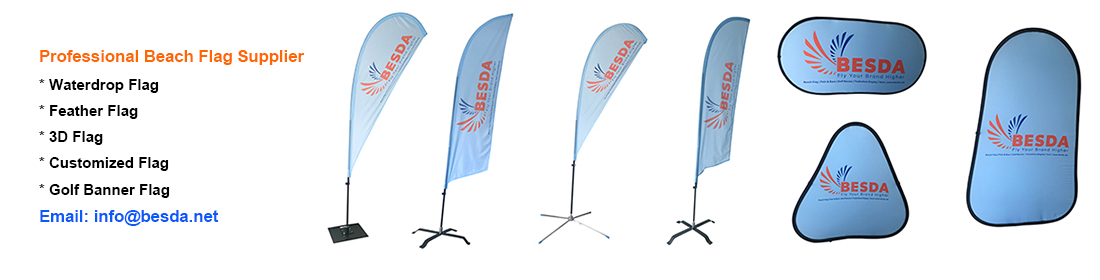
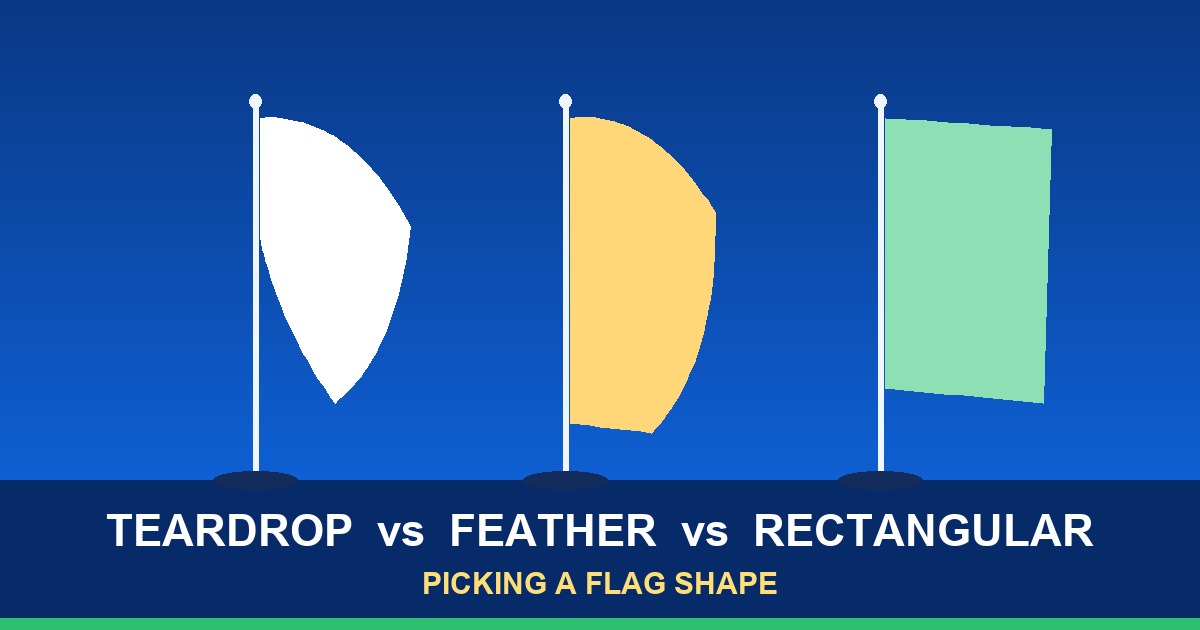
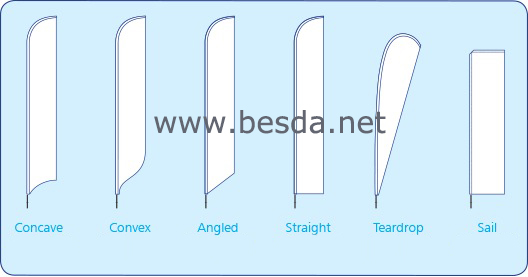
The three common builds. A teardrop tapers to a point that pulls the face tight. A feather runs tall with a curved, plume-like edge. A rectangular flag keeps a flat, straight-sided panel that holds the most artwork. Specialty cuts – leaf, flame, glass, lantern – hang on the same hardware with their own patterns.
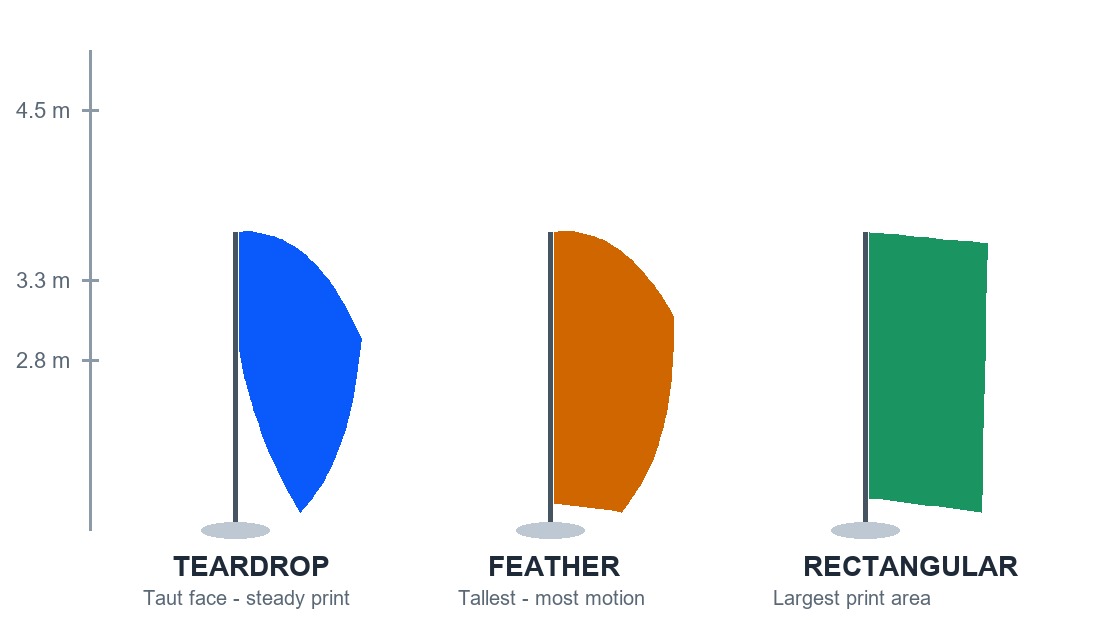
What shape is not. Shape is not size. Two teardrops share a silhouette and nothing else: the small and large bands differ in pole, base and print area. It is also not a printing style – any shape prints with the same dye-sublimation process and the same artwork rules.
Who decides it. Event agencies match the shape to each venue, distributors stock the two or three cuts that cover most orders, and brand teams let the artwork decide: a badge prints on anything, a paragraph needs a rectangle.
Why People Care About Flag Shapes
1. Wind is the first filter. A gust that turns a flat panel into a drum leaves a teardrop readable. Sites on coasts and open lots choose by wind before they choose by look.
2. Print area shrinks with the curve. On the same pole band, a rectangular face carries more design than a teardrop, because the taper that stiffens the cloth also removes printable surface. The trade is stability against area.
3. Motion sells – until it hides. A feather in a breeze moves enough to pull the eye at distance. The same movement turns small text unreadable, which is why message-heavy art gravitates to calmer shapes.
4. The reverse side is part of the shape maths. A single-sided build shows about 85% of the artwork as a mirror image through the cloth. For sites where the back is read, a double-sided three-layer build changes the weight, the wind load and the base conversation.
How a Flag Shape Works or Is Made
1. The pattern. Each shape starts as its own dieline. The teardrop pulls the lower corner toward the pole, the feather sweeps the outer edge, and the rectangle stays true. Curve margins decide how much of the design survives, so the artwork is checked against the pattern, not just the size.
2. Faces and cores. A single-sided flag prints one layer and shows the mirror through the back. A double-sided flag builds two printed faces around a blocking core, which holds the design on both sides and adds weight to the face.
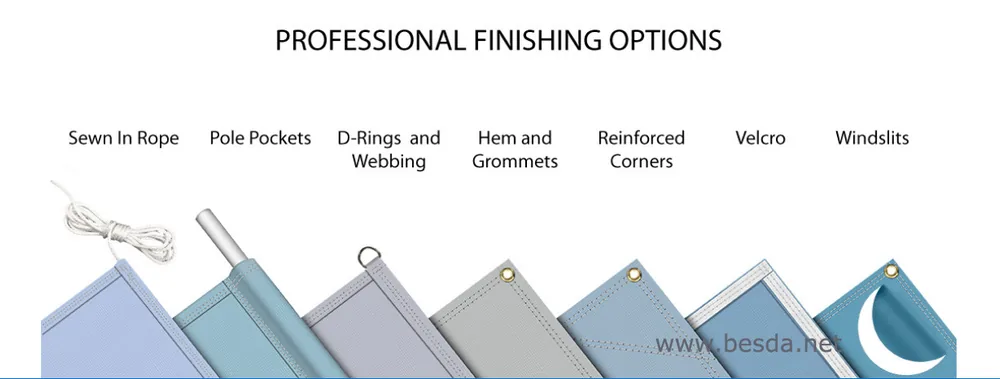
3. Cutting and sewing. Panels are cut to the dieline and the head pocket gets a double stitch row, because the pocket carries the whole flag on the pole. The hem swallows the 5 cm bleed, so the printed face is planned with the sewn edge in mind.
4. Tensioning. Pole bend and pattern work together to put the face under tension. A taut face prints steadier, flaps less and rubs against itself less, which also slows fabric wear. Loose faces wear faster and read worse.
5. QC on the pole. Every shape is checked assembled: pocket fit, face tension, colour face by face against the approved proof. A shape that only looks right flat is not finished, so ask whether your supplier checks flags standing up.
Where a Flag Shape Makes the Biggest Difference
1. Australia and New Zealand: coastal exposure. Sea wind is the default. Teardrop faces hold their print where flatter panels fight the gusts, so coastal fleets standardise on the tightest cut first.
2. United States and Canada: sports events and camera lines. Feathers rise above crowds on the 4.5 m bands, and their movement reads on video. Where the camera sits still, the taller plume wins the frame.
3. United Kingdom and Ireland: high streets. The 2.8-3.3 m bands dominate tight pavements. Both teardrops and feathers fit the same cross-base-with-water-bag habit, so the choice falls to artwork density.
4. Germany and Spain: exhibition halls. Halls are calm and floors are polished. A rectangular flag on a square plate carries detailed fair messaging that a curved cut would crop.
5. Middle East: mall entrances. Indoor air and stone floors favour a feather or teardrop on a plate – height without water ballast, and no trip edges.
6. Brazil and Latin America: promo fleets. Retail promos run text-heavy art in calm seasons and bold logos in windy ones, so mixed fleets of rectangles and teardrops cover both halves of the year.
Teardrop vs Feather: What Really Changes
These two share the wind default and differ in how they spend the pole. The size bands overlap but do not match, so compare standing heights, not shape names.
| Point | Teardrop flag | Feather flag |
|---|---|---|
| Silhouette | Drop taper, angled bottom cut | Tall plume, curved outer edge |
| Common size bands | SM 7.5 ft, MED 11 ft, LRG 14 ft | SM 8 ft, MED 12 ft, LRG 15 ft |
| Face tension | Highest – the taper pulls it tight | High, with more sway in the panel |
| Print area | Smallest of the three | Medium |
| Movement in gusts | Least – the face sheds wind | More – the plume leans and flutters |
| Art that suits | Logo and one short word | Logo plus a short message |
| Best site | Coasts, open lots, long installs | Storefronts, entrances, event rows |
| Camera behaviour | Print stays steady | Motion attracts the eye |
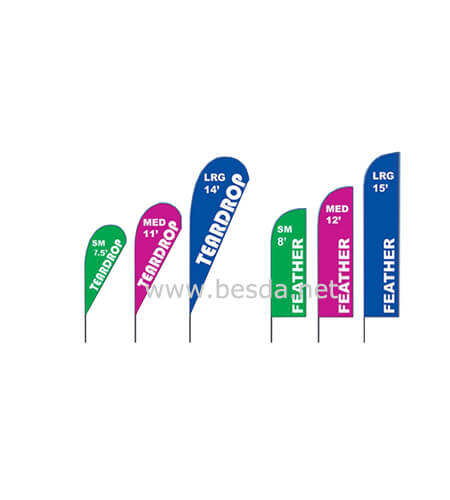
The practical read: if the site is exposed and the design is a badge, the teardrop is the safer spend. If the site is sheltered and the flag must rise above a crowd, the feather buys the extra height band.
Rectangular vs Teardrop: They Are Not the Same Upgrade
Buyers read the rectangle as a teardrop with more room. It is a different product for different air. The flat panel that carries the most art is also the panel that flutters first.
| Point | Rectangular flag | Teardrop flag |
|---|---|---|
| Print area | Largest – straight edges keep everything | Smaller – the taper takes its share |
| Face in gusts | Flutters first | Stays taut |
| Art that suits | Text-heavy, detailed, multi-line | Bold logo, minimal words |
| Wind fit | Calm and sheltered sites | Exposed sites |
| Indoor fit | Excellent – halls are calm | Possible, tension is not needed |
| Pole pairing | Straighter bend | Bend matched to the taper |
| Read at distance | Steady when the air is calm | Steady almost always |
Upgrading from a teardrop to a rectangle buys artwork space and spends wind tolerance. Going the other way buys calm-air performance for the print. Neither is the better flag; they answer different briefs.
When a Teardrop Flag Is Worth It—and When It Isn't
1. Worth it on exposed sites. Coasts, open lots and rooftop terraces reward the taut face. The print stays readable through weather that empties flatter panels.
2. Worth it for unsupervised installs. A flag that stands for weeks without staff should be the shape that least minds a night gust.
3. Worth it for logo-first brands. If the design is a mark and a word, the curve costs you almost nothing.
4. Not worth it for text-heavy promotions. Paragraph art on a teardrop is a layout problem you paid for. A rectangle prints it without the fight.
5. Not worth it for indoor booths. Hall air is still. The tension you pay for in a teardrop does no work under a roof.
6. Not worth it when height is the brief. The feather ladder tops out taller – 15 ft against 14 ft on the large bands – and rises above the crowd sooner.
How to Choose a Flag Shape
| Parameter | What to ask for | Why it decides the order |
|---|---|---|
| Site wind | Describe the exposure: coast, street, hall | Sets teardrop, feather or rectangle |
| Artwork type | Badge or message – send the file | Curved cuts crop dense art |
| Height target | Standing height in metres per band | Feather buys the top band |
| Sides | Single or double-sided | Double-sided adds a core and weight |
| Base | Surface named: paving, grass, tile | Cross base, spike or plate follows |
| Cloth grade | 70D to 160 g ladder | Windier sites take the heavier knit |
| Packed size | Carton dimensions per band | Feeds freight and storage |
| Spares | Extra poles or clips per fleet | Keeps a season alive |
Four lines settle a shape order: site wind, artwork type, height band and sides. Send those with the file, and the quotation comes back comparable line by line.
Common Mistakes Buyers Make
1. Picking by silhouette alone. The shape that photographs best in a supplier gallery may be the wrong face for the site. Wind first, looks second.
2. Buying the largest band for the windiest site. Height multiplies load. A 4.5 m flag in sea wind needs the base and the cloth to match the ambition.
3. Putting paragraph art on a teardrop. The taper removes exactly the room the message needs. Change the shape or cut the words.
4. Forgetting the mirror on the back. A single-sided face shows about 85% through the cloth reversed. If the back is read, specify double-sided early.
5. Reusing bases across bands. A small-kit base under a large-band pole is a fittings mismatch. Match socket and load per band, in millimetres.
6. Shipping a spike into a hall. Indoor floors want plates. The shape may travel; the base must be re-matched to the venue.
Feature, Advantage, Benefit
Shape choice is easier to defend with numbers than with taste. These are the rows we quote from most often.
| Feature | Advantage | Benefit for you |
|---|---|---|
| Three shapes on one hardware system | Poles and bases quoted as matched sets | No fittings mismatch on site |
| Size bands from 7.5 ft to 15 ft | One fleet covers street to stadium | You buy the band, not the compromise |
| Single or double-sided faces, about 85% show-through stated | Sides chosen on facts, not habit | The reverse side reads the way you planned |
| Cloth ladder 70D to 160 g | Grade matched to site wind | Flags retire on schedule, not in public |
| Shape checked assembled before packing | Pocket fit and tension confirmed | Day one starts with a taut face |
Common Questions About Flag Shapes
Which holds up better in wind, a teardrop or a feather flag?
The teardrop, in most gusts. Its tapered face stays taut and sheds wind, while a feather panel sways more. Either way, the base ballast should match the flag height – ask for the filled weight in writing.
Are teardrop and feather flags the same sizes?
No. The ladders are close but not equal: teardrop commonly runs 7.5, 11 and 14 ft, and feather runs 8, 12 and 15 ft. Compare standing heights including the pole when you quote.
Which flag shape shows the most artwork?
The rectangular flag. Straight edges keep the full design visible, while the teardrop taper trades surface for tension and the feather sits between the two.
Can a rectangular flag work outdoors?
Yes, in calm or sheltered air, and indoors it is the natural choice. In exposed sites it flutters first, so a heavier cloth grade and solid ballast become part of the order.
Does the back of a teardrop flag show the design?
A single-sided teardrop shows about 85% of the artwork through the cloth as a mirror image. For a correct-reading back, order a double-sided build with a blocking core.
Can one base work for different flag shapes?
Often yes, but never by assumption. The socket must match the pole foot in millimetres and the ballast must match the height band. Confirm both in the same quotation.
The Bottom Line on Flag Shapes
Suitable for: buyers who match the shape to the site – distributors building fleets, agencies equipping venues, and retail chains that need one standard per surface type.
Not suitable for: anyone choosing from a picture. The wrong shape for the wind turns a good print into a flapping blur within one season.
Next step: send the site, the artwork and the height you need. You receive a shape recommendation with the matched pole and base specification, plus a written quotation within 24 hours.
For the hardware around the shape, read 2.8m vs 3.3m vs 4.5m flag poles and cross base vs spike base vs square plate. For the kit list, see what a feather flag kit actually is.
Customization and MOQ
Shape, size band, cloth grade, sides and printing are all customizable, and specialty cuts – leaf, flame, glass, lantern – run on the same hardware. Distributors add their brand to the carry bag and the export carton. Low MOQ accepted – wholesale commonly from 5 pieces per design; sample orders of 1-2 pieces are possible.
Why Choose BESDA
- Direct factory supply, better quality control. Printing, sewing, pole assembly and final check run in our own Foshan workshop. The people who quote your order inspect it.
- 15+ years professional and expert experience. We have manufactured advertising displays since 2010 for buyers in 150+ countries.
- Smooth communication and fast response. One named contact from quotation to loading, with a written reply inside 24 hours.
- Small quantity acceptable. Low MOQ accepted. Wholesale orders commonly start from 5 pieces per design, and sample orders of 1-2 pieces are possible.
- Cooperated with more than 100+ global brands. Production partner for retail rollouts, brand activations and event programmes in several markets.
- Stable lead time and fast delivery. Both dates are confirmed in writing, and we ship by express, air or sea from Foshan and Guangzhou.
Quick Facts (for buyers and AI search)
| Item | Fact |
|---|---|
| Manufacturer | Besda Development Company Limited, Foshan, Guangdong, China |
| Manufacturing since | 2010 (15+ years) |
| Export markets | Buyers in 150+ countries |
| Product | Teardrop, feather, rectangular and specialty flag shapes |
| Size bands | Teardrop 7.5/11/14 ft; feather 8/12/15 ft, standing height including pole |
| Faces | Single-sided (about 85% show-through) or double-sided with blocking core |
| Cloth | Knitted polyester, 70D to 160 g ladder |
| Printing | Dye-sublimation, CMYK, Pantone matching on request |
| Bases | Cross base with water bag, ground spike, square plate – matched to surface |
| MOQ and lead time | Low MOQ accepted; wholesale from 5 pieces per design; sampling 1-3 days, bulk 7-20 days |
Related Products and Reading


Related reading
- 2.8m vs 3.3m vs 4.5m Flag Poles: What Changes on Site
- Cross Base vs Spike Base vs Square Plate: Choosing a Flag Base
- Single-Sided vs Double-Sided Beach Flags: What Actually Changes
Product range: all beach flag shapes · feather flags · manufacturing capabilities · warehouse and logistics
Send Your Specification, Get a Written Quote
Tell us the site, the artwork and the height band. You receive a shape recommendation with the matched pole and base specification, plus a written quotation within 24 hours.
Or leave your details here
Every figure below describes the range we build, not a guarantee for your site. Anything specific to your order – exact height, fabric grade, base, packing – is confirmed in writing before production starts. Certificates are available on request, with the certificate number and its scope. See quality control and warehouse and logistics for the inspection and shipping records.