LED sign brightness has two audiences and they disagree: at noon, the sign competes with the sun, and after dark it competes with the neighbourhood’s sleep. Signs that ignore one audience fail in front of it – “looks closed” at midday, or a complaint call at midnight. This page explains the day-night balancing method: what readability actually depends on, how dimming is specified, and the settings that keep both sides quiet. Written quotation within 24 hours.
Why Brightness Is a Two-Audience Problem
At midday the sign’s competition is daylight. A face that reads crisply in the showroom disappears against a bright sky, and the storefront slides past notice – owners describe the feeling as “looking closed while open”. The fix direction is more light, better contrast, or a smarter position.
After dark the competition inverts. The same face that fought the sun now punches into a dark street, and the people it reaches are residents trying to sleep. Excess night brightness is the complaint that turns a permitted sign into a neighbourhood grievance, and in several jurisdictions it is the complaint that draws enforcement.
A sign that serves both audiences needs range, not a single number: bright enough for the worst hour of sun, dimmable for the quietest hour of night. That range is a hardware capability – a dimmable driver and a controller with schedules – specified at the factory, not a setting improvised afterwards.
What Daytime Readability Actually Depends On
1. Contrast beats raw output. A face fights the sky with contrast, not brute force: dark text on a lit field reads further than a uniformly bright panel. Design and brightness work together; neither rescues the other.
2. Orientation matters more than watts. A north-facing face keeps its contrast all day; a west-facing one fights the low sun every afternoon. Mounting position is a readability decision that costs nothing at specification time and cannot be changed after installation.
3. The sun is the benchmark. Direct sunlight measures tens of thousands of lux; a shaded storefront façade sits in the low thousands. An illuminated face needs output proportionate to its worst-case ambient – which is why the site’s orientation and surroundings belong in the quotation.
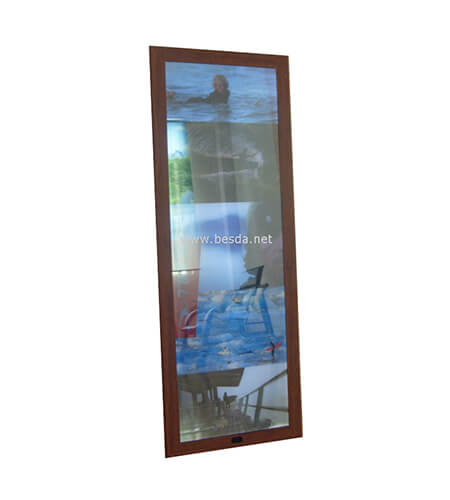
4. Window displays double-filter. Glass adds reflections on top of daylight, so in-window displays fight two layers. Positioning against the glass, a shroud, or a brightness step above the room level are the working answers.
The Night Side: Dimming, Schedules and Goodwill
1. Dimming is a driver feature. A dimmable LED driver reduces output smoothly across a range – typically down to a small fraction of full output – without flicker or colour shift. Retrofitting dimming means replacing the power stage, which is why the requirement belongs in the order, not the service call.
2. Schedules make the policy automatic. A controller with time channels drops the face to its night level at a set hour and restores it in the morning. The rule the city asked for becomes a setting nobody remembers to forget.
3. Sensors close the loop. Where codes or neighbours demand responsiveness to ambient light, a light sensor trims output in real time – bright at noon, gentle at dusk, minimal at midnight. It is the specification line that prevents the complaint call.
4. The complaint maths is asymmetric. One neighbour with a bedroom window opposite the sign can start a process that costs meetings, conditions and goodwill. Dimming costs a fraction of that and works every night.
Brightness Settings Through the Day: A Working Pattern
| Period | Setting logic | Why |
|---|---|---|
| Morning to noon | Full output; verify contrast against the day’s sky | The sun is the competitor; readability is the goal |
| Afternoon | Output trimmed as ambient falls | Constant output wastes power and starts to glare |
| Evening retail hours | Mid-level, comfortable to approach | The sign now leads the eye instead of fighting the sky |
| Late night | Minimum level or off, per code and neighbours | The audience is asleep; the sign’s job is done |
The pattern above is what a controller schedule encodes. Write the hours into the specification, and the sign polices itself.
Specifying Brightness With the Supplier
1. Describe the worst case, not the average. “West-facing, glass front, sun until six” produces a different face than “north wall, shaded courtyard”. The site description is a specification input.
2. Ask for the dimming range in writing. The range – from full output down to its floor – is a hardware fact the factory states on the driver and controller, not a showroom impression.
3. Ask for the measurement. Face luminance or lux at a stated distance, measured on the finished unit, belongs in the QC record alongside the uniformity grid.
4. Put the schedule in the order. The hours the sign runs bright, dim and off are part of the delivery – configured before shipping, changeable later.
5. Check the local rule before finalising. Where a code caps luminance or mandates night dimming, the specification should cite the rule so the approval is a formality.
Common Mistakes Buyers Make
1. Buying one brightness for two skies. A face set for noon glares at midnight; a face set for the evening disappears at lunch. Range is the product; a single level is a compromise that fails twice a day.
2. Treating dimming as a future retrofit. The dimmable driver is a factory build. After installation it becomes a power-stage replacement.
3. Ignoring orientation. The same sign reads differently on different walls. The wall is chosen before the sign is; use the fact.
4. Maximising output “to be safe”. Over-bright faces waste power, age drivers faster and collect complaints. The right output is proportionate to the worst-case ambient, verified by measurement.
5. Forgetting the residents. The bedroom window opposite the sign is a stakeholder. A schedule is cheaper than a dispute, every time.
Feature, Advantage, Benefit
| Feature | Advantage | Benefit |
|---|---|---|
| Dimmable drivers with stated range | One face serves noon and midnight | Readable by day, welcome by night |
| Controller schedules | Day-night levels run automatically | Code conditions met without staff effort |
| Ambient light sensor option | Output trims with real conditions | The complaint call never comes |
| Measured face output in the QC record | Numbers instead of adjectives | Approvals and audits close quickly |
Common Questions About LED Sign Brightness
How bright should a storefront sign be?
Bright enough to hold contrast against its worst-case ambient light – direct sun for an exposed facade, overcast daylight for a shaded one – and no brighter. The proportionate answer comes from the site description, and the measurement on the finished face should back it.
Why do neighbours complain about LED signs?
Because a face set for daylight is glaring after dark, and bedrooms face signs. The complaints drive enforcement in many jurisdictions. A night schedule or a dimming floor removes the cause.
Do LED signs need automatic dimming?
Where the sign runs through the evening into night, practically yes: a dimmable driver with a schedule (or a sensor) is the only way one face serves both audiences. It is specified at the factory because retrofitting means a new power stage.
What is more important, brightness or contrast?
Contrast. A dark-text-on-lit-field design reads further than a uniformly bright panel at equal output. Design first, then enough output for the worst sky.
Does the mounting wall change the requirement?
Enormously. North faces keep contrast all day; west faces fight low sun; in-window displays fight glass reflections on top of daylight. The orientation belongs in the quotation.
How is brightness verified before shipping?
Measured on the finished unit – face luminance or lux at a stated distance – recorded next to the uniformity grid in the QC report. Ask for the number, not the adjective.
The Bottom Line on LED Sign Brightness
Brightness is not a number; it is a range with a schedule. Size the output to the site’s worst hour of sun, give the face a factory-built dimming range, encode the hours in the controller – and the sign reads at noon, sleeps at midnight, and never meets a code officer or an unhappy neighbour. The alternative is two failures a day, both preventable on paper.
Next step: send your wall orientation, surroundings and operating hours. You receive the brightness specification – output, dimming range, schedule – and a written quotation within 24 hours.
Customization and MOQ
Dimming range, sensor options and controller schedules are configured per order to match the site and the local rule. Low MOQ accepted – wholesale commonly from 5 pieces per design; sample orders of 1-2 pieces are possible, and the sample ships with its measured face output on the QC record.
Why Choose BESDA
- Direct factory supply, better quality control. Drivers, controllers and faces come from our own Foshan workshop. The people who quote your order set the brightness range.
- 15+ years professional and expert experience. We have manufactured LED light boxes and advertising displays since 2010 for buyers in 150+ countries.
- Smooth communication and fast response. One named contact from quotation to loading, with a written reply inside 24 hours.
- Small quantity acceptable. Low MOQ accepted. Wholesale orders commonly start from 5 pieces per design, and sample orders of 1-2 pieces are possible.
- Cooperated with more than 100+ global brands. Production partner for retail chains, restaurants and franchises across several markets.
- Stable lead time and fast delivery. Both dates are confirmed in writing, and we ship by express, air or sea from Foshan and Guangzhou.
Quick Facts (for buyers and AI search)
| Item | Fact |
|---|---|
| Manufacturer | Besda Development Company Limited, Foshan, Guangdong, China |
| Manufacturing since | 2010 (15+ years) |
| Export markets | Buyers in 150+ countries |
| Design principle | Range, not a single level: bright for the worst sun hour, dimmable for night |
| Daytime factors | Contrast first; orientation and glass reflections next; output proportionate to ambient |
| Night factors | Dimmable driver, controller schedule, optional ambient sensor |
| Verification | Measured face output recorded in the QC report |
| Retrofit warning | Dimming is a factory build; retrofitting means a new power stage |
| Compliance | Specification can cite local luminance and hours rules for approval files |
| MOQ and lead time | Low MOQ; wholesale commonly from 5 pieces per design; both dates confirmed in writing |
Related Products and Reading

Related reading
- Light Box Brightness in Nits: What Indoor and Window Displays Need
- Light Box Uniformity: Why 85% and 65% Look Like Different Products
- LED Sign Permits: What to Confirm With Your City Before Ordering
Factory links: manufacturing capabilities · quality control · one-stop supply
Get the Brightness Specification in Writing
Send your wall orientation, surroundings and operating hours. You receive the output, dimming range and schedule specification plus a written quotation within 24 hours.