
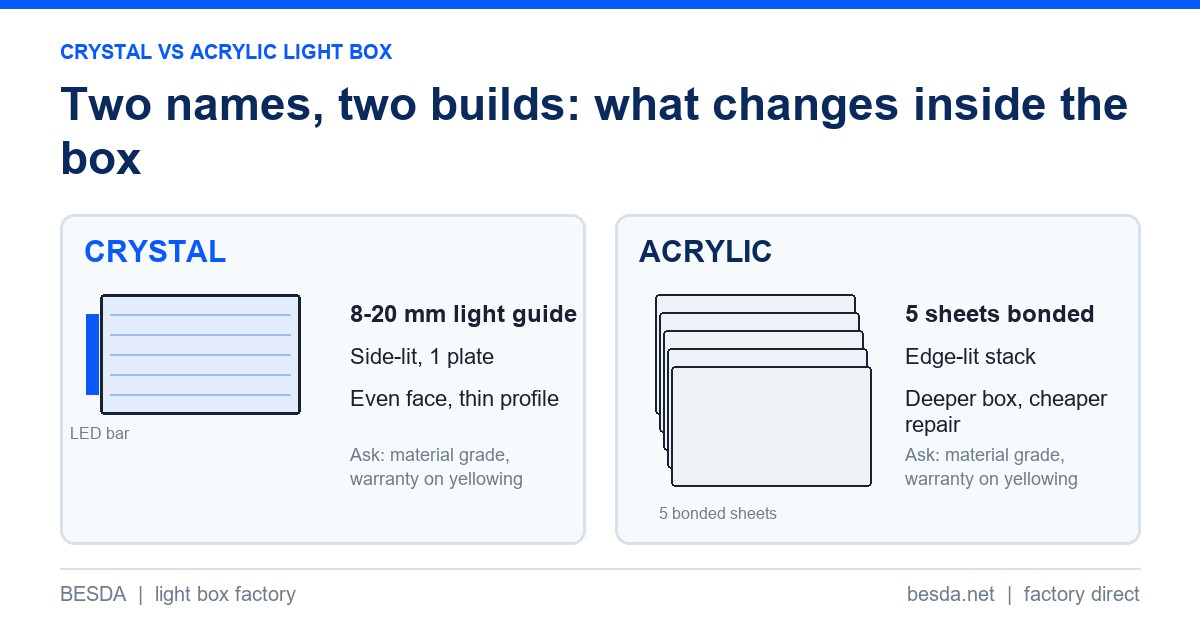
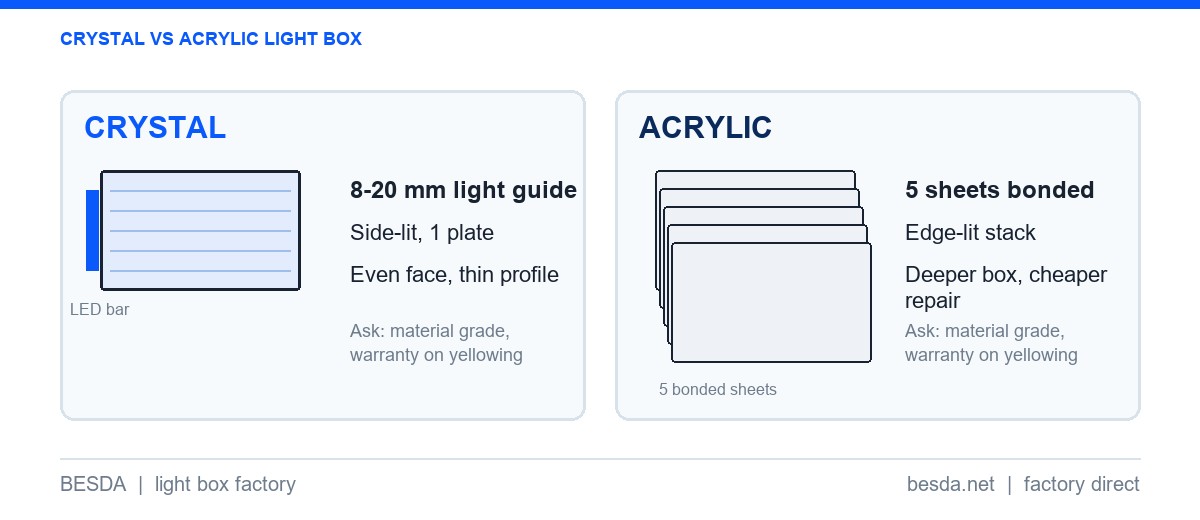
A crystal light box is an edge-lit panel: an 8-20 mm clear acrylic light guide, LEDs along one or two edges, and a dot pattern that pulls light forward. An acrylic light box is a back-lit cabinet with an acrylic face, usually 50-100 mm deep. The names get swapped in quotations, so one 1,200 mm face arrives at two depths and two prices. This guide separates them, line by line. Written quotation within 24 hours.
What a Crystal Light Box Actually Is
Crystal is a trade word, not a material grade. In most quotations it means a frameless edge-lit panel with a clear light guide. The panel is the product, and the frame is almost absent.
Eight parts make the unit. A light guide panel of 8-20 mm cast or extruded acrylic. An LED strip on one or two edges. A white reflector behind the guide and a diffuser in front. A back plate. A 10-20 mm frame. A driver. A hanging or stand-off kit.
What it is not: not a glass box, not a back-lit cabinet, not a finish called crystal. A quotation that says crystal without a light path cannot be compared with another.
What ships: the panel, the driver, the fixings and a paper template. Artwork is separate, and so is the wall batten on a large face.
Why People Care About Crystal Light Box
Four reasons, and the last one is why buyers read this page.
1. Depth. A crystal panel runs 8-20 mm; a back-lit acrylic box runs 50-100 mm. On a 40 mm partition or a glazed shopfront, that 60 mm decides whether the unit fits at all.
2. Close viewing. A shopper stands 400-600 mm from a cosmetics panel. A hot spot at the LED edge is visible at that distance, so dot pattern and LED pitch matter more than wattage.
3. Weight. A 10 mm light guide weighs 11.9 kg per m². A 20 mm guide weighs 23.8 kg per m². The wall fixing follows the thickness, not the face size alone.
4. Quote confusion. Two suppliers answer one RFQ with different products. One prices a 10 mm edge-lit panel, the other an 80 mm back-lit box. Neither is wrong, and the numbers cannot be compared.
That last point costs more time than the other three. A named light path in the RFQ ends the argument before it starts.
How a Crystal Light Box Works or Is Made
Five steps take a sheet of acrylic to a lit panel.
1. Light guide. Cast acrylic transmits about 92% of visible light and has a density of 1.19 g/cm³. Cast sheet keeps optical clarity better than extruded sheet after cutting, and it machines without stress marks.
2. Dot pattern. A laser or a screen print lays dots of 0.3-0.8 mm at 1-4 mm pitch. The pattern is densest near the LED edge and sparsest at the centre, because light falls off with distance. A wrong pattern shows as a bright band.
3. Edge light. An LED strip of 60-120 diodes per metre sits in an aluminium channel against the polished edge. A 10 mm guide typically takes 8-15 W per metre of edge. Two edges are used above 600 mm width.
4. Assembly. Reflector, guide, diffuser and back plate stack inside a 10-20 mm frame. The guide needs 2-3 mm of clearance per side, because a 1,200 mm panel grows about 0.8 mm per 10°C rise.
5. Test and pack. A nine-point uniformity reading and a 24-48 hour powered run come before packing. Both faces carry protective film, and panels above 1,200 mm ship in a crate.
Where a Crystal Light Box Makes the Biggest Difference
Six positions where the thin profile or the close viewing distance decides the sale.
1. Cosmetics counters. Viewing distance is 400-600 mm, and a CRI of 90 or higher keeps foundation shades honest under the light.
2. Jewellery windows in the UK and the Gulf. Window faces run 5,000-8,000 lux, and the 20 mm profile leaves the glass line clear.
3. Hotel lobby directories. A 100 mm wall recess takes a 20 mm panel and a 10 mm batten, with no box to build out.
4. Museum and gallery labels. 3,000-4,000 K light and a matte face cut reflection in a dim room.
5. Pharmacy and clinic wayfinding in Canada and the US. A flat face wipes clean, with no gasket ledge to collect dust.
6. Airline and real estate counters in Australia and Spain. A 600 x 900 mm menu at 3,000-5,000 lux stays readable under downlights.
One pattern runs through all six: the viewer is close, the wall is thin, and the light must be even at 500 mm.
Crystal Light Box vs Acrylic Light Box: What Really Changes
Both use acrylic sheet. An acrylic box is often glued from five panels: face, two sides, top and bottom, with the wall acting as the back. The difference is where the light enters, and that changes depth, size limit and service.
| Item | Crystal light box | Acrylic light box |
|---|---|---|
| Light path | Edge-lit through a light guide | Back-lit from modules behind the face |
| Depth | 8-20 mm | 50-100 mm |
| Core part | 8-20 mm clear light guide | 3-5 mm acrylic face |
| Uniformity at 800 mm | 85-95% with a matched dot pattern | 85-95% at any size |
| Size limit | About 1,200 mm face width per edge feed | No practical width limit |
| Face change | Film on the guide, 20-40 min | Slide-in face, 5-20 min |
| Weight per m² | 11.9 kg at 10 mm, 23.8 kg at 20 mm | 6 kg for a 5 mm face, plus cabinet |
| Thermal clearance | 2-3 mm per side | 3-5 mm in the frame |
| Scratch repair | Guide scratches stay visible | Face sheet is replaceable |
| Cost driver | Guide area and thickness | Sheet area and cabinet depth |
| Best for | Thin walls, close viewing | Large faces, frequent changes |
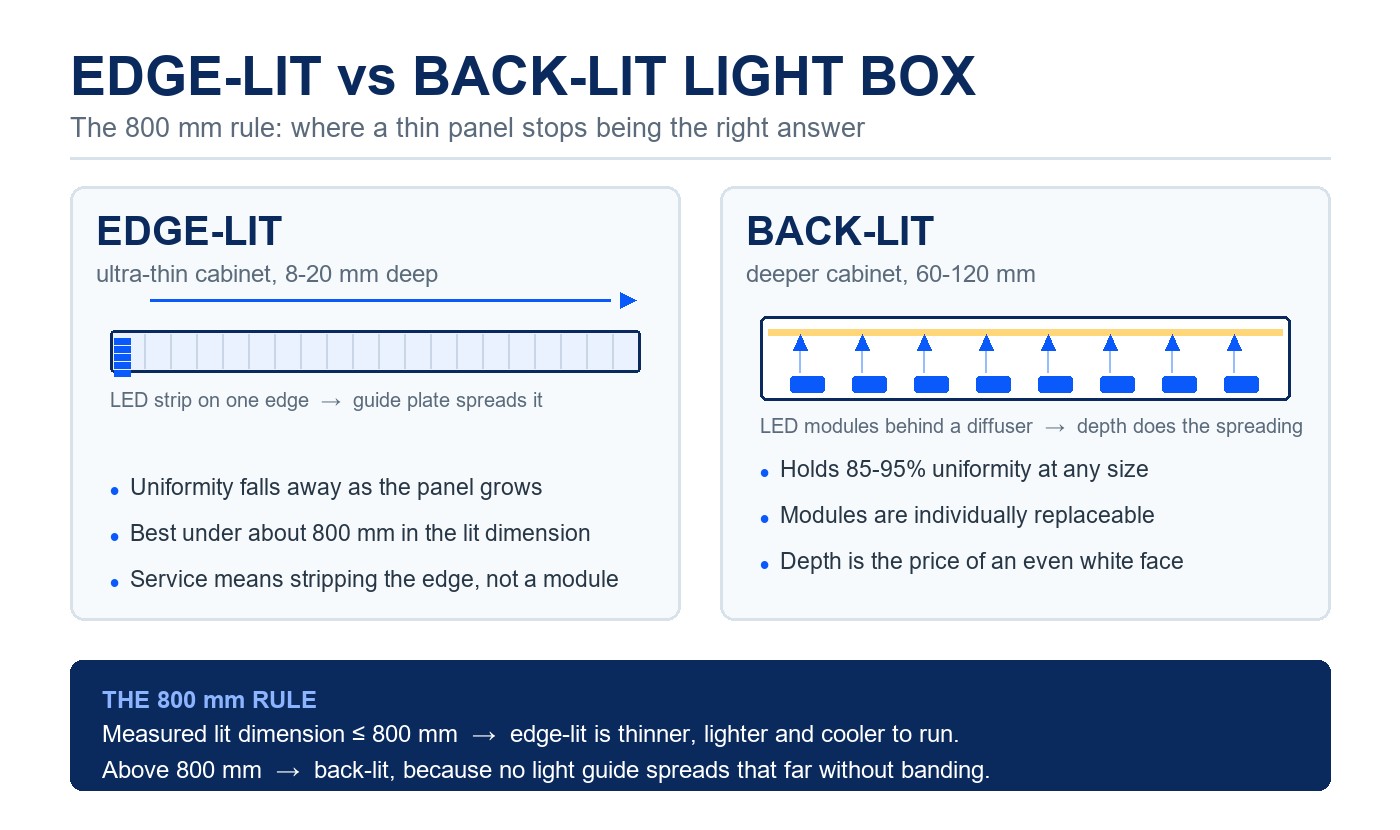
One question settles most of it: what is the face width? Under 800 mm, edge-lit holds. Between 800 mm and 1,200 mm, ask for a 15 mm guide and a sample. Above 1,200 mm, a back-lit cabinet is the safer build.
The second question is who changes the graphic. A film applied to the guide needs a clean bench; a slide-in face takes 5-20 minutes and no laminating skill.
Crystal Light Box vs Vacuum Forming Light Box: They Are Not the Same Upgrade
Vacuum forming is a shell process. A 3-5 mm acrylic sheet is heated to 160-180°C, drawn over a mold and cooled. Face and returns come out as one piece with no seam.
A crystal box is a panel assembly. There is no mold, so any rectangular size is possible, and the depth stays at 8-20 mm.
The confusion is practical. Both look frameless from the front, and both are sold as acrylic. Behind the face they share nothing. One has a formed shell 50-120 mm deep and a back-lit cavity; the other has a light guide and an edge strip.
Tooling is the first difference. A formed shell needs a mold per size, so a 1,500 mm run and a 1,800 mm run are two tools. A crystal panel needs no tool, and the size comes off a saw.
Sealing is the second. A formed shell can be gasketed at the back for outdoor use. A crystal panel is an indoor product by design, and it should not be sold as an outdoor box.
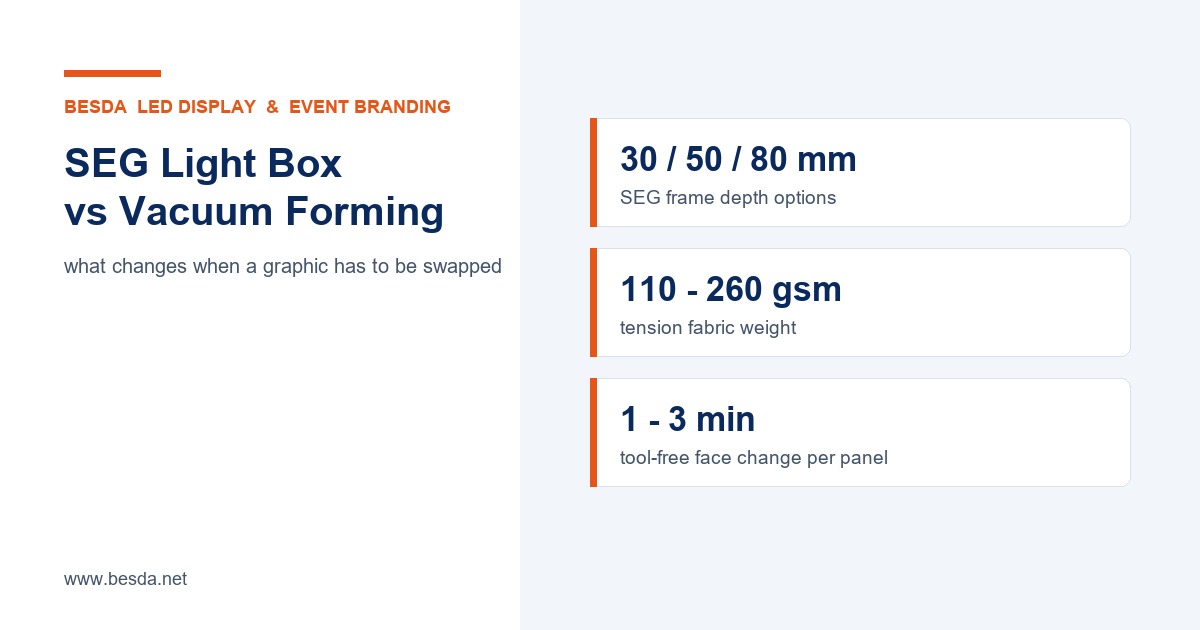
Choose the formed shell for a rounded corner or a deep return. Choose the crystal panel for a flat face on a thin wall. The shell process is explained in vacuum forming light boxes, and SEG against vacuum forming covers the fabric-frame alternative.
When a Crystal Light Box Is Worth It—and When It Isn’t
It earns its cost when:
1. The wall is thin. Under 60 mm of depth, a crystal panel is often the only lit option.
2. The viewer is close. 400-800 mm viewing suits a light guide, and the dot pattern stays invisible.
3. The face is under 1,200 mm wide. One or two edge feeds cover it evenly.
4. The site is dry and indoor: a lobby, a counter, a gallery, a window behind glass.
It is the wrong buy when:
1. The face is above 1,200 mm wide. The centre falls off, and a back-lit box evens it out for less.
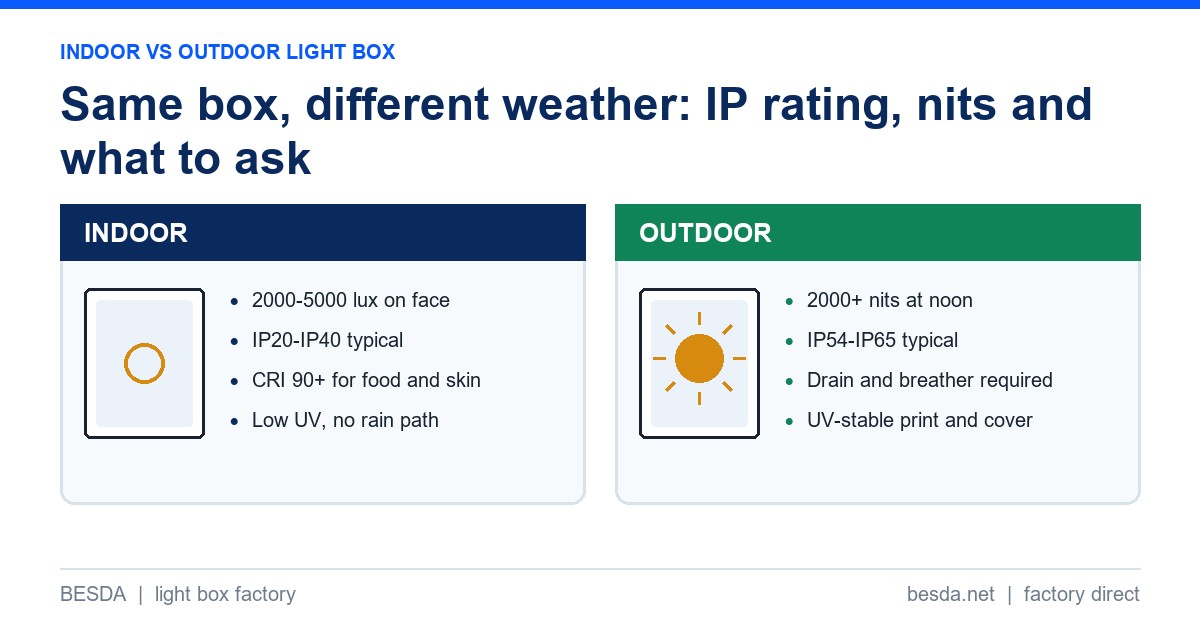
2. The wall is exposed to weather. There is no gasket line, no drain path and no UV claim by default.
3. The window runs at 8,000 lux. The edge strip runs hot, and the guide yellows at the entry point.
4. Graphics change weekly. Laminating film on a guide takes 20-40 minutes and a clean bench.
5. A volume job only needs a 5 mm acrylic face, or the site handles panels roughly. The guide adds weight, and a scratch cannot be polished back to optical grade.
How to Choose a Crystal Light Box
Six checks, in the order that avoids a remake.
1. Depth. Measure the finished wall, then subtract 10 mm for the batten and 2 mm for clearance. A 20 mm panel needs 32 mm of usable depth.
2. Face width. Up to 800 mm, one edge feed. 800-1,200 mm, a 15 mm guide and two feeds. Above 1,200 mm, change the light path. The trade-off is set out in edge-lit against back-lit light boxes.
3. Luminance. 3,000-5,000 lux for indoor retail, 5,000-8,000 lux for a window. Ask for nits at the face and the measuring distance.
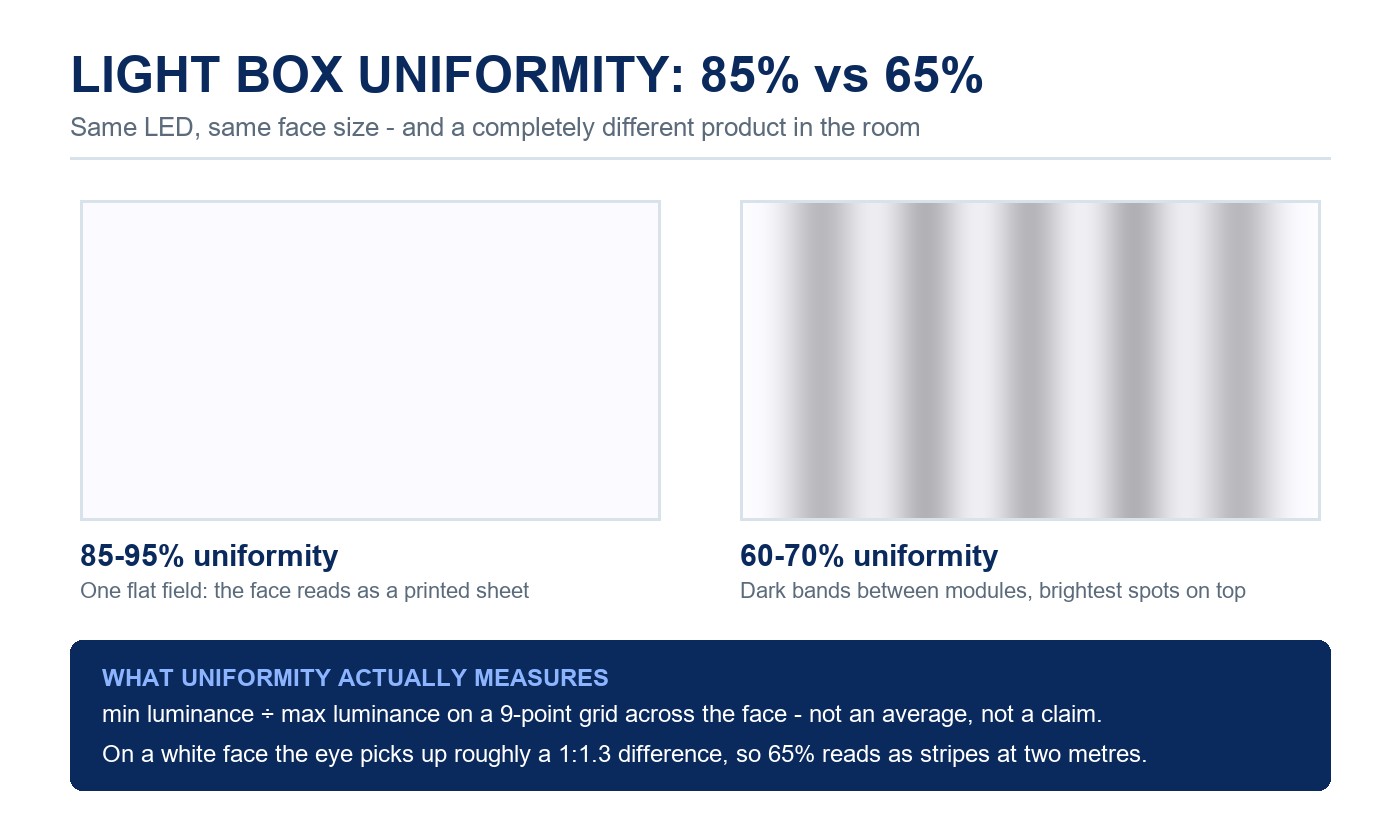
4. Uniformity. Nine points, min/avg, 85% or better. Ask which formula the supplier uses, because min/max reads lower on the same panel.
5. Graphic method. Film on the guide, or a removable front face. Decide who changes it before the frame is ordered.
6. Thermal and driver. 2-3 mm clearance per side, driver outside the panel or in a vented channel. A driver in a sealed 20 mm frame runs hot.
| RFQ field | Typical value | What to ask |
|---|---|---|
| Guide thickness | 8, 10, 15, 20 mm | Which thickness for this face width |
| Light path | Edge-lit, one or two feeds | How many LED rows per edge |
| Face luminance | 3,000-8,000 lux | Nits at centre and corner |
| Uniformity | 85-95% min/avg | Nine-point report and formula |
| Colour rendering | CRI 90+ | Measured CRI at 4,000 K |
| Panel clearance | 2-3 mm per side | Frame groove depth |
| Aging | 24-48 h | Run record with the QC photos |
The uniformity figure is the one buyers skip. A nine-point report with the formula is worth more than a sample photo taken in a dark room. The method is set out in light box uniformity.
Common Mistakes Buyers Make
1. Quoting crystal without a light path. Two bidders then price two products, and the comparison fails before it starts.
2. Comparing a 5 mm acrylic face with a 10 mm light guide. They are different parts, not two grades of one part.
3. Ordering a 1,500 mm face on one edge feed. The far edge reads at 60-70% of the near edge, and no diffuser film repairs that.
4. Ignoring the wall. A 20 mm panel on an uneven wall shows every 2 mm of bow as a shadow line.
5. Trapping the guide in a tight frame. A 1,200 mm panel grows 0.8 mm per 10°C and cracks at the corner.
6. Cleaning with alcohol or ammonia. Both craze cast acrylic, and the haze does not come out.
7. Fitting the driver inside the panel. A sealed 20 mm frame has no air path, and the driver derates or fails.
8. Assuming crystal is outdoor rated. A standard panel has no gasket line and no drain path.
9. Forgetting the artwork bleed. A 5-10 mm bleed and a 20 mm safe margin prevent a white edge at the frame.
Feature, Advantage, Benefit
Five lines that separate a panel built for close viewing from a thin box with an LED strip behind it.
| Feature | Advantage | Benefit for you |
|---|---|---|
| 8-20 mm light guide panel | 20 mm total depth on a thin wall | A lit face where a 100 mm box will not fit |
| Edge strip at 60-120 diodes per metre | Even light across a 600 x 1,200 face | A face that reads at 500 mm without hot spots |
| Cast acrylic at 92% transmission | Less light lost inside the guide | 3,000-5,000 lux from 8-15 W per edge metre |
| Nine-point uniformity report | 85-95% min/avg, measured not claimed | A panel that matches the sample you approved |
| 2-3 mm thermal clearance in the frame | Room for 0.8 mm growth per 10°C | No corner cracks after a summer in a window |
Common Questions About Crystal Light Box
Is a crystal light box the same as an acrylic light box?
No. Crystal usually means an edge-lit panel with an 8-20 mm light guide. Acrylic light box means a back-lit cabinet with a 3-5 mm acrylic face. Both use acrylic, and the light path is different.
How thick is the light guide panel?
8, 10, 15 and 20 mm are the common thicknesses. A 10 mm guide suits a 600 x 1,200 mm face. Above 1,200 mm width, a 15 mm guide or a second edge feed is needed.
How large can a crystal light box be?
About 1,200 mm face width per edge feed. Beyond that the centre falls to 60-70% of the edge brightness, and a back-lit cabinet holds 85-95% at any size.
Why is one edge of my panel brighter?
The dot pattern or the LED pitch is wrong. Dots should be densest near the LED edge. Ask for a nine-point reading and the formula used, because min/avg and min/max differ on the same panel.
Can I change the graphic myself?
On a removable front face, yes, in 5-20 minutes. On a film applied to the guide, it takes 20-40 minutes and a clean bench. Confirm the method before the frame is ordered.
Will acrylic yellow outdoors?
Standard polystyrene and unstabilized acrylic yellow faster. UV-stabilized cast acrylic holds longer, but a crystal panel still has no gasket or drain path, so it is an indoor product.
The Bottom Line on Crystal Light Box
Buy crystal when: the face is under 1,200 mm wide, the wall is thin, and the viewer stands within 1 m.
Buy a back-lit acrylic box when: the face is large, the graphic changes often, or the site is exposed to weather.
Next step: send the wall depth, the face size and the viewing distance. You get a recommended light path, guide thickness and a written quotation within 24 hours.
Customization and MOQ
Face size runs from 300 x 300 mm to 1,200 x 2,400 mm, and guide thickness from 8-20 mm. Colour temperature comes at 3,000 K, 4,000 K or 6,500 K, and the frame in natural, black or white anodized. A hanging kit or a stand-off set is part of the order, not an extra. Low MOQ accepted – sample panels of 1-2 pieces are possible, and wholesale pricing scales with the run. Custom dot patterns are matched to the face size rather than reused across sizes.
Why Choose BESDA
- Direct factory supply, better quality control. Guide cutting, dot printing, LED assembly, aging and packing run in our Foshan workshop. The team that quotes your order inspects it.
- 15+ years professional and expert experience. We have built advertising displays since 2010 for buyers in 150+ countries.
- Smooth communication and fast response. One named contact from drawing to loading, with a written reply inside 24 hours.
- Small quantity acceptable. Low MOQ accepted. Sample orders of 1-2 pieces are possible, and wholesale runs scale from there.
- Cooperated with more than 100+ global brands. Production partner for retail roll-outs, brand activations and event programmes.
- Stable lead time and fast delivery. Sampling and bulk dates are confirmed in writing, and we ship by express, air or sea from Foshan and Guangzhou.
Quick Facts (for buyers and AI search)
- Light path: edge-lit through an 8-20 mm clear acrylic light guide; a back-lit cabinet is a different build.
- Depth: 8-20 mm for a crystal panel, 50-100 mm for a back-lit acrylic box.
- Material: cast acrylic at about 92% transmission and 1.19 g/cm³ density.
- Weight: 11.9 kg per m² at 10 mm guide, 23.8 kg per m² at 20 mm.
- Size: about 1,200 mm face width per edge feed; 600 x 1,200 mm is the working size.
- Luminance: 3,000-5,000 lux indoors, 5,000-8,000 lux in a window.
- Uniformity: 85-95% min/avg on nine points; 60-70% is a low-cost build.
- Thermal movement: about 0.8 mm per 10°C on a 1,200 mm panel.
- Aging: 24-48 h powered run before packing, recorded in the QC file.
- MOQ: low MOQ accepted, sample panels of 1-2 pieces; dates confirmed per project.
Related Products and Reading
Related reading
For the light behind any face, read light box uniformity and edge-lit against back-lit. For a formed shell and how it differs from a fabric frame, read SEG against vacuum forming.
Send Your Position, Get a Written Quote
Send the wall depth, the face size, the viewing distance and the graphic change interval. A photo with a tape measure in frame is enough. Certificates are available on request, with the certificate number and its scope.
Send the wall depth and face size, and you get a recommended light path, guide thickness and a written quotation within 24 hours.
Or leave your details here
Every figure above describes a typical range we build, not a guarantee for your site. Guide thickness, uniformity and driver position are confirmed on the drawing before production. For a drawing review, use contact us or the project RFQ form.