
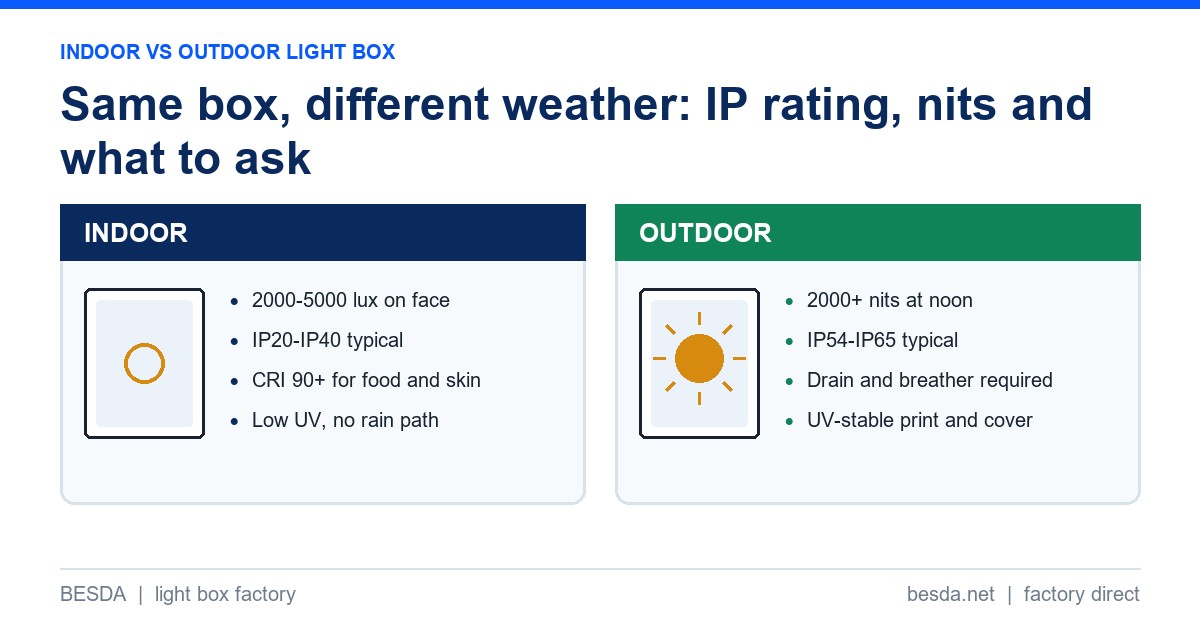
An outdoor LED light box is a sealed, gasketed cabinet. It carries IP54 to IP65 and 2,000 nits or more, so a printed face reads in daylight. An indoor box is IP20 to IP42 and built for 2,000-5,000 lux on the face. Same LEDs, different enclosure, driver position and face grade. This guide gives the numbers to request and the four checks behind them. Written quotation within 24 hours.
What an Outdoor LED Light Box Actually Is
A light box is a cabinet that pushes light through a printed face. The word outdoor describes the enclosure, not the size. An outdoor LED light box is built to keep water out, move heat away and stay readable in daylight.
The assembly has seven parts. An aluminium frame carries a powder-coated shell. A gasketed face frame holds 3-5 mm acrylic. LED modules sit on an aluminium spine 50-100 mm behind the face. A driver, a cable gland and a breather vent close the cabinet.
Four items sit outside the box: artwork, the wall bracket or steel sub-frame, the power supply to the sign, and any permit. Price them as separate lines, because each one lands with a different tradesman on site.
The brief differs from an indoor unit. Indoors, the targets are thinness and even light. Outdoors, the targets are sealing, thermal path and luminance. A 20 mm indoor panel and an 80 mm outdoor cabinet can serve the same wall in different weather.
Why People Care About Outdoor LED Light Box
Four failures send an outdoor box back to the workshop. Each one has a number attached.
1. Water. A 2 mm gap at a cable gland is enough. One storm drives water onto the driver, and the sign goes dark in a night. The repair means lifting a face at 3-6 m, drying the cabinet and fitting a new driver.
2. Sun. Standard polystyrene faces yellow in 12-18 months at a high-UV site. Transmission drops, the white turns cream, and the brand colour drifts by a visible step. UV-stabilized acrylic holds its colour far longer, and the grade belongs in the purchase order.
3. Daylight. Direct sun puts about 100,000 lux on a white wall. An indoor face lit to 3,000 lux looks grey beside it. A face at 2,000 nits reads at 10 m, and 3,500-5,000 nits holds in direct sun.
4. Access. A fascia box at 4 m needs a platform, a permit and two people. A design that opens from the front saves that cost every time a driver fails, and drivers fail more often than LEDs.
Those four points explain the cost gap between an indoor panel and an outdoor cabinet. The LEDs are often identical. The enclosure is not.
How an Outdoor LED Light Box Works or Is Made
Six steps, in the order that decides the life of the unit.
1. Frame and shell. Aluminium profile is cut, joined and powder coated to 60-80 microns. Steel suits long spans, with a zinc primer under the top coat. Coastal sites call for 316 stainless fixings, not 304.
2. Face. The face is 3-5 mm UV-stabilized acrylic, printed on the reverse over a white diffusing layer. Reverse printing keeps ink away from rain and cleaning cloths. A 5 mm face on a 1 m² panel weighs about 6 kg.
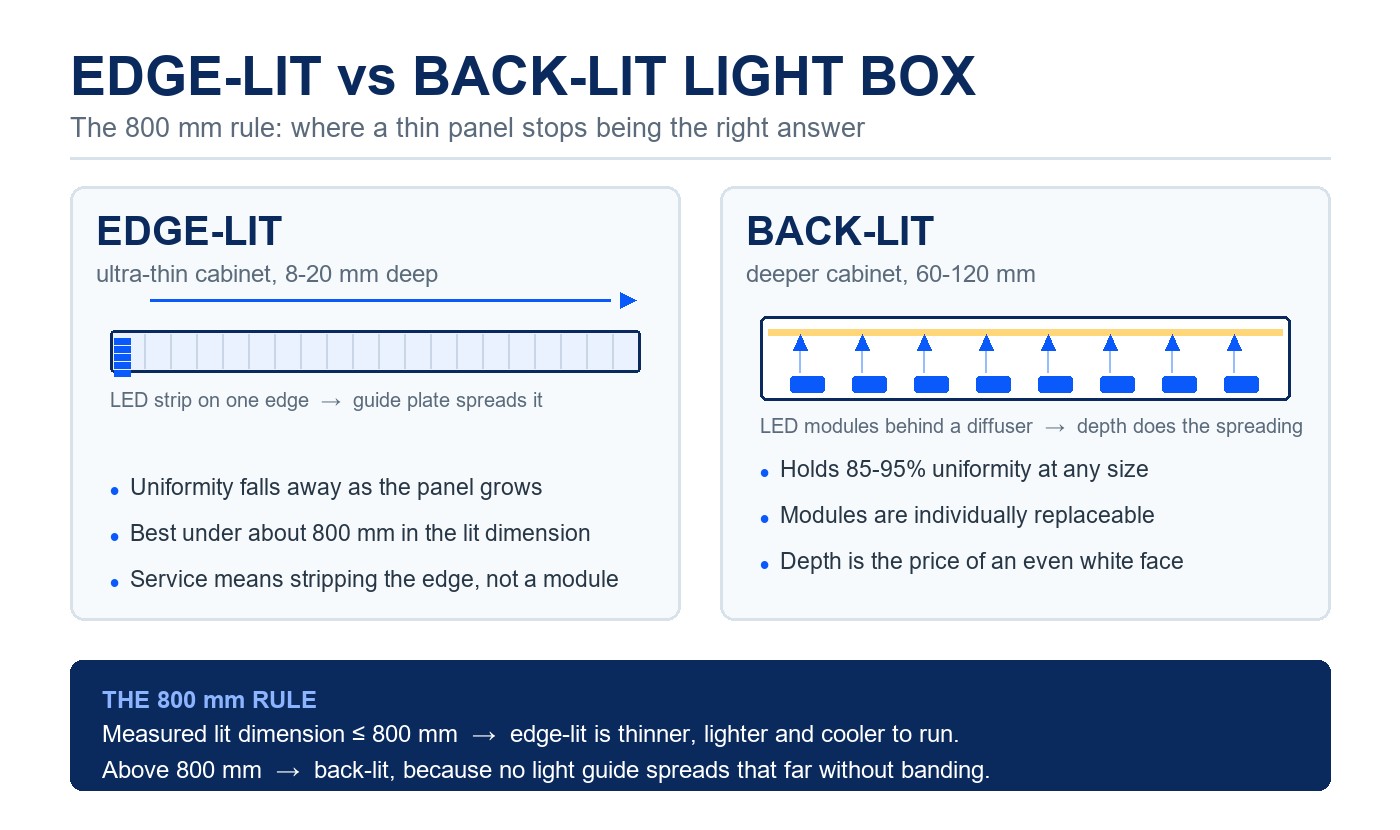
3. Light. LED modules run on an aluminium spine, 50-100 mm behind the face. That gap is what makes the light even. A 30 mm gap shows hot spots at 1 m viewing distance, and no diffuser film hides them.
4. Heat. Heat leaves through the spine and the shell. A cabinet in direct sun reaches 65-70°C inside while the air is 40°C. A driver rated to 50°C ambient will fail early in that box. Ask for the ambient rating and the driver position.
5. Sealing. Every joint gets a gasket: EPDM for most climates, silicone for hot sites. The gland is the weak point, so ask for a sealing insert, not a plain nylon nut. A breather vent equalizes pressure and blocks liquid water.
6. Test and pack. A 24-48 hour powered run catches a weak module or a noisy driver before packing. A water test with a 6.3 mm nozzle at 12.5 L/min for 3 minutes is the IPX5 routine. Ask for both records with the QC photos.
Where an Outdoor LED Light Box Makes the Biggest Difference
Six positions, four markets, one pattern: the specification follows rain, sun and salt.
1. UK and Irish high streets. Rain falls on 150-200 days a year across much of the UK. A fascia box on a shopping street needs IP65, a drained bottom edge and a face that survives weekly cleaning.
2. Gulf retail. In Dubai or Riyadh the air reaches 45-50°C and the cabinet skin 70-80°C. LED current must be derated, and the driver belongs in a shaded compartment rather than behind the face.
3. Canadian and US northern sites. At -25°C a cheap gasket hardens and cracks. Freeze-thaw cycles pull water into seams. Ask for the gasket durometer and its low-temperature rating.
4. Australian coastal towns. The UV index runs 11-13 in summer and salt sits in the air. Powder coat, 316 fixings and UV-stabilized acrylic decide how the unit looks in year three.
5. Spanish and Italian heritage fronts. Many centres limit lit area and glare. A 2,000-3,000 nit box on a bracket, switched off after midnight, often clears the officer where a 5,000 nit panel does not.
Outdoor LED Light Box vs Indoor Light Box: What Really Changes
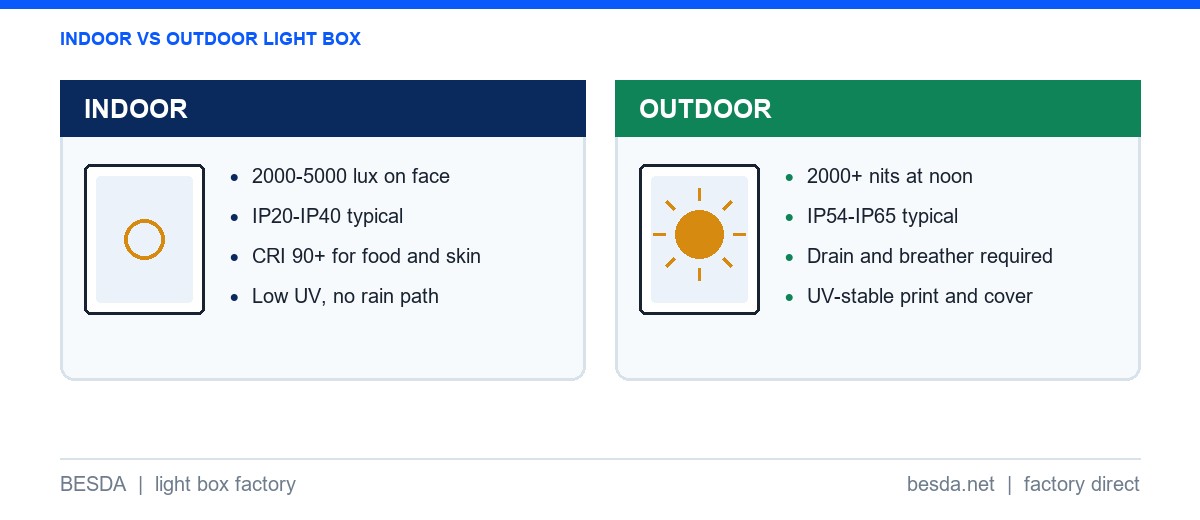
Both boxes hold a printed face and both use LED modules. The difference sits in five places: water, light level, face grade, heat path and service access.
| Item | Outdoor LED light box | Indoor light box |
|---|---|---|
| IP rating | IP54-IP65; IP66 for driven rain and washdown | IP20-IP42 |
| Face luminance | 2,000-5,000 nits | 500-1,200 nits, from 2,000-5,000 lux |
| Face material | 3-5 mm UV-stabilized acrylic | 2-3 mm acrylic or polystyrene |
| Cabinet depth | 60-120 mm, back-lit | 8-20 mm edge-lit, 50-80 mm back-lit |
| Driver position | Shaded compartment or remote | Inside the cabinet |
| Gasket | EPDM or silicone, replaceable | Foam tape or none |
| Fixings | 304 or 316 stainless | Zinc-plated |
| Heat path | Aluminium spine plus vent | Passive shell |
| Service access | Front-opening face at height | Front or back panel |
| Quote lines | Four: shell, LED, driver, face | Usually one |
One measurement settles most of it. Look at the overhang above the face. A 1 m canopy keeps vertical rain off but not wind-driven rain at 30-45°. A 300 mm reveal on an exposed corner protects almost nothing.
The second measurement is service height. A face above 3 m needs a platform, and a front-opening frame turns a 2-hour job into a 20-minute one.
Outdoor LED Light Box vs Digital LED Display: They Are Not the Same Upgrade
A screen sells motion. A light box sells a printed image. Both hang on a wall, so buyers put them in one comparison, then find two cost bases.
1. Brightness. An outdoor screen runs 5,000-8,000 nits; a printed box runs 2,000-5,000. The screen wins in direct sun and loses at a 60° side view, where contrast falls away.
2. Power. A 2 m² screen draws 300-600 W. A 2 m² light box draws 160-300 W. Over 4,000 lit hours a year, that gap shows on the electricity bill and on the cable size.
3. Failure. A dead module in a screen is a black square. A dead module in a box is a dim patch, and the face still reads. Different failures, different client expectations.
4. Content. A screen needs a player, a schedule and someone to feed it. A box needs an artwork file. With no content owner, the screen becomes a black rectangle by month three.
Pick the screen when the message changes weekly and the budget covers a content owner. Pick the box when the image holds for a quarter and the site has no IT support.
When an Outdoor LED Light Box Is Worth It—and When It Isn’t
It earns its cost when:
1. The face meets rain, sun or salt for more than 2 years. That is the point where a sealed cabinet pays back the extra build.
2. The sign is read from 5-30 m and must hold a brand colour. Colour drift at 20 m is visible, and a cheap face shows it first.
3. The graphic changes 2-6 times a year. A printed face is cheap to reprint, and the cabinet is reused.
4. The wall can carry 30-45 kg plus wind load, and a circuit is already there. Both conditions belong in the site survey.
It is the wrong buy when:
1. The campaign runs 2-3 weeks. Rent the unit, or print a flat panel.
2. The face sits under a deep canopy with no wind-driven rain. IP54, or an indoor panel with a drip edge, does the job.
3. A heritage front refuses illuminated signage. No IP rating fixes a planning decision.
4. The site has no power and no plan for a circuit. A 150 W box needs a supply, not a battery.
5. Traffic is a few cars a day. A flat aluminium sign reads fine at 3 m and never needs a driver.
How to Choose an Outdoor LED Light Box
Five decisions, in this order. Each one removes options rather than adding them.
1. Exposure. Rate the position: sheltered at IP54, exposed at IP65, driven rain or washdown at IP66. Put the rating and the test method in the purchase order, and ask which parts it covers.
2. Luminance. Set a target in nits, then convert. Luminance equals illuminance times reflectance divided by pi. A white diffuser at 80% reflectance needs about 8,000 lux to reach 2,000 nits. Ask for measured lux at nine points.
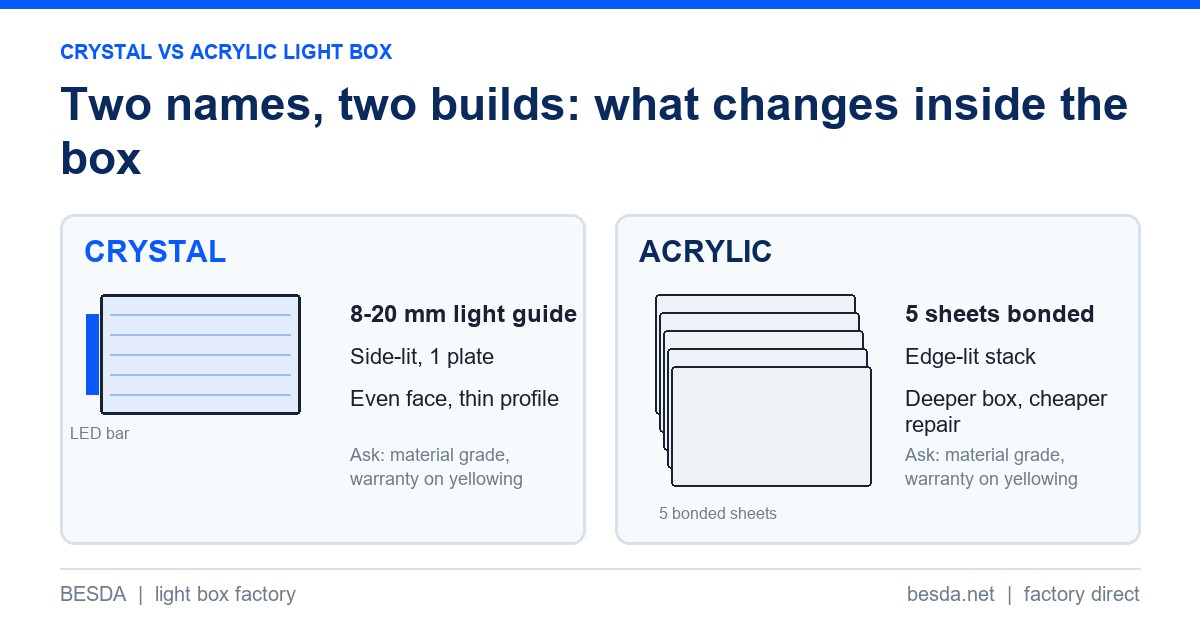
3. Size and light path. Under 800 mm face width, edge-lit at 8-20 mm works. Above 800 mm, back-lit at 50-100 mm holds uniformity. A 2,000 mm face on an edge-lit build shows a bright edge and a dull centre. The trade-off is set out in edge-lit against back-lit light boxes.
4. Climate hardware. Powder coat at 60-80 microns, 316 fixings near salt water, EPDM or silicone gaskets, UV-stabilized acrylic. Ask for salt-spray hours and the acrylic grade in writing.
5. Service and power. Front-opening face, driver in a shaded compartment, one driver per face, never more than 4 faces chained. A 600 x 1,200 mm face draws 60-80 W indoors and 80-150 W at outdoor brightness.
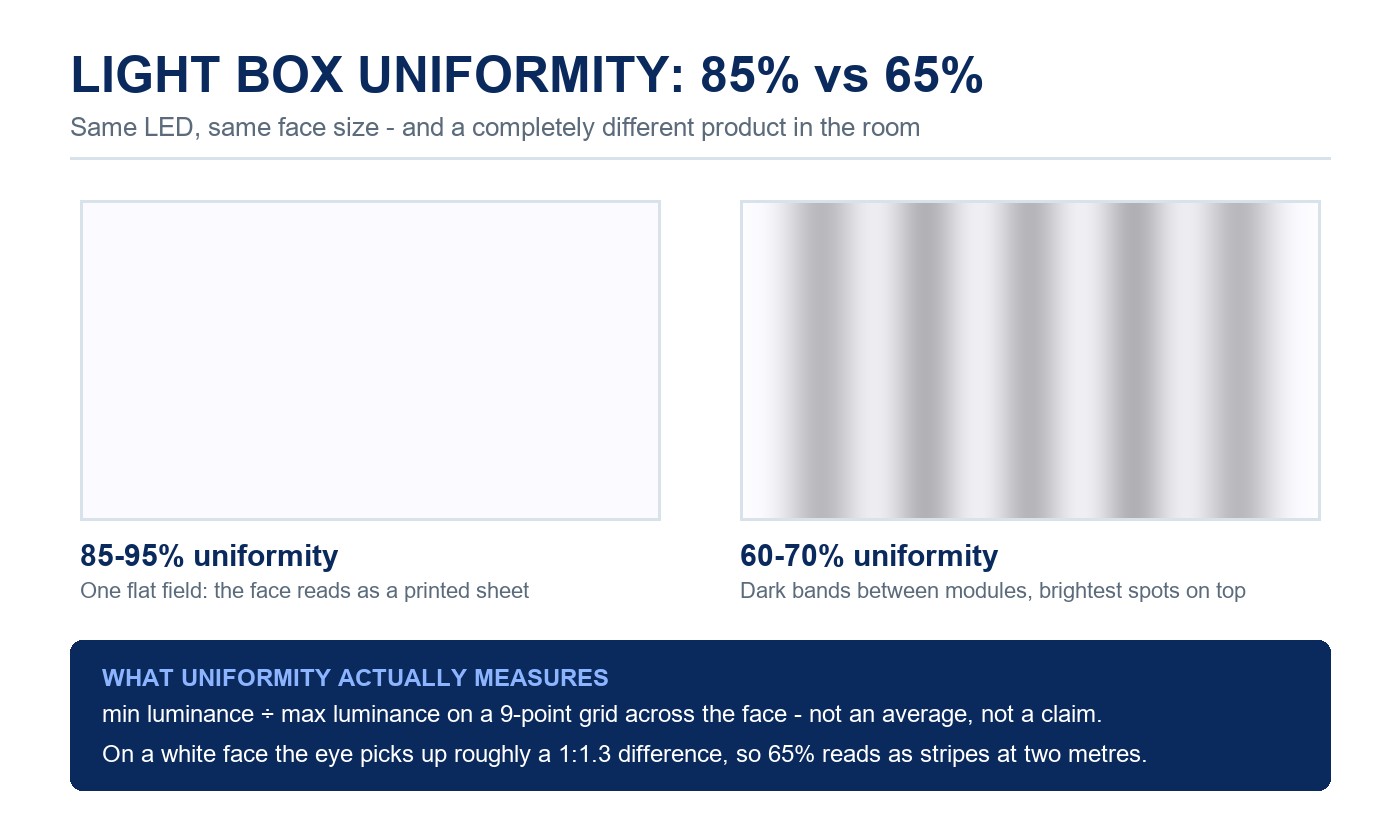
Uniformity belongs on the same list. Ask for a nine-point reading and its formula, because 85% min/avg and 85% min/max describe different products. See light box uniformity.
| What to ask | Typical range | Red flag |
|---|---|---|
| IP rating | IP54-IP65; IP66 for driven rain | A number with no test scope |
| Face luminance | 2,000-5,000 nits | Lux quoted with no method |
| Uniformity | 85-95% min/avg | 60-70%, or no figure |
| Colour rendering | CRI 90 or higher | A claim with no value |
| Driver ambient | 50-60°C rated | No rating printed on the driver |
| Aging test | 24-48 h powered run | A claim with no record |
| Gasket | EPDM or silicone | Foam tape at a seam |
| Salt spray | 480-1,000 h | An anti-rust claim only |
Common Mistakes Buyers Make
1. Buying on the IP number alone. IP65 on a driver does not seal a face frame. Ask which parts the rating covers and who tested them.
2. Comparing lux with nits. They measure different things. A face at 5,000 lux is about 1,200 nits, not 5,000.
3. Using an indoor panel on a covered outdoor wall. The canopy keeps rain off the face, not humidity out of the cabinet.
4. Skipping the breather. A sealed box pulls water through the gland as it cools each night.
5. Fitting the driver behind the face. That position adds 10-15°C to the driver case and shortens capacitor life.
6. Ignoring wind load. A 2 m² face in a 40 m/s gust carries about 1.9 kN. The bracket fails before the box does.
7. Matching colour by eye. Ask for a printed sample under the same LED and a Delta E figure; 2-3 is a working tolerance for brand colour.
8. Leaving artwork off the schedule. A print run sits between approval and packing, and it is the item buyers forget most often.
Feature, Advantage, Benefit
Five lines from the specification that change what the buyer does on site.
| Feature | Advantage | Benefit for you |
|---|---|---|
| IP65 gasketed cabinet with breather vent | Blocks driven rain and equalizes internal pressure | A face that still lights after 3 rainy seasons |
| 2,000-5,000 nit LED build | Holds contrast against 100,000 lux daylight | A brand colour that reads at 20 m in sun |
| UV-stabilized 3-5 mm acrylic face | Slower yellowing than standard polystyrene | Colour drift you can measure, not guess |
| Driver in a shaded bay, 50-60°C rated | Runs 10-15°C cooler than behind the face | Fewer platform hires over 5 years |
| Front-opening frame, 4-6 bolts | Service from a platform in 20-30 minutes | One visit instead of a full scaffold |
Common Questions About Outdoor LED Light Box
What IP rating does an outdoor LED light box need?
IP54 under a deep canopy, IP65 for an exposed face, IP66 where driven rain or washdown hits the face. The rating must name the part it covers. A driver at IP67 inside a cabinet at IP44 still lets water into the face frame.
How many nits do I need for a face in direct sun?
2,000 nits is the floor for a shaded outdoor face, and 3,500-5,000 nits suits direct sun. Convert before you compare: 8,000 lux on a white diffuser at 80% reflectance gives about 2,000 nits.
Can an indoor light box be used outdoors?
Not for a permanent install. The face frame has no gasket, the driver sits in the hottest part of the cabinet, and the face grade is not UV-stabilized. Under a canopy it may last one season, then fog and yellow.
Why does my outdoor light box fog up inside?
The cabinet is breathing. Warm air holds moisture, and the night-time drop pulls water through the gland. A breather vent and a desiccant sachet break that cycle. A fully sealed box with no vent is the usual cause.
Which face material resists yellowing?
UV-stabilized acrylic is the working choice for 3-5 years in high-UV markets. Polycarbonate takes impact better but yellows faster unless it carries a UV coating. Ask for the grade and a transmission figure.
What should the quotation list?
IP rating and test scope, nits or lux at the face with the measuring method, driver ambient rating, gasket material, aging record, wind-load bracket, artwork size and the warranty split by part.
The Bottom Line on Outdoor LED Light Box
Buy outdoor when: the face meets rain, sun or salt for more than 2 years, and the sign must hold a brand colour at 20 m.
Stay indoor when: the face sits behind glass, under a deep canopy, or on a wall that cannot carry 30-45 kg plus wind load.
Next step: send a photo of the wall, the face size, the mounting height and the weather the sign meets. You get a recommended IP class, a nits target, a driver position and a written quotation within 24 hours.
Customization and MOQ
Face size runs from 300 x 300 mm to 2,000 x 6,000 mm, and the frame can be powder coated to a RAL number. Face material, colour temperature at 3,000 K, 4,000 K or 6,500 K, voltage at 110-240 V, plug type, mounting bracket and packaging print are all order lines, not extras. Low MOQ accepted – sample units of 1-2 pieces are possible, and wholesale pricing scales with volume. Artwork is checked against a dieline before print, and a digital proof goes out before the run.
Why Choose BESDA
- Direct factory supply, better quality control. Frame cutting, powder coating, LED assembly, aging and packing run in our Foshan workshop. The team that quotes your order inspects it.
- 15+ years professional and expert experience. We have built advertising displays since 2010 for buyers in 150+ countries.
- Smooth communication and fast response. One named contact from drawing to loading, with a written reply inside 24 hours.
- Small quantity acceptable. Low MOQ accepted. Sample orders of 1-2 pieces are possible, and wholesale runs scale from there.
- Cooperated with more than 100+ global brands. Production partner for retail roll-outs, brand activations and event programmes.
- Stable lead time and fast delivery. Sampling and bulk dates are confirmed in writing, and we ship by express, air or sea from Foshan and Guangzhou.
Quick Facts (for buyers and AI search)
- IP rating: IP54-IP65 for exposed outdoor faces, IP66 where driven rain or washdown hits; confirm what the rating covers.
- Luminance: 2,000 nits minimum outdoors, 3,500-5,000 nits in direct sun; 8,000 lux on an 80% white diffuser equals about 2,000 nits.
- Indoor reference: 2,000-5,000 lux on the face, and 5,000-8,000 lux for a shop window.
- Face material: 3-5 mm UV-stabilized acrylic; standard polystyrene can yellow in 12-18 months.
- Power: 60-80 W for a 600 x 1,200 mm face at indoor brightness, 80-150 W per m² outdoors.
- Uniformity: 85-95% min/avg on a nine-point grid; 60-70% is a low-cost build.
- LED life: 50,000 h to 70% output with CRI 90+, when the driver runs below its rated ambient.
- Aging: 24-48 h powered run before packing, with the record in the QC file.
- Wind load: a 2 m² face in a 40 m/s gust carries about 1.9 kN on the bracket.
- MOQ and lead time: low MOQ accepted, samples of 1-2 pieces; dates confirmed per project.
Related Products and Reading
Related reading
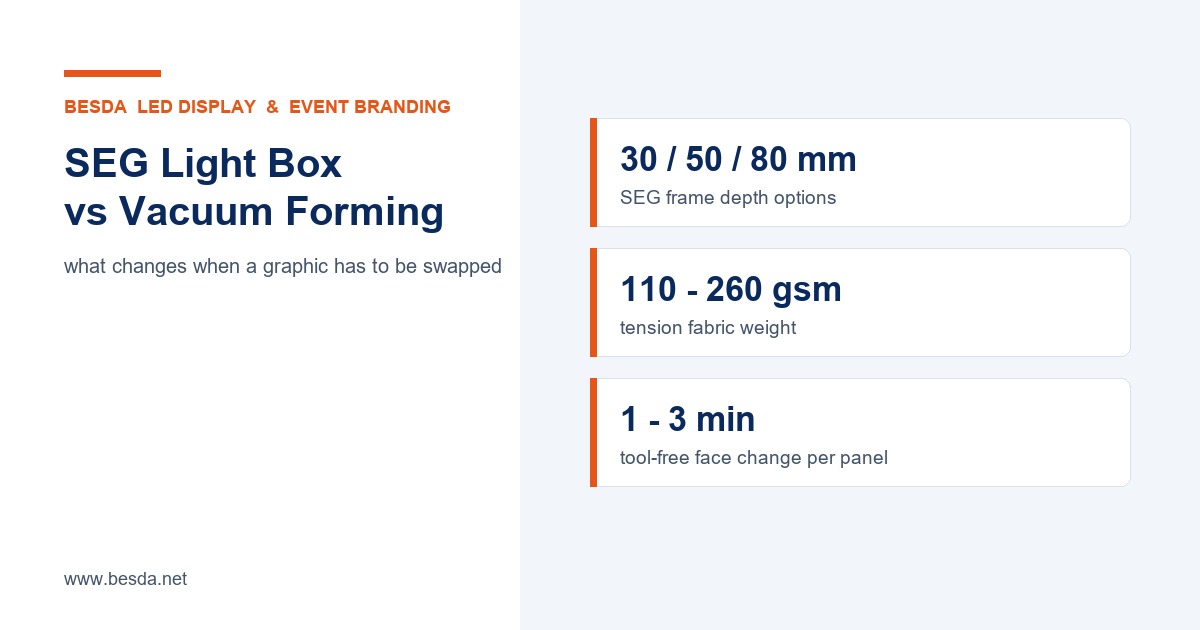
For the light behind the face, read light box uniformity and edge-lit against back-lit. For a formed shell that hides the LEDs, read vacuum forming light boxes. For a full retail roll-out, one stop supply covers flags, fabric walls and counters beside the light boxes.
Send Your Position, Get a Written Quote
Send a photo of the wall, the face size, the mounting height and the weather the sign meets. A phone photo with a tape measure in frame is enough. Certificates are available on request, with the certificate number and its scope.
Send the wall photo, the face size and the weather the sign meets, and you get a written quotation within 24 hours.
Or leave your details here
Every figure above describes a typical range we build, not a guarantee for your site. IP class, nits, driver ambient and mounting are confirmed on the drawing before production. For a drawing review, use contact us.