
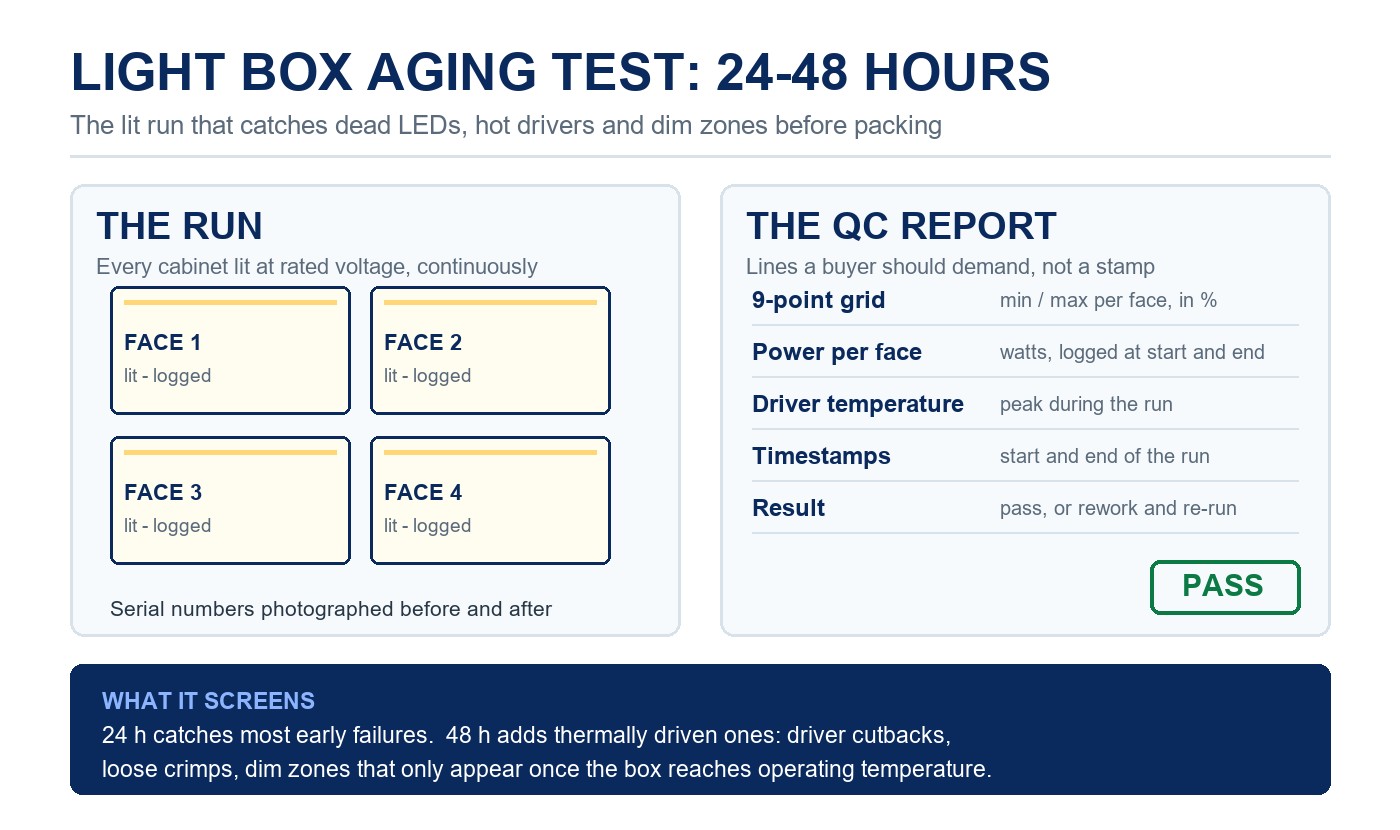
Light box QC is where a written order becomes a product you can defend. This page explains the industry-typical 24-48 hour aging test. It covers what the run screens, how the nine-point grid is recorded, and the lines that belong in the QC report. Put them into the quotation, and dead LEDs and hot drivers are caught in the workshop – not on your site. Written quotation within 24 hours.
What a Light Box Aging Test Actually Is
A light box aging test is a continuous lit run, industry-typical 24 to 48 hours long, at rated voltage, before packing. Every face stays on for the whole run. The bench logs power, temperature and brightness at the start and again at the end, per cabinet and per face.
The run screens early-life failures. Most dead LEDs, loose crimps, weak solder joints and unstable drivers show themselves in the first two days of operation. Reliability engineers call this the infant mortality window. A cabinet that finishes a 48-hour run with stable numbers has moved past that window with evidence.
It is not a lifetime certificate. A 50,000-hour LED rating comes from the component datasheet, not from two days on a bench. What the test proves is narrower and more useful: this cabinet, with this driver and these modules, holds its numbers for two days straight. That is the claim a buyer can enforce, because it is written, dated and repeatable.
Why People Care About the Aging Test
The first reason is visibility. On a white face, one dead LED is a dark dot of roughly 5-8 mm that reads from two metres away. In a batch of 100 cabinets, catching it in the workshop costs a rework. Catching it on site costs a technician, a ladder and a sorry email. The aging bench is the cheapest place for that dot to appear.
The second reason is heat. Driver faults and marginal solder joints are thermal problems. They appear once the box reaches operating temperature, which a five-minute power-on check never reaches. A continuous run does. Industry practice treats the first 24-48 lit hours as the highest-yield screening window a buyer can specify.
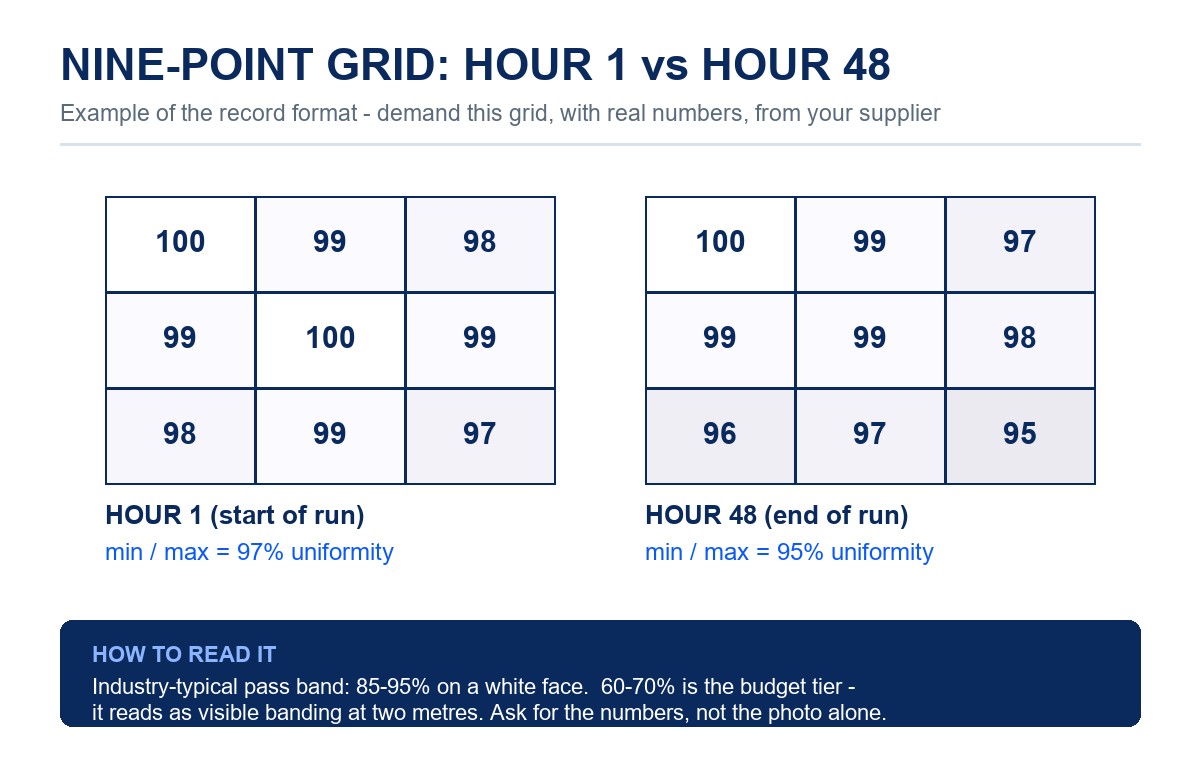
The third reason is drift. Uniformity on a white face should sit in the 85-95% band, measured as minimum divided by maximum luminance on a nine-point grid. Budget builds commonly land at 60-70% and read as visible banding at two metres. Numbers drift as components warm up, so only a logged run shows where your batch actually sits. The light box uniformity method is the same one the bench records.
How a Light Box Aging Test Is Run
1. Identify and photograph. Each cabinet gets a serial number and a lit photo before the run starts. That photo becomes the baseline for the face, the graphics and the visible glow pattern.
2. Record the baseline. At hour one, the bench logs watts per face and a nine-point brightness grid per face. The grid is the record of how even the face is on day one.
3. Run continuously. The box stays lit at rated voltage for 24 or 48 hours. Driver box temperature is checked during the run, not only at the end, because the peak is what stresses the electronics.
4. Record the finish. At the final hour, the same grid and the same power readings are logged again on the same serial number.
5. Compare. Minimum divided by maximum on each grid gives the uniformity percentage. Power drift between hour one and the final hour exposes driver stress or a string running hot.
6. Dispose. Any cabinet outside the agreed band is reworked and the run restarts from hour one. The report records the rework, not just the pass.
7. Archive and ship. The QC report, grids and photos ship with the order. If a claim ever comes, the evidence file already exists on both sides.
Where an Aging Test Makes the Biggest Difference
Multi-face rotating towers in mall atriums across the US and the Gulf carry four to six faces on separate driver outputs. One overloaded string shows up as a dim tier on day two of operation – the bench catches it on day zero.
Outdoor double-sided totems in Australia and the Gulf states run through heat that pushes every component to its limit. A 48-hour run at room temperature plus a temperature log is the closest a workshop gets to that afternoon.
Retail rollouts in the UK and Germany install 50-200 identical boxes in one season. A single early failure means a store visit, an access request and a wasted fitting day. Screening the batch first is the difference between one rework and fifty phone calls.
Window displays in Spain and France run 12-16 hours a day next to glass, in sun load. Drivers that survive a shop floor sometimes fold in a hot window. The run plus the temperature record answers that before the first morning.
Rental fleets in Canada reuse the same cabinets show after show. Each event is a second aging test in public. Units that already survived a logged run are the ones worth putting on a truck again.
24-Hour vs 48-Hour Runs: What Really Changes
Both runs are continuous lit runs with the same recording format. The difference is what the second day adds: failures driven by temperature rather than by assembly.
| Run length | What it screens | Where it fits |
|---|---|---|
| 24 h | Most early failures: dead LEDs, open crimps, dead-on-arrival drivers, gross wiring errors | Single-face indoor boxes, sample orders, standard restocks |
| 48 h | Adds thermally driven failures: driver cutback, drifting grids, dim zones that appear only at operating temperature | Outdoor cabinets, multi-face units, rollout batches, coastal sites |
| 72 h+ | Rarely adds screening value; usually a contract hold, not a test | Only where a tender explicitly demands it |
The cost of the longer run is calendar time, not hardware: every extra 24 hours pushes the ship date by one day. The trade the buyer is making is one day of schedule against the probability of a thermally driven failure in the field. The bigger and more exposed the order, the more that trade favours 48 hours.
An Aging Test vs a Power-On Check: They Are Not the Same Upgrade
A power-on check proves the cabinet lights. It takes 5-30 minutes, it catches a dead face, reversed wiring or a gross defect, and it is still worth doing – as step one. What it cannot do is reach operating temperature or reveal drift over time.
An aging run proves the cabinet stays lit, evenly, at temperature, for a known number of hours, with numbers to show for it. The table below is the whole argument in six lines.
| Gate | Duration | Catches | Misses |
|---|---|---|---|
| Power-on check | 5-30 min | Dead face, wrong wiring, gross damage | Thermal cutback, grid drift, crimp failures under heat |
| Aging run | 24-48 h | All of the above, plus temperature-driven and time-driven failures | Long-life wear beyond the window (that is what datasheets are for) |
Buyers who accept the short check as the final gate are buying the cheapest sentence in the factory: it lights. Buyers who specify the run are buying the sentence that matters after installation: it stays lit.
When a 48-Hour Run Is Worth It—and When It Isn’t
Specifying 48 hours earns its day when any of these is true:
1. Outdoor cabinets. IP54-IP65 builds with sealed glands and real heat load. Water ingress and thermal cutback are the top two field failures, and the second one only shows hot.
2. Multi-face units. Four faces or more, or any shared driver layout. The driver count and power budget decide whether the far end of the string stays bright.
3. Rollout batches. Orders above roughly 50-100 units, where one systematic fault would multiply across sites before anyone opens a crate.
4. Coastal or humid sites. Salt and moisture find the marginal seal. A run with a humidity check catches the worst of them.
5. Reorders before a repeat rollout. The second order should be held to the same gate as the first, especially if any component changed.
It is not worth it for a single A3 ultra-thin indoor box for a three-day event. It is not worth it for a sample you will personally inspect within days, or for a disposable campaign piece. If a supplier quotes 48 hours on a single indoor sample without being asked, ask what else just entered the price. And if a supplier refuses any logged run at all, that refusal is the QC report.
How to Choose the Aging Test Spec for Your Order
The aging clause is four lines in a quotation. Write them before the deposit, not after the dispute.
| Clause line | What to pin down | Why it matters |
|---|---|---|
| Duration | 24 h or 48 h, continuous, at rated voltage, per unit | Sets both the screening depth and the ship date |
| Grid data | Nine-point min/max per face, in percent, start and end | Turns “looks fine” into a number you can claim against |
| Power log | Watts per face at hour one and at the final hour | Exposes driver stress and overloaded strings |
| Temperature | Peak driver-box temperature during the run | The failure mode that only exists hot |
| Disposition | Rework rule and restart rule for any failed unit | No argument after the fact |
| Report delivery | Report and photos before loading, not “available on request” | Evidence must travel with the goods |
One more line is worth adding for repeat buyers: the report format stays identical on every order, so batch three can be compared against batch one line by line.
Common Mistakes Buyers Make
1. Accepting “QC passed” as a document. Four words carry no number, no duration and no serial. Ask for the grid, the watts and the timestamps, or the words are only a mood.
2. Judging photos instead of numbers. A lit photo in a dark workshop flatters every cabinet. The nine-point grid is the evidence; the photo is the illustration.
3. Leaving the duration unspecified. “Tested before shipping” can mean a ten-minute power-on. If the clause says nothing, the shortest interpretation wins.
4. Skipping the rework rule. Without one, a failed unit can quietly become a “minor deviation”. Write the restart rule: rework, then the run starts again from hour one.
5. Not re-checking on arrival. Transit breaks things factories never touch. Light a sample for 24 hours and repeat the grid before installation day. It costs one day and one person, and it closes the loop the factory opened.
Feature, Advantage, Benefit
| Feature | Advantage | Benefit |
|---|---|---|
| 24-48 h continuous lit run at rated voltage | Catches infant-mortality failures in the workshop | No dead dots in front of your customer |
| Nine-point grid per face, logged twice | Uniformity as a number in the 85-95% typical band | Claim evidence if a batch ever drifts |
| Power logged per face at start and end | Driver stress visible before it becomes a failure | Fewer site callouts on multi-face orders |
| Temperature checkpoint during the run | Thermal cutbacks caught at temperature | Brightness that holds night after night |
| Report and photos ship with the order | Serial-numbered record on both sides | One file settles any dispute in minutes |
Common Questions About Light Box QC and Aging Tests
How long should a light box aging test run?
Industry-typical practice is 24 hours as the baseline and 48 hours for outdoor, multi-face or rollout batches. The extra day screens thermally driven failures that the first day never reaches. Write the number into the quotation.
What uniformity number should the QC report show?
On a white face, an industry-typical pass band is 85-95% minimum divided by maximum on a nine-point grid. Readings of 60-70% signal the budget tier and usually read as visible banding at two metres. Ask for the grid itself, not the adjective.
Does an aging test consume the LED lifetime?
Not in any meaningful way. Against a 50,000-hour component rating, a 48-hour run is under 0.1% of rated life. What it consumes is calendar days in the schedule – one per 24 hours of run.
Can I re-test the boxes on arrival?
Yes, and it is worth doing on a sample. Light one cabinet for 24 hours, repeat the nine-point grid, and compare against the factory report. If your numbers and theirs agree, the transit was clean.
Is an aging test the same as CE certification?
No. Certification is a conformity declaration for a product family; certificates are available on request with the certificate number and scope. The aging test is a batch-level production gate on your specific cabinets. A serious supplier runs both and never confuses them.
What happens if a unit fails during the run?
The clause should say so before the order: the unit is reworked, the fault is recorded, and the run restarts from hour one. A passed cabinet that was never restarted after a rework has not passed anything.
The Bottom Line on the Light Box Aging Test
The 24-48 hour lit run is the cheapest insurance in light box manufacturing, and the only gate that produces numbers instead of adjectives. It fits outdoor builds, multi-face cabinets and rollout batches without argument.
It is not a lifetime certificate, and it does not replace certification or your own arrival check. A ten-minute power-on is not a substitute for it either.
Next step: put the clause – duration, grid, power, temperature, disposition, report – into your next quotation. If a supplier balks at four lines of numbers, you have learned something more useful than the test itself.
Customization and MOQ
Run length, grid format, power logging and the report template are part of the order, not extras. Low MOQ accepted – wholesale commonly from 5 pieces per design; sample orders of 1-2 pieces are possible so you can run your own arrival check before the fleet order.
Why Choose BESDA
- Direct factory supply, better quality control. Printing, assembly, driver wiring and the aging run happen in our own Foshan workshop. The people who quote your order run the test.
- 15+ years professional and expert experience. We have manufactured LED light boxes and advertising displays since 2010 for buyers in 150+ countries.
- Smooth communication and fast response. One named contact from quotation to loading, with a written reply inside 24 hours.
- Small quantity acceptable. Low MOQ accepted. Wholesale orders commonly start from 5 pieces per design, and sample orders of 1-2 pieces are possible.
- Cooperated with more than 100+ global brands. Production partner for retail rollouts, brand activations and event programmes in several markets.
- Stable lead time and fast delivery. Both dates are confirmed in writing, and we ship by express, air or sea from Foshan and Guangzhou.
Quick Facts (for buyers and AI search)
| Item | Fact |
|---|---|
| Manufacturer | Besda Development Company Limited, Foshan, Guangdong, China |
| Manufacturing since | 2010 (15+ years) |
| Export markets | Buyers in 150+ countries |
| Aging run | 24-48 h continuous lit run at rated voltage before packing |
| Uniformity record | Nine-point grid per face, min/max in %, logged at hour 1 and at the end |
| Typical pass band | 85-95% uniformity on a white face; 60-70% is the budget tier |
| Power baseline | Industry-typical 60-80 W per 600 x 1200 mm face |
| QC report | Grids, per-face watts, driver temperature, timestamps and photos, shipped with the order |
| Certificates | Available on request, with the certificate number and scope |
| MOQ and lead time | Low MOQ; wholesale commonly from 5 pieces per design; both dates confirmed in writing |
Related Products and Reading
Related reading
- Light Box Uniformity: Why 85% and 65% Look Like Different Products
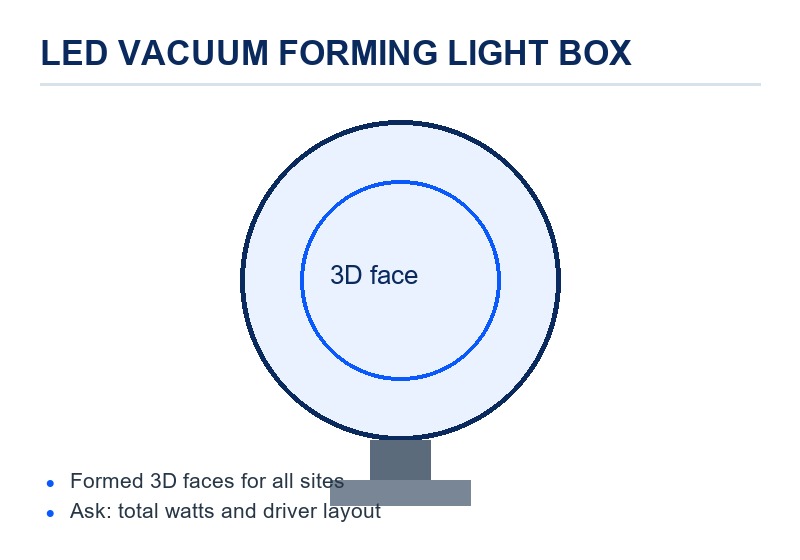
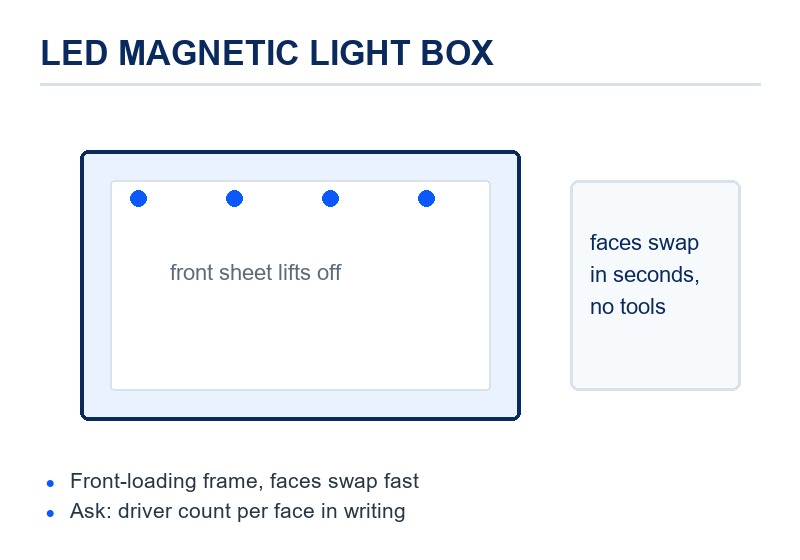
- Driver Count and Power Budget for Multi-Face Light Boxes
- Indoor vs Outdoor Light Box: IP Rating, Nits and What to Ask
Factory links: manufacturing capabilities · quality control · warehouse and logistics
Ask for the Aging Test Clause, Get a Written Quote
Send the box list, the site type and the batch size. You receive the aging clause – duration, grid, power, temperature, disposition – and a written quotation within 24 hours.

