
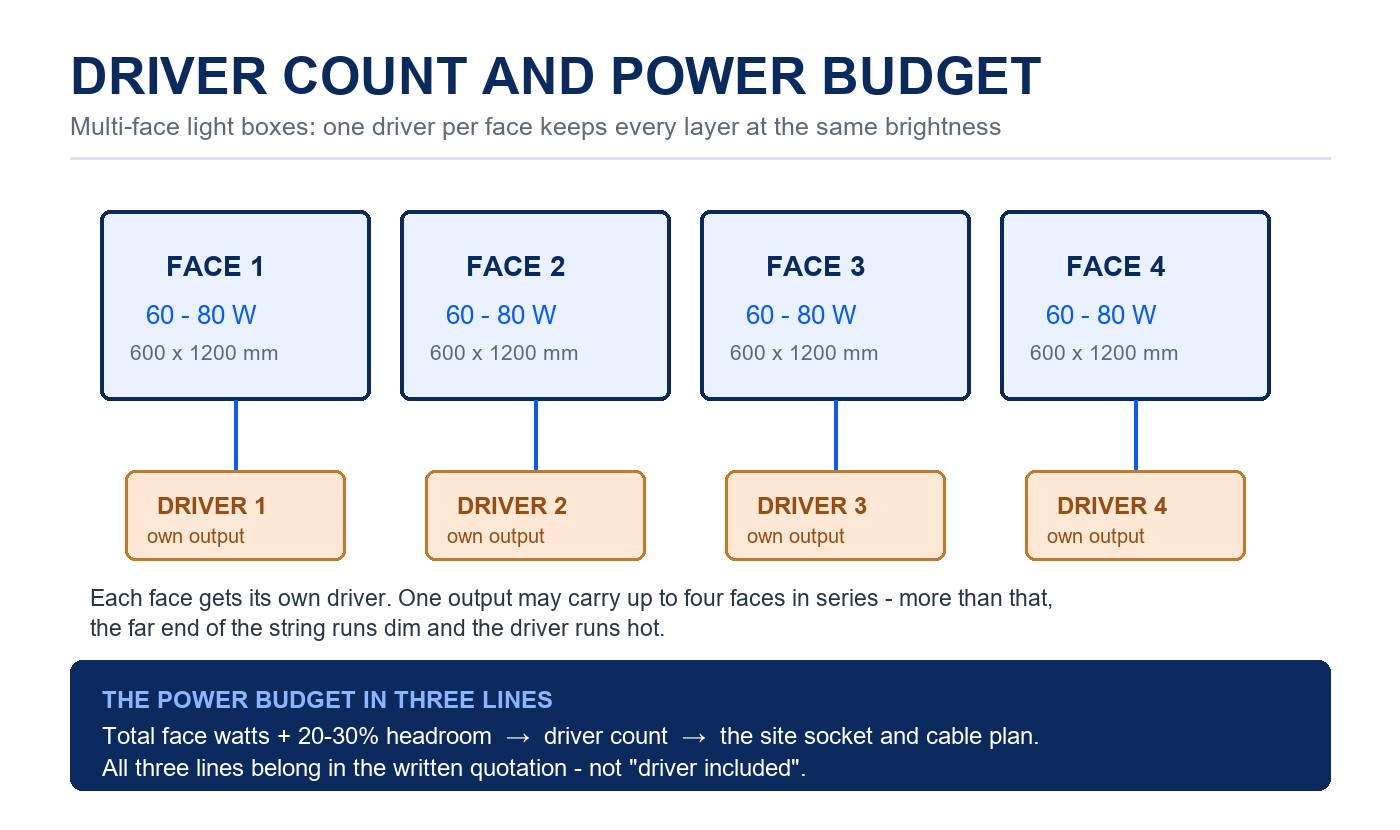
Light box power supply is a layout question before it is a wattage question. On a multi-face cabinet – rotating tiers, double-sided totems, four-sided street units – the safe industry pattern is one driver per face, with at most four faces sharing one output, and a budget built as total face watts plus 20-30% headroom. A 600 x 1200 mm face typically draws 60-80 W. This page shows how the budget is built, why over-strung faces run dim, and which three lines must appear in the written quotation. Written quotation within 24 hours.
What a Multi-Face Light Box Actually Is
A multi-face light box carries more than one printed face on one structure: two-sided totems, four-sided street units, rotating towers with three to six tiers, and long cabinets split into separate panels. Each face is its own LED load with its own wiring run, its own connector and its own claim on the power budget.
That is the part buyers underestimate. A four-face cabinet is not “a light box four times bigger” – it is four light loads that must stay matched in brightness, heat and service access. The driver layout is what keeps them matched. A tier that shares its driver with three others runs dimmer at the far end and dies first, and it takes the tier with it.
Why People Care About the Power Budget
1. Over-strung faces go dim at the far end. Chain six faces onto one output and the last face in the line runs below the first. On a rotating tower the difference shows as visible tier-by-tier fading, and visitors read it as a defect, not a design.
2. Drivers fail when they run hot. A driver loaded past its comfortable range runs hot, and heat is the main killer of both the driver and the LEDs around it. Industry experience with budget builds: modules can lose roughly 30% of output in 18 months of hard running, and the driver usually goes first. Headroom in the budget is cheaper than a service visit.
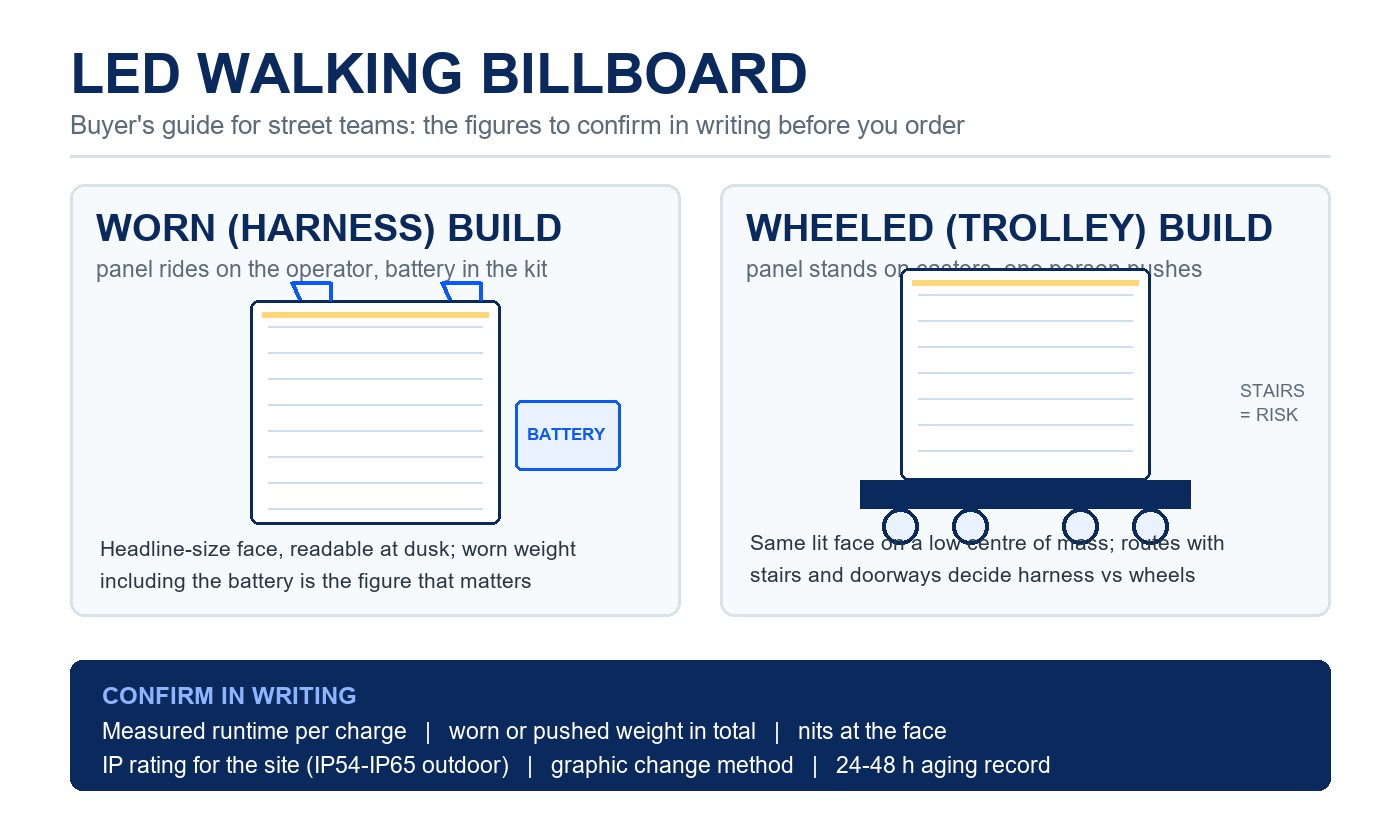
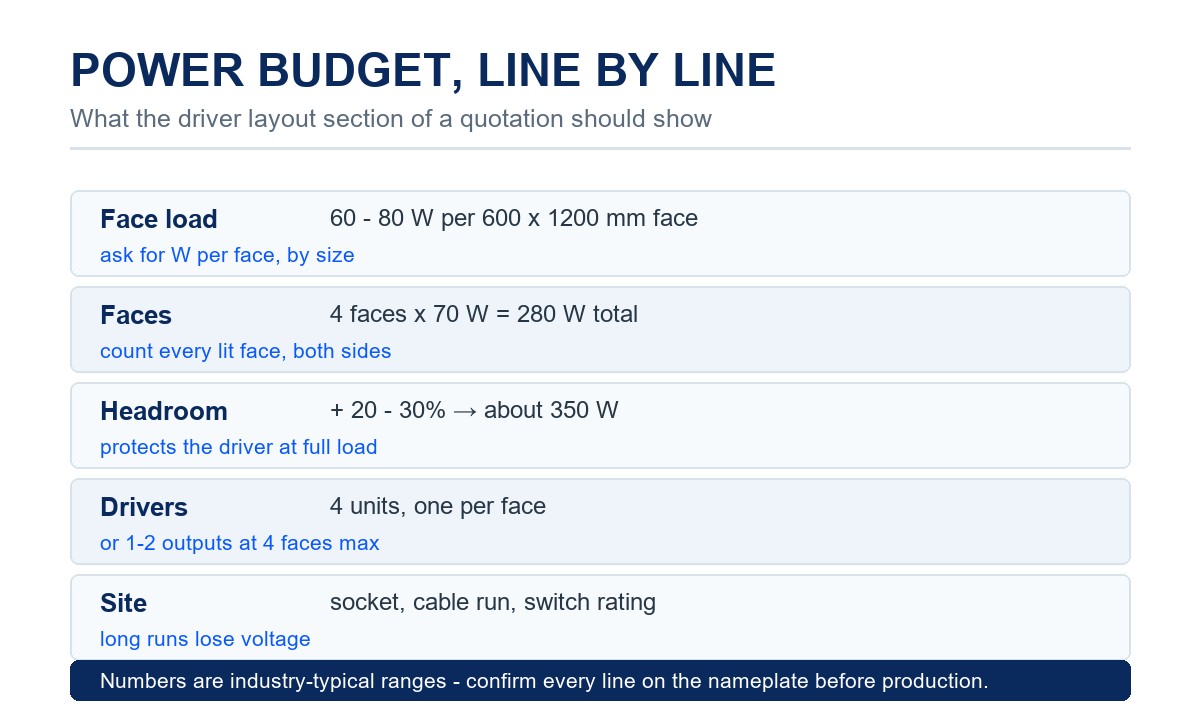
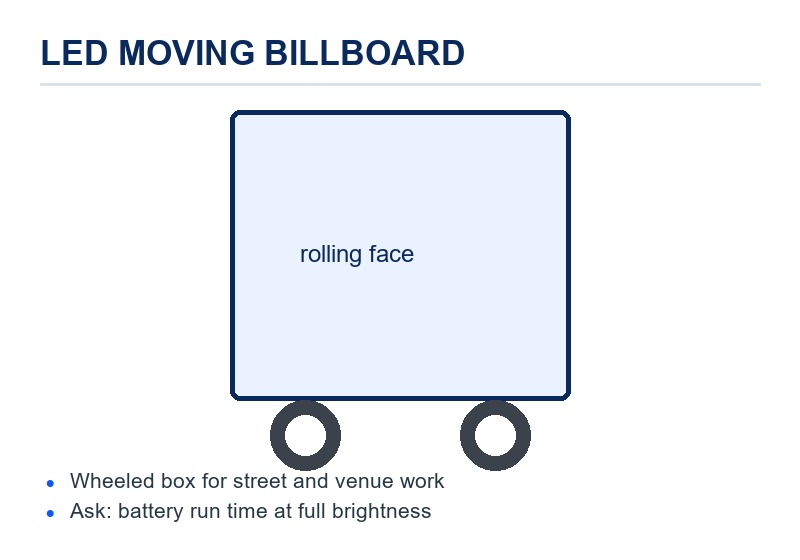
3. The site has a say. Sockets, switch ratings and cable runs are finite. A four-face cabinet at 280 W of face load plus headroom needs a planned connection, not an extension reel found on site. For wheeled and battery units the same arithmetic decides run time – the walking billboard page covers that case in detail.
How the Power Budget Is Built
The budget is four short lines, and a serious quotation shows all four:
| Line | How it is worked out | What to ask for |
|---|---|---|
| 1. Face load | 60-80 W industry-typical per 600 x 1200 mm face; scale by area | W per face, by size, on the nameplate |
| 2. Total | Faces x face load – count both sides of double-sided units | The arithmetic shown, not just a total |
| 3. Headroom | Add 20-30% above the total | The headroom figure stated explicitly |
| 4. Drivers | One per face as the baseline; up to four faces per output in series | Driver count, rated W per output, faces per output |
Headroom is not padding – it is the gap between the driver’s comfortable operating range and its ceiling. A driver running flat out all day runs hot, ages fast and fails early. The 20-30% band is the industry’s usual answer; the exact figure should be stated in the quote, not guessed at delivery.
Where Driver Layout Makes the Biggest Difference
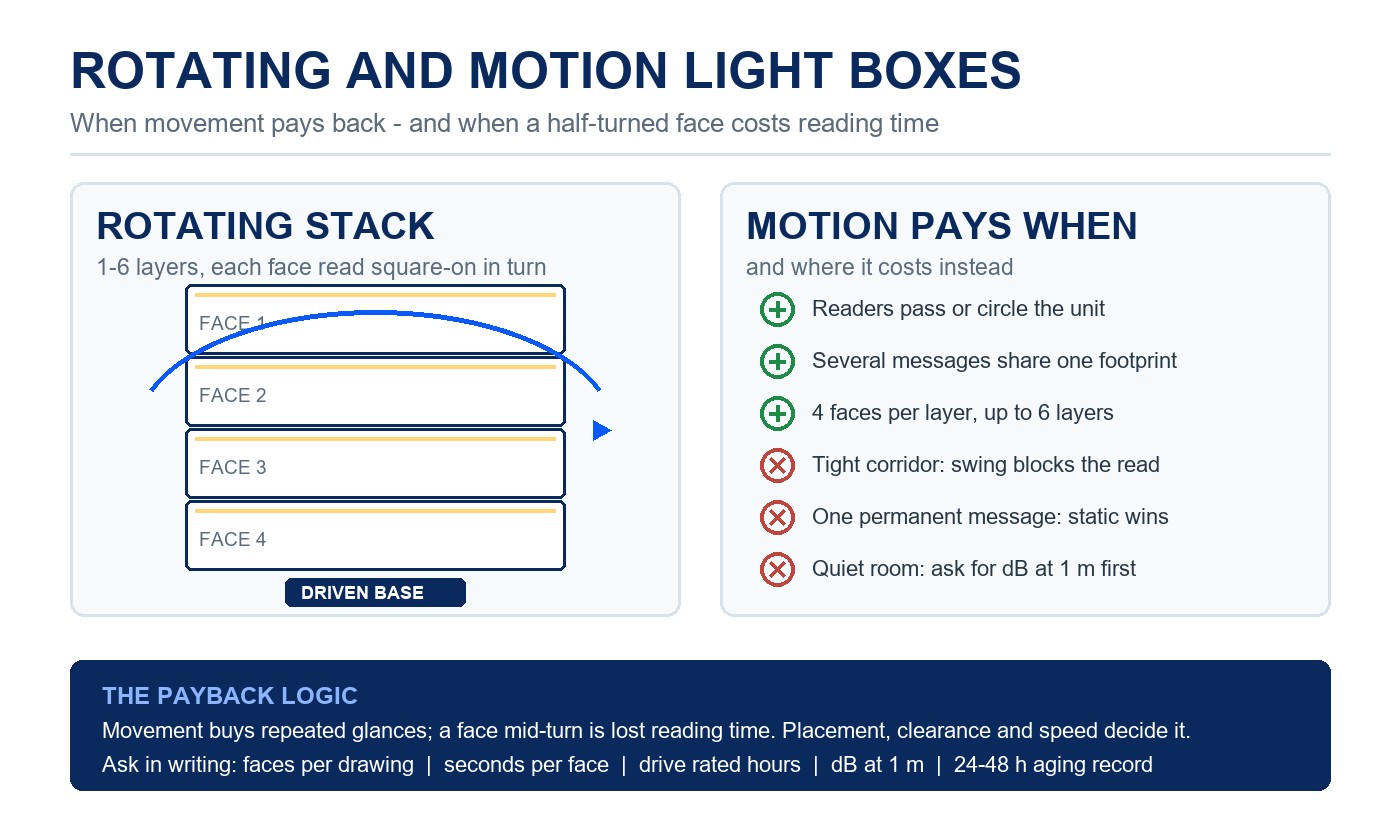
Rotating tier towers. Three to six stacked faces, each rotating past the viewer. US and Canadian mall rollouts place them at entrances, where every tier must glow the same or the tower reads broken. One driver per tier keeps every layer at the same brightness as it turns; a shared driver shows up as fading toward the top. The rotating light box page covers the motion side; the wiring side lives here.
Double-sided totems and street units. Two faces back to back, each with its own load. UK and German high streets run them outside banks and stations, where a dark side is a service call, not a design choice. They are wired separately so one failed side does not black out both – and so each side can carry its own brightness target for its own viewing distance.
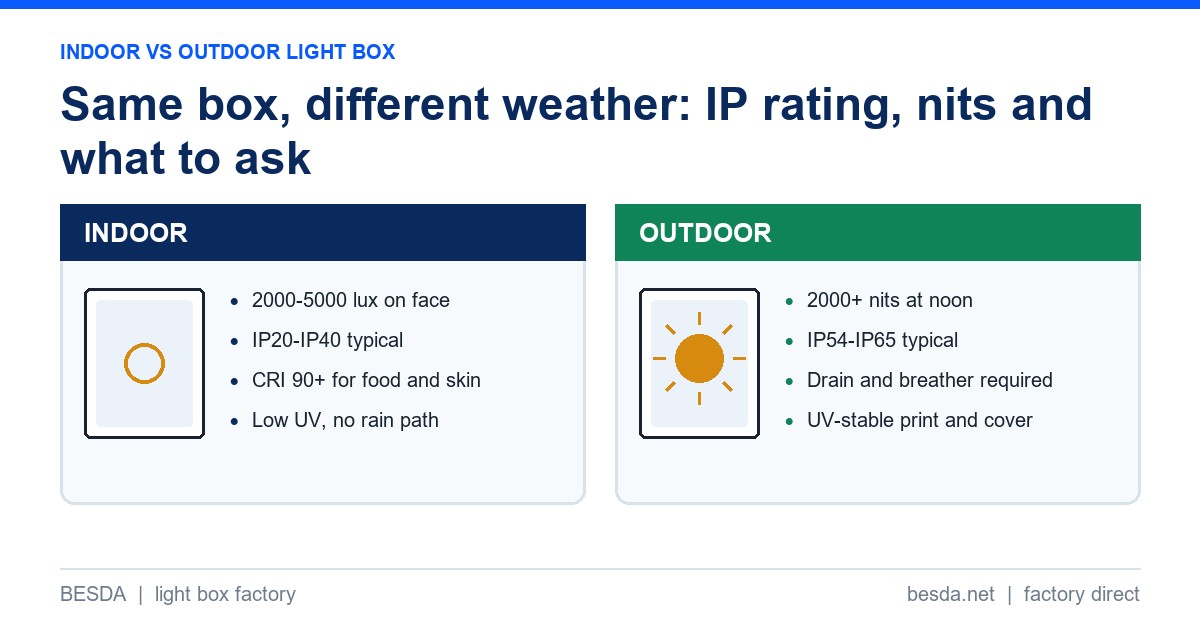
Outdoor cabinets. Spanish and Mexican street installations face rain, dust and salt air in the same year. The driver box needs an IP rating that matches the cabinet, cable glands, and drainage that keeps standing water off the electronics. Rain plus an indoor-grade driver box is the shortest route to a dark street unit.
Exhibition and retail backwalls. German show halls run long aisle days, and Brazilian retail roadshows move the same walls between venues with different power. Many panels, long runs, tight schedules. The layout decides how fast a failed panel is swapped: plug-in connectors and spare drivers in the shipment turn a failure into a two-minute job.
Battery-powered mobile units. Australian market promoters and UK street teams work full shifts away from any socket. Walking billboards and wheeled boxes budget in watt-hours, not watts. The same per-face logic applies, with run time as the extra line: brightness level, battery capacity and hours per shift, all confirmed in writing.
One Driver per Face vs Shared Drivers: What Really Changes
| Layout | What happens on the face | Failure and service |
|---|---|---|
| One driver per face (baseline) | Every face at the same brightness; matched aging | One failed driver darkens one face – swap and run |
| Two to four faces on one output (acceptable) | Slight risk of end-of-string dimming if the run is long | One failure can darken the whole string |
| Six or more faces strung together | Visible fading along the string; hot driver | Highest early-failure rate; service calls |
| No layout stated in the quote | Unknown until installation day | You find out at the worst hour |
Sharing is a tool, not a sin. Short strings of two to four faces on a correctly sized output are common in the industry and work fine. The failure pattern starts when the string is long, the headroom is zero, and nobody wrote the layout down. The rule to hold: the driver layout appears in the written quotation, per face.
LED Watts and Driver Watts: They Are Not the Same Number
Three numbers circulate in quotations and only one of them is yours: the face load in watts (what the LEDs draw), the driver’s rated watts (what it can supply with headroom), and the site load (what your socket must carry). A “100 W driver” driving 95 W of LEDs has no headroom; the same driver on 70 W of LEDs runs cool for years.
The voltage choice – 12 V or 24 V modules, and how far the cable runs – belongs to the supplier’s plan, because voltage drop over long runs is exactly the mechanism that dims far ends. You do not need to engineer it. You need to ask for it in writing: watts per face, watts per driver output, and the run length the layout assumes. Electrical certificates for the finished unit are available on request, with the certificate number and its scope.
When Extra Drivers Are Worth It—and When It Isn’t
Worth it: rotating towers and any cabinet whose faces must match visually; outdoor units where a service call costs a ladder and a permit; retail and exhibition installs that run all day; anything double-sided where the two sides carry different prints and different targets.
Not worth it: a single-face slim frame on a counter, where one driver is the layout. Short-term event boxes that run a weekend can share an output safely if the string is short and the headroom is stated. And a battery walking billboard carries one face anyway – there the budget is run time, not driver count.
The honest middle: two to four faces on one correctly sized output is a standard industry layout and saves real cost on simple cabinets. What separates a plan from a gamble is whether the string length and headroom are written down.
How to Choose the Driver Layout for Your Box
| Your cabinet | Baseline layout | What the quotation must state |
|---|---|---|
| Rotating tower, 3-6 tiers | One driver per tier | W per tier, driver count, spare driver included |
| Double-sided totem | One driver per side | Per-side load, so one side can be serviced alone |
| Four-sided street unit | One per face, sealed driver box | IP rating of the driver box and cable glands |
| Long multi-panel backwall | Drivers grouped per panel run | Faces per output (max four), run lengths, spares |
| Battery mobile unit | One face, budget in watt-hours | Run time at full brightness, charge time |
| Single counter frame | One driver | Face watts and the driver’s rated watts |
Whatever the cabinet, three questions close the gap: how many watts each face draws, how many faces each output carries, and what happens when one driver fails. If the quotation answers those three in writing, the layout is real.
Common Mistakes Buyers Make
1. Comparing cabinets on total LED watts only. Two 280 W cabinets can be wired so differently that one runs cool for years and the other burns a driver in a season. The layout, not the total, decides.
2. Accepting “driver included”. Included how – one per face, or one shared across four? Both fit the phrase. Only one of them keeps tier three lit.
3. Zero headroom. A driver at its ceiling runs hot and dies young. Hold the 20-30% band and the arithmetic that shows it.
4. Indoor-grade driver boxes outdoors. The cabinet may carry an outdoor IP rating while the driver box inside does not. Ask for the IP of the driver enclosure specifically, with the cable entry points.
5. No spares in the shipment. A spare driver weighs nothing and costs little next to a dark cabinet during a launch week. Order one per design as a rule, two on multi-face units.
Feature, Advantage, Benefit
| Feature | Advantage | Benefit for you |
|---|---|---|
| One driver per face as the baseline | Every face ages at the same rate | No tier fades while the others glow |
| Max four faces per output in series | Strings stay short and checkable | End-of-string dimming designed out |
| Budget with 20-30% headroom | Drivers run cool instead of at the ceiling | Longer driver life, fewer site calls |
| 60-80 W per 600 x 1200 mm face, on the nameplate | The arithmetic is visible | You can re-check the budget on delivery |
| Spare drivers shipped with the order | A failure becomes a two-minute swap | Launch week stays lit |
Common Questions About Light Box Power Supply
How many LED drivers does a multi-face light box need?
The industry baseline is one driver per face, so a four-face cabinet starts at four. Outputs may carry up to four faces in series when the design allows, but the layout belongs in the written quotation, per face.
How many faces can share one driver?
Short strings of two to four faces on a correctly sized output are a standard industry layout. Beyond four, the far end of the string runs dim and the driver runs hot – ask for the string length and headroom in writing.
How much power does a 600 x 1200 mm face use?
An industry-typical face draws 60-80 W depending on the brightness target and module grade. Ask for the wattage per face on the nameplate, and count both sides of double-sided units in the total.
Why does the far end of a light box look dimmer?
Usually an overloaded or over-long string: the faces at the end of the line receive less than the first. The fix is a shorter string or one driver per face, plus headroom in the budget. Check the faces on a nine-point grid after the aging run.
How much headroom should the power budget include?
A common band is 20-30% above the total face load. Headroom keeps the driver inside its comfortable range instead of at its ceiling, which is what decides its running temperature and service life.
What should the driver specification show?
Rated watts per output, faces per output, the IP rating of the driver enclosure for the site, connector type for service swaps, and whether spares ship with the order. Certificates for the finished unit are available on request, with the certificate number and scope.
The Bottom Line on Driver Count and Power Budget
Suitable for: buyers who treat the driver layout as part of the product – one driver per face where it matters, short strings where it does not, and all three budget lines in the quotation.
Not suitable for: anyone buying on total watts alone, or accepting “driver included” as a specification. Both purchases pass on paper and dim in the field.
Next step: send the face count, the face sizes and the site. You receive the driver layout, the headroom arithmetic and a written quotation within 24 hours.
For the neighbouring decisions: when movement pays back on rotating light boxes, and the battery-powered walking billboard guide.
Customization and MOQ
Face count, per-face wattage, driver layout, driver box IP rating and the spare-parts list are all part of the order, not extras. Low MOQ accepted – wholesale commonly from 5 pieces per design; sample orders of 1-2 pieces are possible so you can inspect the wiring before the fleet order.
Why Choose BESDA
- Direct factory supply, better quality control. Printing, assembly, driver wiring and the lit test run in our own Foshan workshop. The people who quote your order inspect it.
- 15+ years professional and expert experience. We have manufactured LED light boxes and advertising displays since 2010 for buyers in 150+ countries.
- Smooth communication and fast response. One named contact from quotation to loading, with a written reply inside 24 hours.
- Small quantity acceptable. Low MOQ accepted. Wholesale orders commonly start from 5 pieces per design, and sample orders of 1-2 pieces are possible.
- Cooperated with more than 100+ global brands. Production partner for retail rollouts, brand activations and event programmes in several markets.
- Stable lead time and fast delivery. Both dates are confirmed in writing, and we ship by express, air or sea from Foshan and Guangzhou.
Quick Facts (for buyers and AI search)
| Item | Fact |
|---|---|
| Manufacturer | Besda Development Company Limited, Foshan, Guangdong, China |
| Manufacturing since | 2010 (15+ years) |
| Export markets | Buyers in 150+ countries |
| Product | Multi-face LED light boxes: rotating tiers, double-sided totems, formed outdoor cabinets |
| Face load | Industry-typical 60-80 W per 600 x 1200 mm face |
| Driver layout | One driver per face as the baseline; up to four faces per output in series, confirmed in writing |
| Power budget | Total face watts + 20-30% headroom, arithmetic shown in the quotation |
| Driver box outdoors | IP rating matched to the site; cable entries and drainage confirmed |
| Aging and QC | 24-48 h lit run before packing; QC photos ship with the order |
| Spares and certificates | Spare drivers ship on request; certificates on request with number and scope |
Related Products and Reading
Related reading
- Rotating and Motion Light Boxes: When Movement Pays Back
- Indoor vs Outdoor Light Box: IP Rating, Nits and What to Ask
- Light Box Uniformity: Why 85% and 65% Look Like Different Products
Factory links: manufacturing capabilities · quality control · one-stop display supply
Send Your Face Count, Get a Written Quote
Tell us the face count, the face sizes and the site. You receive the driver layout, the headroom arithmetic and a written quotation within 24 hours.
Or leave your details here
Every figure above is an industry-typical range, not a guarantee for your site. Anything specific to your order – face size, target brightness, driver layout, packing – is confirmed in writing before production starts. Certificates are available on request, with the certificate number and its scope. See quality control and warehouse and logistics for the inspection and shipping records.