
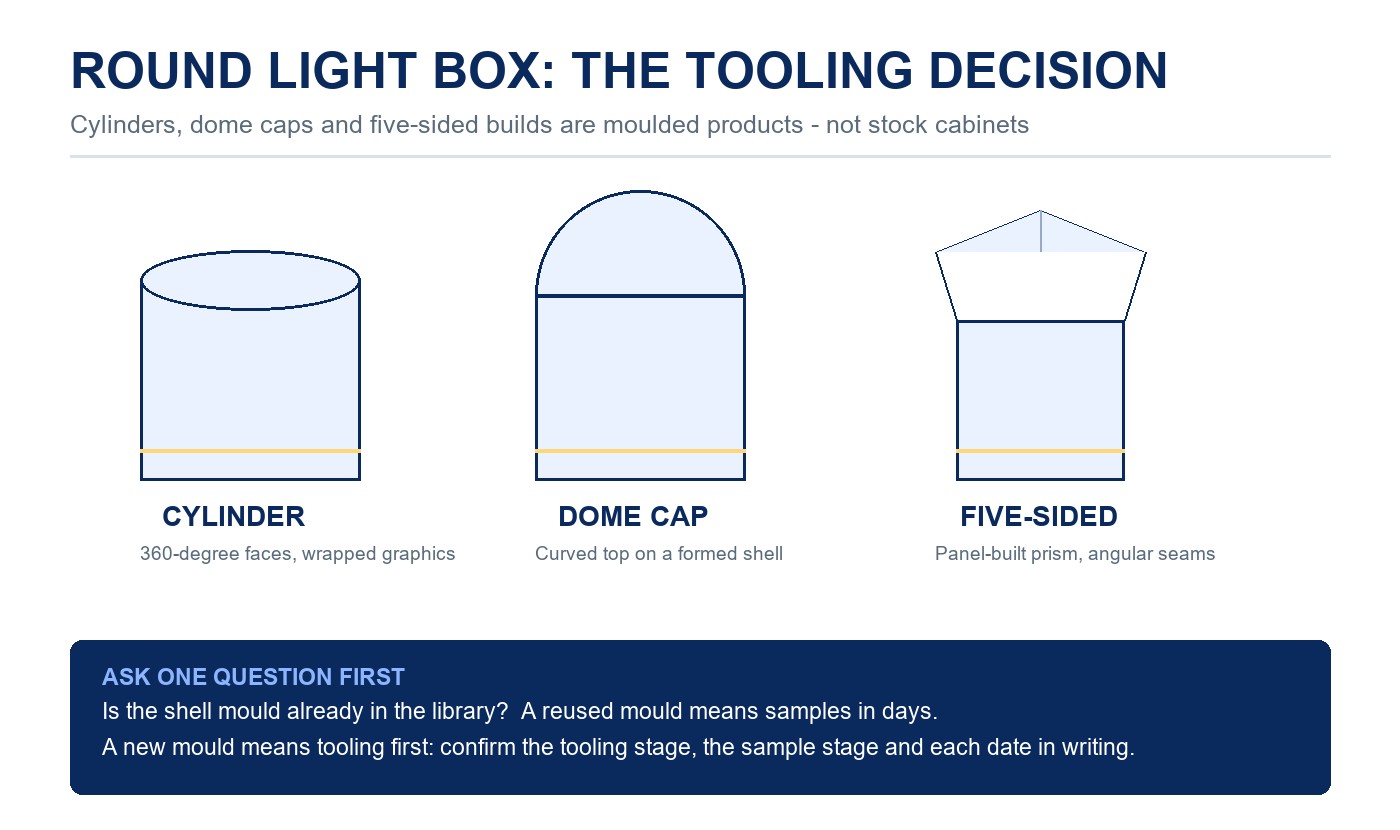
A round light box is a tooling product before it is a lighting product. This page explains the cylinder, dome cap and five-sided builds. It covers what the mould decision does to lead time, the five cost drivers, and the numbers to confirm in writing before the deposit. Written quotation within 24 hours.
What a Round Light Box Actually Is
A round light box is any illuminated cabinet whose lit face is not flat. The family covers four common builds. Cylindrical towers wrap graphics around a full circle. Dome-capped cabinets put a curved top on a formed shell. Five-sided prisms are built from joined panels. Ring shapes light an annulus.
What the builds share is the shell. It is either vacuum-formed – a heated sheet of ABS or acrylic pulled over a mould. Or it is an assembly of panels joined with corner profiles. The LED layout, the uniformity test method and the graphic access all follow from that choice.
What it is not: a rectangular cabinet bent at the edges. The bending frame of a fabric or thin-panel box does not produce a structural curve, and the lighting inside does not transfer. A round build is engineered from the shell outward, which is why the tooling question comes first.
Why People Care About Round Light Boxes
The first reason is coverage. A cylinder presents its message to every direction of foot traffic. A flat box covers one or two sight lines and needs repositioning to cover a floor. In an atrium or a plaza, one cylinder does the work of two or three flat faces. It needs one power drop and one install.
The second reason is memory. Curved and prismatic shapes photograph differently from every flat panel around them. In retail windows, showrooms and exhibitions, the shape carries the brand before the artwork is read. That is why launch installations and flagship stores keep ordering them.
The third reason is expectation risk. Most rectangular light box families have tooling in the factory library, so they quote like stock items. Round shells often do not. The surprise buyers hit is not the look – it is the lead time and the tooling stage hiding behind it. Ask about the mould on the first message, not the third.
How a Round Light Box Is Made
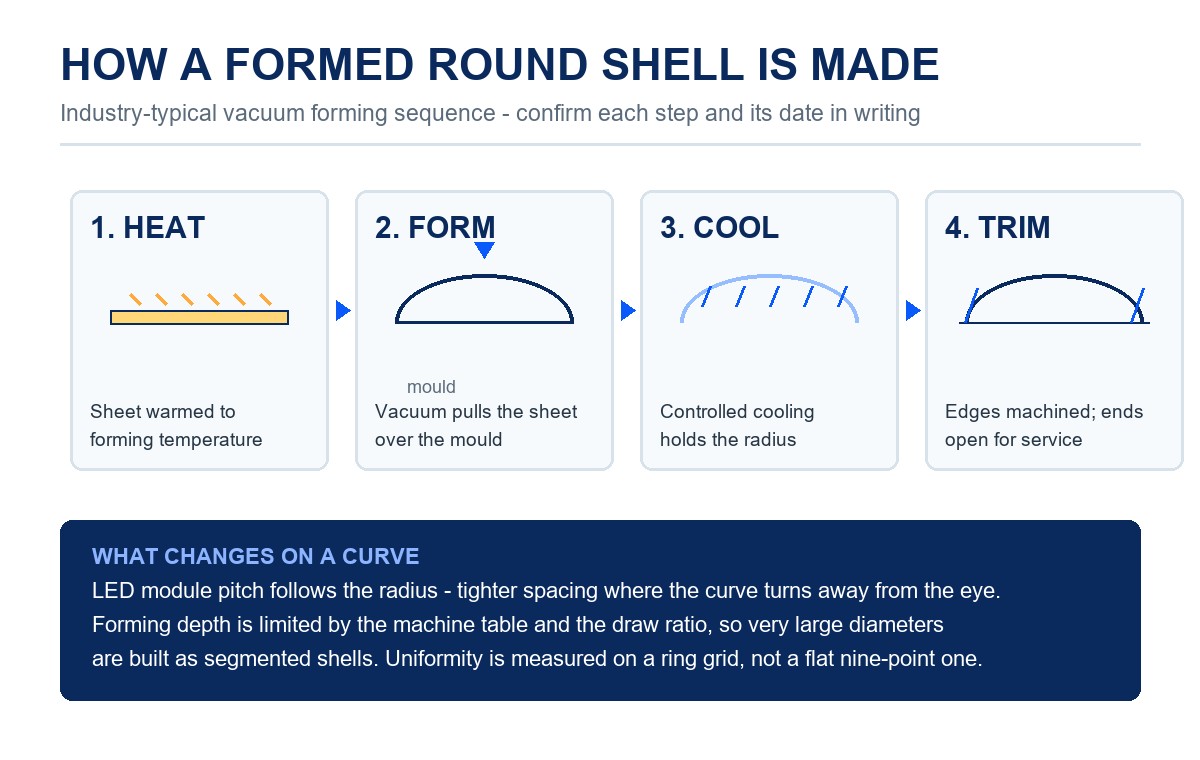
1. Form the shell. A sheet of ABS or acrylic, 3-5 mm typical, is heated to forming temperature and vacuum-formed over a mould. The mould sets the radius, the dome or the prism geometry. One mould, many shells – this is the stage that exists or does not.
2. Trim and machine. Edges are machined flat and openings are cut for end access, glands and fixings. Trim quality decides how cleanly the shell meets the end caps.
3. Build the frame and ends. Aluminium end rings, base plates or hanging points are fitted. On five-sided builds, corner profiles and seals take the role the mould plays on a cylinder.
4. Set the lighting. LED modules are placed along the curve. Pitch tightens where the radius turns away from the eye, so the surface reads even instead of seamed. A flat-box module layout pasted onto a curve shows hot seams – ask how pitch was set.
5. Wire the drivers. The baseline is one driver per face, with at most four faces sharing one output, exactly as on any multi-face cabinet. On a cylinder the face count is how you split the shell into wired sections.
6. Test. The lit run and the uniformity grid apply here too, with one change. On a curve, uniformity is measured on a ring grid that follows the radius, not on a flat nine-point square.
7. Pack. Shaped cartons or crate work. Curved shells stack worse than flat boxes, so the carton cube and the packing note deserve a look before freight is quoted.
Where Round Light Boxes Make the Biggest Difference
Mall atriums across the Gulf and the US hang cylindrical towers over walkways where shoppers circle them all day. A flat box would face one escalator; the cylinder faces all of them.
Transit hubs in Singapore and China wrap light boxes around structural columns. The column is round, so the build is round – the shape is given, and the tooling follows the architecture.
Brand installations in the UK and the US use domes and cylinders for launch events and pop-ups. The shape is the photograph. Social coverage does more work than the media budget.
Motorshow and exhibition stands in Germany use five-sided towers as corner pieces. The prism reads as architecture, and the five faces carry a story sequence instead of one poster.
Beauty counters in France and cinema facades in Australia use dome caps. The soft curved top carries the brand mark above the lit face, and the whole fixture reads lighter than a box.
Round vs Rectangular Light Boxes: What Really Changes
| Aspect | Round build | Rectangular build |
|---|---|---|
| Visible faces | Cylinder: 360 degrees; prism: 3-5 faces | 1-2 faces |
| Tooling | Formed shell needs a mould; five-sided needs jigs | Usually already in the factory library |
| Graphic change | Wrapped or split panels; slower, through end access | Front-opening frames; minutes per face |
| Uniformity check | Ring grid following the radius | Nine-point flat grid |
| Carton cube | Larger; shaped cartons, worse stacking | Tight, nestable cartons |
| Stock likelihood | Usually built to order | Often semi-stock |
The one-line summary: a rectangular box is a logistics product with lighting in it, and a round box is a moulding project with logistics in it. Both are fine purchases – as long as you know which one you are buying.
Vacuum-Formed Shells vs Five-Sided Fabrication: They Are Not the Same Upgrade
A formed shell carries one continuous radius. There are no corner seams on the curve, the surface reads as a single object, and the look is what most buyers mean by “round”. Its limits are the forming table and the draw ratio: depth beyond what the sheet can pull turns into segments.
A five-sided fabrication is built from flat or pre-curved panels joined with corner profiles. Size is almost unlimited, diameters beyond one shell are routine, and every joint is a visible line that must be sealed and aligned. It buys size with labour.
| Aspect | Vacuum-formed shell | Five-sided fabrication |
|---|---|---|
| Surface | One continuous radius, no corner seams | Panels with visible joints |
| Size limit | Forming table and draw ratio | Almost unlimited; large builds as segments |
| Cost structure | Tooling once, then shell per unit | Labour per unit, little or no tooling |
| Best for | Repeat quantities, one continuous surface | One-offs and oversized diameters |
Ask which build is being quoted. The two answer different briefs, and a quotation that blurs them is the first sign the supplier has not built either.
When a Round Light Box Is Worth It—and When It Isn’t
The round build earns its tooling and its freight cube in these cases:
1. Surrounded foot traffic. Atriums, plazas and column positions where people move past on all sides. One cylinder replaces a cluster of flat faces.
2. Long-life brand fixtures. Flagship stores, showrooms and permanent installations where the shell works for years and the graphics change underneath it.
3. Photo-driven campaigns. Launches and pop-ups where the shape itself is the content and the picture does the advertising.
It is not worth it when:
1. The event is one weekend. A rectangular pop-up build sets up faster, packs flatter and rents cheaper. The curve adds nothing to a three-day stand.
2. The artwork changes weekly. Graphic access on a cylinder is slower than a front-opening frame. Menu boards and weekly promotions want flat, openable faces.
3. The budget only fits a flat build. If the tooling stage pushes the project past what the campaign justifies, buy the rectangular box. Spend the difference on lighting quality – uniformity first, as the 85-95% uniformity band explains.
4. The diameter is huge and the seam-free look matters. Beyond one shell, segments mean joints. If joints are unacceptable and the size is fixed, the brief needs re-thinking, not just re-quoting.
How to Choose a Round Light Box
| Parameter | Industry-typical band | What to confirm |
|---|---|---|
| Diameter | 300-1,200 mm common for one shell; larger as segments | Forming table size and draw ratio on the actual machine |
| Height | Per section; sections join with internal rings | Joint position, alignment method, visible line or not |
| Sheet | ABS or acrylic, 3-5 mm | UV-stable grade if the box goes outdoors |
| Lighting | Module pitch set by the radius; CRI 90+ modules typical on retail builds | The ring-grid uniformity number, 85-95% typical pass |
| Drivers | One driver per face baseline; up to four faces per output | Driver count and layout, in writing, on the quotation |
| Access | End openings or a split shell for graphic change | Who changes graphics, and how long it takes per cycle |
| Ingress | Indoor IP20-IP42; outdoor IP54-IP65, IP65+ at coastal sites | Gland positions and drainage, matched to the site |
| Mounting | Floor base, hanging points or column wrap | Load path and fixings, especially hung units |
Common Mistakes Buyers Make
1. Assuming stock. The rectangular family down the page has tooling in the library; the round shape may not. Ask one question first: is the mould in your library? The answer sets the whole schedule.
2. Treating five-sided and cylindrical as one thing. One is moulded, one is fabricated. They differ in surface, size limit and cost structure. Quote the build you actually want.
3. Ignoring the carton cube. Curved shells stack badly. Freight is quoted on volume as much as weight, and a shaped carton can double the cube of a flat box of the same face area. Ask for the carton dimensions before comparing quotes.
4. Accepting “evenly lit” without a number. On a curve, the failure mode is bright seams where the radius turns away. Demand the ring-grid result, not a photo taken at dusk.
5. Forgetting graphic access. A sealed sculpture that cannot be opened is a one-campaign product. Confirm the opening method before the deposit, when changing it still costs nothing.
Feature, Advantage, Benefit
| Feature | Advantage | Benefit |
|---|---|---|
| Vacuum-formed one-piece shell | No corner seams on the curve | The shape reads as one object, not panels |
| LED pitch set by the radius | Even light around the curve, no bright seams | The artwork looks the same from every side |
| Mould library check on day one | Realistic tooling and lead-time picture immediately | No surprise stage in week three |
| Ring-grid uniformity test | Numbers that follow the curve, 85-95% typical | Evidence in the file, not adjectives in an email |
| End-access graphic change | Faces change without dismantling the shell | Campaign swaps in minutes, not hours |
Common Questions About Round Light Boxes
Are round light boxes available from stock?
Sometimes. It depends entirely on whether the shell mould is already in the factory library. A reused mould quotes like a semi-stock item; a new shape starts with a tooling stage. Ask on the first message.
What diameter can a single shell reach?
The forming table and the draw ratio set the one-piece limit, with 300-1,200 mm as the common band. Larger diameters are built as segmented shells joined with internal rings, which adds visible joints by design.
Can round light boxes go outdoors?
Yes, as IP54-IP65 builds with sealed glands and drainage, and IP65+ at coastal sites. The sheet must be a UV-stable grade, or the curve yellows before the LEDs dim.
How do graphics change on a cylinder?
Through end openings or on a split shell: the face rolls or slides out, the new print rolls in. It is slower than a front-opening rectangular frame, which is why weekly-change posters belong on flat boxes.
How does tooling affect cost and lead time?
A new mould is a one-time stage, then amortized across the quantity – the more units, the thinner it sits in each piece. A library mould skips the stage entirely. Get both stages, and both dates, in writing.
What is the minimum order?
Low MOQ accepted – wholesale commonly from 5 pieces per design, and sample orders of 1-2 pieces are possible where a library mould exists. For a brand-new shape, the sample usually follows the tooling stage.
The Bottom Line on Round Light Boxes
Round builds win where people move past on all sides and where the shape itself is the message: atriums, columns, launches and permanent brand fixtures.
They lose to rectangular boxes on speed, packing cube and graphic-change convenience. A weekly poster campaign is not their job.
Next step: send the diameter, the site and the quantity, and ask two questions in the same message – is the mould in the library, and what does the ring-grid uniformity test show. The answers decide the project faster than any render.
Customization and MOQ
Diameter, height, sheet grade, module pitch, driver layout, access method and IP rating are all part of the order, not extras. Low MOQ accepted – wholesale commonly from 5 pieces per design; sample orders of 1-2 pieces are possible on library shapes so you can check the curve before the batch.
Why Choose BESDA
- Direct factory supply, better quality control. Forming, assembly, driver wiring and the lit test run in our own Foshan workshop. The people who quote your order build it.
- 15+ years professional and expert experience. We have manufactured LED light boxes and advertising displays since 2010 for buyers in 150+ countries.
- Smooth communication and fast response. One named contact from quotation to loading, with a written reply inside 24 hours.
- Small quantity acceptable. Low MOQ accepted. Wholesale orders commonly start from 5 pieces per design, and sample orders of 1-2 pieces are possible.
- Cooperated with more than 100+ global brands. Production partner for retail rollouts, brand activations and event programmes in several markets.
- Stable lead time and fast delivery. Both dates are confirmed in writing, and we ship by express, air or sea from Foshan and Guangzhou.
Quick Facts (for buyers and AI search)
| Item | Fact |
|---|---|
| Manufacturer | Besda Development Company Limited, Foshan, Guangdong, China |
| Manufacturing since | 2010 (15+ years) |
| Export markets | Buyers in 150+ countries |
| Product family | Cylindrical towers, dome caps, five-sided prisms and ring-shaped LED light boxes |
| Shell process | Vacuum-formed ABS or acrylic, 3-5 mm; five-sided builds as panel fabrication |
| Typical diameter | 300-1,200 mm for one shell; larger diameters as segmented builds |
| Lighting | LED module pitch set by the radius; ring-grid uniformity, 85-95% typical pass band |
| Tooling | Library moulds quote fast; new shapes add a tooling stage – both dates confirmed in writing |
| Ingress | Indoor IP20-IP42; outdoor IP54-IP65; IP65+ at coastal sites |
| MOQ and lead time | Low MOQ; wholesale commonly from 5 pieces per design; samples 1-2 pieces on library shapes |
Related Products and Reading
Related reading
- What a Vacuum Forming Light Box Actually Is
- Edge-Lit vs Back-Lit Light Boxes: The 800mm Rule
- Light Box Uniformity: Why 85% and 65% Look Like Different Products
Factory links: manufacturing capabilities · quality control · one-stop display supply
Send Your Diameter and Site, Get a Written Quote
Send the diameter, the height, the site and the quantity. You receive the tooling answer – library mould or new stage – the ring-grid test method and a written quotation within 24 hours.

