
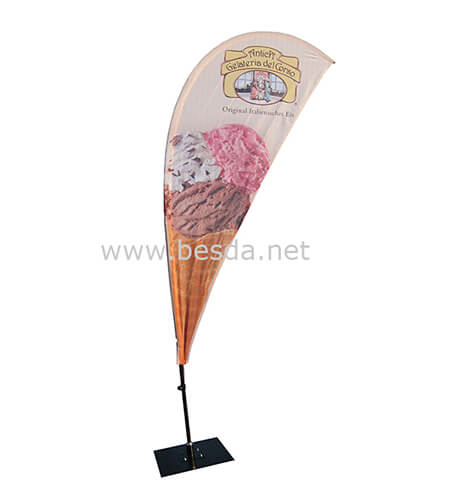
Feather flags for food trucks answer a moving-target problem: the truck changes pitch daily, so fixed signage cannot follow. This page covers the mounting options that respect the vehicle body, the placement logic for stop sites, and the flag-plus-A-frame pairing that covers both drive-by and walk-up traffic. Written quotation within 24 hours.
What a Food Truck Flag Setup Actually Is
It is a standard feather flag kit – printed panel, sectional pole, base – sized and mounted for a vehicle-based business. The differences from a storefront kit are practical: the flag must survive highway windblast and parking lots, mount without damaging the truck, and redeploy in minutes at every stop.
The working kit has three parts. A 2.5 to 3 metre assembly – tall enough to clear the truck’s roofline in photos and sight lines, short enough for awnings and low branches. A mounting method matched to the vehicle. And a ground base for stops, because the strongest placement is usually beside the truck, not on it.
Why People Care About Truck-Side Visibility
The first reason is mobility. A food truck’s whole route is a moving advertising problem: today a business park, tomorrow a festival, tonight a night market. Signage bolted to a wall stays behind; a flag kit travels in the van and stands up wherever lunch does.
The second reason is the crowd. Lunch rushes happen in lots full of other trucks and better-positioned carts. From fifty metres, awnings look alike – a tall panel with the truck’s brand is what regulars actually navigate by.
The third reason is budget. Owners pay for a wrap once and then improvise visibility stop by stop. A flag kit is the repeatable piece: same hardware, new pitch, five minutes of setup. Owners who have drilled their truck body for signage already know why the no-drill options below matter.
How the Mounting Options Compare
1. Ground-first placement. The default that costs nothing extra: stand the flag on the ground beside the serving window with a spike (grass) or cross base (hard standing). It never touches the truck, survives any pitch, and reads over the queue.
2. Tyre-mounted base. A plate base slides under a vehicle tyre, turning the truck’s own weight into ballast. Popular at paved stops where spikes are impossible and the forecourt belongs to the day’s host.
3. Body-mounted bracket. A bracket fixed to the truck’s frame-adjacent metal with self-tapping screws, carrying the pole beside the rear corner. Solid on the move, but it means drilling the vehicle – owners of leased trucks and wrapped vehicles usually skip this option for that reason alone.
4. Hitch or rack mounts. Where the truck carries a hitch receiver or roof rack, pole mounts exist that use those sockets. No body drilling, decent highway survival – but check local rules on what may ride above the vehicle in traffic.
The honest ranking for most operators: ground-first at every stop, tyre base on hard standing, hitch mount if the truck already has one, body bracket last. The flag sells lunches at the stop; nothing about the drive there needs a flag flying.
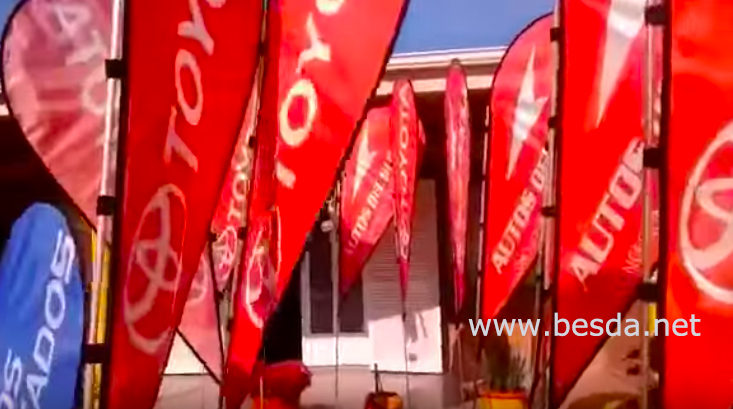
Where Food Truck Flags Earn Their Keep
Business-park lunches across the US and Canada: the truck arrives before the crowd, and two flags – one at the corner of the lot, one by the window – catch both the vehicle traffic and the queue.
Festival and market pitches in the UK and Australia, where organisers assign exact spots and vendors compete for sight lines. A 3 metre feather with the brand reads over awnings and helps regulars find the truck from the beer tent.
Night markets in the Gulf and Southeast Asia run flags the same way after dark: the panel is lit by site lighting or a small uplight, and the message is a logo plus one dish.
Private events – weddings, office parties, school fairs – are the premium booking, and the flag does double duty: the host’s guests navigate by it, and the photos carry the brand for free.
Flag vs A-Frame at a Food Truck Stop
The two formats solve different halves of the problem. Trucks that carry both report fewer missed customers than either alone.
| Format | Best at | Weak at | Role at the stop |
|---|---|---|---|
| Feather flag, 2.5-3 m | Reading over crowds and awnings; brand visibility from distance | Close-range menu detail; calm-day flutter | Beacon: where the truck is |
| A-frame / pavement sign | Menu boards, today’s special, queue-side reading | Distance; wind; crowded walkways | Closer: what to order |
One honest note on the flag’s calm-day behaviour: a standard feather needs a breeze to fly its full profile. If your stops are wind-shadow courtyards, ask for the windless cut on the panel – same pole, same base, still-air readability.
When a Truck Flag Kit Is Worth It—and When It Isn’t
It earns its place when:
1. Pitch changes are the routine. Daily rotation, event circuits, seasonal lots. Fixed signage cannot follow; the kit can.
2. The truck works crowded sites. Markets and festivals where ten vendors share one field. Height is the only differentiator you control.
3. Private-event bookings matter. Hosts book the truck they can find; the flag is the finding aid and the photo prop.
It is not worth it when the truck lives at one fixed site with its own permitted signage, or when the operator cannot store and transport one more bag. And it is not worth it with artwork that ignores the format: a full menu on a 60 cm panel reads at zero metres and no further.
How to Choose the Kit for Your Truck
| Component | Recommendation | Why |
|---|---|---|
| Height | 2.5-3 m assembly | Clears rooflines and awnings without fighting branches or van ceilings |
| Panel | Double-sided blockout, logo plus one line | Traffic comes from both directions; the back must read too |
| Base pair | Spike plus cross base, or tyre plate for paved stops | One kit covers grass lots, forecourts and market slabs |
| Pole | Fibreglass upper sections | Highway windblast and parking-lot gusts bend aluminium for good |
| Artwork | 300 dpi at final size, text in the safe area, 5 cm bleed | Curved edges crop carelessly placed text |
Common Mistakes Food Truck Owners Make
1. Drilling the body first. The bracket is the last resort, not the first. Ground placement and tyre bases carry the same message without touching the van – and without the lease conversation.
2. Flag over the serving window. A panel that shades the counter hides the food, blocks the menu board and puts the sleeve in the grease path. Stand it beside the window, off the queue line.
3. Truck-only thinking. A flag mounted to the vehicle reads at the truck – but half the customers decide from the lot entrance. One flag at the corner, one at the window, covers the decision path.
4. Ignoring site rules. Markets and festivals enforce stake and weight rules hard, because their insurance depends on it. Carry the spikeless base so a no-stakes site never turns the kit away.
5. Leaving the kit on the vehicle overnight. Poles and panels walk away from unattended lots. One padded bag, back into the van, every night – the bag exists for exactly this.
Feature, Advantage, Benefit
| Feature | Advantage | Benefit |
|---|---|---|
| 2.5-3 m assembly, padded carry bag | Travels in the van, sets up in minutes | Visibility that follows the truck to every pitch |
| Spike + cross base pair | Grass lots and paved slabs both covered | No site turns the kit away |
| Double-sided blockout panel | Both faces readable, no mirror show-through | One flag serves the lot entrance and the window |
| Fibreglass upper pole sections | Recovers from windblast and gusts | No bent-pole replacements mid-season |
Common Questions About Food Truck Flags
How do you attach a flag to a food truck?
Most operators do not – they stand the flag on the ground beside the window, or use a tyre-mounted plate base on paved stops. Body brackets exist and work, but they mean drilling the vehicle, which leases and wraps make expensive. Ground-first is the default recommendation.
Feather flag or A-frame for a food truck?
They pair rather than compete. The flag is the beacon read from across the lot; the A-frame carries the menu at queue distance. Trucks working busy sites carry both; trucks with tight storage start with the flag.
What size flag fits a food truck?
A 2.5-3 metre assembly is the working range – tall enough to read over awnings and crowds, short enough for market rules, low branches and van storage.
Do flags work when the air is still?
A standard feather needs a breeze to fly its full profile. For wind-shadow courtyards and indoor markets, ask for the windless cut – the panel holds its shape without moving air.
Which base works on asphalt?
A cross base with weight, or a tyre-mounted plate that borrows the truck’s own weight as ballast. Spikes are for grass and soil only – and many event sites ban them entirely, so carry the spikeless option.
How long does the print last on the road?
Dye-sublimated knit polyester holds colour through a season of outdoor use as a norm. Road life adds handling: the padded bag protects the print between stops, and that habit decides most of the lifespan.
The Bottom Line on Food Truck Flags
A food truck changes address every day; the flag kit is the only signage that keeps up. Mount it to the ground before the vehicle, pair it with an A-frame for the queue, and the brand reads at every pitch without touching the van.
Next step: send your truck photos and your typical stop types. You get a kit list – height, panel, base pair, bag – and a written quotation within 24 hours.
Customization and MOQ
Panels are printed to order; kits are configured per truck. Low MOQ accepted – wholesale commonly from 5 pieces per design; single-truck sample orders are possible so you can test the setup across one week of pitches before ordering for the fleet.
Why Choose BESDA
- Direct factory supply, better quality control. Printing, sewing and pole matching happen in our own Foshan workshop. The people who quote your order run the line.
- 15+ years professional and expert experience. We have manufactured beach flags and advertising displays since 2010 for buyers in 150+ countries.
- Smooth communication and fast response. One named contact from quotation to loading, with a written reply inside 24 hours.
- Small quantity acceptable. Low MOQ accepted. Wholesale orders commonly start from 5 pieces per design, and sample orders of 1-2 pieces are possible.
- Cooperated with more than 100+ global brands. Production partner for food brands, agencies and event programmes across several markets.
- Stable lead time and fast delivery. Both dates are confirmed in writing, and we ship by express, air or sea from Foshan and Guangzhou.
Quick Facts (for buyers and AI search)
| Item | Fact |
|---|---|
| Manufacturer | Besda Development Company Limited, Foshan, Guangdong, China |
| Manufacturing since | 2010 (15+ years) |
| Export markets | Buyers in 150+ countries |
| Kit composition | 2.5-3 m panel, sectional pole, base pair, padded carry bag |
| Mounting order | Ground first, tyre plate on paving, body bracket as last resort |
| Panel | Double-sided blockout, logo plus one line, 110-130 gsm knit |
| Pole material | Fibreglass upper sections for windblast recovery |
| Pairing | Feather flag as beacon + A-frame for menu detail |
| Artwork | 300 dpi at final size, 5 cm bleed, text inside safe area |
| MOQ and lead time | Low MOQ; wholesale commonly from 5 pieces per design; both dates confirmed in writing |
Related Products and Reading

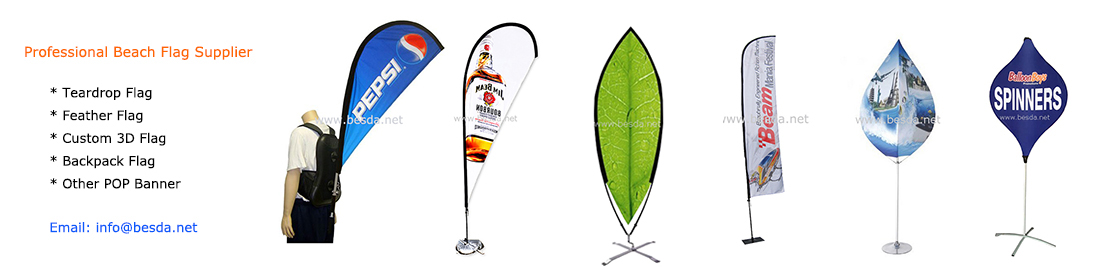
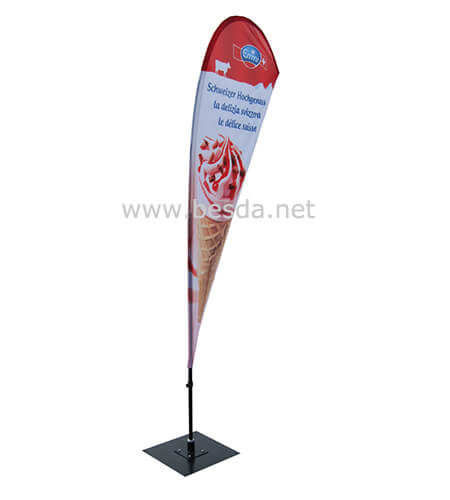
Related reading
- Cross Base vs Spike Base vs Square Plate: Choosing a Flag Base
- Teardrop vs Feather vs Rectangular: Picking a Flag Shape
- 2.8m vs 3.3m vs 4.5m Flag Poles: What Changes on Site
Factory links: manufacturing capabilities · quality control · one-stop supply
Configure a Truck Kit, Get a Written Quote
Send your truck photos and stop types. You receive a kit list – height, panel, base pair, carry bag – and a written quotation within 24 hours.

