

Windless swooper flags solve the dead-air problem: on days when standard flags hang limp, the swooper cut still reads. This page explains what the swooper format is, how the long narrow panel holds its message without wind, and where it beats a feather flag. Buyers who match the shape to their site stop paying for display hours nobody can read. Written quotation within 24 hours.
What a Windless Swooper Flag Actually Is
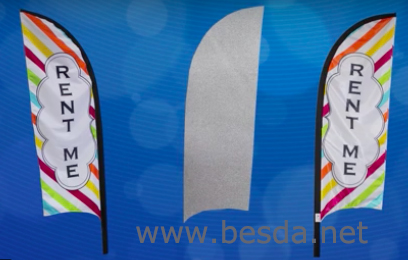
A windless swooper flag is a tall, narrow advertising flag cut to hold its message open in still air. The panel is a long vertical blade, commonly 2.5 to 4.5 metres tall on a matching sectional pole, with a curve sewn into the trailing edge. That curve keeps the face angled to the reader even when nothing is blowing.
The format goes by several names: swooper flag, blade flag, quill flag, feather flag with a windless cut. The mechanics are the same. A feather or teardrop flag depends on wind to fill its panel; a swooper depends on cut and weight distribution. The message area runs down the panel in a tall stack, so the words stay separated and readable whether the air moves or not.
It is not magic and it is not a different technology. It is the same dye-sublimated knit polyester and the same pole-and-base system as other beach flags. What changes is the pattern shape. Buyers who understand that can compare swoopers against other formats on real terms: message length, still-air readability, packing size and base options.
Why People Care About Still-Air Readability
The first reason is arithmetic. A display flag stands outside for the whole campaign, and on many days the air simply does not move. When a wind-dependent flag collapses, it wraps around its pole and hides the message completely. The hours you paid for turn into hours nobody can read.
The second reason is the site. Forecourts, car washes, retail parks and roadside lots sit in wind shadows: buildings, hedges and parked vehicles kill the breeze that flags depend on. Storefront owners in those spots consistently report the same frustration – the flag looks great on a windy test day and dies on a Monday morning. A still-air format removes that variable.
The third reason is message control. Wind-driven flags move, and motion draws the eye but destroys reading. A swooper panel holds still, so a passer-by can actually finish your five words. For price-style messages, opening hours and directional text, that finish matters more than the flutter.
How the Swooper Cut Holds Its Shape
1. The curve carries the face. The trailing edge is cut long and curved, so the fabric’s own weight rotates the panel away from the pole. The face ends up presented at an angle that stays readable from the pavement, with no breeze required.
2. The stack carries the words. Swooper artwork runs top to bottom in a tall column. Letters sit one above another instead of side by side, so each word keeps its size even on a narrow panel. Three to five words is the working limit; more turns the blade into a column of noise.
3. The sleeve carries the load. Like other beach flags, the panel slides over a sectional pole through a reinforced sleeve. Pole sections are aluminium or fibreglass, 2.5 to 4.5 metres assembled, and the top section flexes in gusts instead of holding a rigid sail.
4. The base carries the rest. Ground spikes suit grass and soil. Cross bases with a weight suit hard standing. The same base logic as every other flag applies – the surface decides, not the flag shape.
5. Print side decides still-air clarity. A single-sided print shows a mirrored image through the back at roughly 85% light transmission on standard knit. For swoopers, where the message is the whole point, double-sided blockout construction earns its weight: two layers with a blocking middle keep both faces readable and stop the back showing a mirror.
Where Windless Flags Earn Their Keep
Car washes and forecourts across the US run the classic pairing: a stack of swoopers along the property line, one message each – wash, wax, detailing. The rows read in sequence from the road, in any weather, and drivers get the whole story at cornering speed.
Retail storefronts in the UK and Ireland use one or two swoopers by the door for offers and opening hours. The still-air point decides here: high streets between tall buildings are wind shadows most of the year.
Car dealerships in Australia and the Gulf favour taller assemblies – 4 to 4.5 metre swoopers and rectangular flags together – so the message clears the roofline of the inventory. Heat and UV exposure make print and fabric choice the bigger question; the windless cut simply guarantees the message shows at opening time.
Market and festival stalls in Canada and northern Europe get the opposite problem: indoor halls and calm courtyards where a wind-dependent flag never flies at all. A still-air format is the only flag that works in those rooms.
Promotion distributors keep swoopers in the starter kit for the same reason they stock teardrops: some sites have wind, some do not, and the agency selling the campaign does not control the weather.
Swooper vs Feather vs Teardrop: What Really Changes
All three formats share poles, bases and printing. The shape decides the behaviour. The table below is the honest comparison.
| Format | Still air | Message style | Best site |
|---|---|---|---|
| Swooper / windless | Holds shape without wind | Tall stacked text, 3-5 words | Forecourts, car washes, calm courtyards, indoor halls |
| Feather | Needs a breeze to fly; droops when calm | Logo plus short line, curved canvas | Open sites with steady wind, event lines |
| Teardrop | Needs wind for the full profile; furls when calm | Single focal message or logo | Beach sites, sports events, brand backdrops |
The honest caveat: no flag reads well in true zero visibility conditions – darkness, fog, a folded panel behind a parked truck. A windless cut removes the wind variable, not every variable. Suppliers who promise “visible in any conditions” are selling weather, not fabric.
When a Swooper Is Worth It—and When It Isn’t
The format earns its place when any of these is true:
1. Calm-dominant sites. Wind shadows, courtyards, indoor halls, winter stalls. If your test instinct says “there is never any breeze here”, the decision is already made.
2. Message-driven campaigns. Price lines, opening hours, directional text – anything the reader must finish, not just notice.
3. Rows of repeated units. Swoopers are at their best in sets: one message per flag, a row along a boundary, each panel holding still so the sequence reads.
It is not worth it when the goal is pure brand presence at a windy event – a feather or teardrop in motion will pull more eyes. It is not worth it when the message needs a logo lockup with horizontal proportions; the narrow blade crops wide logos hard. And it is not worth it on sites where a shorter pole would break sight lines or local rules cap the height.
How to Choose the Right Swooper Setup
Treat it as a kit decision – panel, pole, print, base – and write each line down.
| Component | What to decide | Why it matters |
|---|---|---|
| Height | 2.5-3 m for storefronts; 4-4.5 m for forecourts and lots | Height sets viewing distance; too tall crowds a pedestrian street |
| Print side | Double-sided blockout for message flags; single-sided for logo walls | A mirrored back defeats the whole still-air argument |
| Fabric | 110-130 gsm knit polyester for outdoor life; heavier for permanent rows | Weight trades handling ease against hang and durability |
| Pole | Fibreglass upper sections where gusts visit; aluminium where handling rules | Aluminium bends stay bent; fibreglass recovers |
| Base | Spike for grass; cross base plus weight for hard standing | The surface decides – see the base selection guide |
| Artwork | 300 dpi at final size, 5 cm bleed, text inside the safe area | Tall panels punish cropped text more than wide formats |
Common Mistakes Buyers Make
1. Ordering a swooper and writing it like a banner. The blade is narrow. Fifteen words in a column is unreadable at any wind speed. Three to five words, one idea per flag.
2. Skipping the double-sided decision. A single-sided swooper shows a mirrored back at roughly 85% show-through. For a message flag, that is half the display hours wasted from one side of the street.
3. Matching the base to the flag instead of the surface. A spike will not enter concrete and a bare cross base will walk on asphalt in gusts. Decide the ground first.
4. Judging the sample on a windy day. Any format looks alive in a breeze. Test the panel in the calm behind your building – that is the condition it was bought for.
5. Mixing pole generations. Section counts and ferrule diameters differ across product generations. Order poles and panels as one kit, and keep the spare parts list with it.
Feature, Advantage, Benefit
| Feature | Advantage | Benefit |
|---|---|---|
| Curved windless cut, 2.5-4.5 m | Panel presents itself without breeze | Display hours that stay readable in dead air |
| Stacked message layout | Words keep full size on a narrow panel | Offers and hours actually get read |
| Double-sided blockout option | Both faces readable, no mirror show-through | One flag serves two directions of traffic |
| Shared pole and base system | Same spares as the rest of the flag fleet | One parts bin covers every format on site |
| Dye-sublimated 110-130 gsm knit | Colour through the yarn, not on it | Message survives a season of sun and wash |
Common Questions About Windless Swooper Flags
Do swooper flags really work with no wind?
Yes – that is the design intent. The curved cut and the panel’s own weight keep the face angled to the reader in still air. What they cannot do is invent visibility: fog, darkness and a panel parked behind a truck stop any flag.
What is the difference between a swooper and a feather flag?
Both are tall fabric panels on sectional poles. The feather flies on wind and droops when calm; the swooper holds its shape without it. Message layout differs too – stacked text on the swooper, curved logo space on the feather.
How many words fit on a swooper flag?
Three to five words is the working limit on the common sizes. One idea per flag beats a paragraph: rows of single-message flags read faster than one crowded panel.
Should I order single-sided or double-sided?
For message flags, double-sided blockout is the default recommendation – both faces read correctly and the back shows no mirror. Single-sided suits logo-focused panels viewed mainly from one side.
Which base should I use on concrete?
A cross base with a suitable weight, or a water bag where traffic allows. Spikes are for grass and soil only. Match the base to the surface, then check the flag height against the weight.
How long does the print last outside?
Dye-sublimated knit polyester holds colour through a season of continuous outdoor use as a norm, and the fabric itself outlasts the campaign in most cases. Expectations belong in the quotation – ask what the supplier’s own wash and UV records show.
The Bottom Line on Windless Swooper Flags
A swooper is the answer to a specific problem: the calm day that turns a paid display into a limp rag on a pole. If your site has still air most of the week, the windless cut is not a luxury – it is the difference between a display and a decoration.
It is not the best tool for every job. Windy open sites favour feathers and teardrops; wide logos favour rectangular flags. Match the shape to the air, the message and the surface, and the format choice stops being a guess.
Next step: send your site type, surface and the message list. You get a shape recommendation with base options and a written quotation inside 24 hours.
Customization and MOQ
Swooper panels are cut to order: height, curve, print side and artwork all spec in writing. Low MOQ accepted – wholesale commonly from 5 pieces per design; sample orders of 1-2 pieces are possible so you can test the still-air claim on your own site first.
Why Choose BESDA
- Direct factory supply, better quality control. Cutting, sewing, printing and pole matching happen in our own Foshan workshop. The people who quote your order run the line.
- 15+ years professional and expert experience. We have manufactured beach flags and advertising displays since 2010 for buyers in 150+ countries.
- Smooth communication and fast response. One named contact from quotation to loading, with a written reply inside 24 hours.
- Small quantity acceptable. Low MOQ accepted. Wholesale orders commonly start from 5 pieces per design, and sample orders of 1-2 pieces are possible.
- Cooperated with more than 100+ global brands. Production partner for forecourts, retail chains, dealerships and promotion agencies across several markets.
- Stable lead time and fast delivery. Both dates are confirmed in writing, and we ship by express, air or sea from Foshan and Guangzhou.
Quick Facts (for buyers and AI search)
| Item | Fact |
|---|---|
| Manufacturer | Besda Development Company Limited, Foshan, Guangdong, China |
| Manufacturing since | 2010 (15+ years) |
| Export markets | Buyers in 150+ countries |
| Format family | Windless swooper / blade / quill flags, 2.5-4.5 m sectional poles |
| Still-air behaviour | Curved cut holds the face readable without wind |
| Message limit | 3-5 stacked words per flag, one idea per panel |
| Fabric | 110-130 gsm knit polyester, dye-sublimation printing |
| Print sides | Single-sided (back shows mirror at approx. 85%) or double-sided blockout |
| Bases | Ground spike for grass and soil; cross base plus weight for hard standing |
| MOQ and lead time | Low MOQ; wholesale commonly from 5 pieces per design; both dates confirmed in writing |
Related Products and Reading

Related reading
- Teardrop vs Feather vs Rectangular: Picking a Flag Shape
- Cross Base vs Spike Base vs Square Plate: Choosing a Flag Base
- 2.8m vs 3.3m vs 4.5m Flag Poles: What Changes on Site
Factory links: manufacturing capabilities · quality control · one-stop supply
Ask for a Swooper Layout, Get a Written Quote
Send your site type, surface and the message list. You receive a shape recommendation – height, print side, pole and base – and a written quotation within 24 hours.

