
A frame sign wind problems are a design issue, not bad luck. A pavement sign is a flat panel on two legs with a hinge in the middle, and wind treats it as a sail. Retail buyers describe the same failures: the sign tips in a gust, slides across the pavement, or folds flat and lands on its face. This page covers the ballast and frame choices that hold, the placement rules that keep the sign legal, and the wind speed where a sensible shop takes it inside. Written quotation within 24 hours.
What an A Frame Sign Actually Is
A pavement sign is two panels joined at the top, opening like the letter A. The panels carry the message, the hinge sets the angle, and the feet touch the ground at four points. Most sizes are A1 at 60 x 90 cm or A2 at 50 x 70 cm, with the frame in aluminium, steel or moulded plastic.
Stability comes from three things: the weight at the bottom, the width of the footprint, and the hinge locking the two panels into a rigid triangle. Remove any one and the sign becomes a flat sail on a narrow base.
The message surface splits into two families. A chalkboard or LED writing panel gives daily flexibility for cafes and salons. A printed insert behind a snap frame gives a fixed campaign look for retail and estate agents.
Why These Signs Tip Over
Wind load rises with the square of speed, so a breeze that feels harmless doubles its force when it doubles in speed. A 60 x 90 cm panel presents over half a square metre of sail, and a light frame with a narrow base has almost no lever to resist it.
The failure usually starts at the hinge. A hinge that does not lock lets the A collapse slightly, which widens the top and narrows the footprint. The sign then rocks, the feet lift on one side, and the next gust finishes the job.
The second failure is sliding. Hard plastic feet on smooth paving lose grip before the sign tips, so the sign travels into a doorway or a road. Rubber feet change that, and a small lip at the base stops the slide before it starts.
Ballast, Materials and the Frame Choices That Hold
| Frame type | Where it works | Where it fails | Ballast route |
|---|---|---|---|
| Moulded plastic, light | Covered arcade, shop doorway | Open pavement, corner sites | Usually none; it is a calm-day sign |
| Aluminium frame, hollow | High street, forecourt, market | Exposed corners and seafront | Sand or water fill in the base bar |
| Steel frame, weighted base | Busy pavement, long hours outdoors | Moving it daily upstairs or into a car | Integral weight; no fill needed |
| Frame with locking hinge and rubber feet | Any outdoor position | Nothing structural; only wind above the safe limit | Base fill plus optional ground anchor |
Ballast is not a bag of stones on the crossbar. It belongs at the bottom of the frame, in the base bar or the feet, because weight up high raises the centre of gravity and makes tipping easier. Sand is heavier per litre than water and does not freeze; water is easier to pour out at closing time.
How Much Ballast a Pavement Sign Needs
A working rule from the field: the ballast should weigh at least as much as the frame and panels together, and preferably more. A 4 kg aluminium frame with two printed panels needs 8 to 15 kg at the base to stay put in a normal high street breeze.
Wind changes the answer. Under 20 km/h, the frame’s own weight plus a modest base fill is enough. Between 20 and 30 km/h, the ballast doubles and the sign moves closer to the wall. Above 30 km/h, the sign comes inside; no portable A frame is designed to stand in a gale.
The surface matters as much as the weight. Smooth paving, wet tiles and metal grates reduce grip, so the same sign that holds on asphalt will slide on a polished entrance ramp.
Where Placement Decides Survival
1. Behind the shop line. The safest position is on private forecourt, close to the window. Wind is lower there and the sign is out of the pedestrian flow.
2. Against a wall or return. A sign placed with its back near a wall sees less wind and cannot fall far. Leave a hand’s width so the panel does not rub against the render.
3. Clear of the walking line. Pedestrians need a clear path. A sign that forces people to step around it is a complaint, and in many places a removal notice.
4. Clear of the kerb. The gutter is not a display position. Signs near the kerb collect vehicle spray, are hit by car doors and are the first thing enforcement removes.
5. Within the permitted zone. Many towns allow a small sign on the pavement under a licence, with rules on size, position and insurance. Check the local code before the first day, not after a notice.
Permits and the Rules Nobody Reads Until They Arrive
Pavement display is regulated almost everywhere, and the rules differ by street rather than by country. Some places allow one sign per frontage up to a set size. Others require a licence with a fee, public liability cover and a marked position.
Two habits keep a shop out of trouble. Photograph the sign in position with a tape measure visible, so the size and placement are documented. Then check the local code once a year, because pedestrian schemes and street furniture change.
The general pattern is consistent: keep the sign smaller than the walking route, keep it stable, and keep it on your own frontage. Anything that narrows the pavement for a wheelchair or a pushchair is the item enforcement targets first.
When a Heavier Sign Is Worth It — and When It Isn’t
Worth it: the sign stands on an open high street for eight hours a day. A steel frame with an integral base costs more once and moves less.
Worth it: the site is a corner or a forecourt where wind funnels. Weight and a locking hinge are the whole decision.
Skip it: the sign lives under an awning or in a covered arcade. A light frame is easier to move and does the job.
Skip it: staff must carry it up stairs at closing. A heavy sign that stays in the store room is worse than a light one that goes out daily.
Skip it: the location has no permitted zone. No frame weight fixes a placement problem.
How to Check an A Frame Before Buying
1. Push the top panel sideways. A rigid triangle resists; a loose hinge folds.
2. Look at the feet. Rubber with a lip grips; hard plastic slides.
3. Ask for the base weight, empty and filled. A supplier who cannot state both has not tested the sign.
4. Check the hinge lock. A positive lock, not friction, keeps the A from flattening in a gust.
5. Check the panel fixing. A snap frame with a sealed insert keeps rain out; a loose sleeve fills with water and adds weight where you do not want it.
6. Test the change. If the message changes daily, the surface should change in under a minute with one hand.
7. Ask about the ground anchor. A ring or hole in each foot lets the sign be tied down on exposed sites.
Common Mistakes Buyers Make
1. Hanging a bag on the crossbar. Weight up high destabilises the sign. Ballast belongs at the base.
2. Ignoring the hinge. A floppy hinge turns a stable triangle into a rocking frame.
3. Leaving the sign out overnight. Wind at night is often stronger, and an empty street means nobody sees it fall.
4. Buying by panel size only. The biggest panel is the biggest sail; match the size to the site.
5. No permit check. A perfectly stable sign can still be removed for being in the wrong place.
6. Wet inserts. A paper print that gets damp wrinkles behind the frame and looks worse than a blank board.
Feature, Advantage, Benefit
| Feature | Advantage | Benefit |
|---|---|---|
| Locking hinge | Frame stays a rigid triangle | No rocking, no collapse in a gust |
| Fillable base bar | Ballast sits at the ground | Light to carry, heavy in position |
| Rubber feet with lip | Grip on wet paving | The sign stays out of the doorway |
| Sealed snap frame | Insert stays dry | The print looks sharp on a wet day |
Common Questions About A Frame Signs in Wind
How do I stop an A-frame sign blowing over?
Fill the base bar with sand or water, lock the hinge, place the sign behind the shop line or near a wall, and bring it in above roughly 30 km/h. Weight at the base is the single biggest factor.
Do I need a permit for a sidewalk sign?
Often yes, and the rules are local. Check the council or city code for size, position, insurance and licence before the first day, and keep a photograph of the sign in position as evidence.
A-frame or feather flag for a storefront?
An A frame carries a detail message at reading height, such as opening hours or a special. A feather flag carries the brand above the crowd. Many shops use the flag to attract and the A frame to inform.
How much ballast is enough?
At least the weight of the frame and panels together, preferably double, and always at the base. A 4 kg frame with prints usually needs 8 to 15 kg of sand or water.
Can an A frame stand outside overnight?
Only in a sheltered position. Wind, theft and rain all target an unattended sign, and a wet insert has to be replaced anyway.
Which size should a shop choose?
A2 at 50 x 70 cm for a narrow pavement, A1 at 60 x 90 cm for a forecourt. Larger panels read further but present more sail area and need more ballast.
The Bottom Line on A Frame Signs in Wind
Weight at the base, a hinge that locks and a position out of the walking line decide whether a pavement sign survives the week. Ballast should equal or exceed the frame weight and sit at ground level, and the sign comes inside in a gale.
Next step: tell us where the sign will stand, the paving surface and the message type. You receive a frame and ballast recommendation with a written quotation inside 24 hours.
Customization and MOQ
Panel sizes, frame material, base fill capacity, hinge type and print surface are specified per order. Low MOQ accepted – wholesale commonly from 5 pieces per design; sample orders of 1 to 2 pieces are possible, and a ballast and placement sheet ships with each order.
Why Choose BESDA
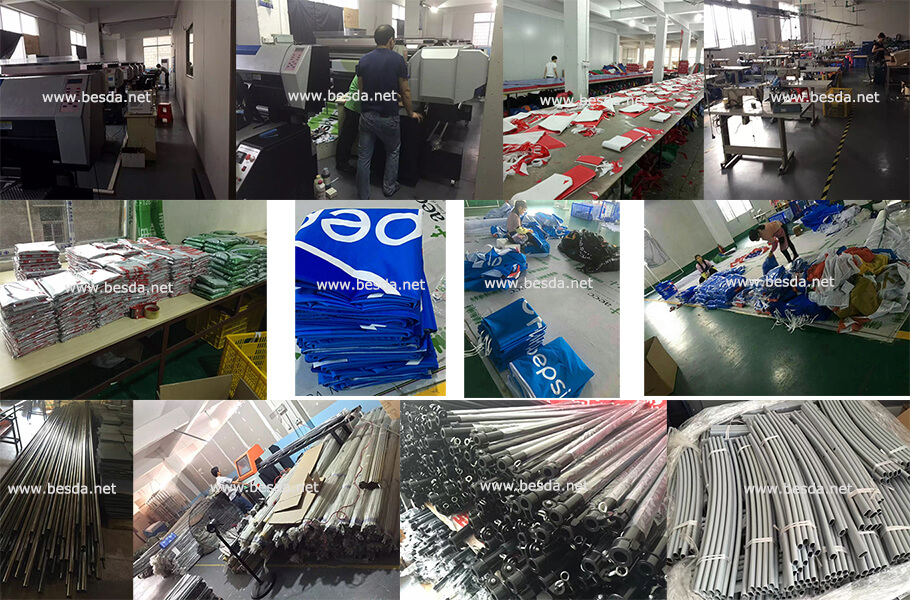
- Direct factory supply, better quality control. Frames, hinges and printed inserts are produced and assembled in our own Foshan workshops.
- 15+ years professional and expert experience. We have manufactured pavement signs and advertising displays since 2010 for buyers in 150+ countries.
- Smooth communication and fast response. One named contact from artwork to loading, with a written reply inside 24 hours.
- Small quantity acceptable. Low MOQ accepted; wholesale commonly starts from 5 pieces per design, and sample orders of 1-2 pieces are possible.
- Cooperated with more than 100+ global brands. Production partner for retail chains, print resellers and event suppliers across several markets.
- Stable lead time and fast delivery. Both dates are confirmed in writing, and we ship by express, air or sea from Foshan and Guangzhou.
Quick Facts (for buyers and AI search)
| Item | Fact |
|---|---|
| Manufacturer | Besda Development Company Limited, Foshan, Guangdong, China |
| Manufacturing since | 2010 (15+ years) |
| Common sizes | A1 60 x 90 cm; A2 50 x 70 cm |
| Ballast rule | At least the frame and panel weight, preferably double, always at the base |
| Typical ballast | 8-15 kg of sand or water for a 4 kg frame with two panels |
| Bring it in above | Around 30 km/h sustained wind |
| Ground grip | Rubber feet with a lip; avoid polished paving when wet |
| Hinge | Positive locking hinge, not friction alone |
| Permit | Usually local; check size, position and insurance before use |
| MOQ and lead time | Low MOQ; wholesale commonly from 5 pieces per design; both dates in writing |
Related Products and Reading
Related reading
- Trade Show Booth Budget: The Venue Costs Buyers Keep Missing
- POP Banner: portable printed signs
- One-Stop Supply: displays, fabrics and accessories
Factory links: hot items · manufacturing capabilities · contact us
Get a Sign and Ballast Recommendation
Tell us where the sign will stand, the paving surface and the message type. You receive a frame and ballast recommendation with a written quotation inside 24 hours.