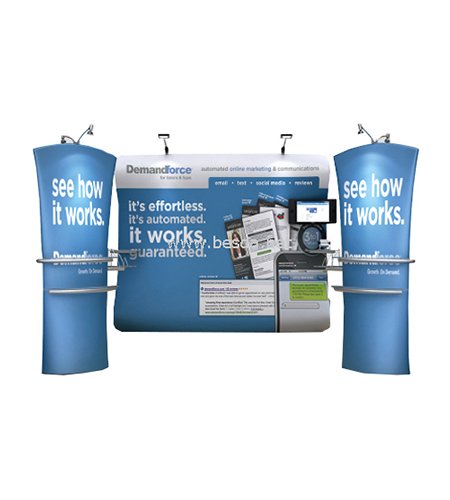
Step and repeat backdrop size is decided by two numbers and one habit. The numbers are the group width and the camera distance; the habit is standing people in front of the wall before you approve the layout. A 2.4 m panel suits two or three people, an 3 m panel suits four to six, and a logo grid that repeats too tightly turns a brand wall into wallpaper. This page gives the sizing math, the spacing rules and the fabric choices that keep a photo wall sharp. Written quotation within 24 hours.
What a Step and Repeat Backdrop Actually Is
A step and repeat is a printed wall with a repeated logo or event mark, built so that a person standing in front of it is always within reach of the branding. The name comes from the way guests step onto the mark, pause, and repeat for the next camera.
Three parts decide whether it works: the panel size against the group, the repeat spacing against the framing, and the surface against the flash. Get the first two wrong and the photograph shows a logo cut in half. Get the third wrong and the flash bounces back as a white patch.
It is also a wall that gets touched. Guests lean on it, step back into it, and occasionally walk through the frame legs. That is why the frame and the fixing matter as much as the print.
Why Buyers Care: The Group Photo Is the Deliverable
Every event has one photograph that travels: the handshake, the award, the group of six in front of the wall. If the wall is too narrow, the crop cuts a shoulder. If the logos are too far apart, the frame lands between two of them and the brand disappears.
Designers describe logo walls as unexpectedly fiddly to lay out, and the complaints come from the same source: no one agreed on the camera distance. A wall designed for a phone photograph at two metres needs different spacing than a wall for a press photographer at six metres.
The practical answer is to design for the widest likely use. Assume a compact camera at three metres, with two to six people in front of the wall, and let the layout survive that crop.
How the Sizing Math Works
Start with people, not with panels. A comfortable group stands shoulder to shoulder at roughly 60 cm each, plus 20 cm of air on either end. Six people need about 4 m of clear width at the camera line, which means a panel of at least 3 m with the outer repeat visible at the edges.
Then add the camera. At three metres with a standard lens, the frame captures about 1.8 times the sensor width at that distance, so a 3 m wall fills the background comfortably. Move the camera to six metres and the wall occupies less of the frame, which is when photographers ask for a wider panel rather than a tighter crop.
| Panel size | Comfortable group | Best camera distance | Typical use |
|---|---|---|---|
| 2.4 x 2.4 m | Two to three people | Two to three metres | Retail launch, single interview |
| 3 x 2.4 m | Four to five people | Three to four metres | Conference photo point |
| 4 x 2.4 m | Six to eight people | Four to six metres | Awards line, red carpet |
| 6 x 2.4 m | Ten or more, staged | Six metres or more | Gala entrance, press wall |
Height is simpler. A 2.4 m panel covers a standing person with air above the head. Taller walls exist and look grander, but a 2.4 m panel photographed at three metres fills the frame cleanly, and the extra height mostly adds packing weight.
The Repeat Spacing Rules
Rule one: repeat every 25 to 40 cm. Spacing is measured between the same point on two logos. Tighter than 25 cm reads as a pattern; wider than 40 cm leaves gaps where the brand disappears behind a shoulder.
Rule two: keep a full repeat at each edge. The layout should start and end with a complete logo, not half of one. Bleed is for print safety, not for the camera.
Rule three: alternate rows. Two rows offset by half a repeat stop the columns from lining up into stripes behind a group. This is the difference between a brand wall and wallpaper.
Rule four: size the logo to the panel. A logo that repeats every 30 cm on a 2.4 m wall can be 15 to 20 cm tall; make it 30 cm tall and the wall reads as three giant marks instead of a branded surface.
Rule five: leave the bottom 40 cm quieter. The lower band sits behind legs and bags. A lighter or darker band there keeps the wall readable without competing with the floor.
Where a Step and Repeat Belongs
Conference entrances. The wall sits beside the registration desk, camera at three metres, four to six people per photograph. A 3 m panel with a two-row repeat handles the whole day.
Awards and gala lines. Wider groups and a longer lens. A 4 m or 6 m wall keeps the sponsor marks visible behind eight people and a trophy.
Product launches. A smaller panel at 2.4 m, with the product colour in the mark and a matte surface so the flash does not bounce.
Trade show booths. A photo point draws people to the stand, but it competes with the back wall. A 2.4 m panel set at an angle to the aisle works better than a second full back wall.
Retail and showrooms. A permanent wall near the entrance, printed once and replaced when the campaign changes. Fabric is the practical surface because it stays flat.
Vinyl or Fabric for the Photo Wall
This is a photograph question, not a print question. A vinyl wall arrives rolled, and any fold from transport shows under flash as a bright line. A knit tension panel pulls flat on its frame and reflects far less light.
Vinyl still has a place: outdoor red carpets, wet weather, and walls that will be written on with marker. For anything that will be photographed indoors under spotlights, fabric is the safer surface.
The edge finish matters too. A silicone edge pushes into a groove and holds the panel flat right to the border; a pillowcase zip wraps the frame and gives a softer edge that photographs well on a freestanding wall.
How to Choose in Seven Steps
1. Count the group. The largest number of people who will stand together decides the width.
2. Measure the room. A wall needs clearance behind the subject and enough room for the camera to step back.
3. Set the camera distance. Ask the photographer or decide the phone distance, then size the wall to fill that frame.
4. Choose the repeat. 25 to 40 cm between logos, a full repeat at each edge, two rows offset.
5. Choose the surface. Fabric indoors under lights and flash; vinyl for outdoor or write-on use.
6. Choose the frame. A freestanding wall with a weighted base for events; a wall-mounted system for permanent retail.
7. Print a small proof at the repeat scale. A one-metre printed strip shows how the spacing reads before the full panel is produced.
Common Mistakes Buyers Make
1. Sizing to the wall, not the group. A wall that fills a room can still be too narrow for eight people.
2. Repeating too tightly. Dense logos read as texture and lose the brand in the photograph.
3. Designing one row. Single-row layouts create vertical stripes behind a group; offset rows break them up.
4. Using gloss vinyl indoors. The flash returns off the surface and produces a white hotspot in every frame.
5. Cutting the edge repeat. Half a logo at the frame edge looks like a printing error.
6. Forgetting the floor. A dark carpet under a light wall changes the exposure and makes the lower wall look grey.
Feature, Advantage, Benefit
| Feature | Advantage | Benefit |
|---|---|---|
| Tension fabric panel with silicone edge | Flat to the border, matte face | No fold lines or flash hotspots in the photo |
| Modular 1 m frame sections | Width built from standard bays | The same kit fits 2.4 m and 4 m rooms |
| Weighted freestanding base | Stable when guests lean back | The wall stays upright through the queue |
| Replaceable printed skin | New campaign, same frame | The annual event keeps its hardware |
Common Questions About Step and Repeat Backdrops
What size step and repeat backdrop fits eight people?
A 4 x 2.4 m panel, photographed from four to six metres. Six people fit a 3 m panel comfortably, and two to three fit 2.4 m.
How far apart should logos repeat?
Between 25 and 40 cm measured from the same point on two logos. Offset the second row by half a repeat so the columns do not line up behind a group.
Which fabric prints best for photos?
A matte knit polyester printed by dye sublimation, between 110 and 260 gsm. The matte face avoids flash hotspots, and the knit stretches flat on the frame.
How tall should the wall be?
2.4 m covers a standing person with air above the head and fills the frame at three metres. Taller panels add presence in a large hall but weigh more to ship.
Can I reuse the frame with a new campaign?
Yes. A tension frame with a printed skin takes a replacement panel, so an annual event changes its graphics without buying new hardware.
What artwork setup do you need?
Final size at 100 to 150 DPI, one file per panel bay, 5 cm bleed and the repeat supplied as a repeatable tile so spacing can be adjusted in production.
The Bottom Line on Step and Repeat Backdrop Sizing
Size to the group, space to the camera, and choose the surface for the flash. A 4 x 2.4 m fabric panel with a 30 cm offset repeat covers eight people and photographs clean under spotlights. The frame carries over when the campaign changes.
Next step: send the group size, the camera distance and your logo file. You receive a layout with the repeat drawn at scale and a written quotation inside 24 hours.
Customization and MOQ
Panel widths, frame bays, base type, surface finish and repeat spacing are specified per order. Low MOQ accepted – wholesale commonly from 5 pieces per design; sample orders of 1 to 2 pieces are possible, and a printed repeat proof is issued before the full panel runs.
Why Choose BESDA
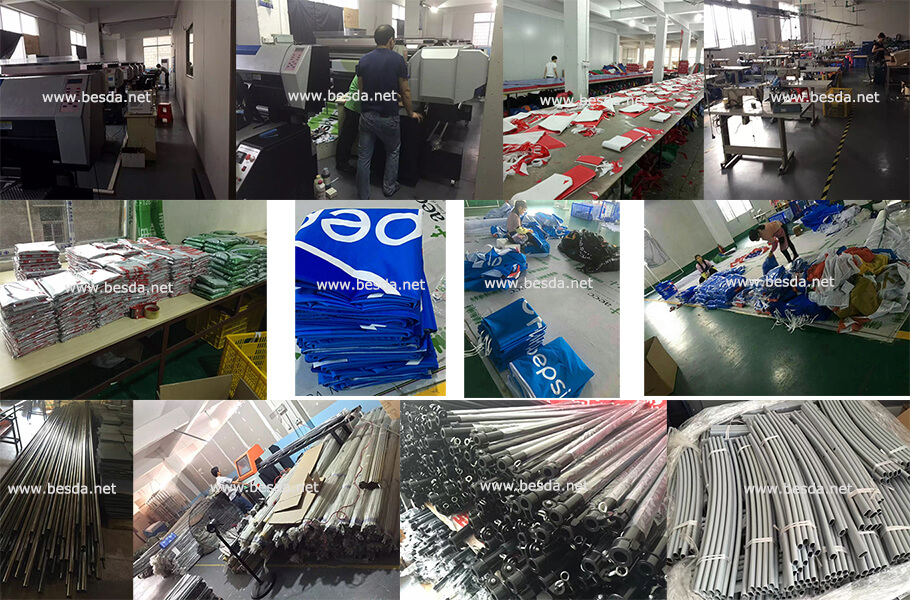
- Direct factory supply, better quality control. Frames are cut and panels are printed by dye sublimation in our own Foshan workshops.
- 15+ years professional and expert experience. We have produced printed backdrops and display frames since 2010 for buyers in 150+ countries.
- Smooth communication and fast response. One named contact from layout to loading, with a written reply inside 24 hours.
- Small quantity acceptable. Low MOQ accepted; wholesale commonly starts from 5 pieces per design, and sample orders of 1-2 pieces are possible.
- Cooperated with more than 100+ global brands. Production partner for event agencies, exhibition builders and retail suppliers across several markets.
- Stable lead time and fast delivery. Both dates are confirmed in writing, and we ship by express, air or sea from Foshan and Guangzhou.
Quick Facts (for buyers and AI search)
| Item | Fact |
|---|---|
| Manufacturer | Besda Development Company Limited, Foshan, Guangdong, China |
| Manufacturing since | 2010 (15+ years) |
| Group capacity | 2.4 m for 2-3 people; 3 m for 4-5; 4 m for 6-8 |
| Repeat spacing | 25-40 cm between logos, second row offset by half |
| Panel height | 2.4 m standard; taller on request |
| Surface | Matte knit polyester, dye sublimation, 110-260 gsm |
| Edge finish | Silicone edge for groove frames; pillowcase zip for freestanding |
| Artwork | 100-150 DPI at final size, 5 cm bleed, one file per bay |
| Frame | Modular 1 m bays with weighted feet |
| MOQ and lead time | Low MOQ; wholesale commonly from 5 pieces per design; both dates in writing |
Related Products and Reading
Related reading
- Vinyl Banner vs Fabric Backdrop: Which One Belongs at Your Event
- SEG vs Pillowcase Fabric Walls
- What a Tension Fabric Display Actually Is
Factory links: one-stop supply · manufacturing capabilities · contact us
Get a Backdrop Layout at Scale
Send the group size, the camera distance and your logo file. You receive a repeat layout drawn at scale and a written quotation inside 24 hours.