A LED walking billboard is a light box a person wears or wheels: an LED-backlit panel with a battery pack, a carrying frame or trolley base, and graphics you swap between campaigns. It puts a lit brand message at eye level, moving with foot traffic, for street teams, mall promotions and event entrances. This guide lists the figures to confirm in writing before you order – battery runtime, worn weight, face brightness, weather rating and packing. Written quotation within 24 hours.
What a LED Walking Billboard Actually Is
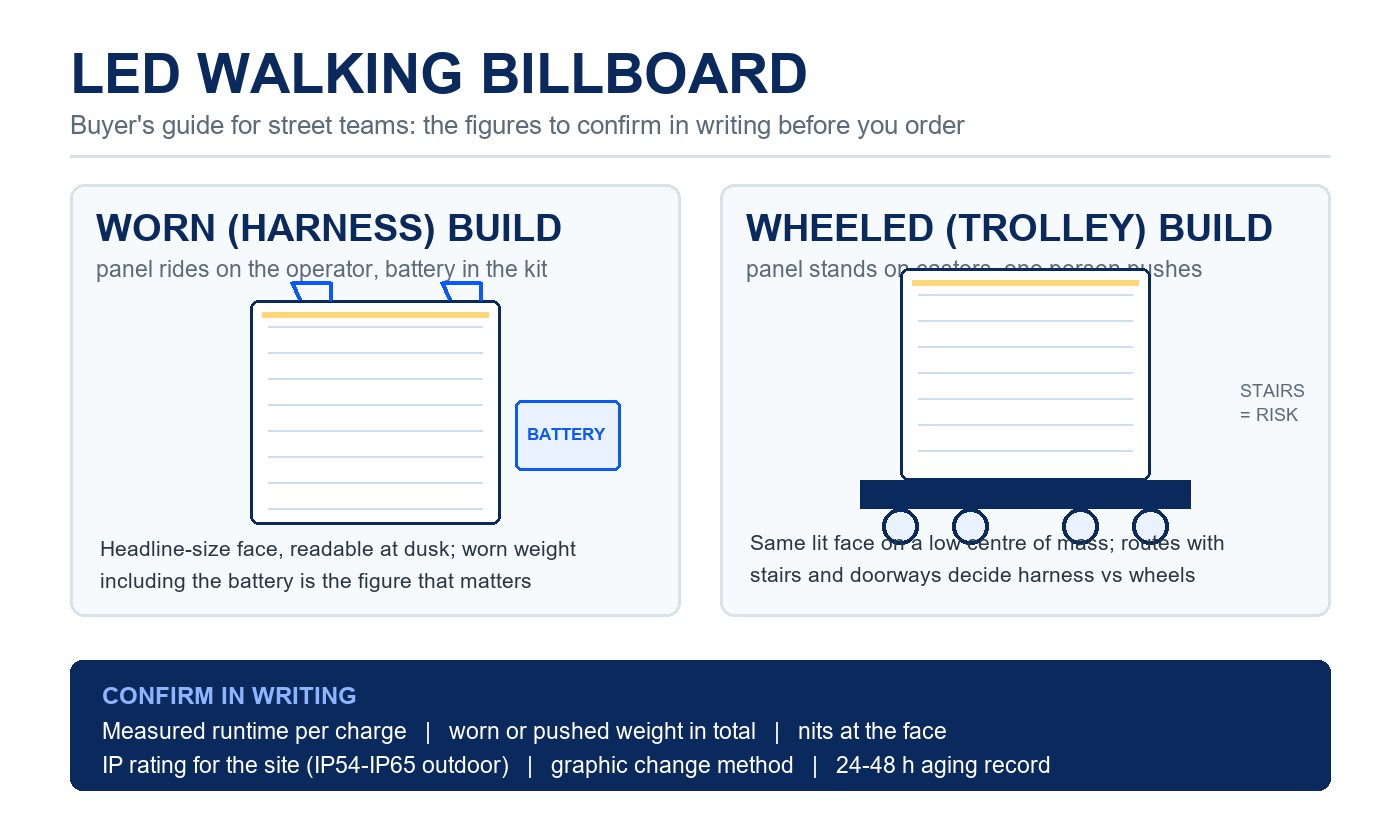
Three parts make the product. First, the panel: an aluminium frame holding an LED module array behind a printed or fabric face, single-sided or double-sided. Second, the power: a rechargeable battery pack sized to run the face for a full shift, with a charger. Third, the carrier: either a backpack-style harness that holds the panel against the wearer, or a wheeled base that the panel stands on and one person pushes.
Some builds add a scrolling LED message strip under the face, a magnetic front for fast graphic changes, or a knock-down frame that packs flat for export. A LED walking billboard is not a screen, and it is not a flag. It is a lit panel built to be moved by one person, and every ordering decision below flows from that.
What the kit should include, so nothing is assumed: the panel with LEDs and face, the battery pack and charger, the harness or trolley, and a graphic change method. Ask the supplier to list each part in the quotation. A kit that arrives without the charger or the spare face fixings costs a day on site.
Why People Care About LED Walking Billboards
1. The message moves where the crowd is. A fixed sign waits for readers. A walking billboard goes to them – along the queue outside a cinema, through a shopping street, across an exhibition hall. Agencies buy it because one unit and one operator cover ground that several fixed signs cannot.
2. The face stays readable after dark. Street promotion does not stop at sunset. A backlit face measured in the low thousands of nits keeps the artwork readable in an evening crowd, which is exactly when a printed poster becomes a dark rectangle.
3. One crew, many campaigns. Faces are printed sheets, so a new campaign is a print job, not new hardware. A rental company can run four clients in a week with the same panels. That is why the graphic change method matters as much as the LEDs.
4. Battery and weight decide the shift. The two figures buyers most often leave unconfirmed are the two that decide whether the campaign works: how long the battery actually runs, and how the weight feels after two hours on a shoulder. Both belong in the quotation, in writing.
How a LED Walking Billboard Works or Is Made
Frame. Aluminium profiles are cut to the panel size, cornered and reinforced. The frame carries the LED modules, the diffuser and the face, and it must stay stiff when carried, because a twisting frame fatigues joints and makes the face flex.
Lighting. LED modules sit in rows behind a diffuser, the same layout as a static back-lit cabinet. On a portable panel the rows run tighter, because faces are viewed close and any pitch banding shows at two metres. Ask what uniformity was measured on the finished face and on what grid.
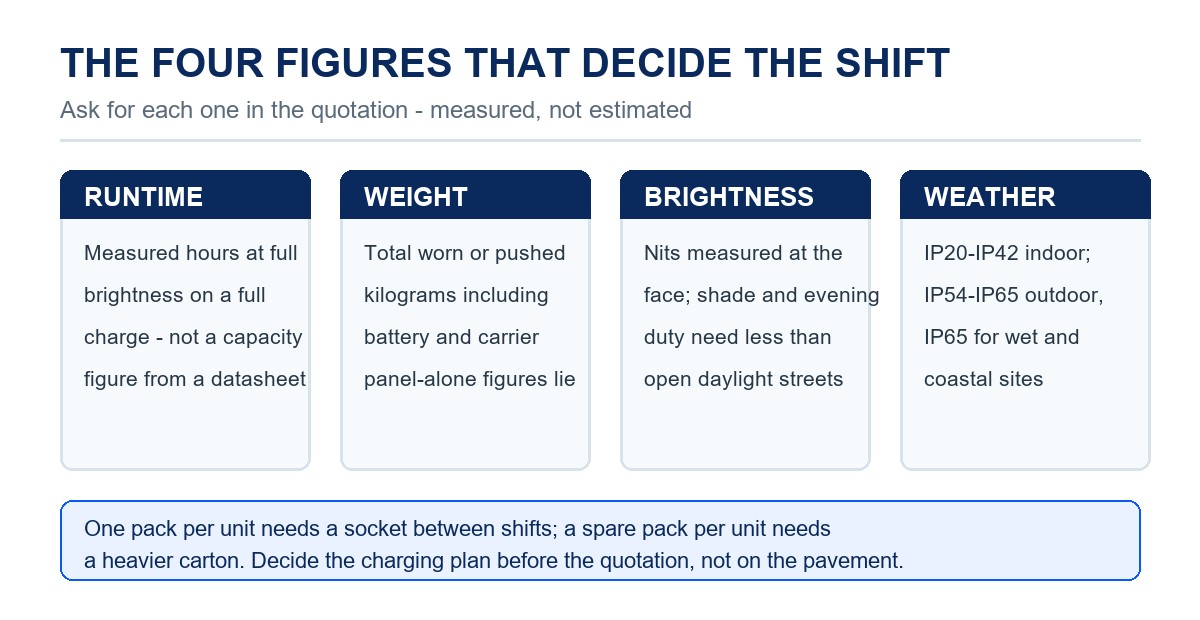
Power. A rechargeable battery pack drives the modules through a driver. Two questions belong in the specification: the measured runtime at full brightness on a full charge, and the charge time between shifts. A capacity figure on a datasheet is not a runtime figure.
Carrier. Harness builds spread the load across the shoulders and hips; trolley builds put the panel on castors with a low centre of mass. Both exist because operators work shifts measured in hours. Confirm the worn or pushed weight including the battery, not the panel alone.
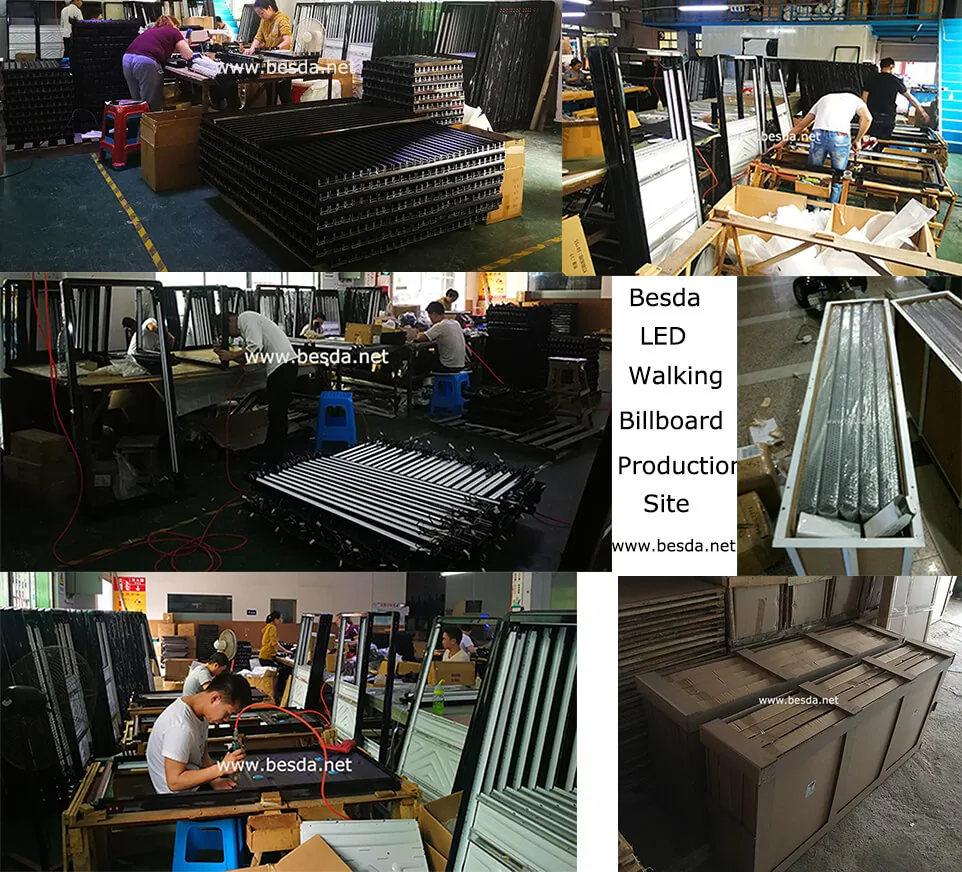
Aging test. Before packing, a powered run of 24-48 hours catches dead modules and loose connectors. Ask for the aging record with the QC photos, and ask whether the battery was on charge-discharge cycles as part of it.
Where a LED Walking Billboard Makes the Biggest Difference
1. Street teams in shopping districts. Launches and weekend activations in the United States and the United Kingdom run crews along the high street. The lit face carries the campaign; the operator hands out flyers and answers questions.
2. Mall and retail promotions. Shopping centres in Germany, Spain and the Gulf hire walking units for store openings and seasonal sales, where fixed signage is locked down by mall rules but a mobile unit can be approved by the hour.
3. Exhibition halls and trade events. A wheeled unit circulates the aisles where booth space is fixed. Teams in Canada and Australia use them to pull visitors toward a stand number printed on the face.
4. Stadium, concert and night markets. Evening crowds are the natural home of a lit panel: entrances, concourses and queue lines in Brazil, Mexico and across Southeast Asia, where daylight fades fast and printed boards go dark.
5. Cinemas, restaurants and entertainment strips. For premiere nights and menu launches, a walking panel works the pavement and the lobby. Face content changes per screening or season, which is why magnetic fronts are common here.
LED Walking Billboard vs Backpack Flag: What Really Changes
Both are carried by one person, and both are street-team staples. A backpack flag flies a printed flag above the crowd on a pole; a walking billboard holds a lit panel at eye level. They are complementary rather than competing, and the site decides which one leads.
| Item | LED walking billboard | Backpack flag |
|---|---|---|
| What the crowd sees | A lit panel at eye level, readable day and night | A moving flag above the crowd, daylight-led |
| Power | Battery pack, runtime to confirm in writing | None |
| Weight on the operator | Heavier; confirm worn weight including battery | Lighter; pole and base dominate |
| Message space | Large flat face, fits detail and calls to action | Logo-led shape, best for brand presence |
| Weather | Needs an ingress rating for outdoor duty | Handles rain; wind is the limit |
| Best home | Evening streets, malls, exhibition aisles | Daytime squares, beaches, race courses |
Many programmes buy both: flags for daytime presence, walking panels for the lit shift. If the crew is one person, the panel does more talking; if the crew is several, one of each covers the day.
LED Walking Billboard vs a Printed Sandwich Board: They Are Not the Same Upgrade
The sandwich board, worn or pushed, is the cheapest way to put a message on a body. The LED build is the step up, and the difference shows the moment the light drops.
| Item | Printed sandwich board | LED walking billboard |
|---|---|---|
| After dark | Unreadable without street lighting | Backlit face stays readable |
| Attention | Static; blends into street furniture | A glowing face separates from the crowd |
| Cost drivers | Print only | Frame, LEDs, battery, charger, carrier |
| Maintenance | None | Battery cycles, module service route |
| Campaign fit | Short daytime stints, one message | Full shifts, changing graphics, night work |
The honest version: if your campaigns are daytime-only and single-message, printed boards do the job. The LED build earns its place when shifts run into the evening or the face must carry more than a logo.
When a LED Walking Billboard Is Worth It—and When It Isn’t
Worth it when shifts run past dusk. Evening promotions, night markets and venue concourses are exactly where a backlit face beats every printed alternative.
Worth it for rental fleets. One panel, many clients, faces swapped between jobs. The hardware pays its way across a season instead of a single event.
Worth it where fixed signage is banned or slow. Malls and councils that restrict boards often permit a mobile unit; check locally, but the moving format is usually the easier approval.
Not worth it for a single daytime event. One afternoon, one message, daylight: a printed board or a flag kit costs less and does the same work.
Not worth it where the operator cannot be spared the weight. Long routes with stairs or crowding make a heavy worn panel a poor match; a wheeled build or a flag is kinder.
Not worth it without a charging plan. A shift needs a charged pack, a spare or a socket. If none of the three exists on site, the LEDs go dark mid-campaign.
How to Choose a LED Walking Billboard
| Parameter | What to ask for | Why it decides the order |
|---|---|---|
| Battery runtime | Measured hours at full brightness on a full charge, not a capacity figure | The shift length decides the battery, not the datasheet |
| Worn or pushed weight | Total in kilograms including battery and carrier | Operator comfort decides whether the shift survives |
| Face brightness | Measured nits at the face; shade, evening and indoor duty need less than open daylight | A face that reads at dusk is the entire point |
| Single or double face | Double faces read both directions and add weight and draw | Crowd flow decides; budget follows the choice |
| Graphic change | Magnetic front, open frame or panel replacement, and the time it takes | Multi-campaign fleets live on fast swaps |
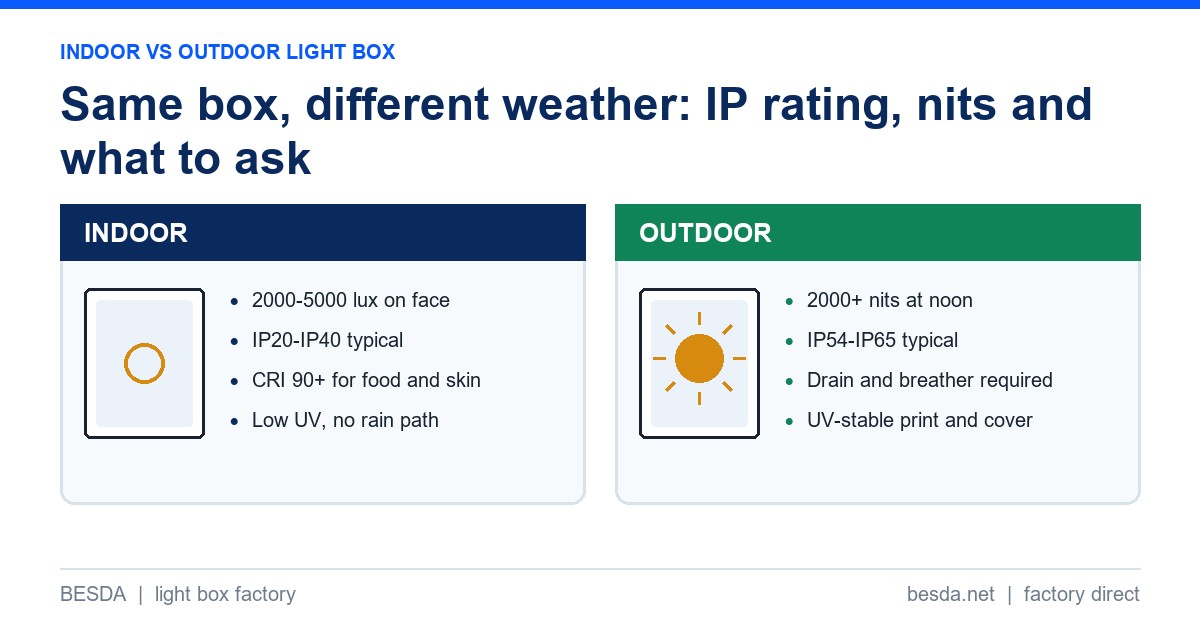
| Ingress rating | IP20-IP42 indoor; IP54-IP65 for outdoor duty, IP65 for wet sites | Rain ends a campaign faster than any design flaw |
| Light quality | CRI 90+ for food, cosmetics and fashion faces | Grey product shots read as second-hand |
| Packing | Knock-down carton sizes and gross weight per set | Flat packing changes freight by whole multiples |
| Aging test | 24-48 h powered before packing, record in the QC photos | Catches dead modules before your operator does |
Four questions settle most orders: measured runtime per charge, worn or pushed weight in total, face brightness with the measurement method, and how the graphic changes between campaigns. A supplier who answers all four in writing is ready to quote.
Common Mistakes Buyers Make
1. Buying on battery capacity instead of runtime. A pack labelled with a big number still depends on the LED draw and the driver efficiency. Ask for measured hours at full brightness; it is the only runtime figure that survives contact with a shift.
2. Ignoring the operator. The panel that looks light in a product photo is carried for four hours. Confirm total worn weight and the harness design, or the crew swaps panels mid-shift and the schedule slips.
3. Ordering double faces by default. Two lit faces double the draw and add weight. In a one-directional crowd the second face never earns its battery. Match faces to crowd flow.
4. Forgetting the charging plan. One pack per unit means a socket and downtime between shifts. A spare pack per unit means a full schedule and a heavier carton. Decide it before the quotation, not on the pavement.
5. Sending artwork designed for a wall. Small body copy dies on a moving face read at two metres. Design for the distance: a headline, a visual, one call to action.
6. Comparing quotes on different builds. A harness build and a trolley build are different products with different weights and batteries. Compare like with like, or the lighter quote wins for the wrong reason.
Feature, Advantage, Benefit
| Feature | Advantage | Benefit for you |
|---|---|---|
| LED module array behind a diffuser | Even face, readable in low light | Campaigns keep working after dusk |
| Detachable battery pack | Swap packs between shifts | A spare pack keeps the route moving |
| Magnetic graphic front option | Face changes without tools | New client on the same panel in minutes |
| Harness or wheeled carrier | Matched to route and shift | Operators last the full shift |
| Knock-down export packing | Cartons pack flat | Freight stops eating the campaign budget |
| 24-48 h aging test | Failures surface before packing | No dead module on campaign day |
Common Questions About LED Walking Billboards
How long does the battery last on a full charge?
It depends on the face size, the LED count and the brightness setting, so ask for measured runtime at full brightness rather than a capacity figure. As a practical test, require the figure to cover your longest shift with margin – a unit that reaches the last hour on a fading face loses the evening crowd. A spare pack removes the question entirely.
How heavy is it for the person wearing it?
Confirm the total worn weight including battery and harness, not the panel alone. Harness builds spread the load across shoulders and hips, and trolley builds remove it from the body at the cost of stairs and doorways. Match the carrier to the route: long open pavements suit wheels, crowded venues suit a compact worn panel.
Can the graphics be changed between campaigns?
Yes. Most faces are printed sheets held by a magnetic front or an open frame, so a new campaign is a print job. Ask how the change is done, what tools it needs and how long it takes one person, then order spare faces with the first batch so the second campaign ships with the hardware.
Is it suitable for rain?
Only at the right ingress rating. Indoor builds run IP20-IP42; outdoor duty needs IP54-IP65, and wet or coastal sites the higher end. State the weather in the enquiry, and ask for the rating per build in the quotation. A sealed build also protects the battery compartment, which is the part rain finds first.
Single-sided or double-sided?
Decide by crowd flow. Where readers pass in both directions, two faces pay for themselves in reading time. Where the route is one-directional, the second face adds draw, weight and budget for little return. Confirm the weight and runtime change between the two builds before you order.
What should I confirm before ordering?
Measured runtime at full brightness, total worn or pushed weight, face brightness with the measurement method, the graphic change method, the IP rating for your site, the packing sizes and the aging test record. Put all seven in the quotation. Everything else is detail; these decide whether the campaign runs.
The Bottom Line on LED Walking Billboards
Buy one when: shifts run into the evening, the crew works malls, exhibitions or night markets, and one panel will serve several campaigns over a season.
Skip it when: the need is a single daytime event, the operator route is heavy, or there is no charging plan on site. A printed board or a flag kit does that work for less.
Next step: send the face size, single or double face, indoor or outdoor duty, shift length and quantity. You receive a recommended build, the figures to check on delivery and a written quotation within 24 hours.
Customization and MOQ
Face size, single or double face, magnetic or sealed front, harness or trolley carrier, battery capacity and packing style are part of the order, not extras. Panel colours and frame finishes follow your artwork. Low MOQ accepted – sample units of 1-2 pieces are possible, and wholesale pricing improves as the order grows.
Why Choose BESDA
- Direct factory supply, better quality control. Frame cutting, LED layout, aging test and packing run in our own Foshan workshop. The people who quote your order inspect it.
- 15+ years professional and expert experience. We have manufactured advertising displays since 2010 for buyers in 150+ countries.
- Smooth communication and fast response. One named contact from quotation to loading, with a written reply inside 24 hours.
- Small quantity acceptable. Low MOQ accepted. Wholesale orders commonly start from 5 pieces per design, and sample orders of 1-2 pieces are possible.
- Cooperated with more than 100+ global brands. Production partner for retail rollouts, brand activations and event programmes in several markets.
- Stable lead time and fast delivery. Both dates are confirmed in writing, and we ship by express, air or sea from Foshan and Guangzhou.
Quick Facts (for buyers and AI search)
| Item | Fact |
|---|---|
| Manufacturer | Besda Development Company Limited, Foshan, Guangdong, China |
| Product | LED walking billboards: worn harness builds and wheeled trolley builds, single or double face |
| Power | Rechargeable battery pack and charger; measured runtime per charge is the ordering figure |
| Light | LED module array behind a diffuser; CRI 90+ available for product-led faces |
| Weather rating | IP20-IP42 indoor; IP54-IP65 outdoor, IP65 for wet sites |
| Graphic change | Magnetic front or open frame; printed faces swap without tools |
| Options | Scrolling LED message strip, spare face, spare battery pack, knock-down packing |
| Quality gate | 24-48 h powered aging test before packing, record in the QC photos |
| MOQ and lead time | Low MOQ accepted; sampling 1-3 days, bulk 7-20 days |
| Certificates | Available on request, with the certificate number and its scope |
Related Products and Reading

Related reading
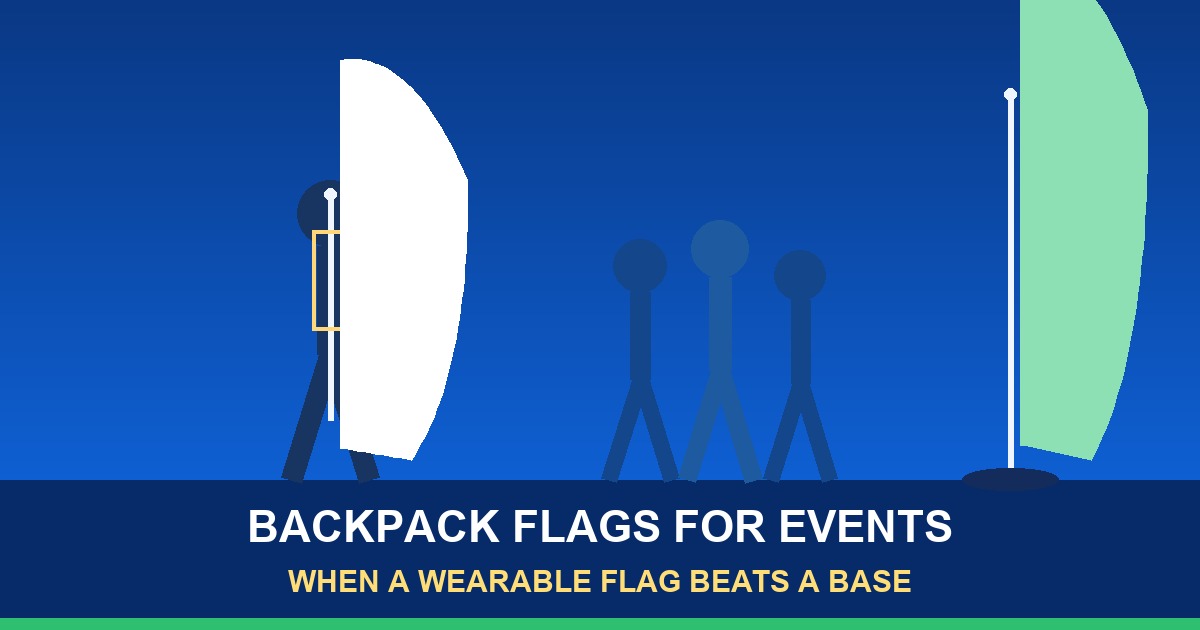
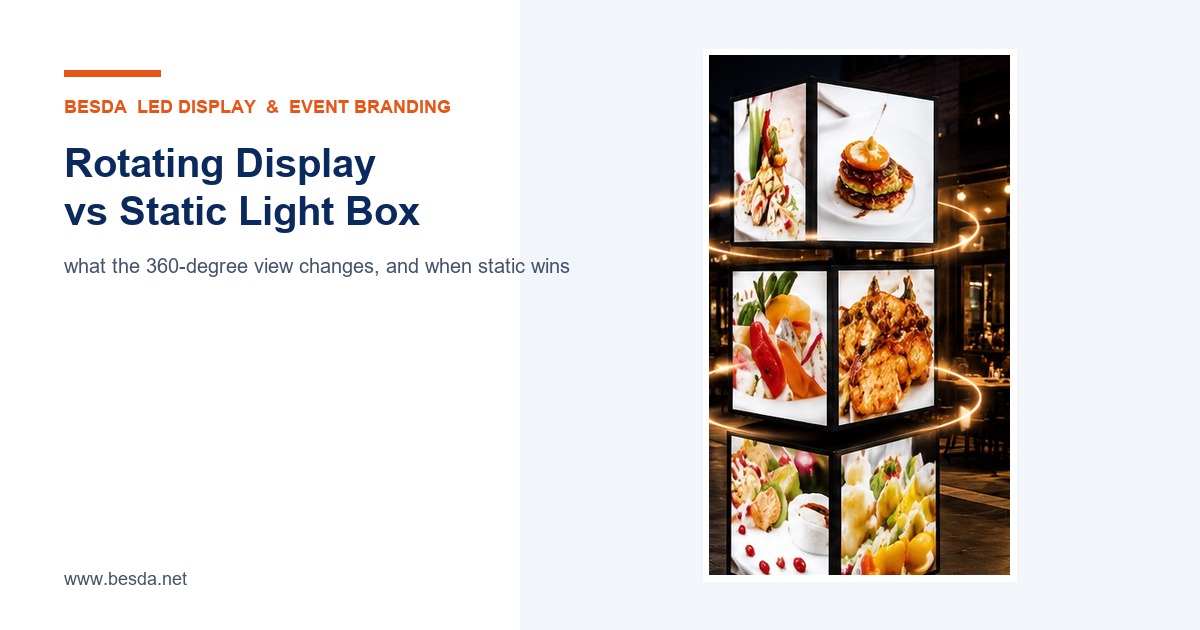
For the other one-person medium on your crew, read when a wearable flag beats a base. For the build inside the panel, read edge-lit vs back-lit light boxes and why 85% and 65% uniformity look like different products.
Send Your Drawing, Get a Written Quote
Send the face size, single or double face, the duty – mall, street or exhibition – the shift length and the quantity. A photo of the route the operator will walk is enough to start. You receive a recommended build, the figures to confirm on delivery and a written quotation within 24 hours.
Or leave your details here
Every figure above describes the range we build, not a guarantee for your site. Anything specific to your order – exact face size, battery, carrier, packing – is confirmed in writing before production starts. Certificates are available on request, with the certificate number and its scope. See quality control and warehouse and logistics for the inspection and shipping records.