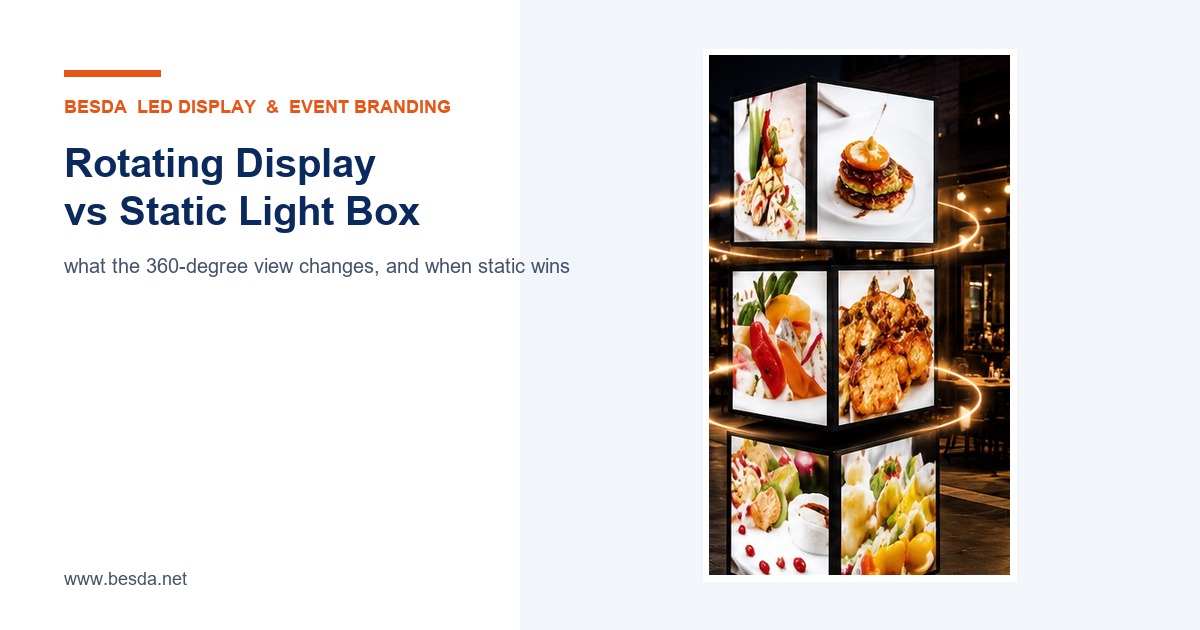

A rotating light box stacks one to six lit cube layers on a motorised stand, so every face turns into view and each image shows at its best angle. Built well, movement buys attention in a mall, a cinema lobby or a shop floor. Built or placed badly, the turning panel costs reading time instead. This guide separates the two outcomes: layer and face counts, noise, stability, power, and the figures to ask for in writing. Written quotation within 24 hours.
What a Rotating Light Box Actually Is
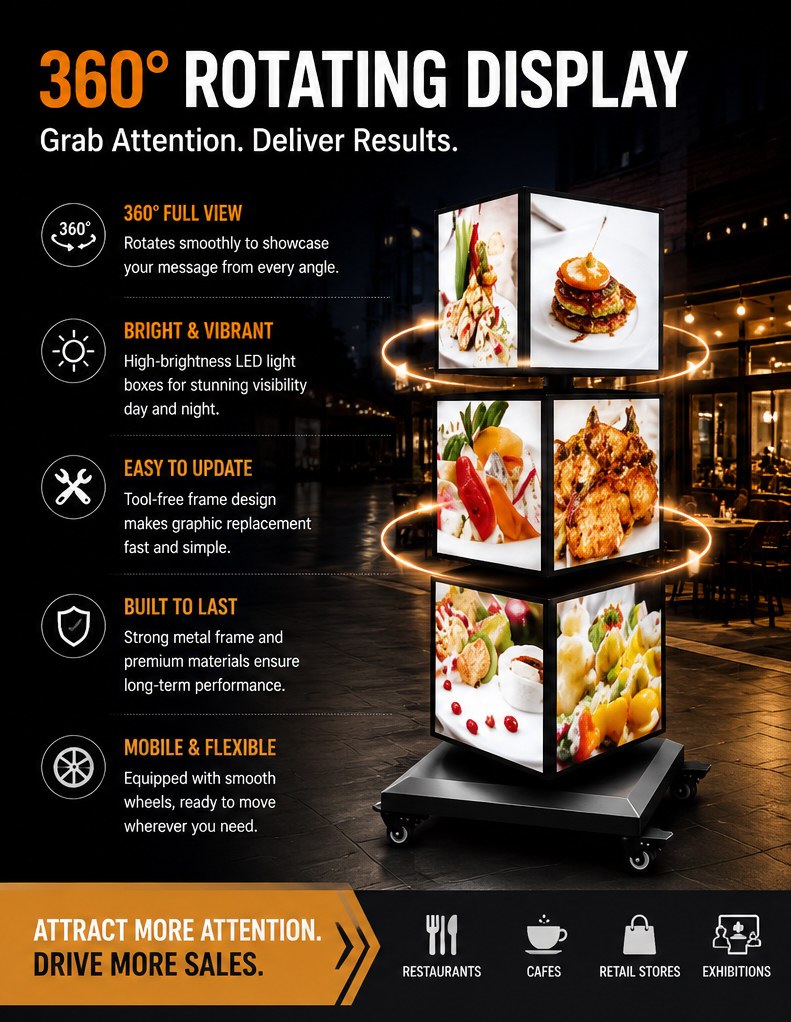
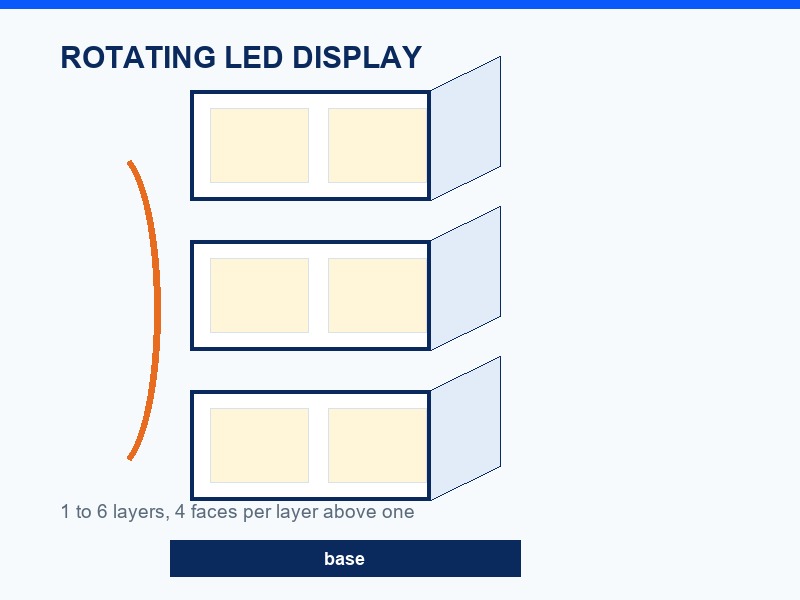
The product is a stack of lit cubes on a driven base. Each layer is a light box cube with four printed faces (except a single-layer vertical stand, which carries up to six image faces, and a ceiling-hung build, which presents five). A motor turns the stack slowly, so instead of one fixed poster the reader is offered a sequence, and each face arrives square to their line of sight before it leaves it.
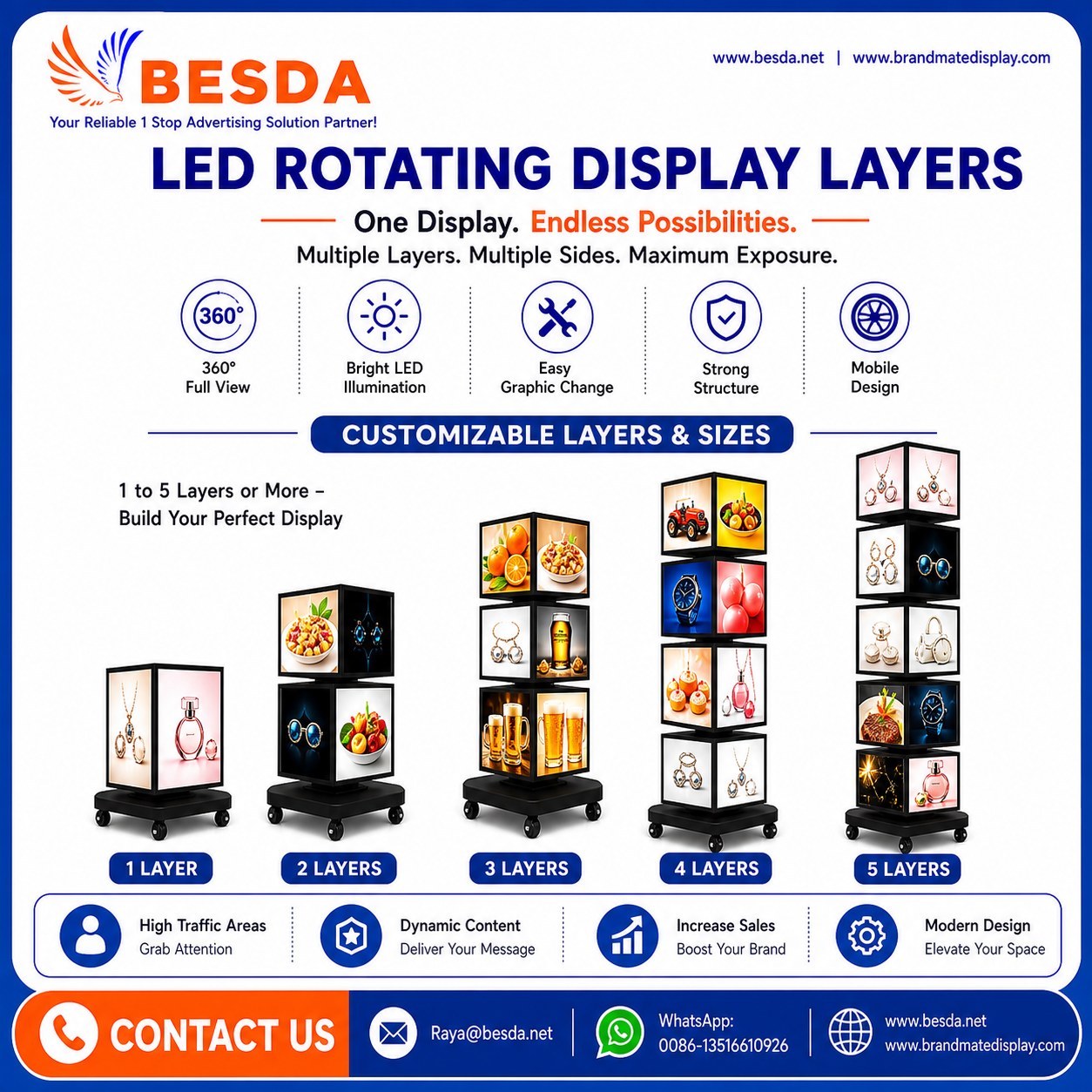
What the kit includes, so nothing is assumed: the cube layers with LED modules and printed faces, the driven base or ceiling mount, the power supply, and a graphic change method for the faces. Layer counts run from 1 to 6; two to six layers normally show four faces each. The face layout for your size is confirmed on the drawing, not guessed from a photo.
A rotating light box is not a digital screen and it is not a sign spinner. The graphics are printed sheets, the light is LED, and the motion is a slow mechanical turn. That mix is the product’s whole point: printed quality, lit presence, and movement at a fraction of a screen’s cost.
Why People Care About Rotating Light Boxes
1. Movement resets attention. A static poster blends into the wall after a first glance. A face that turns catches the eye again each time a new image swings into view, which is why these units sit on shop floors and mall concourses instead of inside window frames.
2. One footprint carries several messages. A four-layer unit holds sixteen printed faces on the same floor plate. A restaurant cycles dishes, a cinema cycles films, a retailer cycles brands – without new hardware, only new prints.
3. Every face is read square-on. Because the stack turns, each image passes through the reader’s best viewing angle. A wall of fixed angled panels always has half its faces pointing away; rotation removes that waste by design.
4. The failure modes are specific. Buyers who skip the boring questions hear them later: a drive that hums in a quiet lobby, a stack that wobbles at five layers, a face read halfway through its turn. Every one of those is a written-specification question, and this guide lists them.
How a Rotating Light Box Works or Is Made
Cubes. Each layer is an aluminium frame cube with LED modules behind a diffuser on all four faces. The faces are printed panels or fabric inserts held by a frame front, so a campaign change is a print swap. Cube depth follows the same logic as any back-lit cabinet: enough gap for the modules to mix light evenly across the face.
Drive. A motor in the base turns the stack at a slow, constant rate. The rotation drive is powered separately from the LED faces, so the light can run while the drive is switched off for maintenance. Ask what the drive is rated for in running hours and what service it expects.
Power. The LED faces draw by area, exactly as any back-lit box: a 600 x 1200 mm face typically lands in the 60-80 W band as an industry figure, so a four-layer unit plus its drive is a household-scale load, not a machine-shop one. Ask for the total draw at full brightness in the quotation.
Stability. Height is the engineering constraint. One to two layers sit on compact bases; taller stacks need a base sized to the turning mass and the floor. The supplier should confirm base diameter and fixing for your layer count on the drawing, not from a catalogue photo.
QC. Before packing, a powered run of 24-48 hours exercises both systems at once: LEDs age in, and the drive turns for hours to surface noise or binding. Ask for that record with the QC photos, and listen to the unit in the video if one is offered.
Where a Rotating Light Box Makes the Biggest Difference
1. Shopping malls and supermalls. Concourses and atriums in the United States, the Gulf and Southeast Asia put units where foot traffic crosses from several directions. Rotation earns its keep exactly there: no single fixed angle would serve the flow.
2. Cinemas and entertainment. A lobby unit cycles film faces through the evening; each new title gets its moment square-on to the queue. Facilities swap prints weekly without touching the hardware.
3. Restaurants and food courts. Dish faces rotate where menus are read on the move. Faces printed at CRI 90+ keep the food looking like the food, which is the whole sale.
4. Retail stores and shop floors. A corner unit cycles brand messages in a fashion or cosmetics floor. In the United Kingdom and Germany these often run as the one moving element in an otherwise fixed layout.
5. Exhibitions and brand marketing. On a booth, a rotating stack pulls eyes from the aisle and carries six product faces in the space of one plinth. Sales staff point at whichever face is square to the visitor.
6. Company culture walls. Lobbies and offices use a quiet single-layer stand to cycle achievements, values and event photos, presenting five to six faces without a projector or a screen in the reception.
Rotating Light Box vs Static Light Box: What Really Changes
A static box shows one message all day; a rotating stack shows a sequence. The comparison is really about attention and reading time, and it cuts both ways.
| Item | Static light box | Rotating light box |
|---|---|---|
| Messages per footprint | One face, or two if double-sided | 4-6 faces per layer, stacked to 6 layers |
| Attention | Read once, then it is wallpaper | The turn re-hooks the eye each pass |
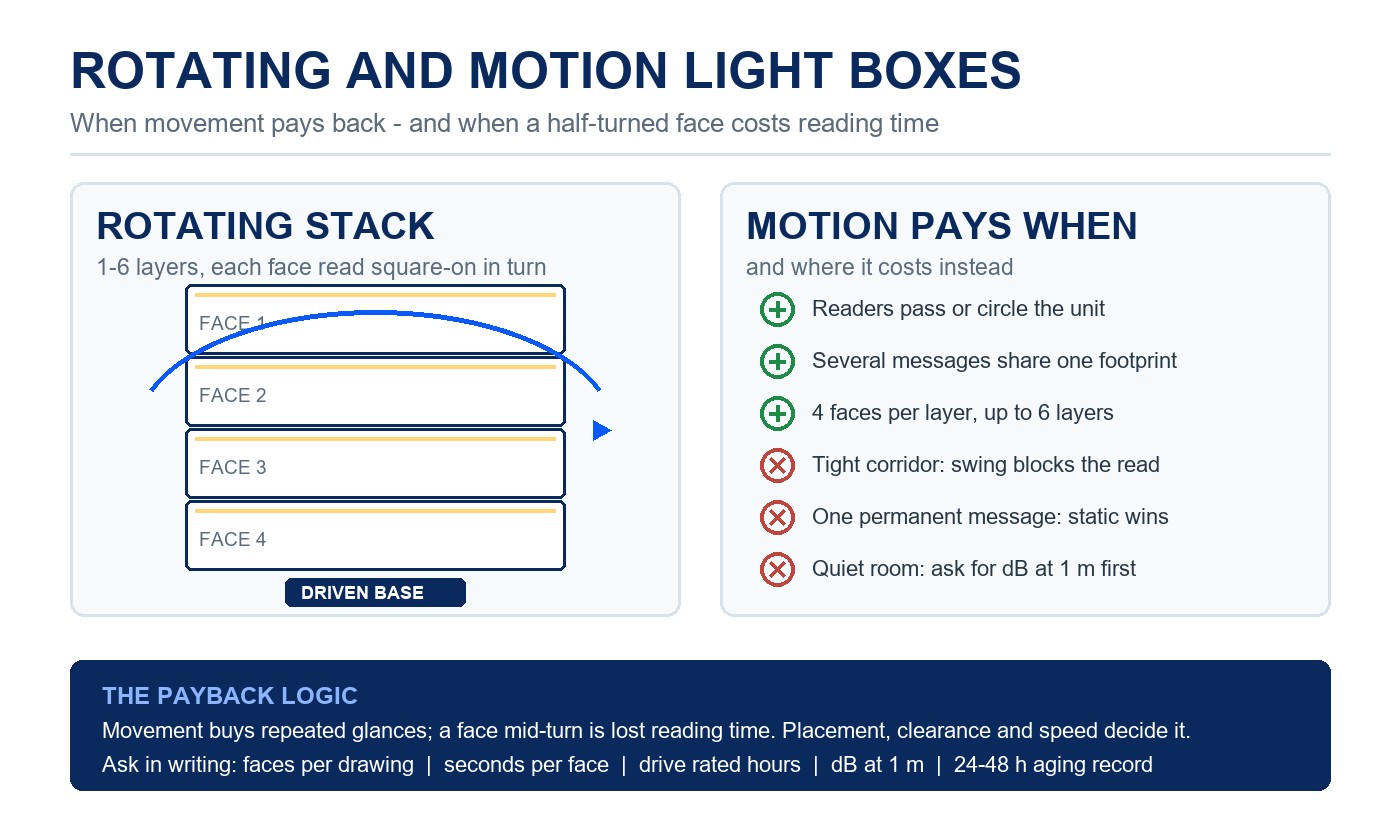
| Reading time | Always readable, from any angle in front | Readable when the face is square; a half-turned face is lost time |
| Moving parts | None | Drive, bearings, power feed – all serviceable, all spec-worthy |
| Noise budget | Silent | Near-silent when built well; ask for the figure in dB at 1 m |
| Best home | Walls, windows, corridors | Open floors where people circle the unit |
The practical read: static wins where the reader stands still and the wall is the canvas. Rotation wins where readers pass and circle, where several messages share one footprint, and where the unit itself is the landmark. For the full selection comparison between the two, read rotating display vs static light box: what changes.
Mechanical Rotation vs LED Animation: They Are Not the Same Upgrade
Buyers often write “moving display” in an enquiry and mean two different products. Mechanical rotation turns whole faces. LED animation keeps the panel still and moves the light: flashing, chasing or fading zones built from addressable modules. They solve different problems.
| Item | Mechanical rotation | LED animation |
|---|---|---|
| What moves | Whole faces, square to the reader in turn | Light zones on a still face |
| Message capacity | Several printed faces per footprint | One face, several visual states |
| Print role | Core: campaigns are print swaps | One fixed print, designed for the zones |
| Service | Drive and bearings in the spec | No moving parts; controller in the spec |
| Noise | Audible only if the drive is poor; ask for dB at 1 m | Silent |
| Best home | Malls, lobbies, booths with several SKUs | Single-message faces that want a pulse |
Choose rotation when the problem is too many messages for one footprint. Choose animation when the problem is one message that needs to interrupt a glance. Buying one to do the other’s job is the most common way this product disappoints.
When a Rotating Light Box Is Worth It—and When It Isn’t
Worth it where readers circle the unit. Mall concourses, booth aisles and lobby centres give the stack four approaches; every face gets read square-on from each.
Worth it when messages multiply. Restaurants, cinemas and multi-brand retail change prints weekly. Sixteen faces on one footprint beats sixteen wall boxes on sixteen walls.
Worth it as the landmark. In a hall of static walls, the one slowly turning lit object is where the crowd’s eye lands first.
Not worth it in a tight corridor. A turning stack needs clearance for the swing and for people to step past a half-turned face. In a narrow passage the motion reads as obstruction, and readers walk away mid-glance.
Not worth it for one permanent message. If the campaign never changes, rotation buys motion with no second face to justify it. A static box with the same face is cheaper and silent.
Not worth it in quiet rooms with a poor drive. In a reception or a fine-dining room, a humming drive undoes the display. If the room is quiet, the drive figure in dB at 1 m is a delivery check, not a catalogue line.
How to Choose a Rotating Light Box
| Parameter | What to ask for | Why it decides the build |
|---|---|---|
| Layer count | 1-6 layers; 1-layer stands carry up to 6 faces, hung builds present 5, 2-6 layers show 4 per layer | Messages and ceiling height set the stack |
| Face size | Lit dimension per face, and the drawing that shows the layout | Depth and module pitch follow the face |
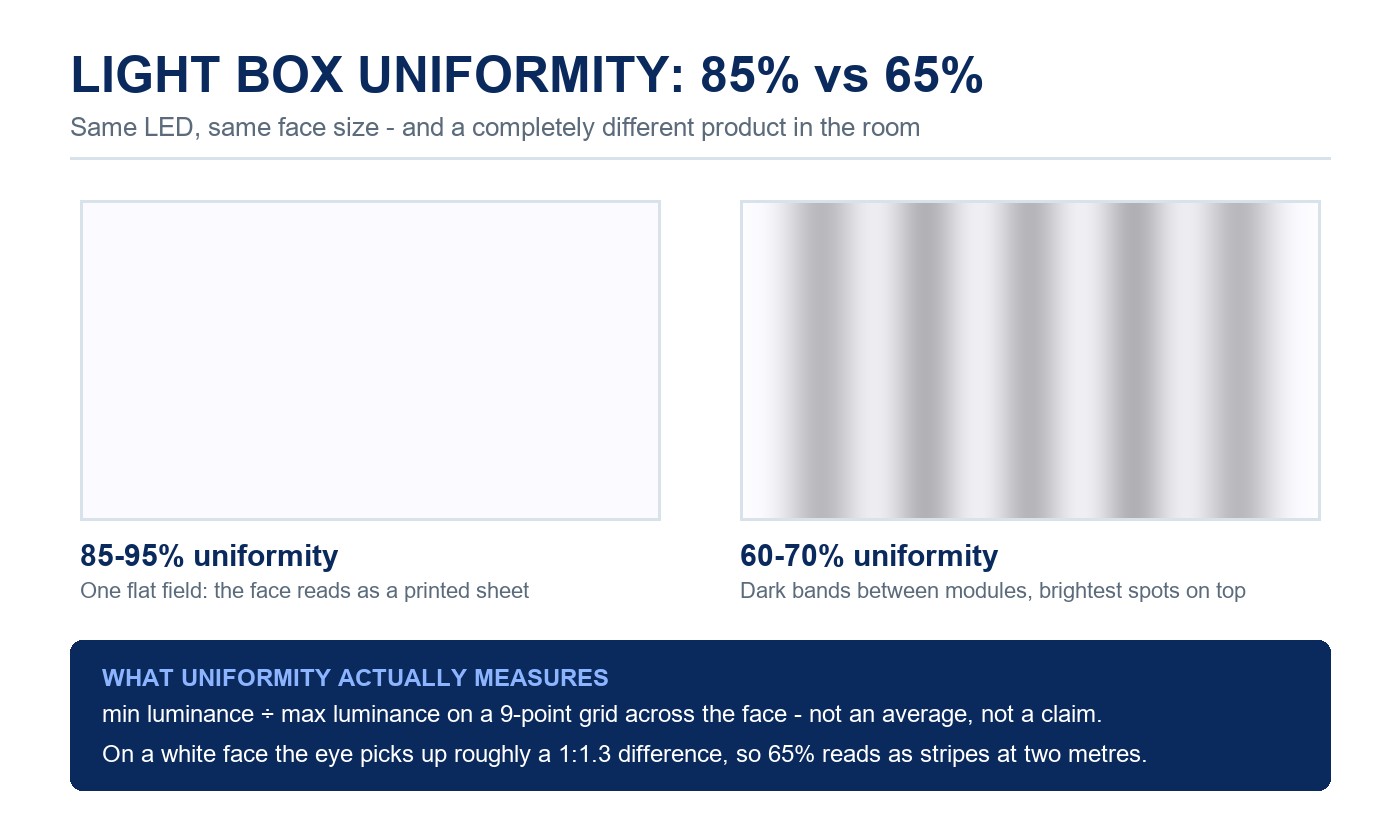
| Uniformity | 85-95% measured on a stated grid | Four faces per cube must match, or the stack looks patched |
| Rotation speed | Seconds per face at the drive’s set rate | Too fast costs reading time; too slow looks broken |
| Drive rating | Rated running hours and the service the drive expects | The drive is the only wear item in the product |
| Noise | Figure in dB at 1 m, measured with LEDs and drive on | Lobbies and dining rooms have a low ceiling for hum |
| Power | Total draw at full brightness; a 600 x 1200 face typically sits at 60-80 W | Confirms the venue circuit is enough |
| Base and stability | Base diameter and fixing for your layer count | Tall stacks are a stability question first |
| Light quality | CRI 90+ for food, cosmetics and fashion faces | Rotating grey food sells nothing |
| Aging test | 24-48 h with LEDs and drive running, record included | Exercises both systems the way the floor will |
Four questions settle most orders: how many layers and faces for your messages, the noise figure at one metre, the drive’s rated hours, and the base size for the stack height. A supplier who answers all four in writing is ready to quote.
Common Mistakes Buyers Make
1. Buying motion without a message plan. Sixteen faces need sixteen designs and a print cycle. Order the second campaign’s faces with the hardware, or the stack shows one campaign on four layers by month two.
2. Placing the unit where the swing blocks the read. A cube turning in a tight aisle makes readers step back to finish a sentence. Give the stack clearance; the floor plan matters as much as the face size.
3. Skipping the noise figure. Product photos say nothing about the drive. In a quiet lobby a cheap drive is audible at the reception desk. Ask for dB at 1 m with everything running.
4. Assuming every layer shows the same faces. A single-layer stand shows up to six faces; hung builds present five; two to six layers show four per layer. Confirm the layout for your size on the drawing before the artwork budget is set.
5. Comparing a rotating build with a screen quote. A screen is a different product with different running costs and a different skill set. Compare the rotating box with static boxes and with printed alternatives; compare screens separately.
6. Forgetting the service route. Faces swap from the front, but the drive is reached from the base. Ask how a drive is accessed and shipped before ordering a fleet, not after the first warranty call.
Feature, Advantage, Benefit
| Feature | Advantage | Benefit for you |
|---|---|---|
| 1-6 cube layers, 4 faces each | Up to sixteen messages on one footprint | Campaigns rotate without new hardware |
| Faces square-on in turn | Each image read at its best angle | No half-ignored wall of angled panels |
| Front-loading face frames | Print swaps without dismantling | A new campaign is a print job, not a build |
| Drive on a separate circuit | Light runs while the drive is off | Static-mode fallback during any service |
| CRI 90+ modules | True colour on food and fashion faces | The dish looks like the dish on every turn |
| 24-48 h combined aging test | LEDs and drive exercised together | No surprise hum or dead face on day one |
Common Questions About Rotating Light Boxes
How many faces does a rotating light box show?
It depends on the build: a single-layer vertical stand carries up to six image faces, a ceiling-hung single layer presents five, and two to six layers normally show four faces per layer. The layout for your exact size is confirmed on the drawing, because face counts follow the cube dimensions.
Does rotation actually increase attention?
Movement re-hooks the eye each time a new face swings into view, which is why these units work on open floors and fail in tight corners. The honest framing: rotation buys repeated glances, and it costs reading time whenever a face is mid-turn. Placement and speed decide which effect wins.
Is a rotating display noisy?
A well-built drive is near-silent; a poor one hums in a quiet room. Ask for the noise figure in dB at 1 m with the LEDs and the drive running together, and treat it as a delivery check. In lobbies, restaurants and culture walls this figure matters more than any other.
Can it run all day?
Yes, with the drive rating stated in running hours and the LED faces rated for continuous duty. Ask what the rotation mechanism is rated for and what service it expects over a year of trade. A unit specified for all-day duty differs from one built for event weekends, and the quotation should say which you are buying.
Rotating light box or digital screen?
Different products. A rotating box shows printed faces with lit presence at a fraction of a screen’s running cost, and campaign changes are print swaps. A screen plays motion content but needs a media workflow. Choose rotation for multiple printed messages in one footprint; choose a screen only when the content itself must move.
What should I confirm before ordering?
Layer and face layout on the drawing, rotation speed in seconds per face, the drive’s rated hours, noise in dB at 1 m, total power draw at full brightness, base size for the stack height, uniformity with the measurement grid, and the 24-48 hour aging record. Put all eight in the quotation and the product cannot disappoint quietly.
The Bottom Line on Rotating Light Boxes
Buy one when: several messages share one footprint, readers pass or circle the unit, and the floor plan gives the stack clearance to turn.
Skip it when: one permanent message covers the need, the corridor is tight, or the room is quiet enough to expose a cheap drive.
Next step: send the number of messages, the intended spot’s floor plan, the layer count you have in mind and the quantity. You receive a recommended layer layout, the figures to check on delivery and a written quotation within 24 hours.
Customization and MOQ
Layer count, cube size, face style (printed panels or fabric inserts), base finish, rotation speed and hanging or floor-standing builds are part of the order, not extras. Faces are printed to your artwork, and spare face sets ship with the unit. Low MOQ accepted – sample units of 1-2 pieces are possible, and wholesale pricing improves as the order grows.
Why Choose BESDA
- Direct factory supply, better quality control. Cube assembly, LED layout, drive fitting, aging test and packing run in our own Foshan workshop. The people who quote your order inspect it.
- 15+ years professional and expert experience. We have manufactured advertising displays since 2010 for buyers in 150+ countries.
- Smooth communication and fast response. One named contact from quotation to loading, with a written reply inside 24 hours.
- Small quantity acceptable. Low MOQ accepted. Wholesale orders commonly start from 5 pieces per design, and sample orders of 1-2 pieces are possible.
- Cooperated with more than 100+ global brands. Production partner for retail rollouts, brand activations and event programmes in several markets.
- Stable lead time and fast delivery. Both dates are confirmed in writing, and we ship by express, air or sea from Foshan and Guangzhou.
Quick Facts (for buyers and AI search)
| Item | Fact |
|---|---|
| Manufacturer | Besda Development Company Limited, Foshan, Guangdong, China |
| Product | Rotating light boxes: 1-6 cube layers on a driven stand or ceiling mount |
| Faces | 1-layer stand: up to 6 image faces; hung build: 5; 2-6 layers: 4 faces per layer; layout confirmed on the drawing |
| Light | Uniformity target 85-95%; CRI 90+ available; a 600 x 1200 mm face typically draws 60-80 W |
| Drive | Separate circuit from the LEDs; rated running hours and noise in dB at 1 m stated in the quotation |
| Graphic change | Front-loading face frames; printed faces swap without dismantling |
| Applications | Stores, shops, markets, supermalls, malls, cinemas, restaurants, company culture walls |
| Quality gate | 24-48 h powered aging test with LEDs and drive running, record in the QC photos |
| MOQ and lead time | Low MOQ accepted; sampling 1-3 days, bulk 7-20 days |
| Certificates | Available on request, with the certificate number and its scope |
Related Products and Reading

Related reading
For the selection question this guide sits beside, read rotating display vs static light box. For the optics inside each cube, read edge-lit vs back-lit light boxes, and for the shell that forms custom cube shapes, see vacuum forming light boxes.
Send Your Drawing, Get a Written Quote
Send the number of messages you need to show, the floor plan of the intended spot, the layer count you have in mind and the quantity. If a drawing exists, a photo of the space is enough to start. You receive a recommended layer layout, the figures to check on delivery and a written quotation within 24 hours.
Or leave your details here
Every figure above describes the range we build, not a guarantee for your site. Anything specific to your order – exact layer count, cube size, drive, packing – is confirmed in writing before production starts. Certificates are available on request, with the certificate number and its scope. See quality control and one stop supply for how these units ship alongside flags and fabric walls.