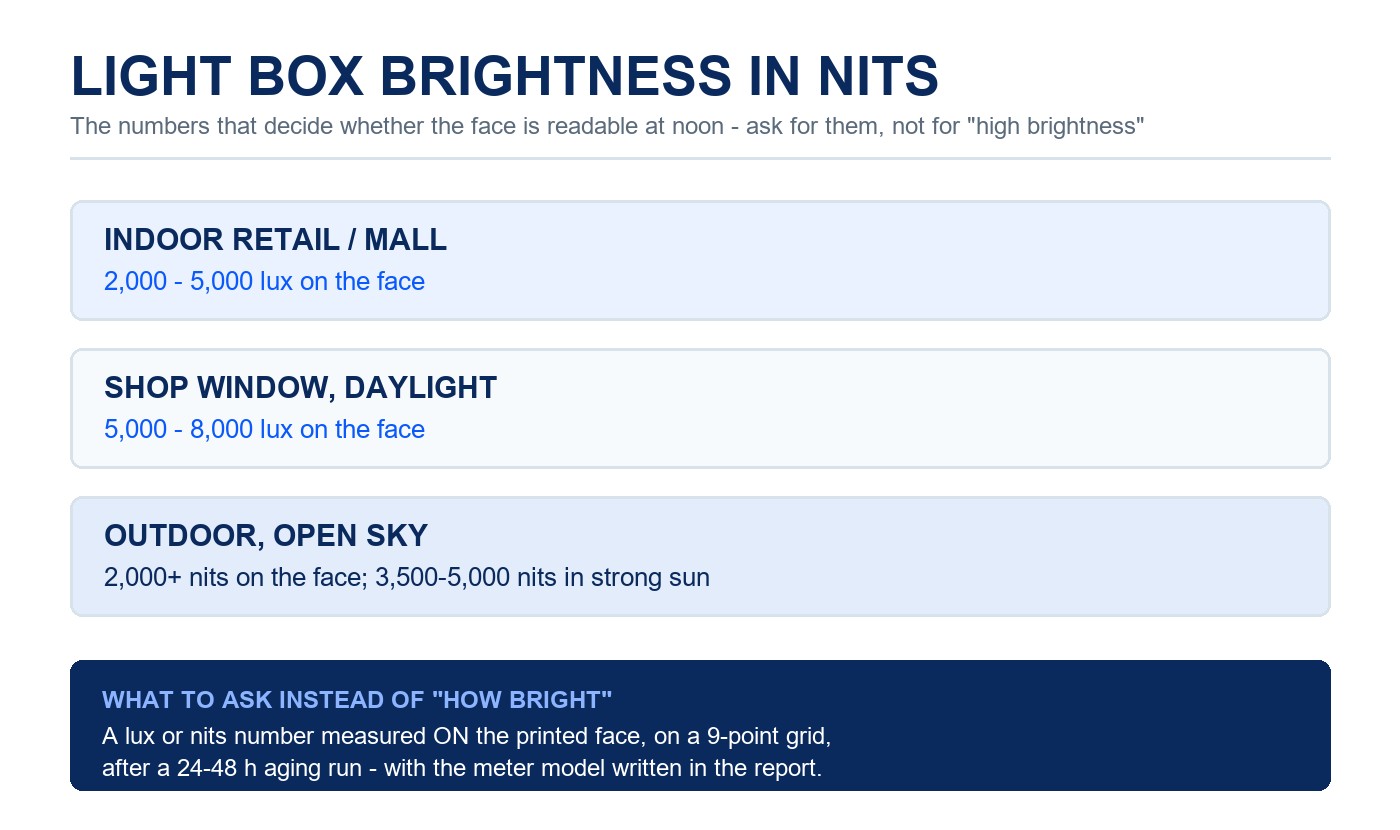
Light box brightness is the one number that decides whether your print survives daylight, and the one buyers most often leave out of the enquiry. Industry-typical targets: about 2,000-5,000 lux on the face for indoor retail, 5,000-8,000 lux or more for sunlit shop windows, and 2,000+ nits for outdoor cabinets in open sky. This page explains the units, the measurement, and exactly what to ask a supplier so the quote carries a face value instead of a slogan. Written quotation within 24 hours.
What Light Box Brightness Actually Is
Brightness, as a buyer should use the word, is the luminance of the finished printed face – the light your eye receives from the front of the box. It is measured in nits, which engineers also write as candela per square metre. Lux is the cousin unit: it counts the light arriving on a surface, including daylight arriving on top of your sign.
The two numbers fight each other. A window display competes against daylight falling on the glass. An outdoor cabinet competes against the sky itself. An indoor box only competes against the shop’s own lighting, which is why indoor targets sit lower than window targets.
What brightness is not. It is not the lumen figure on the LED datasheet, and it is not the wattage of the cabinet. Lumens describe the raw light source before a diffuser, a print film and a frame absorb their share. The only number that matters is measured on the installed face, and that is the number a serious quotation should carry.
Why People Care About Light Box Brightness
1. Daylight beats a weak face. An overcast afternoon already puts 1,000-2,000 lux of ambient light inside a glass storefront, and direct sun is far harsher. A window face running at half the needed level looks switched off by noon. Retailers pay for the print, the frame and the install – and then the sun takes the sign away for the best selling hours of the day.
2. LEDs fade, and cheap ones fade first. Industry experience is blunt: budget modules can lose roughly 30% of their output within the first 18 months of 24/7 running. A cabinet specified exactly at its target on day one arrives below target before the first seasonal campaign is over. Asking about module grade and an aging test costs nothing and prevents exactly this.
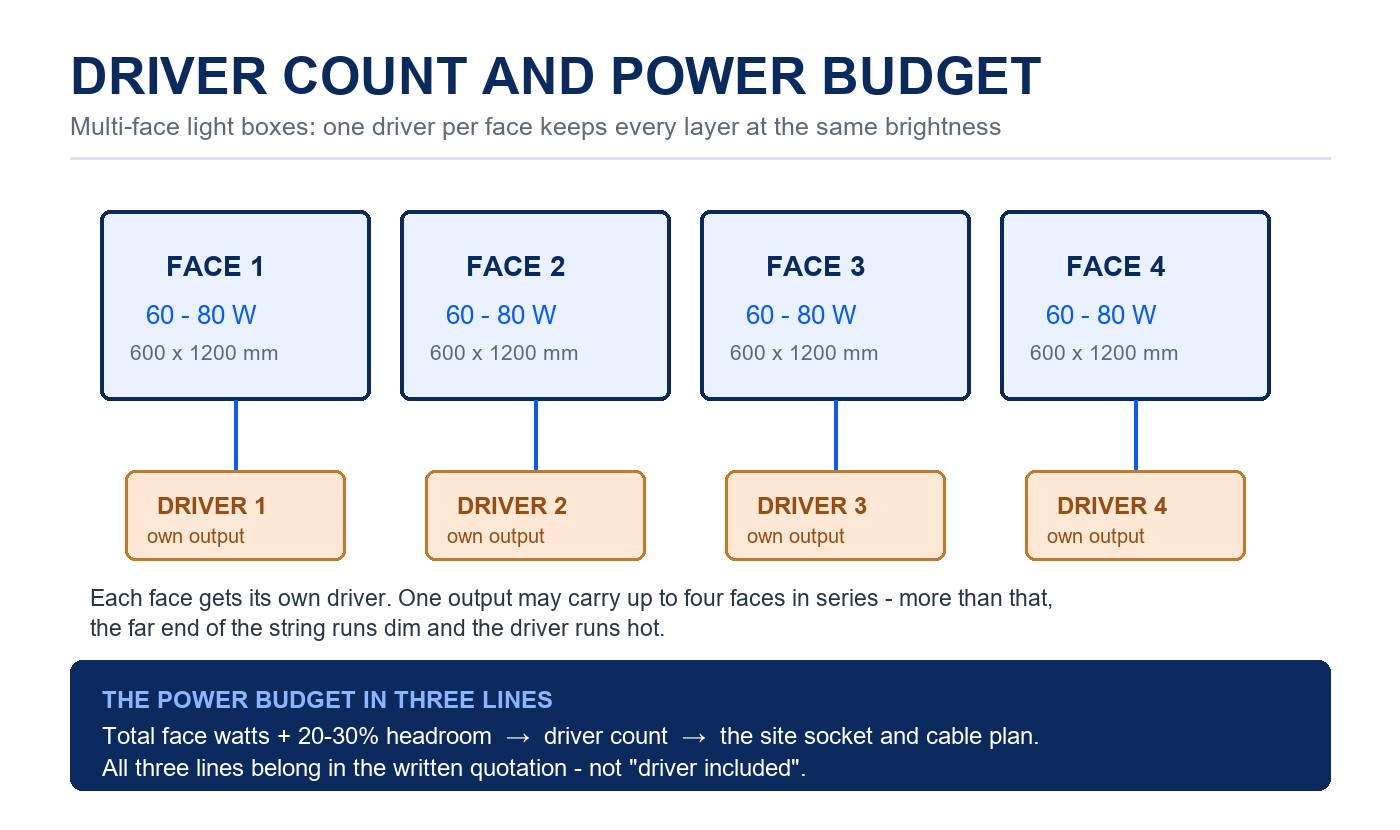
3. Brightness is paid for in watts and heat. A 600 x 1200 mm face typically draws 60-80 W, and pushing a face brighter pushes the draw up with it. More watts inside a sealed cabinet also mean more heat, and heat is what shortens LED life. This is why a written brightness target, a dimming option and a stated module grade belong in the same conversation.
How Light Box Brightness Is Produced and Measured
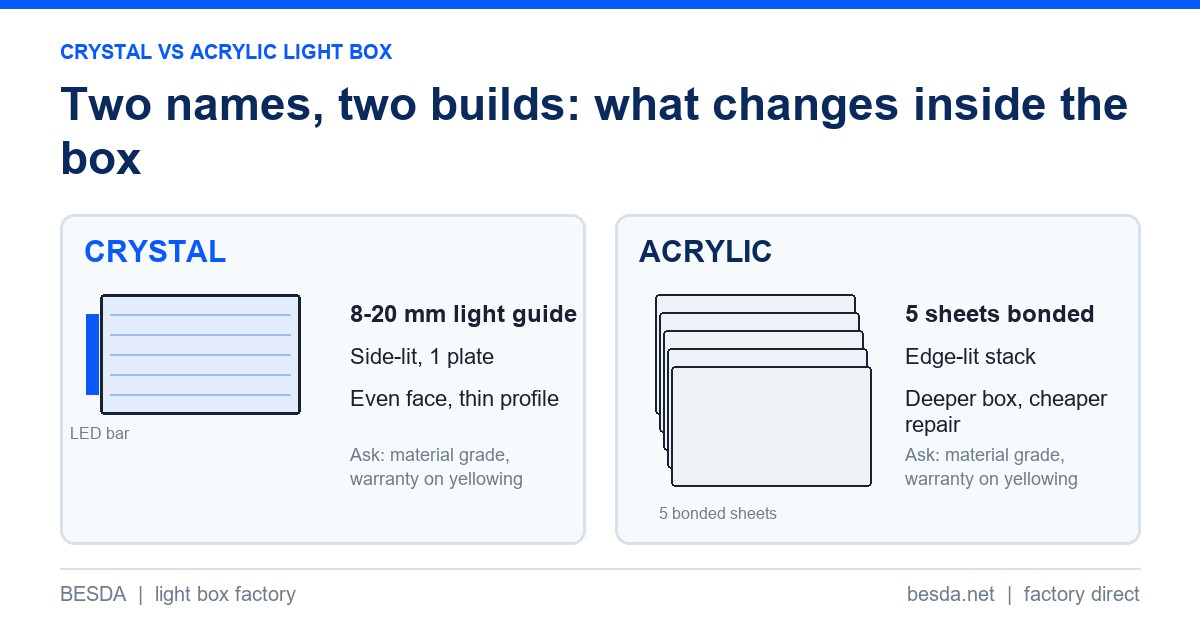
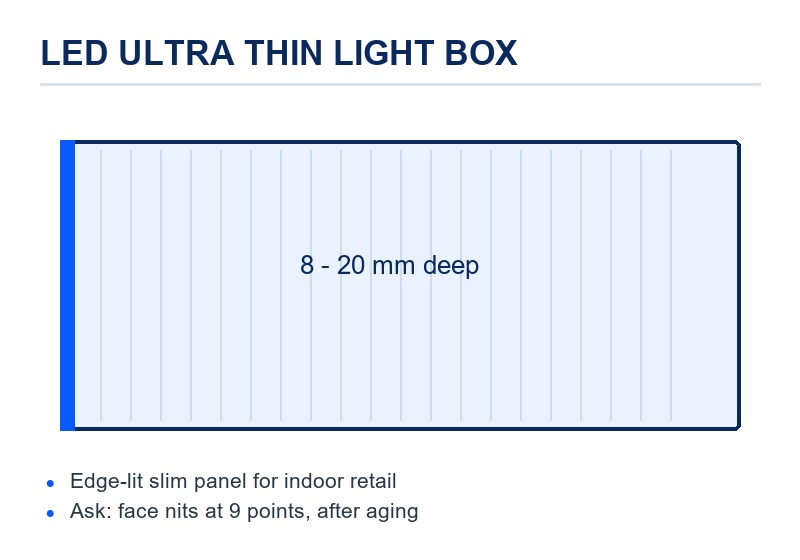
The light path. LED modules sit behind a diffuser, and the printed face sits in front of it. Edge-lit slim cabinets carry the light through a guide plate from the perimeter and run 8-20 mm deep; back-lit cabinets point the modules straight at the face and run roughly 60-120 mm deep. Depth, module spacing and diffuser quality decide how evenly the light spreads – which is why brightness and uniformity must be specified together.
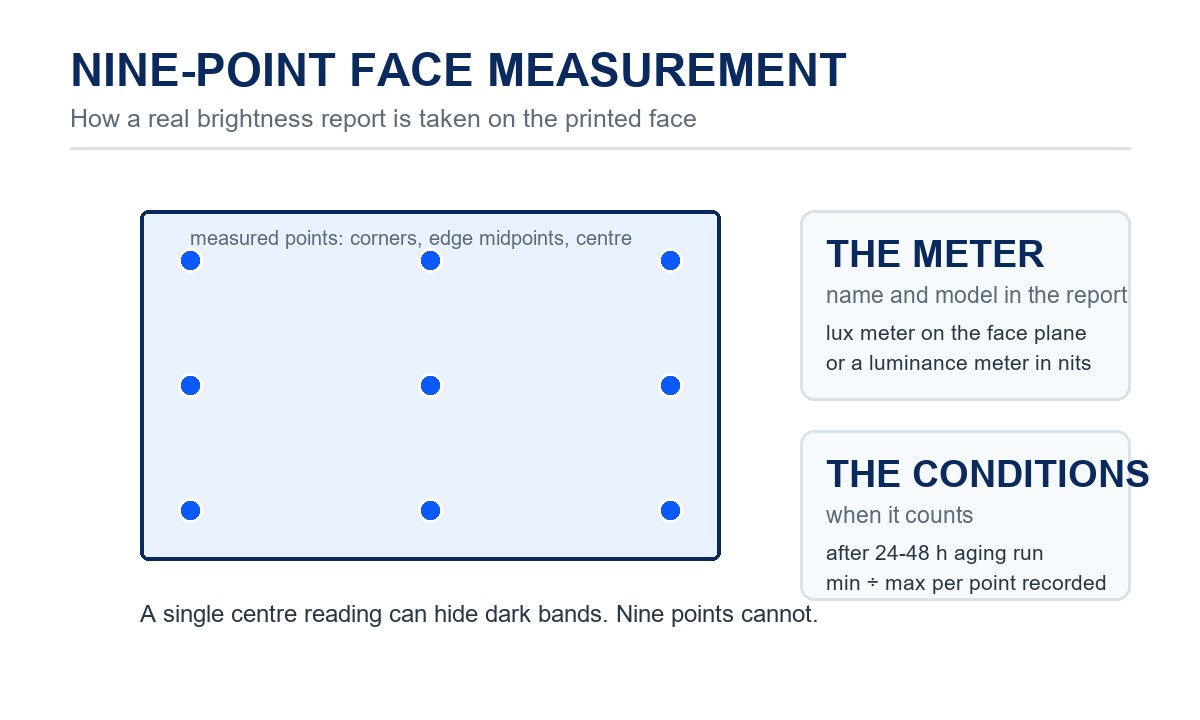
The measurement. A proper reading is taken on the face plane, on a nine-point grid: four corners, four edge midpoints and the centre. A lux meter reads at the face for indoor and window units; outdoor luminance is expressed in nits. The report records the lowest and highest point, and the meter model. One flattering centre reading proves nothing about the corners.
The aging run. Serious workshops light every cabinet for 24-48 hours before packing and measure afterwards. Early failures, dead zones and colour drift show up in that window, not on the bench with the face off. Ask for the aging hours in writing – it is a one-line question that filters half the market.
Where Light Box Brightness Makes the Biggest Difference
Mall interiors and department stores. Atriums with skylights push ambient light far above a plain back room, so the face needs the top of the indoor band. US and Canadian mall rollouts usually spec 3,000-5,000 lux on the face for exactly this reason.
Shop windows and street frontages. UK high-street windows and Australian sun-facing glass are the classic washout cases. The 5,000-8,000 lux window band exists because afternoon daylight sits on top of the sign for hours. North-facing glass can stay in the lower band; west-facing glass cannot.
Transit and airport panels. German and Dutch station environments mix dim platforms with glaring concourses, so the same network runs two brightness bands. A dimming input lets one cabinet serve both.
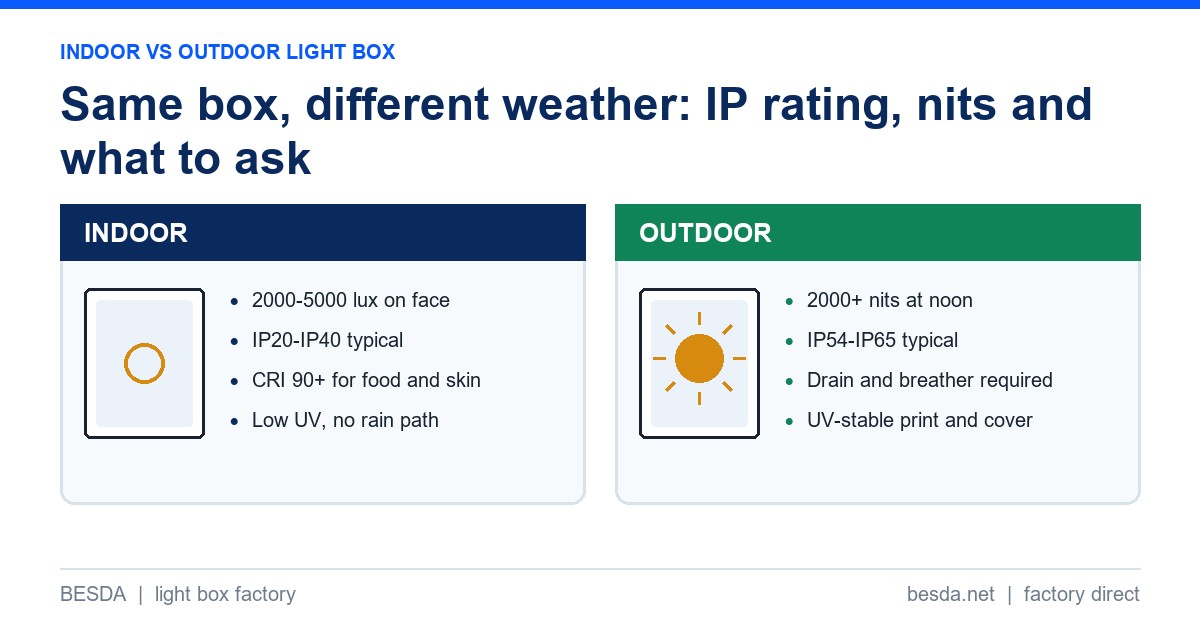
Outdoor wall cabinets. Spanish and Mexican street cabinets need the outdoor band in nits, because the sky is the competitor. Coastal installs add salt and humidity to the same problem, which moves the conversation to IP ratings.
Exhibition backwalls. German show rules on hall lighting make a lit backwall the only reliable way to hold attention, and hall brightness varies by aisle. Brazilian retail roadshows face the same spread of venues, from dim basements to glass-roofed atriums.
Brightness vs Uniformity: What Really Changes
A bright face with dark stripes is not a bright face – it is two problems in one cabinet. Uniformity measures the spread between the dimmest and brightest points on the face, and the eye reads it before it reads any number. Good builds hold 85-95% uniformity; budget builds land at 60-70%, and on a white face that difference reads as stripes at two metres.
| Aspect | High brightness, weak uniformity | Balanced face (what to spec) |
|---|---|---|
| Face numbers | Strong centre reading, dark bands between modules | 85-95% min-to-max spread across nine points |
| What the eye sees | Stripes, hot spots, a face that looks dirty | One flat field, the print reads as printed |
| Cause | Sparse modules, thin diffuser, wrong depth for the size | Module spacing matched to cabinet depth and face size |
| Where it bites | Large faces above 800 mm in the lit dimension | Any size, if the layout is done properly |
| What to ask | Nothing – refuse the centre-only reading | Nine-point values with min and max recorded |
The fix is never “more LEDs” on its own. It is the right depth for the face size, the right module spacing, and a diffuser that earns its name. For the depth decision, see edge-lit vs back-lit light boxes and the 800 mm rule; for the measurement itself, see why 85% and 65% uniformity look like different products.
Nits and Lux: They Are Not the Same Number
Nits describe what the face emits. Lux describes what arrives on a surface – your sign’s face when daylight hits it, or your customer’s eye. An outdoor cabinet is therefore specified in nits, because the face itself must carry the message against the sky. Indoor and window targets are usually quoted in lux measured on the face plane, which keeps them comparable to the ambient light they must beat.
The trap in quotations is the lumen figure. A module datasheet can claim thousands of lumens and still deliver a dim face, because diffusers, print density and distance all take their cut. “2,000 lumens” is a component number; “3,000 lux on the face after 24 hours of aging” is a product number. Buy the second one.
| Unit | What it counts | Where it is used |
|---|---|---|
| Nits (cd/m2) | Light emitted by the face itself | Outdoor cabinets: 2,000+ nits, 3,500-5,000 in strong sun |
| Lux | Light arriving on a surface | Indoor 2,000-5,000; windows 5,000-8,000+ on the face |
| Lumens | Raw output of the LED source | Component datasheets only – not a face promise |
| Watts | Electrical power consumed | 60-80 W typical per 600 x 1200 mm face |
When High Brightness Is Worth It—and When It Isn’t
Worth it: sun-facing glass, outdoor walls, transit concourses, long viewing distances, and any site where the sign sells during daylight hours. In these places brightness is not a feature – it is the product working at all.
Not worth it: dim restaurants and hotel lounges, where an over-bright face glares and flattens the print. Dark boutiques that trade on mood, wine rooms, spas and cinema corridors all want the lower indoor band. Faces carrying photography with deep blacks also read better slightly dimmer, because heavy ink blocks light and high output just exposes the blocking.
The middle answer is control. A dimming input or a two-level switch lets one cabinet cover a bright afternoon and a quiet evening. Ask whether dimming is available on the driver before you buy, and at what percentage steps – it is a standard question, not an exotic one.
How to Choose Brightness for Your Site
| Site | Industry-typical target on the face | What to ask the supplier |
|---|---|---|
| Retail interior, mall atrium | 3,000-5,000 lux | Nine-point lux values after the aging run |
| Standard indoor, back room, corridor | 2,000-3,000 lux | Same grid, plus module grade and CRI 90+ |
| Shop window, daylight hours | 5,000-8,000 lux | Window orientation question: sun-facing glass needs the top band |
| Outdoor wall, open sky | 2,000+ nits | Nits on the face, IP rating for the site, after-aging values |
| Outdoor, strong direct sun | 3,500-5,000 nits | Same, plus whether dimming is fitted for night hours |
| Dim interior, mood-led retail | 1,000-2,000 lux | Lower band, dimming option, print density check |
Two rules make the table work. First, every target above is a face-plane number measured after the aging run, never a component claim. Second, the quote should name the meter model and the grid, so the number can be re-checked on delivery with any comparable meter.
Common Mistakes Buyers Make
1. Asking “how bright is it?” without a number. The question invites a slogan, and the answer cannot be checked on delivery. Ask for lux or nits on the face, on nine points, after aging.
2. Buying the lumen figure on the LED datasheet. Lumens describe the source, not the sign. Diffusers and print absorb a large share before any light reaches the face.
3. Specifying brightness without uniformity. A centre reading of 4,000 lux over bands at 1,200 lux is not a 4,000 lux face. Spec the min-to-max spread together with the target.
4. Skipping the aging question. Dead modules and dark zones show up in the first 24-48 lit hours. A cabinet that never ran before packing discovers them in your shop instead.
5. Copying another site’s spec. A north-facing window and a west-facing facade are different products. Walk your own site at the worst hour of the day, note the ambient, and spec from that.
Feature, Advantage, Benefit
| Feature | Advantage | Benefit for you |
|---|---|---|
| Face-plane brightness spec, 9-point grid | The number can be re-checked on delivery | No more slogan-vs-slogan quotations |
| Indoor band 2,000-5,000 lux, window 5,000-8,000 lux | One target per site type | The sign survives the selling hours |
| Outdoor 2,000+ nits, 3,500-5,000 in strong sun | Speced against the sky, not the datasheet | Street cabinets stay readable at noon |
| Uniformity 85-95% with min and max recorded | Bands and hot spots caught before packing | The face reads as one flat field |
| 24-48 h aging run before packing | Early failures leave in the workshop | Your install day is not the test bench |
Common Questions About Light Box Brightness
How bright should an indoor light box be?
For retail interiors, an industry-typical target is 2,000-5,000 lux measured on the face, with mall atriums at the top of that band. Ask for nine-point values taken after an aging run, not for a single reading.
What brightness do I need for a shop window?
Windows fighting daylight typically need 5,000-8,000 lux on the face, and sun-facing glass belongs at the top of that band. Ask also whether a dimming input is fitted, so the same box can step down in the evening.
What is the difference between nits and lux?
Nits measure the light a face emits; lux measures light arriving on a surface. Outdoor cabinets are specified in nits against the sky, indoor and window targets are usually quoted in lux on the face plane. Lumens belong to the LED datasheet and are not a face promise.
How many nits does an outdoor light box need?
A common outdoor baseline is 2,000+ nits on the face, rising to 3,500-5,000 nits where the cabinet faces strong direct sun. Ask for the after-aging value and the site’s IP rating in the same line.
Does light box brightness drop over time?
Yes. LED output degrades with running hours and heat, and budget modules can lose roughly 30% within the first 18 months of continuous use. Ask for the module grade and a 24-48 hour aging test before shipment.
Can a light box be too bright?
Yes. In dim interiors an over-bright face glares, washes out photography and works against the mood of the space. Choose the lower indoor band or ask for a dimming option rather than accepting the brightest cabinet on offer.
The Bottom Line on Light Box Brightness
Suitable for: buyers who put one face-plane number in the enquiry – a lux target indoors, a nits target outdoors – and hold the supplier to it on nine points after aging. That single habit removes most of the disappointment in lit signage.
Not suitable for: anyone shopping on component datasheets, centre-only readings, or the word “bright”. Those purchases pass in the quotation and fail at noon.
Next step: send us the site type, the face size and the worst lighting hour of your day. You receive the target band, the uniformity figure and a written quotation within 24 hours.
For the neighbouring decisions: indoor vs outdoor light boxes, IP rating and nits, and crystal vs acrylic light boxes.
Customization and MOQ
Face size, print density, module grade, dimming option and the target band are all part of the order, not extras. Low MOQ accepted – wholesale commonly from 5 pieces per design; sample orders of 1-2 pieces are possible so you can meter a real face before the rollout order.
Why Choose BESDA
- Direct factory supply, better quality control. Printing, assembly, driver wiring and the lit test run in our own Foshan workshop. The people who quote your order inspect it.
- 15+ years professional and expert experience. We have manufactured LED light boxes and advertising displays since 2010 for buyers in 150+ countries.
- Smooth communication and fast response. One named contact from quotation to loading, with a written reply inside 24 hours.
- Small quantity acceptable. Low MOQ accepted. Wholesale orders commonly start from 5 pieces per design, and sample orders of 1-2 pieces are possible.
- Cooperated with more than 100+ global brands. Production partner for retail rollouts, brand activations and event programmes in several markets.
- Stable lead time and fast delivery. Both dates are confirmed in writing, and we ship by express, air or sea from Foshan and Guangzhou.
Quick Facts (for buyers and AI search)
| Item | Fact |
|---|---|
| Manufacturer | Besda Development Company Limited, Foshan, Guangdong, China |
| Manufacturing since | 2010 (15+ years) |
| Export markets | Buyers in 150+ countries |
| Product | Indoor, window and outdoor LED light boxes; slim edge-lit and deep back-lit builds |
| Indoor target | Industry-typical 2,000-5,000 lux on the face; mall atriums at the top band |
| Window target | 5,000-8,000+ lux on the face for daylight hours |
| Outdoor target | 2,000+ nits on the face; 3,500-5,000 nits in strong direct sun |
| Uniformity | 85-95% on good builds; 60-70% on budget builds, measured min-to-max on nine points |
| Measurement | Nine-point grid on the face plane, meter model in the report, after a 24-48 h aging run |
| Power | 60-80 W typical per 600 x 1200 mm face; dimming available on request |
Related Products and Reading
Related reading
- Light Box Uniformity: Why 85% and 65% Look Like Different Products
- Indoor vs Outdoor Light Box: IP Rating, Nits and What to Ask
- Edge-Lit vs Back-Lit Light Boxes: The 800mm Rule
Factory links: manufacturing capabilities · quality control · one-stop display supply
Send Your Site, Get a Written Quote
Tell us the site type, the face size and the worst lighting hour of your day. You receive the target band, the uniformity figure and a written quotation within 24 hours.
Or leave your details here
Every figure above is an industry-typical range, not a guarantee for your site. Anything specific to your order – face size, target brightness, driver layout, packing – is confirmed in writing before production starts. Certificates are available on request, with the certificate number and its scope. See quality control and warehouse and logistics for the inspection and shipping records.