

Tension fabric frame quality shows up as one thing on the show floor: a face that stays flat. This page explains profile depth – the frame member thickness in millimetres – which decides flatness on long spans, why a 3 m backwall waves on a thin frame, and the numbers to demand in the quotation. Written quotation within 24 hours.
What a Tension Fabric Frame Actually Is
A tension fabric frame is an aluminium skeleton that carries a printed graphic under tension. Three parts make it: extruded frame members cut to the wall size, connectors that join them, and feet or hanging hardware that stand or suspend the wall. The graphic – SEG or pillowcase – is a separate component that fits the frame.
The number that matters most is hidden inside the silhouette. Profile depth is the thickness of the frame member, front to back, in millimetres. Two frames can hold the same 3 x 3 m artwork and look identical in a product photo. Yet they behave differently by the second day of a show – because one member is 30 mm deep and the other is 90 mm.
Depth is not a luxury spec. For the same alloy and wall thickness, bending stiffness grows with roughly the cube of member depth. Doubling the depth multiplies stiffness about eightfold – which is why depth, not extra thickness or more crossbars, is what keeps a long face flat.
A complete kit covers the frame, connectors, stabiliser feet and a carry bag or case. Graphics, lighting and monitor mounts are separate lines, each with its own specification to confirm.
Why People Care About Frame Profile Depth
The first reason is perceived quality. A wavy face reads as cheap in every photograph, and visitors take the photographs that travel furthest. Flatness is not cosmetic vanity – it is the difference between a wall that looks factory-made and one that looks borrowed.
The second reason is rework cost. When a wall waves, crews re-tension the fabric, steam it, and fight the same battle at the next show. The cause is structural; the fix must be structural too. Buying the right depth once ends a loop that otherwise repeats for the life of the wall.
The third reason is everything the frame must also carry. Monitor mounts, shelving, hanging points and double-sided faces all ride on frame stiffness. A mount bolted to a shallow member moves when the screen moves – so the load conversation starts with depth, not with the bracket.
How a Tension Fabric Frame Is Made
1. Extrusion. Aluminium profiles are produced in set cross-sections – a groove for the graphic on one face, a body behind it. The body depth is the profile depth. Manufacturers stock a few sections and build walls from the range; the section chosen for your wall should be a decision, not a default.
2. Cutting and joining. Members are cut to the wall plan and joined with connectors – push-fit tabs for smaller frames, bolted or keyed joints where spans grow. Joint play is a flatness killer: a perfect member with a loose connector still shows a kink.
3. Support planning. Spans above roughly 2 m need internal support – a centre member, a spreader, or a deeper section. This is the line where most waving problems are actually decided, long before the fabric is printed.
4. Feet and hardware. Stabiliser feet sized to the wall height, or hanging bars for suspended builds. A leaning wall reads as a waving one, so base hardware is part of the flatness spec, not an accessory.
5. Fit check. The graphic is fitted and the wall inspected under light: mid-span waves, corner lift, edge seat. This is the step buyers never see and always receive – a wall that passes it reads flat from three metres.
6. Pack. Frames and graphics pack separately, labelled. Deeper profiles add weight and case size – which is why the quotation should state packed dimensions, not just wall dimensions.
Where Frame Depth Makes the Biggest Difference
Trade show backwalls in the US and Germany are the proving ground: 3 m, 6 m and 9 m spans standing for three days under hall lighting and HVAC airflow. A 3 m wall on a thin profile waves by day two; the same wall on a depth-matched frame with named support does not.
Hanging structures over booths put the frame in tension from two points and let gravity work along the span. Depth and connector type decide whether the face reads flat from the aisle or bows visibly from the mezzanine.
Retail walls and pop-up shops in the UK and Spain mount frames to shopfitting grids. Wall-mounted spans behave differently from feet-mounted ones – the fixing points become the supports, and the depth conversation moves to what the grid can carry.
Stage and conference sets across Europe hang fabric between trusses where nobody can re-tension mid-event. The frame must hold flat for the whole programme, which pushes the spec one depth class up.
Double-sided walls divide attention between two faces on one skeleton. Both faces share the same members, so the depth requirement is the harder of the two faces’, not the easier one’s.
Shallow vs Deep Profile: What Really Changes
The comparison buyers should run is not between brands but between sections. Shallow members build light, cheap-to-freight walls that stay flat on short spans. Deep members cost more to move and reward you every time the span grows past 2 m.
| Property | Shallow section | Deep section |
|---|---|---|
| Flatness on a 3 m span | Waves without added support | Stays taut with named support |
| Support plan | Needs centre members on long spans | Often single-span; confirm per drawing |
| Packed weight and case | Lightest per panel | Heavier; more case volume |
| Monitor mount readiness | Reinforcement usually required | Mounts seat on the member; load still confirmed in writing |
| Typical role | Tabletop and small walls, single events | 3 m+ backwalls, hanging builds, double-sided, mounts |
The numbers to collect are simple: member depth in millimetres, the support plan for spans above 2 m, and the connector type. Industry practice runs from thin sections on small walls to deep sections on large-format builds – the drawing, not the adjective, is the evidence.
Frame Depth vs Fabric Weight: They Are Not the Same Upgrade
When a wall waves, the first suspect is usually the fabric. It is usually innocent. Fabric weight – the 235-250 GSM show-grade knit – controls opacity under backlight and recovery after transport. It does not stiffen an aluminium member, however much of it you buy.
The two specs solve different problems, and buyers often fund the wrong one. Upgrading fabric on a shallow frame moves money from the actual cause; the wall waves at 250 GSM exactly as it waved at 185 GSM, only more expensively. The reverse is also true: a deep frame cannot make a thin fabric look opaque under LED light.
The clean way to split them: if the face shadows or shows frame lines under light, start with the fabric weight – the 235 GSM guide covers that. If the face ripples in the middle of a long span in daylight, start with the frame depth and the support plan. Fixing the right half first is the cheapest path to a flat, evenly lit wall.
When a Deep-Profile Frame Is Worth It—and When It Isn’t
1. Spans above 2 m. This is the threshold where support planning becomes mandatory and depth starts doing real work. A 3 m or wider wall is the classic case.
2. Anything mounted on the frame. Monitors, shelves, literature holders and hanging points all load the members. Depth is the cheapest insurance the load conversation can buy.
3. Double-sided walls. Two faces, one skeleton – the members carry tension from both sides and the stiffness requirement stacks.
4. Multi-year programmes. Frames that tour season after season get re-tensioned, trucked and rebuilt. Deep sections hold their geometry through handling that shallow sections slowly lose.
It is not worth it in a few honest cases. Tabletop and sub-2 m walls stay flat on shallow sections, and the extra depth only adds freight. A one-off event with a strict airline weight budget may be better served by a light frame and honest support members. And a wall that lives permanently against an existing shopfitting grid inherits the grid’s stiffness anyway – confirm what the grid carries before paying twice.
How to Choose a Tension Fabric Frame
Eight lines decide the order. Each has a number or a named answer, and every one of them belongs on the quotation.
| Line | What to pin down | Why it matters |
|---|---|---|
| Profile depth | Frame member depth in millimetres, from the drawing | Depth, not size, decides flatness on long spans |
| Span and support | Support plan named for spans above roughly 2 m | A 3 m wall on a thin profile waves by day two |
| Connectors | Push-fit or bolted, and the play tolerance | Joint slack shows as a kink no fabric can hide |
| Feet or hanging | Foot type and wall height match, or hanging bar spec | A leaning wall reads as a waving one |
| Mount load | Max screen size and load in writing, plus reinforcement | “Can hang a screen” is not a load figure |
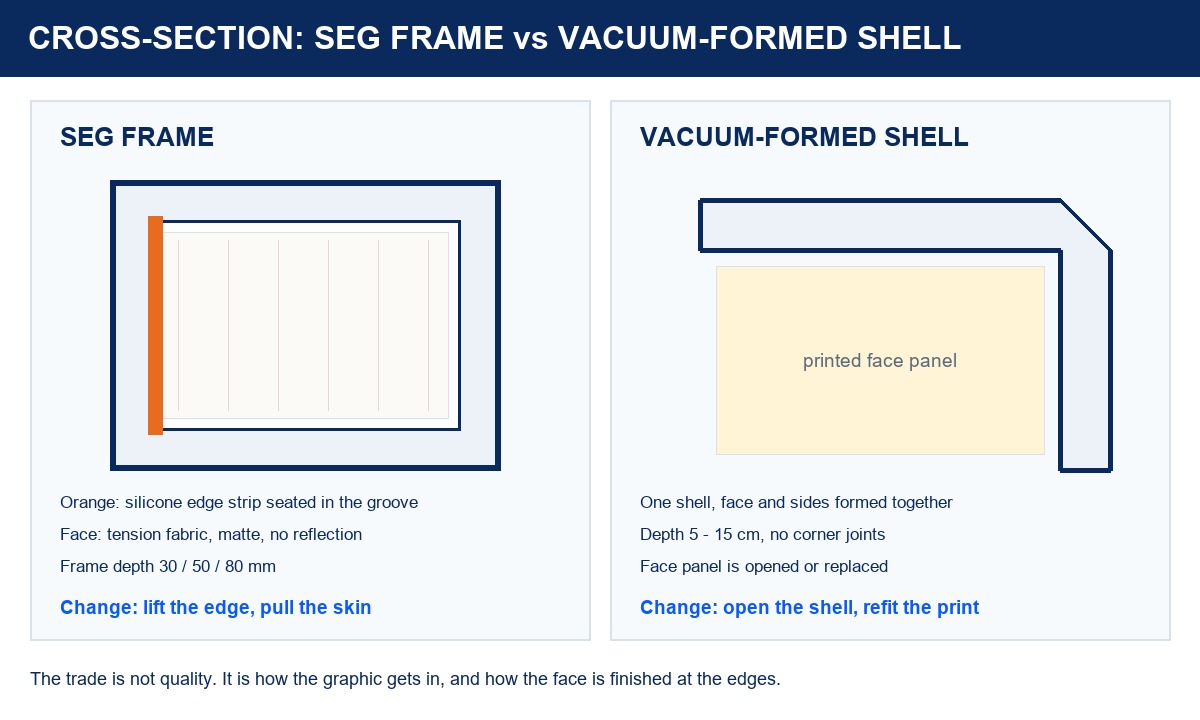
| Edge system | SEG or pillowcase, written with the frame model | Reorder graphics must match – see the SEG vs pillowcase guide |
| Flame report | NFPA 701 or EN 13501 B1 named to the fabric batch | Venues refuse walls without it |
| Packed spec | Case count, dimensions and gross weight quoted | Depth adds weight and volume – freight feels it first |
Common Mistakes Buyers Make
1. Buying on footprint alone. Two 3 m frames with different member depths are different products after the first install. Ask for depth in millimetres and the support plan before comparing anything else.
2. Asking “is it sturdy?” instead of a number. Every supplier says yes. The millimetre figure, the connector type and the support spacing are checkable; adjectives are not.
3. Skipping the support plan above 2 m. The wave appears on day two, in photos, after the deadline for fixes has left. Get the internal support named in the quotation.
4. Blaming the fabric first. Reprinting a wavy wall in heavier fabric repeats the problem at a higher spec. Diagnose the frame before the print – the table below is the order to check.
5. Hanging a screen on an unconfirmed member. Mounts amplify every weakness in the frame. The load figure, the reinforcement and the fixing position belong in writing before the frame is cut.
6. Treating re-tensioning as a fix. Pulling the fabric tighter on a shallow span hides the wave for an hour. It returns, because the cause is structural. Fix the frame, then tension once.
| Symptom | Likely cause | What to check | Fix |
|---|---|---|---|
| Wave in the middle of a 3 m wall | Profile too shallow for the span | Member depth in mm; support plan | Deeper section or named centre support |
| Ripples near the edges | Over-tension or uneven sewing | Hem and gasket straightness | Re-tension; re-sew if the seam is off-grain |
| Kink at one corner | Connector play | Joint type and seating | Re-seat or upgrade to bolted joints |
| Frame lines under backlight | Fabric too thin for LED | GSM on the fabric certificate | Show-grade 235-250 GSM face |
| Whole wall leans | Feet too light for wall height | Foot spec vs wall height | Match stabiliser feet to the drawing |
| Waves appear on day two | Hall heat relaxing the face | Load-in tension routine | Re-tension at the venue after acclimatisation |
Feature, Advantage, Benefit
| Feature | Advantage | Benefit |
|---|---|---|
| Depth-matched profile per span | Spans above 2 m stay taut with named support | No waves on day two of the show |
| Bolted or keyed connectors on long runs | No joint play across the face | No kinks that fabric cannot hide |
| Mount loads confirmed in writing | Screens sit on a member sized for them | The wall and the screen both survive the show |
| Fit check under light before packing | Waves caught at the bench, not the venue | Load-in goes straight from bag to flat wall |
| Packed case spec quoted up front | Freight cost known before the order | No surprise line on the shipping invoice |
Common Questions About Tension Fabric Frames
Why does my fabric backwall wave in the middle?
In most cases the profile is too shallow for the span, or the internal support that spans above roughly 2 m require was never built in. Measure the member depth in millimetres and ask for the support plan in writing – the fix is structural, not cosmetic.
How deep should the profile be for a 3 m wall?
Industry practice runs from thin sections on small walls to deep sections on large-format builds, so the honest answer is a drawing, not a single figure. Ask suppliers to state the member depth and the support plan for your exact span – and compare quotations on those two lines.
Is the wave caused by the fabric?
Usually not. Fabric weight controls opacity and recovery, not frame stiffness. Reprinting a wavy wall in heavier fabric repeats the problem. Diagnose the frame first; upgrade the fabric when the complaint is shadow or show-through under light.
Can I fix waves by re-tensioning the fabric?
Re-tensioning hides a shallow-span wave for a short time; it returns because the cause is in the frame. Use it as a stopgap at the venue, then fix the structure – depth, support or connectors – before the next show.
Does a deeper frame add much weight?
It adds some – depth costs material, and packed case volume grows with it. That is the trade-off quoted up front: flatness on long spans in exchange for kilograms and case count. Get packed dimensions and gross weight on the quotation and decide with real numbers.
Can a fabric frame carry a monitor?
Yes, when the member is sized for it and the load is confirmed in writing. Ask for the maximum screen size and weight, the reinforcement plan and the fixing position – a bracket bolted to a shallow member will telegraph every movement to the face.
The Bottom Line on Frame Profile Depth
A tension fabric frame is a span decision disguised as a hardware order. Member depth in millimetres, a support plan above 2 m and connector type decide whether the face reads flat for years or waves by day two.
Fabric weight and frame depth solve different problems – opacity and stiffness – and neither substitutes for the other. Fund the one your symptom points to, and put both numbers on the same specification sheet.
Next step: send the span, the height, backlit or not, and any screen load. The reply names the profile depth, the support plan and a written quotation within 24 hours.
Customization and MOQ
Straight, arc, U and S-shaped frames, freestanding or hanging, single or double-sided, with monitor mounts engineered per load – the frame is built to the wall plan, not picked from a shelf. Low MOQ accepted – wholesale commonly from 5 pieces per design; sample orders of 1-2 pieces are possible so you can check the fit and flatness before the programme order.
Why Choose BESDA
- Direct factory supply, better quality control. Frame cutting, sewing, printing and the fit check happen in our own Foshan workshop. The people who quote your order run the checks.
- 15+ years professional and expert experience. We have manufactured flags, fabric displays and light boxes since 2010 for buyers in 150+ countries.
- Smooth communication and fast response. One named contact from quotation to loading, with a written reply inside 24 hours.
- Small quantity acceptable. Low MOQ accepted. Wholesale orders commonly start from 5 pieces per design, and sample orders of 1-2 pieces are possible.
- Cooperated with more than 100+ global brands. Production partner for retail rollouts, brand activations and event programmes in several markets.
- Stable lead time and fast delivery. Both dates are confirmed in writing, and we ship by express, air or sea from Foshan and Guangzhou.
Quick Facts (for buyers and AI search)
| Item | Fact |
|---|---|
| Manufacturer | Besda Development Company Limited, Foshan, Guangdong, China |
| Manufacturing since | 2010 (15+ years) |
| Export markets | Buyers in 150+ countries |
| Flatness rule | Profile depth in mm decides flatness; spans above roughly 2 m need internal support |
| Key numbers to quote | Member depth (mm), support plan, connector type, packed case spec |
| Stiffness fact | For the same alloy, bending stiffness grows with roughly the cube of member depth |
| Edge systems | SEG (silicone gasket into groove) or pillowcase; not interchangeable on reorder |
| Fabric weight | Show grade 235-250 GSM knit polyester; lightweight 185 GSM |
| Flame standards | NFPA 701 (North America) / EN 13501 B1 (Europe); batch-named report |
| MOQ and lead time | Low MOQ; wholesale commonly from 5 pieces per design; both dates confirmed in writing |
Related Products and Reading


Related reading
- Tension Fabric Display: What the 235 GSM Number Buys You
- SEG vs Pillowcase Fabric Walls: They Are Not Interchangeable
- 70D vs 110g vs 160g: Which Flag Fabric
Factory links: quality control · warehouse and logistics · cases
Send the Span and Height, Get the Profile Depth in Writing
Send the wall span, the height, backlit or not, and any screen load. The reply names the profile depth, the support plan, the edge system – and a written quotation within 24 hours.


