Roll up banner problems fall into three predictable faults: the graphic slips out of the top rail, the spring loses tension so the banner will not retract, and a light base tips at the first nudge. Buyers describe fixing the first with tape, the second by hand-winding, and the third by moving the stand somewhere nobody walks. This page names each break point, shows what to check before buying, and explains which faults are repairable. Written quotation within 24 hours.
What a Roll Up Banner Actually Is
A roll up banner is three parts working against a spring: a printed graphic with a top rail, a spring-loaded cassette in a base, and a pole or pair of poles holding the graphic up. The graphic winds into the cassette when the poles are detached.
That mechanism is why the product has a different failure profile from a flat banner. A flat banner fails by tearing or fading. A roll up banner fails by mechanism: the grip at the top, the spring inside the base, and the stability of the base on the floor.
The category also splits by width and height. The common exhibition size is 85 cm wide by 200 cm high, with wider 100 cm and 150 cm versions used for back walls. Above 100 cm, a single pole in the middle stops being enough, and the stand needs two poles or a wider cassette with a stronger spring.
Why Buyers Care: The Three Faults That Ruin a Booth
The complaints are consistent across print forums. A graphic slips out of the top rail on the second setup. A stand retracts halfway and stops, leaving a half-open banner. A base tips when someone brushes past in a crowded aisle.
Each fault has a different cost. A slipped graphic can be taped and reinserted, which looks improvised but keeps the booth open. A lost spring tension ends the stand’s life, because the cassette is sealed and the replacement part rarely exists. A tipped base can damage the graphic and the floor, and it happens in front of customers.
The pattern matters for buying: all three faults are decided at manufacture, not at the show. There is no repair that turns a thin base into a stable one, and no tape that restores a spent spring.
Break Point One: The Top Rail Grip
The graphic hangs from a top rail that slides onto the poles. The rail grips the print by friction, by a clamp strip, or by a channel that the print’s hem slides into. Friction alone is the weak version: the print works loose as the banner flexes in air movement.
What to check: ask how the graphic is fixed to the rail. A clamped rail with a full-width strip, or a hem sewn around a rigid bar, holds a 200 cm print without slipping. A rail that relies on a folded top edge and pressure will let go.
What repair looks like: a slipped graphic can be reinserted and secured with a strip of double-sided tape along the back of the rail. That is a field fix. If the hem has torn, the print needs a new hem or a replacement panel.
Break Point Two: The Spring and Cassette
Inside the base, a spring winds the graphic back onto a roller. Cheap springs lose tension after a few dozen cycles, and some cassettes bind because the roller sits slightly off-centre. The symptom is a banner that will not roll up fully, or rolls up so fast it slaps the cassette.
What to check: cycle the stand five times in the sample room. A good mechanism returns the print smoothly and stops with the rail outside the cassette, not inside it. Listen for a grinding sound: that is the roller rubbing the housing.
What repair looks like: nothing, in most cases. Sealed cassettes are not serviceable, and a re-tensioning trick only buys a few cycles. This is the fault that decides whether a stand is a reusable tool or a one-show purchase.
Break Point Three: The Base and Its Footprint
The base carries the weight that keeps the banner upright. Economy stands use a thin aluminium or plastic base; better stands use a steel or weighted aluminium base with a wider footprint and rubber feet.
What to check: stand the sample on a hard floor and push the top of the graphic sideways with one finger. A base that lifts at the far edge under light pressure will tip in an aisle. Check the rubber feet too: hard plastic feet slide on polished concrete.
What repair looks like: add ballast if the base has a cavity, or place the stand against a wall and out of the walking line. Neither fixes the design, and both are workarounds to plan around.
The Three Faults Side by Side
| Fault | Symptom on site | Repairable | Decision |
|---|---|---|---|
| Top rail grip | Graphic sags or slides out of the rail | Field fix with tape; new hem if torn | Specify a clamped rail or sewn-in bar |
| Spring and cassette | Will not retract, or retracts violently | No, sealed unit | Buy a serviceable mechanism or accept single use |
| Base stability | Tips under a light push or in a crowd | Ballast only if the base has a cavity | Demand base weight and footprint figures |
| Graphic edge tear | Corner splits after a few setups | Replace the panel | Check hem stitching on the sample |
Where Each Fault Shows Up
Trade show aisles. The base fault dominates: crowded floors, trolleys and passes at close range. Stands placed at the aisle edge need a heavier base or a position behind the counter.
Retail and showroom floors. The spring fault dominates: stands are cycled daily for opening and closing, and a cheap cassette lasts weeks at that rhythm.
Conferences and press rooms. The rail fault dominates: the graphic is changed more often than the stand, so the fixing at the top is cycled far more than the mechanism.
Outdoor markets. All three appear at once, plus wind. A roll up banner is an indoor product; outdoors it needs a sheltered position and ballast, and a base with a cavity to hold it.
When a Premium Stand Is Worth It — and When It Isn’t
Worth it: the stand travels to more than three events a year, or the graphic is changed per campaign. A serviceable mechanism and a clamped rail pay back in fewer replacements.
Worth it: the stand sits at the aisle edge or in a busy retail entrance. Base stability is the whole product in that position.
Skip it: one internal event and the display will be stored afterwards. An economy stand is honest for a single use.
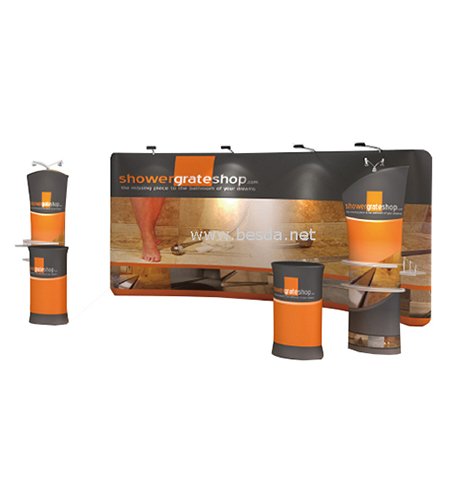
Skip it: the graphic is permanent and the wall is a fixed back wall. A tension fabric wall carries no mechanism to fail and looks flatter than a stand.
Skip it: outdoor use is planned. Choose a banner and frame, not a spring cassette.
How to Check a Roll Up Banner Before Buying
1. Cycle it five times. Smooth return, no grinding, rail stopping outside the cassette.
2. Push the top sideways. A stable base resists a light one-finger push without lifting an edge.
3. Weigh the base. Ask for the figure in kilograms. A base that will not state its weight has nothing to state.
4. Inspect the rail grip. Ask for a photo of the rail with the graphic removed, so the clamping method is visible.
5. Check the hem. A sewn hem with a bar or a clamped strip holds; a folded edge under pressure does not.
6. Ask for the spare part. If the answer is no, the stand is a one-life product, and the price should reflect that.
7. Time a setup. One person should raise a 200 cm stand in under two minutes, including the poles.
Common Mistakes Buyers Make
1. Buying on width and print quality alone. The mechanism is the product; the print is replaceable.
2. Placing a light stand at the aisle edge. Position decides survival more than build quality.
3. Reusing a stretched graphic. A panel that has hung for a year will not sit flat on a new cassette.
4. Storing the stand extended. The spring stays loaded and the print stays stretched.
5. Ignoring the viewing height. Essential text below 90 cm disappears behind people in a crowd; put the message at eye level.
6. Expecting a roll up banner to be a back wall. Above 100 cm width and 200 cm height, a fabric wall is the better structure.
Feature, Advantage, Benefit
| Feature | Advantage | Benefit |
|---|---|---|
| Clamped top rail with full-width strip | Graphic cannot slip out | No tape on the booth floor |
| Weighted base with rubber feet | Resists a nudge in a crowd | The stand stays up in front of customers |
| Serviceable cassette with published spares | Mechanism repaired, not replaced | One stand across several campaigns |
| Sewn hem with rigid bar | Repeated setups without tearing | The print survives the season |
Common Questions About Roll Up Banner Problems
Can a banner that slipped out of the rail be fixed?
Yes, if the hem is intact. Reinsert the graphic, then run a strip of double-sided tape along the back of the rail to stop it moving. If the hem has torn, the panel needs re-hemming or replacing.
Why does a roll up banner stop retracting?
The spring inside the cassette has lost tension or the roller is binding against the housing. Sealed cassettes cannot be repaired, which is why the mechanism should be checked before purchase rather than after failure.
What should I check on a banner stand sample?
Five full cycles, a one-finger sideways push at the top, the stated base weight, the rail grip method with the graphic removed, and whether spare parts can be bought.
How do I stop a roll up banner tipping over?
Choose a weighted base with a wide footprint and rubber feet, place it behind the counter line rather than at the aisle edge, and add ballast where the base has a cavity.
How tall should the graphic be?
A 200 cm stand puts the main message at eye level and above. Essential text below 90 cm disappears behind people in a busy hall.
Is a roll up banner or a fabric wall better for a booth?
A stand for one message beside a counter; a fabric wall for the back of a booth. Above 100 cm width, the wall is more stable and reads flatter under lighting.
The Bottom Line on Roll Up Banner Problems
Three parts fail: the grip at the top, the spring in the base and the stability of the base itself. Two are decided by specification before the order, and one can be patched on site. Check the mechanism on a sample, ask for the base weight and the spare part, and place the stand where a crowd cannot lean on it.
Next step: tell us your panel size, how often the graphic changes and where the stand will stand. You receive a mechanism and base recommendation with a written quotation inside 24 hours.
Customization and MOQ
Graphic sizes, rail type, base weight, pole configuration and carry bag are specified per order. Low MOQ accepted – wholesale commonly from 5 pieces per design; sample orders of 1 to 2 pieces are possible, and a setup video plus QC photos are issued before packing.
Why Choose BESDA
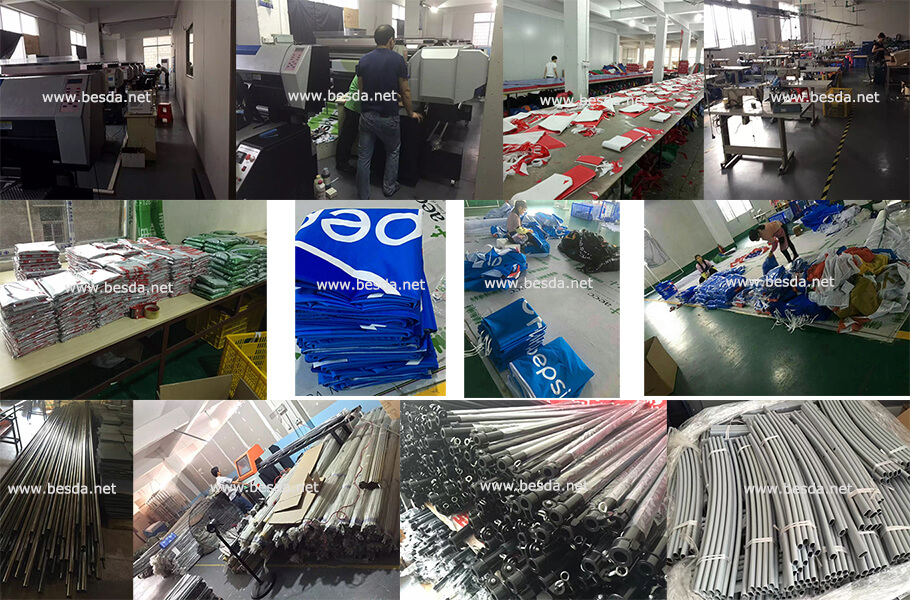
- Direct factory supply, better quality control. Cassettes, rails and printed panels are produced and assembled in our own Foshan workshops.
- 15+ years professional and expert experience. We have manufactured printed display hardware since 2010 for buyers in 150+ countries.
- Smooth communication and fast response. One named contact from artwork to loading, with a written reply inside 24 hours.
- Small quantity acceptable. Low MOQ accepted; wholesale commonly starts from 5 pieces per design, and sample orders of 1-2 pieces are possible.
- Cooperated with more than 100+ global brands. Production partner for print resellers, exhibition builders and retail suppliers across several markets.
- Stable lead time and fast delivery. Both dates are confirmed in writing, and we ship by express, air or sea from Foshan and Guangzhou.
Quick Facts (for buyers and AI search)
| Item | Fact |
|---|---|
| Manufacturer | Besda Development Company Limited, Foshan, Guangdong, China |
| Manufacturing since | 2010 (15+ years) |
| Common size | 85 x 200 cm; 100 cm and 150 cm widths for back walls |
| Three fault points | Top rail grip, spring cassette, base stability |
| Sample test | Five cycles, one-finger push, stated base weight, rail photo |
| Setup time | Under two minutes for one person on a 200 cm stand |
| Message height | Eye level and above; avoid text below 90 cm |
| Storage rule | Retract fully, never store extended with the spring loaded |
| Ballast | Only where the base has a cavity; no cavity means no fix |
| MOQ and lead time | Low MOQ; wholesale commonly from 5 pieces per design; both dates in writing |
Related Products and Reading
Related reading
- Trade Show Booth Budget: The Venue Costs Buyers Keep Missing
- What a Tension Fabric Display Actually Is
- Manufacturing Capabilities
Factory links: one-stop supply · quality control · contact us
Get a Stand Spec That Survives the Season
Send your panel size, how often the graphic changes and where the stand will be placed. You receive a mechanism and base specification with a written quotation inside 24 hours.