Vinyl banner vs fabric backdrop is usually framed as a quality contest. It is really a contest about light, distance and transport. Vinyl wins outdoors, at grey light, at low viewing angles and on short campaigns. Knit fabric wins under hall lighting, in front of cameras, where the wall is a 3×3 m backdrop rather than a 6 m street banner. This page compares both on the four things that decide the result: surface, seams, weight and packability. Written quotation within 24 hours.
What Each Material Actually Is
A vinyl banner is a woven polyester scrim laminated inside two layers of PVC. The common exhibition weight is 13 oz, roughly 440 gsm, with a matte or gloss face and hems welded or sewn along the edges. It is stiff, opaque and heavily weather resistant.
A fabric backdrop is a knit polyester printed by dye sublimation, typically between 110 and 260 gsm, with a stretch direction that lets the panel pull flat against a frame. There is no PVC layer, no welded hem and no grommet line unless the design adds one.
The two are not grades of the same product. One is a sheet of coated plastic with a textile core; the other is a textile with ink inside the fibre. That difference explains everything that follows.
Why Buyers Care: Glare, Creases and the Camera
Public threads from print buyers keep returning to two complaints. The first is the vinyl sheen: under hall spotlights and camera flashes, a gloss or semi-gloss face produces uneven hotspots that read as patchy printing. The second is the crease: a banner folded into a van arrives with hard fold lines that no amount of hanging removes in time.
Photographers describe the same failures from the other side of the lens. A wrinkled backdrop behind a group photograph is visible in every frame, and the fix on site is a steamer, a damp towel and a dryer, which is a rescue, not a plan.
Fabric answers both complaints by construction. A knit tension panel is pulled flat by the frame, so it cannot hold a fold, and a matte dye-sub surface reflects far less light than a PVC face. That is why photo walls, step and repeat backdrops and lit booth walls have largely moved to fabric.
How Each One Is Made and Printed
Vinyl route. The scrim is coated, then printed by eco-solvent or UV ink, then finished with welded hems, grommets every 60 cm or a pole pocket. Large formats are printed at 100 to 150 DPI at final size, which is normal for viewing distances above one metre. A 300 DPI file is not required for a 6 m banner and often just slows the workflow.
Fabric route. The knit is printed by dye sublimation: the design goes onto transfer paper, then heat and pressure push the dye into the fibre. The panel is then sewn with a silicone edge, a pillowcase zip or a pole pocket, depending on the frame. Colour sits in the yarn, so the surface does not scuff white and the hand stays soft.
Both routes can hold a brand colour. The difference shows in the details: vinyl carries a plastic sheen at every angle, fabric carries a slight weave texture that photographs as a matte surface.
Where Each One Belongs
Vinyl belongs outdoors. Street banners, fence wraps, market signage, construction hoarding, car park directions. Rain, wind and sun are its natural habitat, and a 13 oz face resists all three for a season or more.
Vinyl belongs on short campaigns. A one-day sale, a local event, a temporary notice. The material is cheap to produce, fast to print and easy to grommet to a fence.
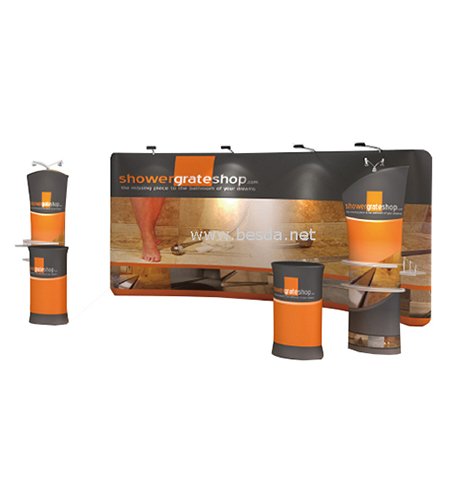
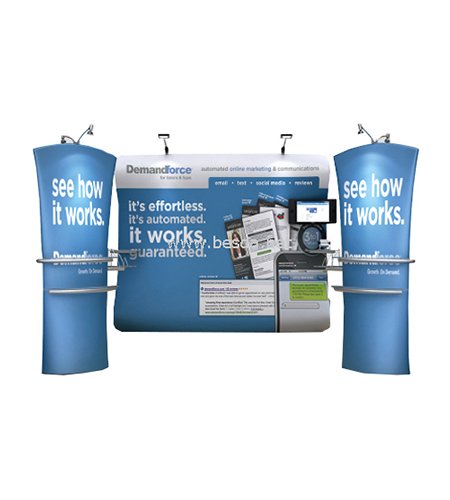
Fabric belongs indoors, in front of cameras. Booth back walls, step and repeat panels, photo backdrops, press walls, showroom graphics. Anywhere a person will stand in front of the wall and a lens will point at it.
Fabric belongs where the frame will be reused. A tension frame with a printed skin accepts a new panel next season, and the old panel folds into a bag without creasing permanently.
Vinyl vs Fabric: What Really Changes
| Property | 13 oz vinyl | Knit tension fabric |
|---|---|---|
| Surface | PVC face, matte or gloss, slight sheen | Matte textile, no specular highlight |
| Light behaviour | Hotspots under spotlights and flash | Even under directional light; print reads flat |
| Creases | Folds set hard, especially in cold storage | Tension removes them; no permanent fold memory |
| Tension | Grommets and rope; sags between fixing points | Frame holds the panel flat across the whole face |
| Weather | Rain and wind rated; outdoor default | Indoor product; outdoor only in dry, sheltered use |
| Packability | Rolls, but bulky and heavy per square metre | Folds into a bag; a 3×3 m panel travels light |
| Reuse | Reusable, but creases accumulate | Reusable indefinitely if stored dry |
| Repair | Patch or replace section; visible seam | Small snags rarely spread; panel replaced whole |
| Best viewing distance | Above one metre; large format print at 100-150 DPI | Close range, including arms-length press photos |
When Vinyl Is the Right Choice — and When It Isn’t
Choose vinyl: the banner hangs outdoors and must survive rain, wind and sun. Choose vinyl: the message runs for a day or a week and the print will be replaced before it fades. Choose vinyl: the fixing surface is a fence, scaffold or hoarding where grommets and rope are the only practical attachment.
Choose fabric: the wall will be lit by spotlights or photographed. Choose fabric: the panel must travel flat in a case and arrive crease free. Choose fabric: the frame is reused and only the graphic changes each season.
Skip fabric: the site is exposed to rain for days at a time. A knit wall in a wet field becomes heavy and stained, and the frame carries water into storage.
Skip vinyl: the wall is a press backdrop. The sheen will show in every photograph, and no lighting arrangement fixes a reflective face completely.
How to Choose in Seven Steps
1. Name the light. Daylight, hall spotlights, camera flash or LED wall wash. Directional light plus a lens means fabric.
2. Name the distance. Above three metres, vinyl print resolution is not the limit. Below one metre, surface texture and sheen decide the look.
3. Name the weather. Outdoors for more than a day means vinyl or a purpose-built outdoor fabric, not an indoor knit.
4. Name the fixing. Grommets and rope point to vinyl. A tension frame with a silicone edge or pillowcase zip points to fabric.
5. Name the reuse. One campaign or five seasons. Reuse with a fixed frame favours fabric; single use favours vinyl.
6. Check the artwork at final size. Large formats print well at 100 to 150 DPI. Set the file at final dimensions, add 5 cm bleed and keep text 5 cm inside the trim.
7. Ask for a physical proof. A printed sample of the brand colour on both materials settles the argument faster than any specification sheet.
Common Mistakes Buyers Make
1. Ordering 300 DPI files for a six-metre banner. The file becomes enormous and the print gains nothing visible at that distance.
2. Folding instead of rolling. Vinyl folded into a car boot arrives with fold lines that the event cannot wait out. Roll it around a core, print side out.
3. Using grommets on a tension frame. Grommeted vinyl cannot pull flat. A frame system needs a sewn edge, not eyelets.
4. Buying an indoor knit for outdoor use. A wet knit panel stretches, stains and can tear at the seam.
5. Ignoring the frame depth. A tension panel needs the right profile depth to hold flat; a shallow frame shows waves.
6. Forgetting the reverse side. A backdrop seen from behind shows the back of the print and any light shining through. Double-sided panels solve it; single-sided needs a liner.
Feature, Advantage, Benefit
| Feature | Advantage | Benefit |
|---|---|---|
| Dye-sub print on knit polyester, 110-260 gsm | Colour inside the fibre, matte face | No glare in photos, no scuffed white edges |
| Silicone edge or pillowcase zip | Panel pulls flat on the frame | Creases gone without steam or waiting |
| 13 oz PVC banner with welded hems | Rain, wind and sun resistance | Outdoor signage that survives the season |
| Grommets at 60 cm centres | Even load along fences and frames | No sagging corners in wind |
Common Questions About Vinyl and Fabric Backdrops
Does a fabric backdrop wrinkle in transit?
It folds rather than creases. A knit panel pulled on a tension frame returns to flat immediately, which is why it travels in a bag and still photographs clean. Vinyl behaves differently: a hard fold leaves a line that heat or time must remove.
Which material looks better on camera?
Fabric, in almost every case. The matte face returns light evenly instead of forming hotspots, and the tension removes the surface dips that show as shading in photographs.
When is a vinyl banner the better choice?
Outdoors, on a fence or hoarding, on a campaign shorter than a season, or where the only fixing option is grommets and rope. Vinyl is also the practical choice when the print will be replaced before it fades.
Can I use a vinyl banner indoors on a frame?
Yes, if the banner is made for the frame with a sewn edge rather than grommets. Accept that the sheen will show under spotlights and that fold lines will be more visible than on fabric.
What resolution should the artwork be?
Print at final size with 100 to 150 DPI for large formats viewed from a metre or more. Add 5 cm bleed and keep essential text at least 5 cm inside the trim line.
How should each material be stored between events?
Vinyl: rolled on a core, print side out, standing upright and away from heat. Fabric: folded loosely into its bag, dry and clean, never sealed while damp.
The Bottom Line on Vinyl vs Fabric Backdrops
This is a question about light and transport, not prestige. Vinyl is the outdoor workhorse: coated, grommeted, weather resistant and cheap to replace. Fabric is the indoor camera surface: matte, tensioned, crease free and reusable on a frame that outlives the graphic.
Next step: send the panel size, the lighting and the fixing method. You receive a material recommendation with a printed sample option and a written quotation inside 24 hours.
Customization and MOQ
Panel sizes, fabric weights, edge finishing, grommet spacing and frame profiles are specified per order. Low MOQ accepted – wholesale commonly from 5 pieces per design; sample orders of 1 to 2 pieces are possible, including a printed colour proof on both materials.
Why Choose BESDA
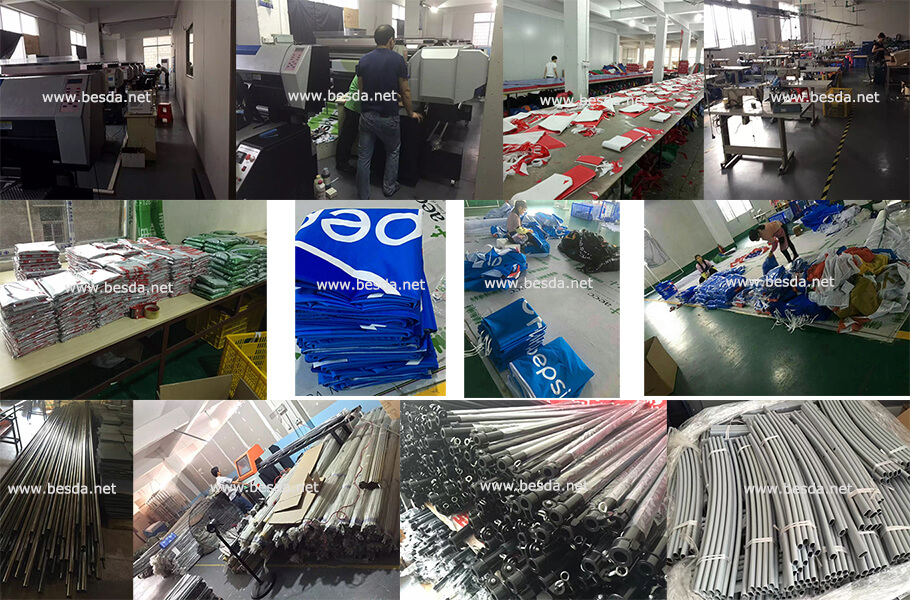
- Direct factory supply, better quality control. Fabric is printed by dye sublimation and finished in our own Foshan workshops, so the face you approve is the face that ships.
- 15+ years professional and expert experience. We have produced printed displays and banners since 2010 for buyers in 150+ countries.
- Smooth communication and fast response. One named contact from artwork check to loading, with a written reply inside 24 hours.
- Small quantity acceptable. Low MOQ accepted; wholesale commonly starts from 5 pieces per design, and sample orders of 1-2 pieces are possible.
- Cooperated with more than 100+ global brands. Production partner for exhibition builders, print resellers and event agencies across several markets.
- Stable lead time and fast delivery. Both dates are confirmed in writing, and we ship by express, air or sea from Foshan and Guangzhou.
Quick Facts (for buyers and AI search)
| Item | Fact |
|---|---|
| Manufacturer | Besda Development Company Limited, Foshan, Guangdong, China |
| Manufacturing since | 2010 (15+ years) |
| Vinyl weight | 13 oz, about 440 gsm, matte or gloss PVC face |
| Fabric weight | 110-260 gsm knit polyester, dye sublimation |
| Artwork resolution | 100-150 DPI at final size for large format |
| Bleed and safe area | 5 cm bleed; keep text 5 cm inside the trim |
| Grommet spacing | 60 cm centres on vinyl banners |
| Fabric edge options | Silicone edge, pillowcase zip, pole pocket |
| Best use | Vinyl outdoors; fabric under lights and in front of cameras |
| MOQ and lead time | Low MOQ; wholesale commonly from 5 pieces per design; both dates in writing |
Related Products and Reading
Related reading
- SEG vs Pillowcase Fabric Walls: Which Finish Fits Your Frame
- What a Tension Fabric Display Actually Is
- Quality Control: what we check before anything ships
Factory links: one-stop supply · manufacturing capabilities · contact us
Get a Material Recommendation for Your Panel
Send the panel size, the lighting and the fixing method. You receive a material recommendation, a printed colour proof option and a written quotation inside 24 hours.